Definition: An undergarment for supporting the breasts.
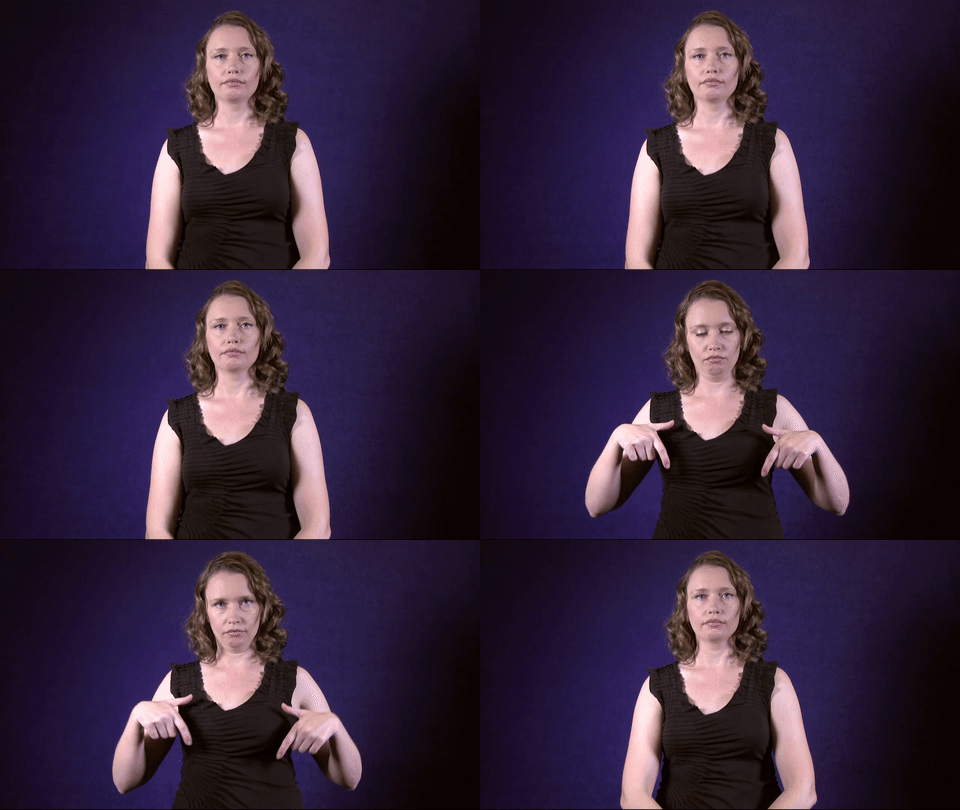
Sign for BRA in ASL

Practice Activities:
To build confidence in using the sign for BRA in ASL, begin with isolated practice by repeating the sign in front of a mirror. This helps focus on handshape, location, and movement. Repetition will reinforce muscle memory and allow you to correct minor adjustments in placement and fluidity.
Next, create short practice sentences using the sign in context. Examples include: “I bought a new bra,” “Her bra is red,” or “She needs a bra.” Signing these out loud to yourself or practicing with a friend provides opportunities to solidify vocabulary and improve your fluid signing abilities.
Use flashcard drills by pairing the sign for BRA in ASL with clothing-related vocabulary like shirt, underwear, socks, and pants. Shuffle them and quiz yourself or your classmates. Intermix the sign with body part signs like chest or torso to reinforce spatial understanding and appropriate sign placement.
Try storytelling activities that involve changing clothes or getting ready for the day. For example, sign a story about a character who tries on different outfits, including mentioning when they put on a bra. This naturally incorporates the sign for BRA in ASL into a sequence and supports language flow.
In partner activities, take turns describing what someone is wearing without pointing or visual aids, requiring the other person to guess. Include the sign for BRA in ASL in your descriptions. This develops expressive and receptive skills while boosting confidence in everyday contexts.
Consider watching ASL vlogs or skits where clothing items are discussed, then pause and mimic the signs. Pay attention to usage, facial expressions, and speed. Finally, create a short fashion show narrative and sign what each model is wearing. Include the term where appropriate and practice transitions between related terms using smooth classifiers.
Cultural Context:
Understanding the sign for BRA in ASL involves more than just learning the physical motion. It also includes recognizing how Deaf culture approaches body-related signs. In American Sign Language, signs for clothing and undergarments are created with respect and sensitivity, keeping in mind cultural norms and comfort within the Deaf community.
The sign for BRA in ASL reflects how everyday vocabulary adapts to reflect both form and function. Since bras are a common item, the ability to clearly express this in ASL is essential for open communication. When teaching this sign, it’s important to provide cultural context so learners understand how it fits naturally within the wider framework of body and clothing signs in ASL.
There isn’t always a one-size-fits-all sign for every brand or style of bra, so variations might exist depending on regional use or personal preferences. That’s why context plays a big role when using the sign for BRA in ASL, especially in conversations about shopping, laundry, health, or personal care. The sign typically focuses on the item’s location on the body, using a motion that gestures respectfully around the chest area.
In Deaf culture, clear and direct communication is valued, but so is sensitivity to subject matter. This cultural value influences how you present signs like the one for BRA in ASL. When this sign is used in class or conversation, it’s usually delivered in a matter-of-fact way, without embarrassment or unnecessary explanation.
Teaching the sign for BRA in ASL also involves understanding personal boundaries and visual communication etiquette. Since ASL is a visual-spatial language, signs that reference parts of the body are always crafted carefully to respect the personal space of both the signer and the audience. This helps maintain comfort and clarity during conversations involving intimate clothing like a bra.
While learning the sign for BRA in ASL, students often encounter related terms like shirt, underwear, or pants. This helps create a network of vocabulary related to clothing that promotes deeper language fluency. Having access to these terms lets ASL users talk about a range of daily topics confidently and appropriately.
Deaf and hearing communities alike benefit from recognizing the cultural norms around personal and clothing-related signs. The sign for BRA in ASL is used in casual conversation, health discussions, fashion contexts, or even while teaching anatomy in classrooms. It provides access to necessary conversations that should be respectful, inclusive, and clear.
Young ASL learners may giggle when they first see the sign for BRA in ASL, but with the right cultural understanding, it quickly
Extended Definition:
The sign for bra in ASL is a practical vocabulary word that connects to clothing and body awareness. Whether you’re discussing fashion, shopping, or personal care, knowing this sign helps communicate clearly and comfortably in American Sign Language.
To sign bra in ASL, use both hands to mimic the straps of a bra by placing your thumbs near your shoulders and moving your hands forward slightly, as if showing the path of bra straps. The movement should be smooth and natural, comfortably indicating the shape and position of a bra on the upper body. This sign is considered iconic, meaning it visually resembles what it represents. It’s usually understood in casual and everyday conversations.
The sign for bra in ASL may vary slightly by region or age group, as is common with many ASL signs. While this sign is generally recognized throughout the Deaf community, some individuals might adopt a fingerspelled version or incorporate clothing classifiers depending on context. Being aware of such variations can enrich your understanding and prevent miscommunication.
In conversations, the sign for bra in ASL may come up in discussions about laundry, shopping, health, or gender-related topics. It’s often used in educational settings, especially when teaching about clothing or parts of the body in ASL classes. Parents, educators, and interpreters regularly use this sign when speaking with children or adults learning new vocabulary.
Cultural sensitivity is important when using signs related to clothing or the body. The bra is a personal item, and the sign should be used respectfully and appropriately, especially in public or group settings. Learning respectful and accurate signs contributes to better interpersonal connections and deeper linguistic fluency.
When learning the sign for bra in ASL, it helps to practice in front of a mirror or watch ASL video demonstrations to see the movement clearly. Understanding the handshape, location, and motion will help make the sign feel more natural and boost your confidence while signing. Engaging with native signers or using trusted ASL learning tools online can enhance your accuracy.
Like many other signs in ASL, the sign for bra may be combined with context clues, facial expressions, and body posture to convey more detail or emphasis. For example, you might use a more animated motion when describing a sports bra compared to a lace bra. Letting facial expression and body language support your signing ensures your meaning is clear and engaging.
Including everyday signs like bra in your ASL vocabulary builds a more complete foundation for fluent communication. As language learners or interpreters expand their knowledge, terms related to
Synonyms: Sorry, but “Bracreate” and “Bracontains” do not seem to be either widely recognized terms or lexicon from standard sources like dictionaries or databases. Could you clarify the terms, or is there a different keyword or concept you had in mind related to ASLinteractive?
Educational resources: Find related learning materials in our course bank!
Want more? Check out some of our popular learning activities on the homepage!
Need to look up a sign? Use our highly rated dictionary: https://aslinteractive.com/best-asl-dictionary/
Follow us on tiktok: https://www.tiktok.com/@aslinteractive. More social media links at the bottom of this page!
Long-tail Keywords: what is the sign for bra in ASL, how to sign bra in American Sign Language, how do you say bra in ASL
Categories:
tags: Clothing, Objects, Language Learning, Everyday Activities, Appearance
Parameters
*Handshape*:
The handshape for the sign for BRA in ASL uses open B-handshapes. Both hands are held with fingers together and thumbs tucked across the palms, resembling flat hands. This configuration represents the structure of a bra as it’s placed over the chest area.
To perform the sign for BRA in ASL, the hands start at the center of the chest and move slightly outward, mimicking the bra’s shape and placement. The B-handshape remains the same throughout the motion, clearly indicating the undergarment.
*Palm Orientation*:
The palm orientation for the sign for BRA in ASL involves both hands in a modified “C” handshape. The palms face inward toward the body, typically aligning near the upper chest area. Each hand slides slightly outward away from the center, mimicking the curve of a bra.
When producing the sign for BRA in ASL, the fingers and thumbs remain open as the shape traces the natural contour across the upper chest. The motion and orientation reflect the bra’s general placement on the body, making the sign visually iconic.
*Location*:
The sign for BRA in ASL is made in the upper chest area, just below the shoulders. This location mimics where a bra is typically worn, helping to visually reinforce the meaning of the sign.
Your hands are positioned near the upper torso, aligned with the bra strap placement on each side. The consistent placement makes the sign for BRA in ASL clear and easy to recognize.
*Movement*:
To produce the sign for bra in ASL, place both hands at shoulder level in an open “B” handshape, palms facing down and slightly inward. Move both hands downward and slightly outward in a gentle, small arcing motion, as if showing the shape or placement of a bra strap and cup.
The movement for the sign for bra in ASL visually mimics how a bra fits on the upper torso. Be mindful to keep the movement smooth and natural, reflecting the object’s form.
*Non-Manual Signals*:
The non-manual signals for the sign for BRA in ASL are generally neutral or slightly focused, with minimal facial expression. Eyebrows may remain relaxed or show a subtle awareness to indicate the topic is clothing-related. This helps ensure clarity and avoids distraction from the specific hand movements used in the sign for BRA in ASL. Slight head nods may accompany the sign, reinforcing emphasis without exaggeration.
*Prosody, Dominant/Non-Dominant Hand*:
The sign for BRA in ASL uses both hands to outline the area where a bra sits on the chest. The dominant hand and non-dominant hand both form relaxed open B-hands and are placed near the upper chest area, then pulled outward slightly as if tracing the band of a bra across the chest.
In some regions or contexts, the sign for BRA in ASL might be replaced or supported by fingerspelling BRA. When fingerspelling, both prosodic placement and clear letter articulation from the dominant hand are essential for accurate understanding.
Tips for Beginners:
Learning the sign for BRA in ASL can feel a bit awkward at first, especially because it’s a more intimate item of clothing. Keep in mind that most people typically fingerspell BRA, or use a blend of a standardized gesture along with fingerspelling. Start by practicing your fingerspelling—make sure each letter is clear and held in a space that’s easy for your conversation partner to see.
Context matters with body-related signs. When using the sign for BRA in ASL around or pointing to the chest area, always make sure to maintain a respectful posture. Keep your facial expressions neutral and appropriate to avoid miscommunication. Remember to use smooth, natural movements rather than exaggerated gestures, since overemphasis can distort the meaning.
One helpful technique is to practice the motion in front of a mirror. This allows you to observe if your handshape and movement correspond correctly with the sign or fingerspelling. Positioning your dominant hand correctly in front of the chest and forming the letters B-R-A in a fluid motion can look more polished with repetition. Don’t rush—accuracy is more important than speed, especially for clear communication.
Common beginner errors include forming the wrong handshape for B or R with a tense wrist. Loosen your fingers and remember that each letter in the sign for BRA in ASL should be distinct. Also, be mindful not to sign too low or too high; features around the upper chest are sensitive areas in sign language, and precision avoids confusion or offense.
Finally, exposure to real-life signing helps develop comfort. Watch ASL videos where people talk about clothing or shopping to see how native signers use the sign for BRA in ASL in everyday situations. Repetition and observation are key to fluency!
bra, sign for bra in asl, asl sign for bra, how to sign bra in asl, fingerspell bra in asl, clothing words in american sign language, learn sign for bra in asl, signing undergarments in asl, fingerspelled bra in sign language
Connections to Other topics:
The sign for BRA in ASL is closely connected to other clothing-related signs, especially undergarments like UNDERWEAR, PANTIES, and SHIRT. These signs often utilize location and handshape in the torso area, helping learners group similar concepts. This makes it easier to remember multiple signs when they share spatial placement or classifier categories.
In many contexts, the sign for BRA in ASL is related to gender-associated clothing and can be part of broader conversations around self-care, dressing, or fashion. It’s often used alongside signs like DRESS, BLOUSE, or even specific lingerie terms that may be fingerspelled. These connections help enrich the language’s ability to discuss personal attire more fully, especially in educational or medical settings.
Learners may encounter the sign for BRA in ASL when discussing body positivity topics, health care environments, or personal hygiene. It also appears in contexts related to shopping ️ or giving instructions about what to wear during certain physical exams. In more advanced ASL usage, the sign may merge with classifiers to describe styles, sizes, or support features, such as padded, strapless, or sports bras.
There are also compound signs where BRA is tied to color or brand when specifics are needed, and fingerspelling is used to clarify types (e.g., SPORTS BRA or VICTORIA’S SECRET). These compound forms highlight how users can expand their vocabulary using a mix of lexical signs and initialized signs or classifiers.
Social context plays a big role too. The sign for BRA in ASL is often adapted for polite or age-appropriate representation, especially in K-12 educational settings or signing with children. Cultural sensitivity may lead to more subtle or euphemistic expressions depending on the audience, further reflecting the fluid nature of ASL in different communities.
Summary:
The sign for BRA in ASL is typically expressed using classifier-like elements to suggest the shape and function of the garment. One common version shows the placement and function of a bra by mimicking the outline of the cups and their position on the chest. The hands may curve slightly as if framing an invisible contour across the chest area.
This depiction aligns with the visual and conceptual nature of American Sign Language. The sign uses iconicity—a visual representation resembling the object conveyed—which is common in ASL. Since bras are intimate apparel, the sign communicates both the function and physical position in a respectful, clear way.
Sometimes the sign for BRA in ASL is modified based on regional usage or personal comfort. Some signers instead fingerspell B-R-A, particularly in formal or medical settings where anatomical accuracy and discretion are needed. This fingerspelled version avoids potential awkwardness and aligns with conventions around discussing undergarments.
Fingerspelling the word allows for transparency when discussing the word BRA in a context like clothing shopping or health consultations. Communities and individual preference may impact whether the descriptive or fingerspelled form is used. Variations are not uncommon, especially depending on age, generation, culture, or comfort level.
As with many clothing-related signs, context plays a crucial role in which version is used. In casual environments, visual classifiers are popular since they are quicker and more kinetic. In more formal dialogues, the fingerspelled approach serves clarity and formality.
The sign for BRA in ASL also connects to signs like CLOTHES, UNDERSHIRT, and UNDERWEAR. These related signs often involve iconic gestures that outline parts of the garment or its position on the body. Understanding these signs in groups can help learners assimilate clothing vocabulary with more ease.
From a grammatical standpoint, BRA functions as a noun. In ASL sentence structure, it can either follow or precede descriptive adjectives depending on how one is building the phrase. For example, in discussing colors or sizes, the adjective typically follows the noun.
Culture and modesty can influence the willingness to use certain signs in front of various audiences. Students learning the sign for BRA in ASL may notice how individual tutors or interpreters adapt signs based on professionalism, age of the audience, or sensitivity. ASL excels in adapting to such contexts fluidly.
The typology of this sign demonstrates how ASL utilizes both morphological and spatial principles. Language learners may appreciate the role of space and visual structural awareness encouraged through clothing-related signs. Signers must imagine where the bra sits and translate that spatial cognition into a gestural form.
Applied linguistics emphasizes the interplay between metonymy and iconicity in signs like BRA. The gesture does not spell or literally draw the object but uses part-for-whole representations. These function to conserve effort while maximizing clarity in communication.
When exploring the sign for BRA in ASL, the concept of embodied cognition is helpful. Embodied cognition suggests that our physical experience reflects in how we perceive and articulate language. In ASL, horns, curves, and body locations carry meaning, directly tying to one’s sensory understanding of wearing such garments.
There is learning potential in how users differentiate gender-related signs in ASL. Though BRA is generally associated with women, gender-neutral conversations about undergarments are becoming more common. Users of ASL are also innovating newer, more inclusive expressions.
Deaf culture approaches topics of body and clothing with unique transparency. ASL often relies on clear depictions, which means signers are accustomed to discussing body functions and apparel in forthright, non-euphemistic ways. This can surprise learners from cultures that consider such topics taboo.
The sign for BRA in ASL makes space for gender expression and body autonomy. It highlights how language evolves not just to describe objects but also to empower identities. It belongs to a category of signs that is adapting in step with wider social representations.
From a semantic field perspective, BRA correlates with intimacy, privacy, gender, and physical support. Also, in discussions about surgery, breast health, or fashion, this sign may become highly significant. It serves technical, medical, and everyday dialogic needs.
Signers might substitute a pointing gesture to the chest with minimal shaping to avoid embarrassment or situational discomfort. This simplified alternative is especially common among younger or newer learners. However, this may reduce clarity for an uninformed audience.
ASL interpreters may decide between using the iconic BRA sign or its fingerspelled form depending on the perceived understanding of the hearing or Deaf client. This decision represents a form of code-switching respective to context, communication goals, and radiance of privacy.
There is also pedagogical value in discussing BRA signs during ASL instruction. Signing the word enables discussion about body awareness, clothing habits, and vocabulary related to healthcare or wellbeing. These topics often empower adolescent signers during their education.
Children and teens who are Deaf or Hard of Hearing benefit from learning the sign for BRA in ASL early in
Want more? Check out some of our popular learning activities!
ASL Interactive Resources
ASLInteractive YouTube Channel
Follow us on tiktok: @aslinteractive.com
Follow us on Instagram: aslinteractive
Facebook page: aslinteractive
Facebook group: aslinteractive
LInkedIn: ASL Interactive LLC
Twitter: @ASL_interactive
*Some information on this page is AI-generated. AI can make mistakes. Please check the information.


Responses