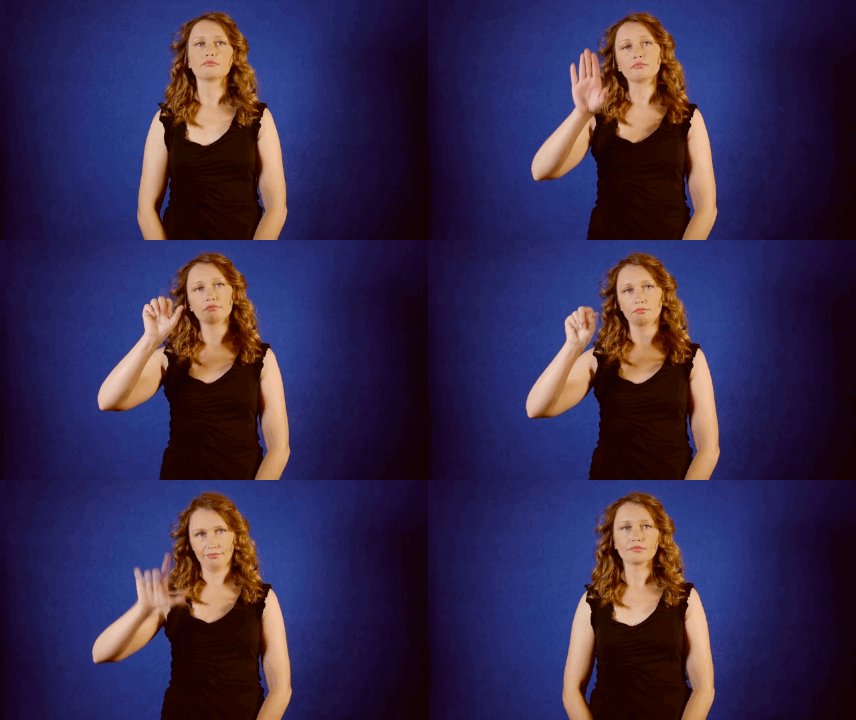
Definition: A country in South America.
Sign for BRAZIL in ASL

Practice Activities:
To effectively learn the sign for BRAZIL in ASL, begin by practicing it in isolation. Stand in front of a mirror and repeat the motion several times, focusing on the correct shape and movement. Make sure your hand location and motion are accurate, as this sign is unique and differs from other country signs.
After mastering the basic form, try using the sign for BRAZIL in ASL in short sentences. For example, sign “I go BRAZIL” or “My friend from BRAZIL.” Practice saying these sentences both with and without facial expressions for added fluency. Gradually expand to longer phrases like “I want to travel to BRAZIL next summer” to build comfort and fluency.
Use flashcards with flags or names of countries and quickly sign the country that appears. When the Brazilian flag or name appears, sign BRAZIL and add a basic sentence describing it. You can say things like “BRAZIL big country” or “BRAZIL has good food” to keep your phrases simple but meaningful.
For partner activities, take turns naming countries and signing them while your partner guesses. When it’s your turn, make sure to include the sign for BRAZIL in ASL multiple times. Switch roles so each partner has the opportunity to recognize and produce the sign in context.
Storytelling is a fun way to get more practice. Create a short story about a trip to Brazil. Use signs like airplane, travel, beach, music, and food along with the sign for BRAZIL in ASL to narrate your adventure. This helps you reinforce both the vocabulary and narrative skills.
To wrap up your practice session, watch ASL videos or vlogs where the country Brazil is mentioned. Pause and mimic the sign whenever it appears. Repetition in context will help lock in both meaning and mechanics of the sign for BRAZIL in ASL.
Cultural Context:
The sign for Brazil in ASL carries a unique cultural connection, much like the country itself. Since Brazil is known worldwide for its vibrant festivals, musical heritage, and diverse population, it’s no surprise that the sign for Brazil in ASL reflects an expressive and easily recognizable gesture.
When discussing international countries in American Sign Language, each has a culturally standardized sign often used in educational and travel contexts. The sign for Brazil in ASL is commonly taught in schools, especially when students learn about geography, global cultures, or when planning travel to South America. It’s important for fluent communication with Deaf people interested in global affairs.
Many Deaf individuals use the sign for Brazil in ASL not only to refer to the country but also in discussions about Brazilian culture, food, or the Portuguese language. Brazil is famous for carnivals, soccer, and the Amazon rainforest, so knowing how to sign it in ASL helps people discuss global issues, current events, and geography without confusion.
The visual nature of ASL allows signs like the sign for Brazil in ASL to capture both geographic and cultural significance in a simple hand motion. This provides quick recognition and allows the Deaf community to talk about Brazil in multiple contexts like politics, sports, or travel.
Understanding the cultural importance of Brazil globally helps ASL users appreciate why there is a need for such a direct and specific sign. Whether you’re chatting about Brazilian coffee or music, integrating the sign for Brazil in ASL ensures that conversations are smooth and inclusive.
In multicultural or multilingual environments, the sign for Brazil in ASL helps bridge communication barriers. It’s especially useful among Deaf travelers, educators, or interpreters who want to ensure clarity when talking about this influential Latin American country.
ASL learners find it helpful to associate the sign for Brazil in ASL with maps or international news. This helps reinforce memory and allows for broader cultural discussions, especially in classrooms or with Deaf peers interested in global nations.
Deaf culture values representation, so having a specific sign for Brazil in ASL is more than just a linguistic feature—it’s a signal of inclusion. It recognizes the global presence of Brazil and allows the Deaf community to talk about it with nuance and precision.
Events like the Olympics or the World Cup have made the sign for Brazil in ASL much more recognizable in recent years. As Brazil continues to play a major role on the international stage, the ASL sign helps keep Deaf discussions current and informed.
Just like signs for other countries, the sign for Brazil in ASL may vary
Extended Definition:
The sign for Brazil in ASL is visually expressive and captures the identity of the country through its unique motion and handshape. It reflects regional language evolution and is rooted in the cultural adaptations of American Sign Language users when referencing international locations.
To sign Brazil in ASL, start by forming the letter B with your dominant hand, keeping your fingers together and your thumb across your palm. Then move the B hand in a smooth, sweeping curve, usually in a zigzag or S-like motion depending on the variant learned. This path mimics the winding shape often associated with the country’s geography or its national symbol. The direction and smoothness of the motion help distinguish it clearly from similar signs.
As with many signs for countries, the sign for Brazil in ASL may vary slightly depending on the region or community. Some ASL users might have learned older versions or signs introduced by native Brazilian Sign Language users (LIBRAS) that have been integrated into American usage. These differences reflect the dynamic and flexible nature of ASL as it evolves over time.
When teaching the sign for Brazil in ASL to students or beginners, it’s helpful to explain the movement and context behind it. Pairing the sign with an image or map of Brazil can deepen understanding and help learners remember it more easily. Educators should also provide opportunities for students to practice the motion so they can build confidence using the sign in real-life conversations.
Understanding the sign for Brazil in ASL adds an important location to a signer’s vocabulary and supports inclusive discussions about culture, travel, and geography. For Deaf travelers or those interested in global events, having accurate signs for countries like Brazil enhances communication and makes storytelling more vivid. It also allows for meaningful connections between ASL users and those learning international sign systems.
If you’re looking to improve your country-related signs, learning the sign for Brazil in ASL is a great addition to your knowledge base. With regular use in discussions about international news, sports events like the Olympics or World Cup, and conversations about South America, this sign is practical and relevant. Including it in your ASL practice helps round out your ability to express global ideas and share cultural insights.
Most importantly, signing Brazil in ASL accurately shows respect for diversity and global inclusion. It acknowledges that Deaf communities are part of the wider world, with access to the same range of topics as hearing individuals. As globalization increases, signs for international places grow in usage, making it essential for learners to expand their vocabulary to include countries like Brazil.
Whether you’re
Synonyms: Brazil, Federative Republic of Brazil, República Federativa do Brasil, Brasil, South American country
Educational resources: Find related learning materials in our course bank!
Want more? Check out some of our popular learning activities on the homepage!
Need to look up a sign? Use our highly rated dictionary: https://aslinteractive.com/best-asl-dictionary/
Follow us on tiktok: https://www.tiktok.com/@aslinteractive. More social media links at the bottom of this page!
Long-tail Keywords: what is the sign for Brazil in ASL, how do you sign Brazil in ASL, ASL sign for Brazil
Categories:
tags: Brazil, Language Learning, Cities, Countries, Geography
Parameters
*Handshape*:
The handshape used in the sign for BRAZIL in ASL involves the dominant hand using a modified “X” handshape, resembling a bent index finger. This handshape is important in forming the sweeping motion that traces a “Z”-like path across the body.
The sign for BRAZIL in ASL begins near the opposite shoulder and travels diagonally down toward the hip. This motion paired with the bent finger helps visually differentiate it from similar signs.
*Palm Orientation*:
The palm orientation for the sign for BRAZIL in ASL generally begins with the dominant hand forming the letter “B” while tracing a curved or zigzag motion downward across the other hand or area in front of the body. The palm of the dominant hand usually faces outward or slightly downward, depending on the specific regional variation.
When using the sign for BRAZIL in ASL, keep your palm steady and movements deliberate to ensure clarity. The palm remains open with fingers together, maintaining a flat handshape throughout the motion.
*Location*:
The sign for BRAZIL in ASL is typically produced in the neutral space in front of the torso, slightly away from the body. The dominant hand makes a “B” handshape and traces a curved line similar to the stripe on the Brazilian flag, moving from the non-dominant side to the dominant.
This movement occurs in mid-air, not touching the body, and remains at chest level for visibility. The sign for BRAZIL in ASL uses location effectively to reflect the unique visual reference to the country’s symbolic elements .
*Movement*:
The sign for BRAZIL in ASL involves using the dominant hand in a “B” handshape. Starting from the upper side of the non-dominant side of the body, the hand moves diagonally downward in a curved motion, forming a shape similar to an inverted “Z” or a loose arc.
The motion is fluid and travels across the body, ending near the opposite hip. The sign for BRAZIL in ASL emphasizes directionality and the visual representation of the country’s name.
*Non-Manual Signals*:
When using the sign for BRAZIL in ASL, the facial expression is generally neutral or slightly inquisitive, depending on the context of the conversation. If asking a question or confirming information, raised eyebrows and eye contact are common to emphasize engagement or curiosity.
The non-manual signals support clarity, especially when distinguishing the sign for BRAZIL in ASL from similar motion-based signs. A relaxed mouth and steady head movement help reinforce the smooth motion of the dominant hand forming the shape.
*Prosody, Dominant/Non-Dominant Hand*:
The dominant hand in the sign for BRAZIL in ASL typically forms the letter “B” handshape. It moves in a downward and slightly forward zigzag pattern, mimicking the shape of a sash or a stylized curve. The non-dominant hand remains at rest or may provide balance as a passive element.
When producing the sign for BRAZIL in ASL, facial expression is usually neutral. The movement is smooth and deliberate, with the dominant hand drawing the path that evokes a cultural or geographic distinction linked to Brazil .
Tips for Beginners:
When learning the sign for BRAZIL in ASL, it’s helpful to focus on both the handshape and the movement. The sign typically uses the dominant hand in a ‘B’ handshape, tracing a curved line near the lower half of the non-dominant arm, almost like a sash or a trail. Visual storytelling is important in ASL, so imagine making a swooping gesture, similar to the shape of a sash or a stylized letter Z.
Consistency in your motion is key. Beginners often vary the shape or direction of their movement too much, which confuses the meaning. Rehearse the movement until it’s smooth and intentional. Remember, your wrist should remain relaxed; stiffness can make the sign appear forced or unclear.
Facial expression might not be crucial for conveying the sign for BRAZIL in ASL on its own, but maintaining engaged facial features supports overall communication. If you’re discussing Brazil in a broader context, your expressions can help emphasize tone—whether you’re sharing excitement, curiosity, or surprise .
One common mistake to watch for is forming the incorrect handshape or mirroring the movement inconsistently. Stick with the ‘B’ handshape and ensure you’re using your dominant hand for the motion. Practice in front of a mirror to spot errors early and build muscle memory.
Another helpful tip is to watch fluent signers use the sign for BRAZIL in ASL during real conversations or vlogs, so you can understand how it fits into natural signing flow. Don’t worry if it takes time to feel confident—accuracy is more important than speed at the start .
Finally, reinforce your learning with repetition and varied usage. Try using the sign as part of a sentence—like “I want to travel to Brazil”—to build fluency. The more you apply the sign for BRAZIL in ASL in context, the more confidently it will come to you in conversation.
Connections to Other topics:
The sign for BRAZIL in ASL offers a great opportunity to explore how geographical locations are often represented visually within the language. Many country signs in ASL involve iconic or abstract representations tied to cultural or linguistic references, and the sign for BRAZIL in ASL follows this pattern. It also connects to a broader set of signs for countries in South America, making it useful when discussing regions or global topics.
In conversations about travel, international news, or culture, the sign for BRAZIL in ASL may be used in compound structures such as BRAZIL CULTURE, BRAZIL FOOD, or BRAZIL DANCE. These compounds allow signers to efficiently convey specific ideas, such as discussions about Brazilian Carnival or cuisine. By combining signs, learners deepen their vocabulary and understand how to express nuanced information.
This sign also connects to the category of signs involving transportation and world exploration. One might see it paired with signs like GO, VISIT, or FLY-TO when describing a trip to Brazil. It reinforces how location signs fit seamlessly into broader narrative structures in ASL storytelling .
The sign for BRAZIL in ASL can also be contrasted with other country signs to illustrate differences in handshape, movement, and locations on the body. For example, signs for countries like CHINA or FRANCE use distinctly different techniques, helping learners see regional and linguistic diversity in sign formation. Recognizing these variations enriches a signer’s geopolitical awareness through ASL.
Additionally, fingerspelling may sometimes be used, especially in academic or formal settings. This opens the door to learning how fingerspelling interacts with standard signs and helps learners spell out lesser-known places or names related to Brazil, such as cities or historic events. Understanding the sign for BRAZIL in ASL thus serves as a foundational element in discussing international topics, cultural identity, and world events in American Sign Language .
Summary:
The sign for BRAZIL in ASL is performed using a dominant hand in the shape of the letter B. The hand moves across the body in a slight diagonal zig-zag or a swooping motion, often from the upper left to the lower right in space.
This movement mimics the general shape or symbolic curve of Brazil’s flag or cultural patterns. Some users describe the motion as drawing a stylized “S” or a band across the chest, depending on regional variation or personal interpretation.
The use of the letter B handshape anchors the geographic reference, making the connection to the country’s name clear. Context helps determine whether the signer is referring to the country, a cultural product, or a team, such as the national soccer team.
The sign for BRAZIL in ASL is not universally standardized, and some communities may still fingerspell the word instead. This can happen in regions where the sign is less commonly known or established, or when clarity is preferred in academic or official settings.
Culturally, Brazil holds a unique position internationally, especially through football (soccer), music, and carnival. The sign for BRAZIL in ASL often appears in conversations about tourism, international news, and entertainment events.
When the sign for BRAZIL in ASL is paired with other country signs, it can be part of discussions about geography, world politics, or international festivals. For example, in narratives about world events like the Olympics, this sign may be featured prominently.
Linguistically, this sign demonstrates how ASL relies on classifiers, initialized handshapes, and movement to produce meaning. The B handshape here is an initialized sign, linking the letter to its English equivalent.
In terms of applied linguistics, the sign for BRAZIL in ASL supports understanding of how language incorporates proper nouns, particularly when naming places. This fits into broader concepts of nominal reference and how signers incorporate culturally relevant symbols into signed discourse.
The sign is often teachable in beginner and intermediate-level ASL courses due to its clarity and ease of performance. It illustrates good practice of directional movement and the use of initialized handshapes that reinforce vocabulary learning through visual patterns.
Narrative contexts might involve the sign for BRAZIL in ASL in storytelling scenarios, such as travel logs, personal experiences abroad, or references to historical events involving Brazil. These stories allow for expressive use of facial expressions, space, and classifiers.
Signers might stylistically adapt the sign based on the topic. For instance, talking about Brazil’s vibrant carnival might involve an energized, stylistic version of the movement, while a discussion of politics might use a more subdued motion.
Grammatically, this sign functions as a proper noun. It commonly appears at the subject or object position in a sentence, or following the preposition FROM when signing about someone’s origin.
In broader visual grammar, the sign for BRAZIL in ASL can be framed within constructed action or storytelling sequences. This may include role shifts, eye gaze, and handshape integration reflecting Brazil’s vibrant social and cultural life.
The sign’s movement is fluid and rounded, offering a visual metaphor that reflects the organic curves found in Brazilian art and architecture. This enhances the cultural resonance of the sign beyond just a label for the country.
Related signs include Rio de Janeiro (often fingerspelled), carnival (mimicking festive dancing or costume frills), and SAMBA, which can be expressed gesturally to reflect typical dance movements. These connections root the country within its cultural exports.
The sign for BRAZIL in ASL reflects a broader theme in ASL where countries are identified with stylized, symbolic gestures rather than exact translations. This adaptation respects the visual modality and expressive nature of the language.
Classifiers may supplement the sign when describing travel to Brazil. A signer may use a CL:3 vehicle classifier to indicate flying to Brazil or a CL:1 to show walking in crowded festival streets.
Deaf international gatherings, such as Deaflympics or WFD events, often include the sign for BRAZIL in ASL when referring to attendees or participants. It becomes a part of global Deaf identity and interaction.
Across different signing communities, slight variation in this sign is to be expected. Some may adjust the orientation of the B hand or modify the motion path due to regional sign language influences or preferences.
This adaptability is consistent with signed languages’ gradient and flexible nature. The sign for BRAZIL in ASL is legible in multiple contexts because of its clear initial letter and iconic movement.
ASL’s spatial and directional affordances allow for adding Brazil to a map space during spatial storytelling. This can include placing BRAZIL in the lower right quadrant to represent its presence in South America.
Signers might also associate this sign with food items like feijoada or cultural exports like Bossa Nova music. In such cases, the sign serves as a cognitive and visual anchor for broader discussions on Brazilian culture.
For Deaf Braz
Want more? Check out some of our popular learning activities!
ASL Interactive Resources
ASLInteractive YouTube Channel
Follow us on tiktok: @aslinteractive.com
Follow us on Instagram: aslinteractive
Facebook page: aslinteractive
Facebook group: aslinteractive
LInkedIn: ASL Interactive LLC
Twitter: @ASL_interactive
*Some information on this page is AI-generated. AI can make mistakes. Please check the information.


Responses