Sign for BRIDGE in ASL | 🌉 ASL Dictionary

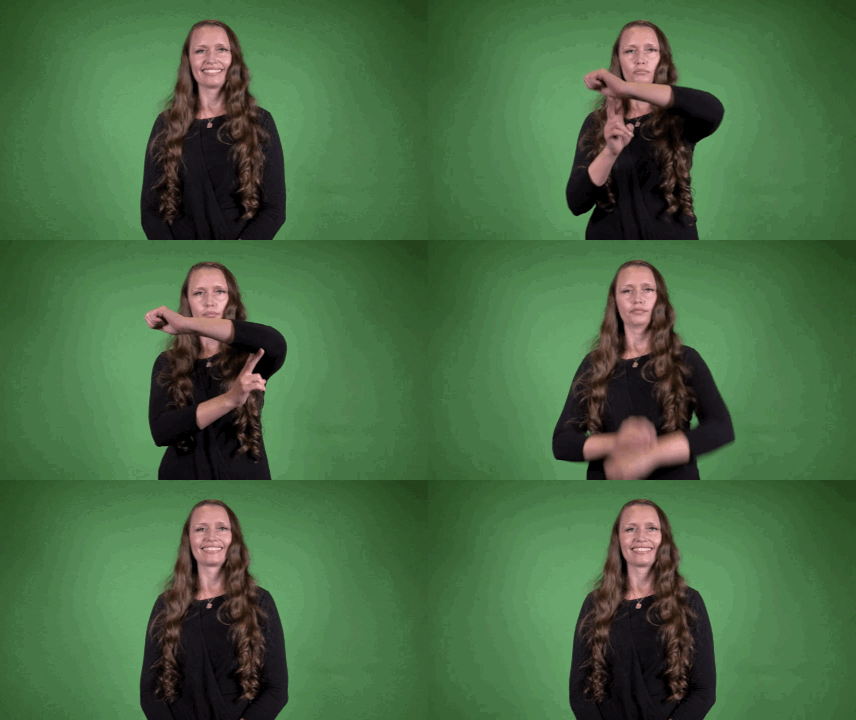
Definition: In ASL, “bridge” is signed by mimicking the shape of a bridge with your hands, often symbolizing a structure spanning a gap or connection between two points.

Sign for BRIDGE in ASL

YouTube player

Practice Activities:

To practice the sign for BRIDGE in ASL, start by signing it in isolation in front of a mirror. Focus on handshape, placement, and the motion that shows the arching or connecting motion typical of a bridge. Repeat it multiple times with both hands staying symmetrical and steady.

Next, try incorporating the sign into basic sentences to reinforce fluency. For example: “The bridge is long,” “We walked across the bridge,” or “That bridge connects two cities.” Sign these slowly first, then increase speed while keeping each sign clear. Record yourself or practice with a friend for feedback.

Create simple storytelling prompts that include the sign for BRIDGE in ASL. Think of a river and someone needing to cross, or a road trip where a bridge was a key part of the journey. Practice signing the full story, focusing on using descriptive signs and facial expressions along with bridge.

If you have a partner, take turns signing related descriptions while the other guesses what kind of bridge or location you’re describing. For example, use signs like WATER, CITY, OLD, or BIG in addition to the sign for BRIDGE in ASL to provide clues. This will help reinforce vocabulary connections.

Use visual references like pictures of famous bridges to prompt spontaneous signing. Look at a photo and describe it using ASL, including how big it is, what it’s made of, and where it leads. This helps develop spatial awareness and descriptive skills in ASL.

Practice bridging metaphorically by using the sign in figurative contexts, such as bridging gaps between people or ideas. Try to incorporate the sign into expressive sentences such as “We need to build a bridge between cultures.” This expands your ASL range and helps you think in the language more naturally.

Cultural Context:

The sign for bridge in ASL reflects more than just a physical structure; it can also carry deeper meanings within the Deaf community. A bridge symbolizes connection, whether it be between two points, two cultures, or two people. When using the sign for bridge in ASL, understanding these cultural layers adds deeper value to communication.

In Deaf culture, the sign for bridge in ASL may be used metaphorically during conversations about access. For example, interpreters often act as bridges between Deaf and hearing people, making communication possible across language barriers. This idea of bridging communication highlights the importance of ASL in promoting equality and inclusion.

The sign for bridge in ASL can also appear in discussions about education and advocacy. Many Deaf individuals view themselves as bridge-builders in society, raising awareness and promoting understanding. In this way, the sign symbolizes not just a structure but a powerful role within the community.

Storytelling is a key part of Deaf culture, and the concept of a bridge often appears in ASL storytelling to represent journeys or transitions. Whether it’s discussing childhood to adulthood or overcoming challenges, the sign for bridge in ASL brings a visual and symbolic layer to these narratives. It adds clarity while strengthening the visual impact of the story.

For children learning ASL, the sign for bridge in ASL may come up in educational settings when learning about infrastructure, transportation, or geography. Teachers and interpreters use it in classroom contexts, tying language development to real-world knowledge. This helps young Deaf children build vocabulary with strong cultural relevance.

In more artistic expressions, Deaf poets may use the sign for bridge in ASL to speak about emotional or spiritual crossings. It can represent overcoming isolation or finding connection in a hearing world. The visual nature of ASL allows this sign to be filled with emotion when used in personal or artistic storytelling.

The sign for bridge in ASL may also show up in discussions about accessibility to services, jobs, and healthcare. Advocates often discuss the need for more bridges to be built through policy and awareness. In this context, the sign takes on a more socio-political meaning while still relying on its basic physical sign form.

When Deaf individuals describe their role in multicultural settings, they may use the sign for bridge in ASL to show how they connect Deaf identity with other cultural experiences. These bridges can span languages, communities, and belief systems. It’s a sign that allows for multiple interpretations, depending on context.

In the Deaf community, respect for ASL and cultural representation is vital.

Extended Definition:

The sign for bridge in ASL is a visually descriptive sign that mimics the shape and concept of a bridge connecting two points. In American Sign Language, this sign is typically made by forming bent hands on both sides and then bringing the fingertips toward each other to create an arch-like motion that resembles the structure of a bridge.

The sign for bridge in ASL is often used in both literal and metaphorical contexts. It may refer to an actual bridge used for crossing a body of water or a gap, such as the Golden Gate Bridge . It can also symbolize a connection or link between two people, communities, or ideas.

When teaching or learning the sign for bridge in ASL, it’s helpful to visualize the purpose of a bridge—to span a gap and connect two separate areas. This concept is naturally represented in the movement and structure of the sign itself. ASL often draws on visual and spatial representations, making the language intuitively expressive.

In a classroom or educational setting, the sign for bridge in ASL might be introduced when discussing geography, travel, architecture, or engineering. It’s also a common word found in ASL storytelling, where physical structures play key roles in narratives or metaphors. The sign is easy to remember once its form is connected with its function.

You may also encounter the sign for bridge in ASL during conversations about city infrastructure, transportation, or when giving directions. In casual conversation, it’s a handy sign to know if you’re navigating through urban areas or describing landmarks. The visual nature of the sign makes it accessible and recognizable to both beginners and fluent signers.

Like many ASL signs, regional variations may exist in how the sign for bridge is executed, depending on community or local usage. However, the core concept remains the same—creating an arched shape that visually resembles a real bridge. Practice and exposure to native signers will help in mastering these slight variations.

The sign for bridge in ASL is not just about depicting a physical object; it also represents unity and transition. Whether talking about building relationships or overcoming challenges, this sign can be used in broader, symbolic ways. This layered meaning adds richness and depth to ASL communication.

To enhance your retention, pair the sign with visual cues, such as images or real-life examples of various types of bridges. Signing along with descriptive terms like big, long, or old can also expand your vocabulary while reinforcing the sign’s use in context. This integrated approach supports deeper understanding.

In digital ASL dictionaries

Synonyms: link, overpass, span, connection, viaduct

Educational resources: Find related learning materials in our course bank!

Want more? Check out some of our popular learning activities on the homepage!

Need to look up a sign? Use our highly rated dictionary: https://aslinteractive.com/best-asl-dictionary/

Follow us on tiktok: https://www.tiktok.com/@aslinteractive. More social media links at the bottom of this page!

Long-tail Keywords: what is the sign for bridge in ASL, how do you sign bridge in American Sign Language, ASL sign for bridge

Categories:

tags: Bridges, Transportation, Infrastructure, Architecture, Travel

Parameters

*Handshape*:

Both hands use the bent 5 handshape, with fingers spread and slightly curved downward like arches. The palms face down and start apart at shoulder width, then move inward until the fingertips nearly touch, creating the appearance of a bridge structure. This bent handshape visually represents the arc of a bridge, reinforcing the meaning of the sign.

The handshape in the sign for BRIDGE in ASL closely mimics the structure of a physical bridge by arching the fingers and moving the hands together. This visual representation helps communicate the concept clearly and accurately within the context of the sign for BRIDGE in ASL.

*Palm Orientation*:

For the sign for BRIDGE in ASL, both hands are typically in the “C” handshape. The palms face downward with fingers curved, mimicking the arch of a bridge. Hands are held slightly apart and then moved toward each other until the fingertips touch, forming the shape of a bridge.

In most versions of the sign for BRIDGE in ASL, the palm orientation remains down to emphasize structure and support, just like a real bridge.

*Location*:

The sign for BRIDGE in ASL is typically made in the neutral space in front of the chest. Your arms are held out with both hands in bent “5” handshapes, starting apart and then moving together so the fingertips nearly touch, forming an arch like a bridge. The location is not on the body but rather in the air before you.

When demonstrating the sign for BRIDGE in ASL, make sure your hands stay at chest level. This placement allows for visibility and gives the bridge-like structure a clear, understandable context for the viewer. The neutral signing space is commonly used for nouns like “bridge” to keep the sign clear and centered.

*Movement*:

To perform the sign for bridge in ASL, begin with both hands in open “3” handshapes, palms facing downward and slightly toward each other. Start with the hands on either side of the space in front of your body. Then, arch both hands inward toward the center, bringing the fingertips into a curve that meets or almost touches at the top, mimicking the arc shape of a bridge .

This movement for the sign for bridge in ASL represents a structural span between two points. The curved path of the hands visually mimics the architectural shape of a real bridge, effectively conveying the concept through gesture.

*Non-Manual Signals*:

When demonstrating the sign for bridge in ASL, the facial expression is typically neutral or slightly focused, reflecting the concept of structure or connection. Eyebrows may lower subtly to emphasize understanding or to show the linking of two points, similar to how a bridge connects two places.

Mouth movements are minimal, possibly with a slight pursing of the lips to convey concentration or precision. The non-manual signals help support the meaning behind the sign for bridge in ASL by reinforcing the idea of span and support ️.

*Prosody, Dominant/Non-Dominant Hand*:

The sign for BRIDGE in ASL uses both hands, typically starting with both open palms facing each other, fingers pointing forward, hands about shoulder-width apart. The hands then arc slightly downward and connect in the middle, symbolizing a structure spanning a gap.

In the sign for BRIDGE in ASL, the dominant and non-dominant hands work together simultaneously to form the arch of the bridge. There is no significant difference in motion between hands, and both move symmetrically.

Tips for Beginners:

When learning the sign for BRIDGE in ASL, start by understanding the concept you’re trying to portray—a structure spanning a space, like over a river or road. Some ASL signs are iconic, which means they visually resemble what they represent, and this can help with memorizing the sign for BRIDGE in ASL.

Use both hands to form the sign. Typically, you’ll extend your hands with curved fingers facing each other, as if creating an arch shape. It’s important to make the curve symmetrical to avoid confusion with other signs. Think about the image of the two ends of a structure joining together, and physically feel that in the position of your hands.

Beginners often struggle with maintaining the correct curvature of the hands. Don’t let your fingers be too stiff or too loose—strike a balance to show the arch clearly. Practicing in front of a mirror can help you check whether the shape you make resembles an actual bridge structure.

Facial expression should stay neutral unless you are elaborating on the context of the bridge, such as its size or the situation involving one. Adding non-manual markers when appropriate is an essential part of ASL, even if the sign is simple in structure.

If you’re unsure you are performing the sign for BRIDGE in ASL correctly, consult reliable video dictionaries or ask a fluent signer for feedback. Small adjustments in hand placement can dramatically improve the clarity of your signing.

Always keep your signs within your signing space, around shoulder height and midline. Overextending or performing signs too low can lessen communication clarity and visual accessibility for your conversation partner.

Lastly, remember that consistency and repetition are key. The more you use the sign for BRIDGE in ASL during conversations, the more natural it will become .

Connections to Other topics:

The sign for BRIDGE in ASL connects to a variety of related spatial and metaphorical concepts. It visually represents structure and connection, which aligns with how bridges operate in both the real world and symbolic usage. In ASL, many signs that describe structures—like ROAD, PATH, or HIGHWAY—also use spatial classifiers and directional cues, making the sign for BRIDGE in ASL useful in broader directional or environmental discussions.

This sign can also function within compound concepts. For example, if describing “bridge collapse,” a signer might combine the sign for BRIDGE with a classifier or verb that shows something falling or breaking. Similarly, for metaphorical uses such as “bridge the gap” or “bridge communication,” the sign for BRIDGE in ASL can be linked with signs like UNDERSTAND, CONNECT, or RELATIONSHIP, depending on the context.

In storytelling or explaining locations, the sign for BRIDGE in ASL can help set a scene. It’s especially useful when describing geography, transportation routes, or even telling someone how to navigate through a cityscape. When combined with directional pointing or classifiers for rivers, roads, or valleys, the sign contributes meaningful spatial clarity.

The sign is also conceptually tied to signs like CONNECT or LINK, since a bridge serves as a connection between two separated points. This sign is also helpful in educational contexts, especially when teaching about historical or symbolic bridges, encouraging deeper connections between language and cultural discussions.

Lastly, idiomatic expressions like “burning bridges” or “building bridges” often require conceptual translation in ASL. These typically incorporate the sign for BRIDGE with appropriate affect and contextual explanation, showing how versatile and integral the sign for BRIDGE in ASL can be in conveying both literal and abstract meaning.

Summary:

The sign for BRIDGE in ASL is both iconic and spatial. It visually mirrors the concept of a structure connecting two points, often using the hands to symbolize each side and an arching gesture between.

Typically, the non-dominant and dominant hands are placed in front of the body with both hands in curved “C” shapes, palms down or angled slightly. Then, the tips of the fingers or knuckles are brought together, forming a curved or arched shape that looks like a bridge suspended over water or land.

Handshape and movement create a meaningful visual analogy to the actual structure of a bridge. This iconicity helps make the sign immediately recognizable even to novice users.

The sign for BRIDGE in ASL taps into ASL’s spatial grammar. It uses space to illustrate the concept of connection and support from one side to another, visually translating an abstract engineering concept into an expressive visual language.

The spatial nature of ASL allows users to describe the location or direction of a bridge. For example, one can easily modify the sign’s orientation to indicate that the bridge is going left to right, forward, uphill, or over a river.

This sign connects well with other transportation or architectural signs. It may appear alongside signs like ROAD, RIVER, HIGHWAY, or even signs related to city infrastructure, emphasizing its role in physical and metaphorical connectivity.

The sign for BRIDGE in ASL can take on broader, symbolic meanings. For instance, it can represent bridging cultural gaps, closing divides, or forming connections between people or ideas.

Metaphorically, the sign for BRIDGE in ASL expands beyond its literal use. In expressive or poetic ASL, it might be used in storytelling to depict personal growth, uniting communities, or transitions in life.

Grammar in ASL allows the sign for BRIDGE to function flexibly. Depending on the sentence structure, it can serve as a noun (the bridge), a modifier (that bridge structure), or be involved in classifiers to describe incidents on or under the bridge.

In classifier constructions, the sign for BRIDGE can be combined with vehicle classifiers to show cars going over the bridge or falling off one. This enhances description in storytelling or informational signing.

The nonmanual signals in using the sign for BRIDGE can add a great deal. Raised eyebrows, mouth shapes, or head tilts can indicate the scale of the bridge, its location, or the speaker’s emotional response to it.

Like many signs in ASL, there’s potential for regional variation. Some signers may use a flatter or more linear handshape rather than the classic “arched” form.

Fingerspelling may be necessary when discussing specific bridge names, like “Brooklyn Bridge” or unfamiliar local names. After fingerspelling the proper name, the standard BRIDGE sign tends to follow.

There’s strong semantic overlap with the concept of LINK or CONNECT. The motion of the hands bridging together can visually resemble these signs, reinforcing the motif of connection.

Linguistically, the sign for BRIDGE demonstrates ASL’s reliance on iconicity and spatial visualization. The alignment of handshape, movement, and space facilitates a clear image-to-concept relationship.

In terms of applied linguistics, teaching the sign for BRIDGE in ASL reveals how physical objects become embodied through signs. It becomes a key example of how visual metaphor operates in ASL pedagogy.

When instructing new students, the sign for BRIDGE is often included in topic units on city infrastructure, travel, or topography. It bridges concrete language and abstract visual learning.

From a cultural standpoint, the concept of a bridge carries deep metaphorical meaning in Deaf culture. It’s often used to talk about bridging the hearing and Deaf worlds or making ASL more accessible to new learners.

Deaf poets and performers may use the sign for BRIDGE in ASL to anchor meaningful transitions in their work. It symbolizes more than roads—it becomes transformation, understanding, and connection.

In academic studies, the sign for BRIDGE links to cognitive linguistics, exploring how physical experience shapes conceptual understanding. The physical structure and metaphorical role of bridges blends both sensorimotor and abstract dimensions.

Interpreters may encounter this sign when working in civic or architectural contexts or storytelling. Context dictates how literally or symbolically the sign will be interpreted.

The sign for BRIDGE in ASL can also appear in artistic and digital renderings of sign poetry. Signers may manipulate size and direction to reflect different types of bridges or transitions.

It pairs naturally with the sign for UNDER or OVER, creating dimensional layers in signed discussions. This becomes a helpful grammatical scaffold when describing complex spatial environments.

Children learning ASL are often engaged by signs like BRIDGE because of their physical clarity. Its clear shape and dynamic hand movement make it memorable and teachable.

When integrated into narratives or dramatic presentations, the sign for BRIDGE can be a storytelling pivot. It often marks pivotal points: decisions, crossings, or challenges overcome.

Soci

Want more? Check out some of our popular learning activities!

ASL Interactive Resources

ASLInteractive YouTube Channel

Follow us on tiktok: @aslinteractive.com

Follow us on Instagram: aslinteractive

Facebook page: aslinteractive

Facebook group: aslinteractive

LInkedIn: ASL Interactive LLC

Twitter: @ASL_interactive

*Some information on this page is AI-generated. AI can make mistakes. Please check the information.

Sign for BRIDGE in ASL

Responses