Sign for BRING HERE in ASL | 👜 ASL Dictionary

Definition: To bring something here.

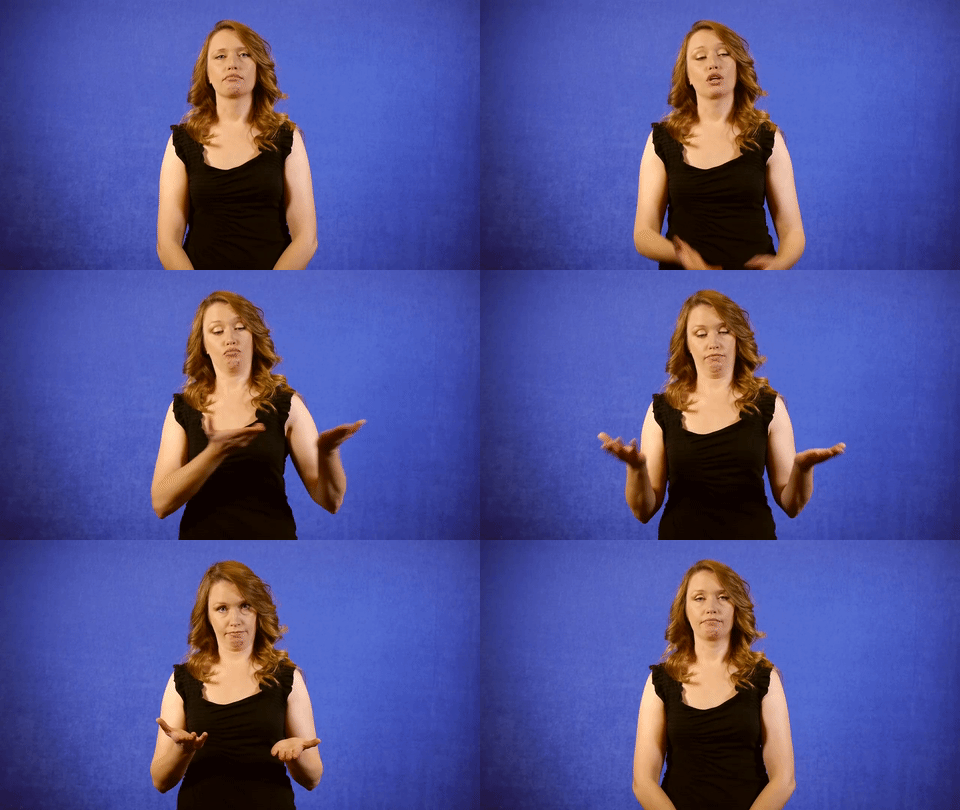
Sign for BRING HERE in ASL

YouTube player

Practice Activities:

To practice the sign for BRING HERE in ASL, begin by isolating the movement. Start by imagining holding something with both hands and gently moving it toward your body and a specific location in front of you. Use a mirror to observe hand movements and placements. Repeat the movement slowly, then increase speed while maintaining clarity.

Next, practice using the sign for BRING HERE in ASL in short sentences. Sign phrases like “bring the book here,” “please bring it here,” or “can you bring the baby here?” Make sure your facial expressions match the context—use a polite expression for requests or a firmer expression for commands. This helps develop natural and meaningful signing.

Use flashcards with objects or people common in your environment. Point to an item or show a card, then sign “bring here.” Say or sign a person’s name, then practice incorporating the sign into a sentence. For instance, if practicing with a teddy bear card, sign “teddy bear bring here.” This helps make the action more concrete and meaningful.

Tell a short story using the sign for BRING HERE in ASL several times. A simple example could be: “I have a cat. The cat is outside. I ask my brother ‘bring here.’ Now the cat is with me.” Retelling and creating more stories improves fluency with the sign in context.

Try partner activities where one person names an object or says a situation and the other responds using the appropriate sign. For example, one signs “I need keys,” and the other signs “bring here.” This interactive method encourages clearer communication and quicker recall.

Regular, varied practice with the sign for BRING HERE in ASL in both visual cues and storytelling will help improve both receptive and expressive skills.

Cultural Context:

In American Sign Language, the sign for BRING HERE plays an important role in everyday conversations. This sign conveys both direction and intent, making it crucial in settings where physical items or people need to be directed toward the signer. The sign for BRING HERE in ASL is particularly useful in classrooms, homes, and social gatherings.

The cultural context of the sign for BRING HERE in ASL ties closely to the visual and spatial nature of the language. Unlike spoken English, ASL relies heavily on body positioning, eye gaze, and the use of space to convey meaning. When someone uses the sign for BRING HERE in ASL, they are not just indicating movement; they are showing location in relation to themselves.

In Deaf culture, clear visual communication is a major priority. That’s why signs like the sign for BRING HERE in ASL are commonly used with body shifts and directional cues. The signer typically faces the person and moves their hands from a space in front of them toward their own body to indicate something needs to be brought to them.

Social interaction in the Deaf community often centers around shared visual context. The sign for BRING HERE in ASL is more than just a basic directional sign; it’s a dynamic part of storytelling, clarifying instructions, or giving stage directions during events. It plays a role in formal and informal conversation, from classroom discussions to casual chats with friends.

When using the sign for BRING HERE in ASL, the distance and location of the object can influence the movement and precision of the sign. If the object is close, the sign may be quick and smaller. If it’s far away, a broader motion is used to show that greater distance. These subtle variations are instinctively understood within the community.

Gesture and physical movement are essential parts of ASL grammar, and the sign for BRING HERE in ASL shows how the language incorporates the body in meaningful ways. Signers learn from an early age how to reference space around them, which makes ASL such a rich, spatial language. This is why placement and orientation are as important as the handshape itself.

Cultural respect plays into how people use directional signs like the sign for BRING HERE in ASL. For example, calling someone over or asking them to bring something has to be done respectfully, just as it would in English. The tone is shown through facial expressions, body language, and motion.

In Deaf social spaces, such as Deaf clubs, events, or even during video calls,

Extended Definition:

The sign for bring here in ASL is a directional and spatially significant movement that represents the concept of bringing something toward the signer’s location. In American Sign Language, location plays a crucial role in the meaning of verbs, especially when indicating direction or destination. This sign uses both hand movement and body orientation to convey the idea of an object or person being brought to the signer’s current place.

To produce the sign for bring here in ASL, you typically use both hands in a flat, palm-up position. Begin by positioning your hands away from your body and then move them toward your chest or the front of your body in a gentle, sweeping manner. Your facial expression can also reinforce the intent, especially in conversational signing where mood and tone add context.

This sign is highly dependent on spatial referencing. ASL is a visual language, so its use of space and directionality is essential for proper understanding. For instance, in a multi-person conversation, the sign for bring here might be slightly altered based on who is being addressed and where they’re standing.

Another important aspect of this sign is its flexibility. The sign for bring here in ASL can be modified based on context, urgency, or the type of object being brought. Classifiers may also be used to further describe the item, such as whether it is large, small, flat, or container-shaped. This enhances comprehension and helps convey specific meaning without using spoken words.

Since ASL is not a word-for-word translation of English, it’s important to understand that bring here is expressed through a visual representation rather than an exact English phrase. Children and adults learning American Sign Language can benefit greatly from practicing directional signs like bring here to strengthen their spatial awareness and fluency in ASL. The physical nature of the sign helps build muscle memory, making it easier to learn and retain.

In everyday conversation, the bring here sign might be seen in situations like asking someone to bring a cup of water, inviting a friend to come over, or requesting that an object be moved closer. It is a practical, commonly used sign and an important part of basic conversational ASL. Adding elements like time indicators or facial expressions can add useful layers to the meaning, such as implying urgency or politeness.

The sign for bring here in ASL also supports storytelling and narrative skills. Storytellers often use directionality and body shifts to establish location, making this sign useful in role-playing or describing movement. Deaf and hearing signers alike utilize this sign to

Synonyms: fetch, deliver here, bring over, take to, carry here

Educational resources: Find related learning materials in our course bank!

Want more? Check out some of our popular learning activities on the homepage!

Need to look up a sign? Use our highly rated dictionary: https://aslinteractive.com/best-asl-dictionary/

Follow us on tiktok: https://www.tiktok.com/@aslinteractive. More social media links at the bottom of this page!

Long-tail Keywords: what is the sign for bring here in ASL, how do you sign bring here in ASL, how to say bring here in sign language

Categories:

tags: Commands, Verbs, Language Learning, Everyday Activities, Passing Items

Parameters

*Handshape*:

The handshape used in the sign for BRING HERE in ASL involves both hands in the flat “B” shape, with fingers extended and together and thumbs resting along the side of the index fingers. Hands are held palm-up and slightly apart, away from the body.

To show the sign for BRING HERE in ASL, the hands move smoothly toward the center of the signing space in front of the torso, indicating direction. The motion, paired with the specific handshape, gives the visual cue of transporting something closer.

*Palm Orientation*:

The palm orientation for the sign for BRING HERE in ASL typically has both hands open with palms facing upward. Hands are placed in front of the body and then moved slightly inward and downward toward a central point, indicating directionality and emphasizing the concept of location.

This palm positioning helps show that something is being brought toward the signer. The sign for BRING HERE in ASL reflects spatial movement and location clearly through palm direction.

*Location*:

The sign for bring here in ASL is made at about waist level, extending from slightly away from the body toward the body, generally ending near the center of the torso. Both hands are used and the motion is directed inward, toward the signer. This location helps emphasize the concept of movement specifically toward the signer, reinforcing the meaning of “here.”

Staying within the signer’s personal space is key to the location of the sign for bring here in ASL. The hands move from an outward position in front of the signer to a point closer to their midsection, typically about a foot away from the torso. This clear spatial orientation conveys the directional aspect of bringing something toward the present location.

*Movement*:

To produce the sign for bring here in ASL, both hands are used, typically in a flat “B” or open palm shape facing upward. Begin with the hands held slightly out and away from the body, then smoothly move them inward toward the body, ending just in front of the torso.

The movement should feel natural, as if you are physically bringing something from a distant point directly toward your current location. The sign for bring here in ASL strongly depends on the context and directionality to complete the meaning.

*Non-Manual Signals*:

For the sign for BRING HERE in ASL, non-manual signals help direct the meaning and tone. A neutral or slightly expectant facial expression is common, especially when making a request. Slight head movement toward the location being indicated reinforces the direction of the bringing action.

Eyebrow position stays neutral unless paired with a question, in which case eyebrows may raise. The sign for BRING HERE in ASL depends on eye gaze to point toward the intended bring-to location, enhancing clarity.

*Prosody, Dominant/Non-Dominant Hand*:

The sign for BRING HERE in ASL uses both hands in a flat “open B” handshape. The dominant and non-dominant hands start away from the body, palms facing up and slightly angled, then move smoothly toward the signer’s torso, stopping near the chest.

This movement mimics the motion of physically bringing something closer. The sign for BRING HERE in ASL often includes a slight lean of the torso or head, depending on context, to emphasize directionality.

Tips for Beginners:

When learning the sign for BRING HERE in ASL, start by understanding the directional nature of the sign. This sign relies heavily on spatial awareness and the established locations of the people or objects involved within the signing space.

The movement of your hands plays a key role. It generally starts with your hands positioned away from your body and moves inward, toward your torso, simulating the action of bringing something closer. Make sure your facial expressions and body orientation support the meaning—this adds clarity and emotional tone to the sign.

One common mistake beginners make is using a generic “come” motion without considering the location being referenced. The sign for BRING HERE in ASL is distinct from more general signs like “come” or “bring,” and should be localized. Practice aiming the motion toward the specific place you’re designating as “here.”

Try using this sign in a number of spatial contexts to get used to its flexibility. For example, you could sign it to suggest someone bring a drink to the table, or call a child over to your side. Each setting helps you build the mental map of directional signing.

Use a mirror when practicing to track your hand positioning and distance. This will help ensure that your movement is purposeful and clear. Slow, fluid motions are better than rushed or jerky ones—accuracy comes with confidence, not speed.

Watching native ASL users sign in real-life scenarios, like conversations on YouTube or Signing Savvy, can reinforce your understanding of the sign for BRING HERE in ASL. Also, don’t hesitate to ask Deaf signers for feedback; they can help you fine-tune your spatial direction and movement.

Remember, signing is about communication more than perfection. Keep practicing the sign for BRING HERE in ASL until it feels natural in your body and flows with your conversation.

Connections to Other topics:

The sign for BRING HERE in ASL connects closely with spatial referencing and directional movement, two core principles in American Sign Language. This sign uses a movement that typically starts away from the signer and moves toward a specific point near the body, utilizing space to incorporate the meaning of “here.” Understanding this sign can enhance comprehension of how verbs of motion in ASL are often modified to reflect direction, which is essential in expressing where something is brought or going.

This sign also ties into the use of classifiers and role shift in ASL. For example, when describing a scene where someone brings an object into a room, a signer might establish a location in space for the object or character and then use the sign for BRING HERE to show the path of movement. This builds narrative fluency and visual storytelling skills, which are crucial in ASL dialogues and discourse.

The sign for BRING HERE in ASL can be part of compound expressions, such as combining it with signs like FOOD or DOCUMENT to communicate context-specific actions like bring food here or bring the paper here. These combinations reinforce sign order and how ASL uses movement and positioning to show relationships between people, objects, and places.

Understanding this sign can also help learners grasp other directional verbs, such as TAKE THERE or COME HERE, which follow similar spatial logic. By comparing them to the sign for BRING HERE in ASL, learners develop a stronger sense of how location and intent are conveyed nonverbally.

In everyday conversations, this sign is frequently used in commands and requests, making it highly practical. Situations involving assistance, invitations, or deliveries often call for this sign, helping learners see its application in real life . Through this, they build both receptive and expressive skills in functional ASL communication.

Summary:

The sign for BRING HERE in ASL captures both physical direction and contextual clarity, making it a great example of ASL’s spatial grammar. It leverages movement and palm orientation toward the speaker or another location that both parties acknowledge as “here.”

This sign is often produced with both hands in a flat “B” or relaxed open handshape. The hands are moved in a scooping or linear motion from the location of the object or imagined location toward the body or a designated point.

Facial expressions add nuance to the sign. A neutral or slightly engaged expression may suggest a request, while firmer expressions may turn the sign into a command.

The sign for BRING HERE in ASL aligns with verbs that are called directional or spatial-modifying. Directionality gives native signers the ability to indicate movement, relationships, and actions in three-dimensional space.

Unlike English, where prepositions and multiple words express direction, ASL condenses these ideas into movement paths and shifts in orientation. The sign for BRING HERE in ASL beautifully fits that category.

It is contextually sensitive. If you are talking about bringing an item from the left side of the room, your hand movement will show that left-to-center motion.

This reflects how ASL is not about mere word-for-word translation. Instead, it conveys ideas using visual and spatial logic.

The phrase doesn’t rely on one universal set of movements but adapts to scene-based mental mapping. It illustrates how understanding of space is central to ASL grammar.

Be careful not to confuse the sign for BRING HERE in ASL with the sign for “come here.” Although similar, bring here often involves carrying or transporting a tangible or imagined object.

In terms of grammar, BRING HERE functions as a composite verb phrase. It often follows subject-verb-object order in ASL but can vary based on topic-comment structure.

Sometimes a signer uses classifiers to indicate what is being brought. For example, a flat hand might show a book, while a curved hand could indicate a small bowl.

This classifier use enhances clarity. It lets the signer give precise visual references to what is being handled or transported.

Culturally, the sign emphasizes clarity of purpose and intention. The signer is not just asking for movement—it’s about delivering or carrying something toward a defined location.

In Deaf culture, such geographic and directional context is routine. Visual language assumes shared perceptual framing, making it easier to coordinate shared understandings quickly.

When engaging in ASL storytelling or conversation, BRING HERE can be used to signal changes in scene, responsibility, or possession. This rhetorical flexibility highlights ASL’s efficiency.

Because of its directional nature, this sign can also be inflected to incorporate pronoun use. Signing it from the area representing a third party toward oneself means “they bring to me.”

The sign can include subtle details depending on the item being brought. For instance, mimicking the way a bicycle might be wheeled or a baby might be held.

These nuances increase communicative precision. By modifying aspects of speed and space, it’s possible to suggest urgency, formality, or the size and weight of an object.

ASL learners often misrepresent this sign by flattening it to a general pull or conflating it with “bring.” It’s important to understand its integrated use with locative grammar.

The sign for BRING HERE in ASL is particularly useful in classroom settings where students are instructed to bring materials, symbolic items, or data from a source to a presentation spot.

In interpreting contexts, understanding this sign deeply helps maintain spatial integrity. Interpreters use it to mirror the original speaker’s intent and geographic references.

Applied linguistics studies show that ASL’s reliance on representational space makes signs like BRING HERE ideal examples of visual-spatial logic compensating for linear syntax.

Speech act theory in ASL often leverages movement-based signs to communicate intent. BRING HERE reflects both imperative and indicative modes, depending on facial cues and pacing.

There is a tactile adaptation of this sign for DeafBlind signers. In ProTactile language, movement and touch convey the transfer and endpoint sensations.

While the exact pathway of movement for the sign varies by context, it always centers the final location as the conceptual and physical “here.” This points to ASL’s heavy usage of focus zones.

In child language acquisition, BRING HERE is among the first directional signs taught. It matches early understanding of object permanence and spatial reasoning.

The sign connects with related directional signs like “take there” or “carry over.” Together they form a language matrix that facilitates varied communication using spatial verbs.

It also serves a didactic role when teaching ASL grammar. Its use illustrates how prepositional phrases collapse into verb directionalities built into signs.

In performance interpreters for theater, the precision of the sign is key. Placement and repeatability ensure continuity in plot while helping Deaf audiences follow physical action.

Varying the handshape slightly or incorporating classifiers

Want more? Check out some of our popular learning activities!

ASL Interactive Resources

ASLInteractive YouTube Channel

Follow us on tiktok: @aslinteractive.com

Follow us on Instagram: aslinteractive

Facebook page: aslinteractive

Facebook group: aslinteractive

LInkedIn: ASL Interactive LLC

Twitter: @ASL_interactive

*Some information on this page is AI-generated. AI can make mistakes. Please check the information.

Sign for BRING HERE in ASL

Responses