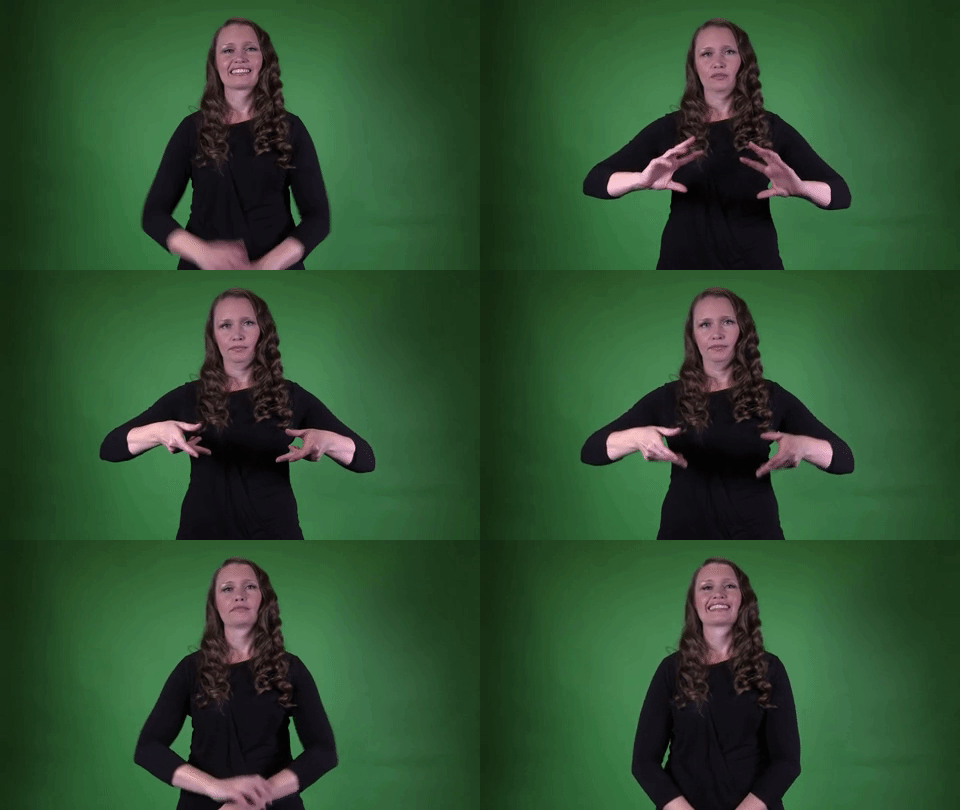
Sign for BURRITO in ASL | 🌯 ASL Dictionary

Definition: A Mexican dish made with a tortilla.

Sign for BURRITO in ASL

YouTube player

Practice Activities:

To build comfort with the sign for BURRITO in ASL, start by practicing the sign in isolation. Stand in front of a mirror and repeat the sign slowly, focusing on the handshape and movement. Try signing it with both dominant and non-dominant hands if needed, and alternate hands for extra muscle memory.

Next, create simple sentences that include the sign for BURRITO in ASL. Examples could include “I eat a burrito,” “She likes burritos,” or “He made a burrito for lunch.” Sign these slowly, then try them at conversational speed. Practice going from English to ASL structure, and think about facial expressions to show emotion or emphasis, such as excitement or hunger.

Work with a partner and take turns ordering meals using ASL. Create a pretend restaurant scene where one person is the server, and the other is ordering. Use the sign for BURRITO in ASL along with other food signs like taco, rice, beans, salsa, and drink. This kind of practice builds comfort using food vocabulary in conversation.

Write a short story about a fun food adventure where a burrito plays a central role. It could be about making a burrito from scratch, having a burrito picnic, or trying unusual burritos. Practice signing the full story using ASL grammar and include the appropriate facial expressions, role shifting, and classifiers.

For additional reinforcement, watch videos or cooking programs in ASL or on mute and interpret what you see, inserting the sign for BURRITO in ASL when appropriate. Label images with vocabulary. Print or view pictures of burritos and related food items, then sign each one.

End your practice session by fingerspelling your favorite burrito ingredients, and then sign the full phrase using the sign for BURRITO in ASL. This builds vocabulary and fluency at the same time.

Cultural Context:

The sign for burrito in ASL connects a favorite food item with a visual language that enhances communication in Deaf and hard-of-hearing communities. Burritos are a popular dish in American and Mexican culture, often enjoyed for their versatility and rich flavors. When expressing such cultural staples in American Sign Language, it’s important to reflect not only the object itself but also how it fits into daily life.

Burritos are commonly eaten at restaurants, food trucks, or made at home, and they are known for being wrapped in a tortilla and filled with ingredients like beans, rice, meat, cheese, and vegetables. The sign for burrito in ASL mimics the wrapping motion of a tortilla, making it intuitive for both Deaf and hearing individuals to learn and use. This sign reflects how ASL often visually represents a concept, especially when related to food.

In Deaf culture, food-specific signs like the sign for burrito in ASL are used frequently in conversations about meals, restaurant preferences, or dietary choices. Clear communication about food is vital, and having distinct signs for popular dishes enhances conversations and ensures inclusion in social gatherings. The burrito sign helps bridge language gaps during communal meals or when ordering food.

Food plays a major role in cultural identity and social experiences, so knowing the proper sign for burrito in ASL can promote cultural exchange between Deaf and hearing communities. When Deaf individuals go to a Mexican restaurant or attend a food-related event, they rely on accurate signs to express their preferences. The sign for burrito in ASL supports these interactions by allowing easy and natural communication.

American Sign Language evolves to include signs for new and foreign foods as they become more integrated into everyday life. Burritos, having become a staple across the United States, naturally found a place in ASL vocabulary. Using the proper sign for burrito in ASL helps ensure respect and understanding across cultural boundaries.

In schools and social settings, teaching the sign for burrito in ASL encourages inclusive communication among students, teachers, and staff. Whether it’s lunchtime discussions or culinary-themed lessons, this sign allows Deaf students to share their food preferences with clarity and confidence. It also helps hearing individuals become more aware of and respectful toward sign language.

The visual nature of ASL makes it ideal for expressing food items that are tactile and process-based, like making and folding a burrito. Because the sign for burrito in ASL often imitates the act of wrapping, it becomes accessible to new learners and more memorable thanks to its

Extended Definition:

The sign for burrito in ASL is a visually descriptive representation of this popular and delicious Mexican dish. It mimics the act of holding and rolling a burrito, making it easily memorable and intuitive for signers of all skill levels. Like many food-related signs in American Sign Language, it draws from both the appearance and the action involved with the item.

To produce the sign for burrito in ASL, your hands generally mimic wrapping or holding a burrito. It can vary slightly depending on regional usage or individual signing style, but the core concept remains consistent. This sign is also commonly used in everyday conversations about food, restaurant orders, or when discussing meals with friends and family.

Understanding the sign for burrito in ASL brings cultural relevance into the conversation. As burritos have grown in popularity across the United States and internationally, the need for accessible and accurate ASL signs for these foods has increased. This ensures that Deaf and hard-of-hearing individuals can fully engage in conversations involving popular cuisine.

The context when using the sign for burrito in ASL matters. For example, it can be part of a sentence like “Let’s eat a burrito” or “Do you want a burrito?” Both formal and casual settings may require this sign, especially when ordering food in a restaurant or discussing what to eat at home. Classrooms teaching ASL vocabulary often include food items early on due to their frequency in daily communication.

Some variations exist in how the sign for burrito in ASL is used or interpreted. Regional dialects in ASL may result in slightly different handshapes or placement. That said, the essence of the sign typically makes it understood by most signers regardless of regional differences.

In ASL, context and facial expressions are key components when signing words like burrito. When expressing excitement about a meal, for example, your facial expression can convey enthusiasm that supports the meaning of your sign. This is one of the unique strengths of ASL, adding emotion and clarity through visual storytelling.

The sign for burrito in ASL is part of a growing lexicon of modern food terms. As cuisine evolves and new items become mainstream, ASL continues to adapt by integrating signs that make conversations more inclusive and expressive. This word also teaches signers how to incorporate familiar physical motions into meaningful language.

In educational settings, the sign for burrito in ASL is often taught with other Mexican food signs like taco, enchilada, or salsa. Learning these related vocabulary

Synonyms: burrito wrap, tortilla wrap, Mexican wrap, taco wrap, rolled tortilla

Educational resources: Find related learning materials in our course bank!

Want more? Check out some of our popular learning activities on the homepage!

Need to look up a sign? Use our highly rated dictionary: https://aslinteractive.com/best-asl-dictionary/

Follow us on tiktok: https://www.tiktok.com/@aslinteractive. More social media links at the bottom of this page!

Long-tail Keywords: What is the ASL sign for burrito, how do you sign burrito in American Sign Language, what’s the proper ASL for burrito

Categories:

tags: Food, Meals, Mexican Cuisine, Dining, Language Learning

Parameters

*Handshape*:

The handshape for the sign for BURRITO in ASL uses both hands in a flat “O” handshape, where the fingertips touch the thumbs to form a closed circle. These handshapes mimic the shape of a rolled burrito .

In the sign for BURRITO in ASL, the hands are held horizontally and rotate around each other, suggesting the wrapping motion of a burrito. This natural movement reinforces the concept and helps visually convey the idea of a wrapped food item.

*Palm Orientation*:

For the sign for BURRITO in ASL, both hands are typically used in a loose fist shape to mimic the motion of rolling a burrito. The palms are oriented toward each other, facing inward, as the hands twist slightly in opposite directions.

The palm orientation is central to correctly conveying the sign for BURRITO in ASL, as it visually resembles wrapping or forming a burrito. Keeping the palms inward and parallel helps capture the concept clearly.

*Location*:

The sign for burrito in ASL is made in front of the torso, centered near the stomach or midsection. This location represents where food typically goes when eaten, helping to visually connect the concept of a burrito with the idea of eating.

While demonstrating the sign for burrito in ASL, the signer’s hands remain at chest or stomach level. This placement reflects a natural space for food-related signs, keeping the movement visible and easily understood.

*Movement*:

To form the sign for burrito in ASL, both hands start in front of the body with palms facing each other, fingers extended and slightly curved like you’re holding a soft wrap. Then move your hands in a rolling motion, mimicking the action of wrapping or rolling a burrito . The sign captures the shape and action associated with making or holding a burrito.

This movement iconically represents the wrapping or rolling of a tortilla around a filling, which is symbolic of the item. The sign for burrito in ASL is often used while discussing food, ordering at a restaurant, or describing different cuisines.

*Non-Manual Signals*:

When demonstrating the sign for burrito in ASL, a neutral or pleased facial expression is generally appropriate, depending on the context. Slight eyebrow raises or a small smile can show positive feelings toward the food item . Mouth movement may be minimal, but some signers may mimic chewing or say “burrito” silently while signing.

Context affects facial expressions in the sign for burrito in ASL. For example, if referring to a delicious burrito, enthusiasm can be indicated by widened eyes or uplifted lips. In more neutral contexts, a relaxed face works best.

*Prosody, Dominant/Non-Dominant Hand*:

The sign for BURRITO in ASL uses both hands to mimic the action of wrapping a burrito. The dominant hand and non-dominant hand start in flat-O handshapes, palms facing each other horizontally. They rotate slightly as if rolling or wrapping something, emphasizing the cylindrical shape of a burrito .

In the sign for BURRITO in ASL, both hands play equal roles as they roll together to represent how a burrito is made. This sign reflects the imagery of folding and enclosing contents, making it iconic and easy to remember for food-related vocabulary.

Tips for Beginners:

When learning the sign for BURRITO in ASL, start by focusing on your hand positioning and movements. This sign typically mimics the action of wrapping a burrito, so it’s important to make your movements smooth and intentional. Keep your hands relaxed but clearly shaped to avoid any confusion with other food signs.

One beginner tip is to practice in front of a mirror to ensure both of your hands are mirroring the correct motion. The wrapping gesture should be done at chest level and remain centered so your conversation partner can clearly see the sign. Avoid rushing the motion—being too fast can make your sign unclear or change the meaning completely.

Another common pitfall is inconsistent hand motion. The sign for BURRITO in ASL uses both hands moving toward each other and twisting slightly as if wrapping. If one hand is stiffer than the other or not synchronized, it can throw off the meaning. Repetition helps; try doing the sign 10–15 times slowly, then gradually speed up to a natural pace.

Pay attention to facial expressions when signing. While the sign itself conveys the object, showing interest or excitement through your expression can help make your signing more natural and expressive. Facial grammar is essential in ASL and helps to give context to any food-related conversation.

Watching fluent signers use the sign for BURRITO in ASL during real or recorded conversations is another great way to build confidence. Try matching their tempo and fluidity once you’re comfortable with the mechanics. Don’t be discouraged if it takes a while—mastery comes through repetition and mindful practice.

Finally, use the sign in real-life settings. Sign it when you’re discussing food, placing an order, or even joking with friends. The more you incorporate the sign for BURRITO in ASL into your interactions, the more second nature it will become .

Connections to Other topics:

The sign for BURRITO in ASL is closely related to food signs that highlight physical characteristics or preparation methods. Similar to signs for TACO or SANDWICH, it uses mime-like movements to depict the act of wrapping or folding, tapping into the classifier system that visually conveys shape and size. This makes it easy to compare and contrast signs representing various handheld or wrapped foods.

Knowing the sign for BURRITO in ASL can support learning other food-related compound signs. For example, if discussing a breakfast burrito, the signs for EGG, SAUSAGE, and BURRITO might appear in succession, providing context and describing ingredients clearly. Learners can combine the sign for BURRITO with other mealtime indicators like LUNCH or DINNER to enhance sentence structure in ASL storytelling or casual conversation.

The sign for BURRITO in ASL may be connected to cultural identity discussions within Deaf spaces. Food signs often act as entry points for talking about heritage, preferences, and regional cuisine. Thus, learning how to sign BURRITO can extend to conversations about Mexican food, fusion cuisine, or dining experiences, creating opportunities for rich cultural exchanges in ASL.

This sign also connects to the concept of classifiers when describing different kinds of burritos like large, small, or double-wrapped meals. Classifiers help expand the descriptive part of ASL and connect nicely with the spatial and visual language nature of ASL. For instance, a classifier may be used following the sign for BURRITO in ASL to show holding a large one with two hands versus a small one with one hand.

In classroom or interpreting settings, recognizing derived signs that indicate cooking, such as WRAP, ROLL, or STUFF, can enrich comprehension. These are often visually and conceptually linked to how the sign for BURRITO is formed. This expanded vocabulary reinforces learning and helps students internalize how signs form meaningful stories.

Summary:

The sign for BURRITO in ASL typically mimics the process of preparing a real burrito. Both hands are used in a loose fist shape, and they are brought together in front of the body. Then, they are rotated slightly to resemble a rolling motion, symbolizing the act of wrapping a burrito .

This motion is iconic, meaning it visually resembles the thing it represents. The rolling motion is easily understood even without a deep cultural context. It reflects how language in sign form often captures real-world concepts through emblematic gestures.

ASL is rich with such iconic signs, especially when it comes to food. The sign for BURRITO in ASL closely relates to signs like TACO, HOTDOG, and SANDWICH, which also visually interpret food preparation or shape. The bodily motion becomes a tool for representation.

Culturally, burritos are a staple in Mexican and Mexican-American cuisine. In American dining culture, they’re also widely consumed in fast food and frozen meal settings. This gives the sign relevance in many conversational contexts, from family meals to social outings and casual conversation about favorite foods.

Because the sign is so visually descriptive, it can easily be understood even by novice signers or those unfamiliar with ASL. It offers a great starting point for learners who are beginning to understand how signs mirror real-life actions. This provides both cognitive and kinesthetic reinforcement when acquiring sign vocabulary.

In casual conversation, the sign for BURRITO in ASL might appear in discussions about food preferences, diet, or even jokes about late-night cravings. It’s common for Deaf individuals and signers to elaborate or modify such signs based on context. This includes signing SMALL BURRITO or BIG BURRITO using spatial referencing or facial expressions.

Grammar in ASL allows for adjustments and modifications of signs through use of nonmanual markers and classifiers. If describing a burrito that is huge or overflowing, one could follow the base sign with a classifier to show size or messiness. This flexibility adds rich detail to signed communication.

Linguistically, the sign demonstrates the principle of iconicity, where form in some way resembles meaning. It contrasts nicely with arbitrary signs, which have no obvious visual connection to their referent. Iconic signs like this one help build mental imagery during communication.

From a morphological viewpoint, the sign for BURRITO in ASL is a root sign with no native inflections but is subject to modifications in ASL discourse. It can integrate into classifier constructions or be followed by adjectives that describe temperature, size, or quality. These elements reflect ASL’s agglutinative nature.

Applied linguistics recognizes the value of teaching such iconic food signs early on. They cater to memory retention and immediate understanding, especially for children or second language learners. The sign becomes a visual anchor for language learning.

The keyword phrase is especially useful for cultural discussions, such as Mexican cuisine representation in Deaf communities. Food traditions are often shared during gatherings and holidays, and having signs like BURRITO allows Deaf individuals to fully participate in these conversations.

Language evolution plays a part here too. As burritos spread and diversify across the United States, new versions and flavors emerge. It’s not uncommon for regional variations in the sign to appear, sometimes incorporating more fingers or modifying the rolling motion.

ASL is not uniform across all regions or communities. Some areas may fingerspell BURRITO or blend signs, depending on heritage or bilingual influences. Bilingual Deaf communities fluent in both ASL and Spanish often merge cultural elements in food signs.

The sign for BURRITO in ASL might include slight variations, such as adding mouth morphemes or changing the size of the rolling movement to indicate different styles. For example, breakfast burritos might be accompanied by a relevant facial expression or added detail for EGGS or BACON.

The semiotics behind the sign are grounded in physical action becoming symbol. It showcases the tendency of human language to draw meaning from relatable physical experiences. Preparing food is universally understood, which makes the gesture almost intuitive.

For narrative storytelling, the sign can be enriched with contextual signs and descriptions. For example, someone might describe making a burrito at home, using sequential signs for ingredients, then ending with the burrito sign as part of the story arc.

The communicative function of such a sign is pragmatic as well as lexical. It serves conversations around meals, dining out, cooking practices, and even lunchtime debates. It has a high utility in both everyday chatter and structured dialogue.

Many Deaf culture events use shared meals as a bonding activity. In these environments, having signs for each dish reinforces cultural cohesion and inclusion. Thus, the sign for BURRITO in ASL plays a role beyond language—it strengthens community ties.

Sociolinguistically, the prevalence of Mexican cuisine in the United States means signs like BURRITO are widely used and understood across diverse backgrounds. This reflects cultural appropriation, assimilation, and even identity politics in terms of food representation.

Language documentation

Want more? Check out some of our popular learning activities!

ASL Interactive Resources

ASLInteractive YouTube Channel

Follow us on tiktok: @aslinteractive.com

Follow us on Instagram: aslinteractive

Facebook page: aslinteractive

Facebook group: aslinteractive

LInkedIn: ASL Interactive LLC

Twitter: @ASL_interactive

*Some information on this page is AI-generated. AI can make mistakes. Please check the information.

Sign for BURRITO in ASL

Responses