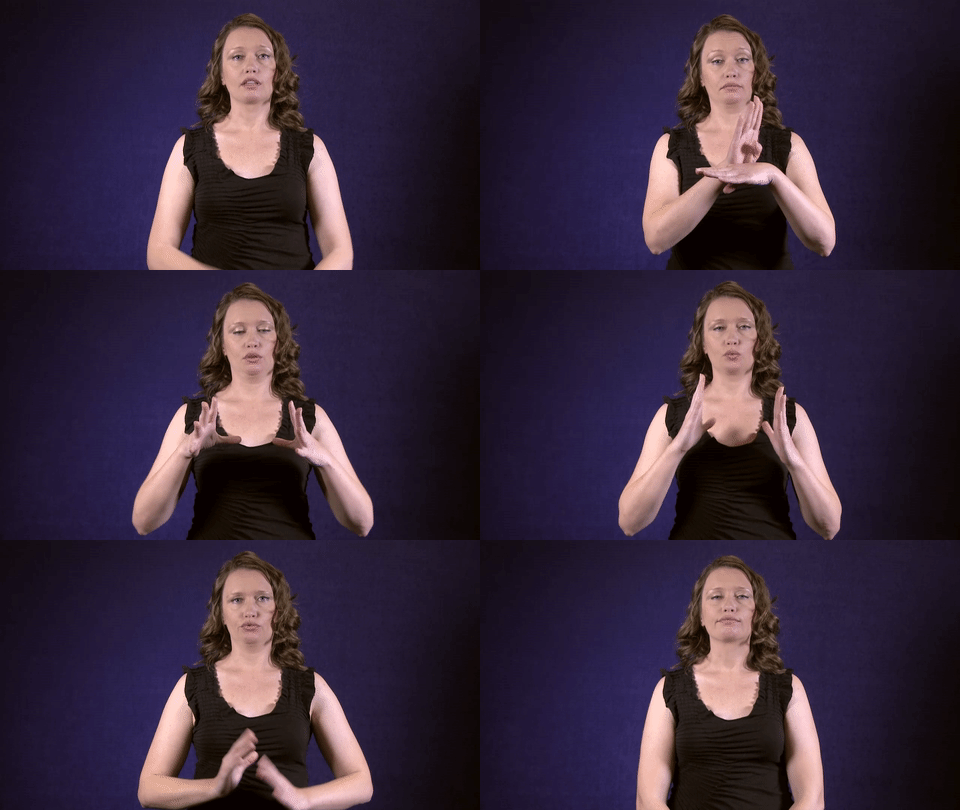
Definition: A person who owns a business.
Sign for BUSINESS OWNER in ASL

Practice Activities:
To practice the sign for BUSINESS OWNER in ASL, begin by working on isolated repetition. Repeat the sign in front of a mirror, paying close attention to handshape, movement, and facial expression. Record yourself and compare your sign to a model video to refine accuracy and clarity.
Next, integrate the sign into basic sentences. Sign phrases such as “MY DAD BUSINESS OWNER,” or “SHE PROUD BUSINESS OWNER.” This helps reinforce vocabulary retention and sentence structure. Try to vary the sentences using different pronouns and possessives like “OUR,” “THEIR,” or “I.”
Create three to five short storytelling prompts related to owning a business. For example, describe someone opening a bakery, managing a bookstore, or running a startup. Use the sign for BUSINESS OWNER in ASL throughout your story to internalize the concept in context. Within the story, also include signs for typical business activities like SELL, BUY, TALK, or MEETING.
Pair up with a learning partner and engage in a role-play activity. One person can pretend to be interviewing the other for a magazine article about successful entrepreneurs. Use questions like “HOW LONG YOU BUSINESS OWNER?” or “WHAT KIND BUSINESS YOU RUN?” This strengthens conversational fluency and responsive signing.
Watch videos or online interviews of actual business owners presented in ASL, if available. While viewing, identify each time the sign for BUSINESS OWNER in ASL appears, and note how it’s used naturally. Shadow the dialogues and retell what you saw, incorporating the targeted vocabulary.
As a final drill, write out a list of jobs or professions, then sign full sentences identifying whether each person is an employee or a business owner. For extra practice, sign what kind of business it is, allowing use of rich vocabulary and reinforcing comprehension.
Cultural Context:
In American Sign Language, cultural context plays an important role when expressing identity and roles, especially with terms like sign for business owner in ASL. The Deaf community places value on clear visual language that reflects responsibility, leadership, and personal achievement. Because of this, signing the term accurately connects more deeply than just labeling someone with a job title.
The sign for business owner in ASL typically combines the sign for business and the sign for owner or boss. This layered approach represents more than just a person who runs a business. It conveys someone who makes decisions, takes on financial risk, and plays a leadership role in their community or organization.
Within Deaf culture, entrepreneurship is respected as a path to independence and empowerment. Knowing the correct sign for business owner in ASL enables participants in the Deaf community to express this identity with clarity and pride. It’s especially meaningful when owned businesses are Deaf-led or Deaf-friendly, as these contribute to the growth and self-sufficiency of the community.
Business ownership is seen as a form of self-reliance, and using the proper sign shows recognition of that accomplishment. When teaching or sharing the sign for business owner in ASL, understanding its cultural significance adds depth to communication. It’s not just vocabulary—it acknowledges a person’s role, effort, and place of authority.
It’s also important to be conscious of how the sign fits in conversation and social context. Depending on the discussion, the sign for business owner in ASL might shift slightly to describe specific industries, services, or types of leadership. For example, a Deaf person running a consulting firm may sign it slightly differently than someone owning a coffee shop, while still grounding the term in the same core definition.
Respecting cultural context also involves understanding representation. Many Deaf-owned businesses promote accessibility and inclusion by employing Deaf staff and using visual alerts and ASL services. Expressing that someone is a business owner by using the correct sign emphasizes the value of these culturally-driven priorities.
Using the sign correctly also recognizes the role of business owners as community stakeholders. Whether they support events, develop resources, or offer job opportunities, the term highlights their ongoing influence. The sign for business owner in ASL carries these connotations, especially among signers who are proud of their professional identity.
Language in the Deaf community often centers on visual storytelling and non-manual markers. Facial expressions and body position can reinforce authority or clarify context when using the sign for business owner in ASL. Learning these nuances ensures respectful, accurate communication that honors
Extended Definition:
The sign for BUSINESS OWNER in ASL is composed of two parts that reflect the meaning of the phrase. First, the sign for BUSINESS is generally done by tapping the letter B (formed in ASL fingerspelling) against the palm of the non-dominant hand in a repetitive motion. Then, to indicate OWNER, the sign usually involves clasping both hands in front of the chest, showing possession or control.
Taken together, the sign for BUSINESS OWNER in ASL conveys the concept of someone who owns or operates a business. This sign is commonly used in conversations about entrepreneurship, small businesses, company leadership, or professional identity. It’s especially helpful for discussing occupations during introductions or interviews in the Deaf community.
Understanding context is important when using this sign in ASL. For instance, if you’re referring to a specific kind of business owner—like a restaurant owner or a shopkeeper—the sign for BUSINESS OWNER can be followed or preceded by the specific type of business being referenced. This helps provide clarity and enrich the conversation.
The sign for BUSINESS OWNER in ASL appears frequently in discussions about self-employment, freelance work, and career planning. It lets Deaf professionals describe their work and also provides hearing ASL students a way to build vocabulary relevant to the business world. Being familiar with business-related signs like this helps learners engage in discussions beyond everyday topics.
Many ASL learners encounter the sign for BUSINESS OWNER in academic settings, especially in business-focused classes that teach job vocabulary and career awareness. Interpreters also benefit from knowing this sign, especially when interpreting business meetings, entrepreneur panels, or network events in the Deaf community. The ability to clearly convey roles like BUSINESS OWNER is crucial for accurate and respectful communication.
Deaf entrepreneurs may use the sign for BUSINESS OWNER in ASL in their marketing videos, presentations, or during networking sessions to describe themselves professionally. It can be used alongside signs for CEO, founder, or similar roles, making it a versatile and essential addition to one’s working ASL vocabulary. This term helps establish authority and credibility when used in personal or professional introductions.
The sign for BUSINESS OWNER in ASL is also used in school settings where students learn about job roles and career paths. It serves as a powerful tool for empowering Deaf youth to imagine themselves in leadership or ownership roles. Representation through vocabulary is an important part of building confidence and inspiring success.
In online ASL tutorials or dictionary listings, you’ll often see the sign for BUSINESS OWNER broken down into videos for clarity. Watching different sign
Synonyms: entrepreneur, company owner, proprietor, business operator, enterprise owner
Educational resources: Find related learning materials in our course bank!
Want more? Check out some of our popular learning activities on the homepage!
Need to look up a sign? Use our highly rated dictionary: https://aslinteractive.com/best-asl-dictionary/
Follow us on tiktok: https://www.tiktok.com/@aslinteractive. More social media links at the bottom of this page!
Long-tail Keywords: what is the sign for business owner in ASL, how to sign business owner in American Sign Language, ASL sign for business owner
Categories:
tags: Business, Occupation, Employment Status, Career, Entrepreneurship
Parameters
*Handshape*:
The handshape used in the sign for BUSINESS OWNER in ASL combines two distinct parts to convey the concept. First, open flat hands (B-handshapes) are used during the sign for BUSINESS, with the dominant hand brushing against the back of a stationary non-dominant hand. Then, for OWNER, both hands form flat hands and tap the upper chest, representing possession or ownership.
This compound sign relies on transitioning smoothly between the B-handshape and flat palms, maintaining clarity throughout. Accuracy in these handshapes is essential for correctly conveying the sign for BUSINESS OWNER in ASL .
*Palm Orientation*:
The palm orientation in the sign for BUSINESS OWNER in ASL involves two distinct parts. For the sign BUSINESS, both hands form the letter “B” and move in small circular motions near the sides of the chest, palms facing downward. This suggests continuous activity, connected to a business setting.
For OWNER, the hands take on a flat “5” shape and tap the chest with fingertips, palms facing inward. This gesture symbolizes possession or ownership. Together, these orientations effectively communicate the full meaning behind the sign for BUSINESS OWNER in ASL .
*Location*:
The sign for BUSINESS OWNER in ASL is produced in two parts. For the sign BUSINESS, both hands are placed in front of the upper torso area, with the dominant hand in the “B” handshape moving back and forth along the palm of the non-dominant hand near the lower chest. Then, for OWNER, the sign moves slightly higher to the upper chest where both flat hands tap the upper body, indicating possession or ownership.
This positioning ensures clarity when combining signs, keeping the location within the central torso zone. The sign for BUSINESS OWNER in ASL stays within a natural signing space that maintains visibility and ease of flow between the concepts of business and ownership.
*Movement*:
To sign the concept in the sign for business owner in ASL, begin with the sign for BUSINESS by placing both hands in the “B” handshake. The dominant hand brushes back and forth against the side of the non-dominant hand near the wrist area, similar to the motion used to show action or engagement.
Then transition directly into the sign for OWNER by placing the flat “5” hands on the upper chest, indicating possession or control. The entire movement flows smoothly from the business motion to the ownership gesture, capturing the complete idea in the sign for business owner in ASL.
*Non-Manual Signals*:
When signing the sign for BUSINESS OWNER in ASL, maintain a confident and assertive facial expression to reflect ownership and professionalism . Slight eyebrow raise and direct eye contact help convey authority and clarity, matching the tone of someone who runs a business.
A neutral or slightly serious mouth posture reinforces the responsibility carried by a business owner. These non-manual signals enhance meaning and give depth to the sign for BUSINESS OWNER in ASL.
*Prosody, Dominant/Non-Dominant Hand*:
The sign for BUSINESS OWNER in ASL uses both hands. The dominant hand forms the sign for BUSINESS by brushing the letter “B” handshape across the back of the non-dominant flat palm. Then, transition to the sign for OWNER by placing both flat hands on the upper chest, indicating possession.
When performing the sign for BUSINESS OWNER in ASL, facial expression plays a role in conveying responsibility or pride. The dominant hand leads in motion while the non-dominant hand remains steady, supporting the meaning clearly.
Tips for Beginners:
When learning the sign for BUSINESS OWNER in ASL, it’s helpful to understand that this involves combining two separate concepts: BUSINESS and OWNER. The sign for BUSINESS typically uses the dominant hand in a “B” handshape brushing back and forth across the wrist of the non-dominant hand in a horizontal position. OWNER is conveyed by placing both flat hands on the chest in a possessive motion. Together, they create a clear compound idea representing someone who owns and runs a business.
One challenge beginners face is maintaining fluidity across the compound sign. Make sure to practice transitioning smoothly between the sign for BUSINESS and the sign for OWNER so the meaning is clear. Jerky or disconnected movements can make the sign look awkward or confuse your audience. Practicing in front of a mirror can help fine-tune your motion and ensure clarity.
Another key tip for learning the sign for BUSINESS OWNER in ASL is mastering facial expressions and eye contact. These non-manual markers help reinforce the importance or seriousness of the statement. ASL is not just about hand movements—your facial grammar provides crucial context and emotion.
Be careful not to confuse the sign for BUSINESS with similar motions used for WORK or JOB. BUSINESS involves a brushing motion, whereas WORK usually uses tapping with a firmer contact. Taking time to distinguish these through repetition ensures better accuracy in conversations.
Consistency with handshapes is essential. Keep your “B” handshape clear and avoid unintentionally morphing it into an incorrect form. Proper handshape control increases understanding and helps avoid miscommunication.
Lastly, watch fluent signers demonstrate the sign for BUSINESS OWNER in ASL through video resources ️. Repetition and active observation will accelerate your muscle memory and improve your confidence in real-life conversations.
Connections to Other topics:
The sign for BUSINESS OWNER in ASL integrates two important concepts: BUSINESS and OWNER. The sign for BUSINESS is typically produced with the dominant hand in a “B” handshape brushing against the non-dominant hand at the wrist, symbolizing activity related to commerce or trade. OWNER is usually signed by placing both “flat” hands over the chest, emphasizing possession or responsibility. The combination of these two signs illustrates not just someone involved in business but specifically someone who owns or runs a business.
This compound sign is closely related to other occupational signs such as MANAGER, EMPLOYEE, and ENTREPRENEUR. The sign for ENTREPRENEUR may involve elements of BUSINESS as well, but with extra emphasis on initiating or creating projects, drawing subtle distinctions in meaning. Similarly, BUSINESS OWNER in ASL may appear in conversations about job roles, self-employment, or business hierarchy, often contrasting it with WOKER or EMPLOYEE.
Learners may also encounter the sign used in conjunction with descriptive classifiers, such as CARS or RESTAURANT, to specify what kind of business someone owns. For example, signing CAR + BUSINESS OWNER provides context for “car dealership owner.” This layering of signs enhances clarity and promotes accuracy during dialogues or storytelling in ASL.
It connects naturally with signs for MONEY, RESPONSIBILITY, and DECISION, as these are all inherent to owning a business. In real-world ASL usage, the sign for BUSINESS OWNER may be used when discussing career goals, attending networking events, or explaining one’s job during introductions . Because this concept involves both roles and relationships, it’s also relevant when framing familial connections, such as discussing a family-run business.
Understanding the sign for BUSINESS OWNER in ASL helps bridge broader themes of identity, agency, and occupation in signed communication. It also opens up pathways to talking about professionalism, ambition, and independence within Deaf culture and beyond.
Summary:
The sign for BUSINESS OWNER in ASL conveys two distinct but connected concepts: business and ownership. Typically, this is expressed using a compound sign, combining the sign for BUSINESS followed by the sign for OWNER. Understanding the cultural and grammatical nuances behind the sign helps deepen its meaning and relevance in both linguistic and Deaf cultural spaces.
To express BUSINESS, the dominant flat B-handshape brushes in small circular motions on top of the back of the non-dominant S-hand. This gesture represents the movement and exchange involved in commercial or work-related activities. The position of the B-hand near the wrist suggests routine and productivity, symbolic of the work dynamics associated with running a business.
For the concept of OWNER, the sign usually uses a possessive gesture. This is done by placing the dominant flat hand on the chest with a firm contact. This signifies personal possession or responsibility, which, in the context of BUSINESS OWNER, emphasizes the personal stake and authority the individual has over the enterprise.
When combined, the phrase becomes a meaningful compound that encapsulates both economic action and personal responsibility. In ASL, compound signs like this are common and help streamline communication by reducing length while retaining full semantic depth. This makes the sign for BUSINESS OWNER in ASL both efficient and expressive.
Grammatically, this sign follows standard ASL syntax patterns. In signed conversations, identifying the role of a person often comes early in a sentence for clarity. The sign for BUSINESS OWNER in ASL often precedes descriptive modifiers or verbs related to business activities or management responsibilities.
The sign can be slightly modified based on context. For example, facial expressions and spatial referencing can intensify or soften the meaning. If someone is emphasizing their self-made status or pride in ownership, a more emphatic contact or facial expression can add layers of meaning to the sign.
Business ownership as a concept carries significant cultural weight in both hearing and Deaf communities. In the Deaf community, becoming a business owner is especially impactful. It can reflect economic independence, empowerment, and a strong connection to community development and representation.
The sign for BUSINESS OWNER in ASL also touches on sociolinguistic themes, such as status and self-identification. In ASL, status is often articulated through occupational signs, and BUSINESS OWNER denotes a high degree of autonomy and respect. This elevates the social dynamics of the conversation when introducing or discussing someone’s profession.
There are subtle regional and generational influences on how the sign is rendered. Younger signers or those involved in Deaf-owned businesses may use more stylized or nuanced deliveries of the sign. Meanwhile, some older signers might prefer to fingerspell O-W-N-E-R after signing BUSINESS based on clarity or setting.
In applied linguistics, the construction of the sign for BUSINESS OWNER in ASL demonstrates key principles of conceptual blending. Two signs come together to form a new idea that is more nuanced than the sum of its parts. This aligns with theories of visual grammar in signed languages, showing how multiple signs can be coordinated to convey complex identities.
This sign also illuminates the morphological patterns typical in ASL. The use of independent root signs that combine into compound signs reflects how ASL builds new meaning from accessible components. Language users manipulate these signs dynamically depending on role, context, and intent.
In real-world usage, the sign often appears in discussions about entrepreneurship, job interviews, small business management, or economic planning. The sign for BUSINESS OWNER in ASL may also arise in academic or advocacy contexts, highlighting the progress of Deaf-owned companies or emphasizing Deaf leadership.
The broader societal shift toward entrepreneurship in the Deaf community has magnified visibility of this sign. As Deaf professionals increasingly start and operate their own enterprises, the sign functions not only as identification but also as a badge of accomplishment and community pride .
There is an intrinsic visual logic to the sign. The tactile contrast between the active brushing motion (representing commerce) and the proud, settled gesture of ownership (hand on chest) creates a visual metaphor. That blend is sensitive to both form and function, a hallmark of signed languages.
One might compare this sign with related signs such as MANAGER, BOSS, or EMPLOYER. Although similar in connotation, each carries unique emphasis and structural design. The sign for BUSINESS OWNER in ASL suggests direct control and responsibility, setting it apart from someone who merely oversees tasks or staff on behalf of an organization.
From a functional linguistic perspective, this is a noun sign. However, in ASL fluidity, it may work in close relationship with verb signs such as MANAGE, OPERATE, or GROW. Signers often couple the sign with directional verbs to show managerial acts or business expansion physically.
In bilingual settings where both spoken English and ASL are used, the sign for BUSINESS OWNER in ASL bridges cultural understandings of professionalism. It’s particularly effective in educational or interpreter-mediated contexts, helping convey class, occupation, or role with clarity and dignity.
This sign also intersects with sociopolitical themes. Entrepreneurs
Want more? Check out some of our popular learning activities!
ASL Interactive Resources
ASLInteractive YouTube Channel
Follow us on tiktok: @aslinteractive.com
Follow us on Instagram: aslinteractive
Facebook page: aslinteractive
Facebook group: aslinteractive
LInkedIn: ASL Interactive LLC
Twitter: @ASL_interactive
*Some information on this page is AI-generated. AI can make mistakes. Please check the information.


Responses