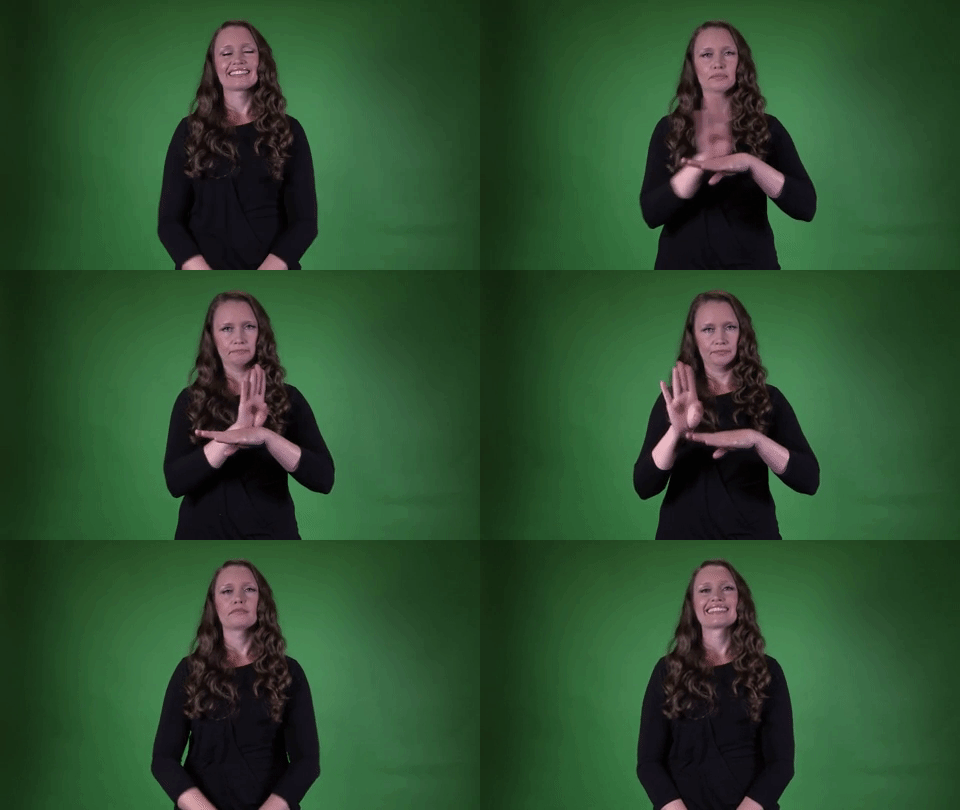
Definition: An occupation, profession, or trade.
Sign for BUSINESS in ASL

Practice Activities:
Practice with the sign for BUSINESS in ASL by first isolating it. Stand in front of a mirror and repeat the sign ten times while maintaining correct handshape and motion. Focus on keeping your non-dominant hand stationary, while your dominant hand moves in a small circular action on the side of your palm. This will help reinforce accuracy and muscle memory.
Next, begin using the sign for BUSINESS in ASL in simple sentence structures. For example, sign phrases like âMy business is successful,â âHe owns a small business,â or âI study business in school.â Practice saying these sentences while signing them to help reinforce language pairing. You can also record yourself and evaluate the clarity of your signs.
Work with a partner to take turns asking and answering questions using the sign for BUSINESS in ASL. Questions could include âDo you want to start a business?â or âIs this your business card?â This activity will help you get comfortable switching between receptive and expressive ASL.
Create a short story or role-play about someone starting a new business venture. Include related vocabulary such as WORK, MONEY, MEETING, and IDEA. Use expressive facial grammar and body language to bring the story to life while incorporating the sign for BUSINESS in ASL naturally and repeatedly throughout.
You can also find business-related articles or job advertisements and summarize them in ASL. As you interpret the content, find places to properly incorporate the sign for BUSINESS in ASL. This not only strengthens your signing skills but also builds your topic-specific vocabulary.
For quick practice, play a flashcard game using signs relating to business and include the sign for BUSINESS in ASL. Challenge yourself to sign short phrases using a combination of the cards. Keep the learning session active and immersive to retain better recall.
Cultural Context:
In the Deaf community, signs often carry more than just literal meaningsâthey reflect cultural values and shared experiences. The sign for BUSINESS in ASL is no exception. Understanding how to use this sign correctly requires some cultural awareness, as it connects with how work, professional identity, and social expectations are seen within the Deaf community.
The sign for BUSINESS in ASL involves a motion near the dominant handâs wrist, usually against a stationary non-dominant hand. This sign physically mimics action and movement, reflecting the energy and drive associated with work or professional life. In Deaf culture, this sign is often accompanied by facial expressions that emphasize seriousness or commitment, depending on the context.
When using the sign for BUSINESS in ASL, it’s important to consider who you’re talking to and what youâre referring to specifically. The concept of business isnât limited to corporate settings in ASLâit can mean self-employment, community work, or even running a home-based service. The versatility of this sign reflects how the Deaf community recognizes diverse forms of economic participation.
The sign for BUSINESS in ASL is commonly used in educational, social, and networking settings. Deaf professionals often use this sign when discussing their careers, projects, or goals. Using this sign accurately helps support clear and confident communication in the workplace and networking environments.
In certain situations, the sign for BUSINESS in ASL is paired with other signs to give more specific meaningâsuch as BUSINESS meeting, BUSINESS partner, or BUSINESS trip. Understanding how to combine signs properly helps convey more complex ideas in a natural and culturally appropriate way.
Deaf business owners and entrepreneurs have shaped how the sign for BUSINESS in ASL is understood today. Many in the community are proud of their work and contributions, and using this sign appropriately shows respect for their efforts and dedication. Cultural fluency goes beyond knowing the gestureâit involves knowing when and why to use it.
Social media has also played a role in spreading awareness of the sign for BUSINESS in ASL. Deaf influencers and creators often use this sign when sharing work-related updates or discussing freelance projects. This visibility has helped broaden the meaning and relevance of the sign across various platforms and age groups.
In formal presentations or interpreted events, the use of the sign for BUSINESS in ASL can set the tone for professional conversations. Interpreters and Deaf presenters often lean on this sign to keep a discussion concise yet impactful. It signals both the topic and the tone, making it an essential sign for clear and effective communication.
Understanding the sign
Extended Definition:
The sign for business in ASL is commonly used in conversations related to work, professions, and commerce. This sign helps convey topics around careers, meetings, entrepreneurship, and financial transactions among deaf and hard of hearing individuals. Understanding the sign for business in ASL is essential for communicating effectively in educational, corporate, and casual settings where professional topics come up.
To create the sign, your non-dominant hand stays flat, palm facing down to represent a surface or foundation. The dominant hand, shaped like the letter B, circles over the back of the non-dominant hand. This movement suggests activity or dynamic action, which reflects the nature of business environments. It’s important to maintain a steady and clear motion to keep the meaning accurate.
The sign for business in ASL can be paired with other signs to talk about business owners, small business, business trips, or business meetings. By combining it with facial expressions and context, users can express whether the topic relates to serious work, casual business interactions, or entrepreneurial efforts. This flexibility makes it a frequently used sign in both formal and informal conversations.
When used in education, this sign can help students describe their career goals or discuss majors like business administration or international business. In the workplace, the sign for business in ASL allows deaf employees to participate fully in conversations about performance, schedules, and projects. It serves as a powerful tool for inclusion and accessibility.
This sign is also useful in everyday interactions. People often discuss running errands for their business, attending online business meetings, or starting their own small business. Even in social media and vlogging, this ASL sign helps deaf creators connect with audiences while talking about their professional lives â .
The sign for business in ASL is not only practicalâitâs empowering. It lets users talk about careers, ambitions, and financial independence with accuracy and confidence. For those advancing in the professional world, knowing this sign establishes greater communication with peers, colleagues, and mentors.
Just like in spoken English, the word business can have multiple meanings depending on the context. The same applies in ASL. Depending on whatâs being discussed, the signerâs tone, facial expression, and additional signs used nearby will add depth and clarity to the message. This flexibility allows signers to adapt the sign for business in ASL to fit many different professional scenarios.
Learning and teaching this sign is crucial for making business-related content accessible to all. ASL teachers, interpreters, and content creators
Synonyms: company, firm, enterprise, corporation, establishment
Educational resources: Find related learning materials in our course bank!
Want more? Check out some of our popular learning activities on the homepage!
Need to look up a sign? Use our highly rated dictionary: https://aslinteractive.com/best-asl-dictionary/
Follow us on tiktok: https://www.tiktok.com/@aslinteractive. More social media links at the bottom of this page!
Long-tail Keywords: what is the sign for business in asl, how do you sign business in asl, business sign language translation
Categories:
tags: Business, Employment Status, Activities, Major Decisions, Everyday Activities
Parameters
*Handshape*:
The sign for BUSINESS in ASL uses a dominant hand in the letter “B” handshape. This handshape is formed by extending the fingers together straight while keeping the thumb across the palm. The non-dominant hand typically remains flat, palm down, in a stationary position while the “B” hand circles around the wrist.
Maintaining a clear “B” handshape is essential for clarity when signing the sign for BUSINESS in ASL . Make sure the fingers remain tight and straight to distinguish it from similar signs.
*Palm Orientation*:
In the sign for BUSINESS in ASL, the dominant hand forms the letter “B” and circles on the back of the non-dominant hand, which is held steady and flat. The palm of the non-dominant hand faces downward, while the dominant “B” handâs palm typically faces sideways or slightly inward as it makes small clockwise circles.
This specific palm orientation helps distinguish the sign for BUSINESS in ASL from similar motions used in other signs. Maintaining clear orientation ensures the sign is both accurate and visually distinct .
*Location*:
The sign for business in ASL is produced at the lower torso area, near the side of the body. The non-dominant hand stays stationary in a âSâ handshape, typically resting near the midsection or hip area.
The dominant hand, also in an open âBâ handshape, circles or brushes against the back of the stationary âSâ hand. This location helps visually ground the sign for business in ASL and emphasizes its connection with routine actions and professionalism. â
*Movement*:
The dominant hand is in the shape of the letter “B” and moves in small, controlled circles over the back of the stationary non-dominant hand, which forms the letter “S” and stays in front of the body. The circular motion of the “B” hand over the “S” hand represents activity or busyness.
The sign for BUSINESS in ASL emphasizes ongoing motion and professional engagement. This sign captures the essence of the term, making it easy to distinguish in conversation â .
*Non-Manual Signals*:
When performing the sign for BUSINESS in ASL, the facial expression is usually neutral or focused, depending on context. There is no exaggerated emotion unless the intensity of a business transaction is being emphasized.
Eyebrows remain in a neutral position, and lip movement may be minimal or show slight mouthing of the word. The overall body movement should be confident and purposeful, matching the formal tone associated with the sign for BUSINESS in ASL .
*Prosody, Dominant/Non-Dominant Hand*:
The sign for BUSINESS in ASL uses the dominant hand in the shape of the letter “B” while the non-dominant hand forms a flat base, palm down. The dominant “B” hand circles or brushes the back of the non-dominant hand in small movements. This sign visually conveys activity or movement, reflecting the dynamic nature of business. The sign for BUSINESS in ASL should be fluid and repetitive to emphasize ongoing work or operations.
Tips for Beginners:
When learning the sign for BUSINESS in ASL, focus on the dominant hand movement and avoid over-exaggeration. This sign uses the letter “B” handshape from the dominant hand rubbing in small circular motions on top of a stationary non-dominant “S” hand. Practicing in front of a mirror can help you ensure your handshapes are correct and your movement is smooth.
Timing is key in executing the sign for BUSINESS in ASL clearly. Beginners sometimes rush the circular motion or make it too large, distracting from the meaning. Keep your wrist relaxed and maintain a consistent tempo. Aim for smooth contact with the back of the fist rather than tapping or slapping, which can confuse the sign with others.
Be careful not to rotate your non-dominant hand or lift your elbow during the sign. The non-dominant hand acts as a base and should remain steady. Some learners make the mistake of having both hands move, which can alter the meaning or make the sign unclear.
Another tip is to practice in context. Use the sign for BUSINESS in ASL in short phrases or sentences, such as “BUSINESS meeting” or “own BUSINESS,” to reinforce its meaning through usage. This helps improve both fluency and comprehension.
Facial expression can subtly support meaning, especially when discussing owning a business or describing it as good or stressful. While the sign itself is neutral, context-based facial cues make your signing more natural.
Exposure is importantâwatch fluent signers using the sign for BUSINESS in ASL in Deaf community videos or vlogs. Seeing the sign used authentically sharpens your understanding and improves retention. Donât worry if it takes time; consistency and mindful repetition will help your muscle memory lock in the sign with precision and confidence.
Connections to Other topics:
The sign for BUSINESS in ASL connects to several key concepts in the language, including economy, work, and organization. It’s closely related to the sign for WORK, as both convey structured activity or effort, but BUSINESS often includes a more abstract layer of commercial intent or professional scope. Understanding this distinction helps clarify contexts such as corporate environments, entrepreneurship, and transactions.
This sign also ties into compound signs like BUSINESS-MEETING, where the sign for MEETING follows BUSINESS to indicate a professional gathering. Similarly, signs like BUSINESS-DEAL or BUSINESS-AGREEMENT build from the original sign to express more specific commercial or contractual scenarios. These compound forms provide clarity and context in conversations involving workplace activities or negotiations.
The sign for BUSINESS in ASL often appears in discussions on job roles, such as when explaining BUSINESS-MAN, BUSINESS-WOMAN, or BUSINESS-PERSON. These variations usually incorporate the sign for PERSON after BUSINESS, providing a human identifier. Understanding these variations aids in both receptivity and expressive fluency when discussing professions or workplace identity.
This sign also has relevance to financial and academic settings. For instance, using it in the phrase BUSINESS-SCHOOL shows how ASL adapts concepts to educational contexts. Learners will notice that this versatility allows the sign to interact with many topics such as accounting, entrepreneurship, and marketing.
ASL learners will find the sign for BUSINESS in ASL is also useful when building narratives about daily routines, career aspirations, or economic issues. It can be paired with store-related signs, fingerspelled brand names, or signs for TRADE and SALES to deepen context. This lexical flexibility makes it a high-frequency sign in both everyday and specialized vocabulary.
Finally, when exploring cultural relevance, the sign for BUSINESS in ASL introduces learners to how Deaf professionals discuss empowerment, advocacy, and ownership in business spaces. It encourages broader conversations about representation and inclusion in the business world. â
Summary:
The sign for BUSINESS in ASL blends both specific handshapes and subtle body movements to convey the idea of professional or commercial activity. This sign is not only linguistic but also emblematic of Deaf community values around self-reliance and professional identity.
To perform the sign for BUSINESS in ASL, the dominant hand uses the âBâ handshape, made by extending all four fingers together with the thumb crossed over the palm. The non-dominant hand stays flat in front of the body, palm facing down. The dominant âBâ hand circles over the back of the non-dominant hand several times in a horizontal motion, resembling movement or exchange.
The circling motion relates metaphorically to the rhythm and ongoing nature of work or commerce. The âBâ hand is symbolic as a classifier, representing individual or grouped entities moving within an economic framework. It implies activity, management, fluidity, and movement, which aligns with ideas of business transactions and operations.
ASL often uses classifiers and visually motivated structures to represent abstract ideas like BUSINESS. The placement of the B hand atop the still base hand mimics the layered infrastructure of commerceâfoundations of finance, trade, and administration. This visualization enables ASL users to see the concept as much as express it.
Context is essential in distinguishing the meaning of BUSINESS from similar nouns like WORK or JOB. While they all share connections in the professional sphere, each has its own sign. For example, WORK emphasizes the act of labor or physical activity and involves tapping an âSâ handshape over a similar non-dominant hand. This differs semantically from BUSINESS, which reflects structured or organizational work.
The sign for BUSINESS in ASL has evolved with time to reflect modern usage. As the Deaf community has expanded its participation in entrepreneurship and advocacy, the signâs role in conversations has grown. It now conveys nuances ranging from professionalism to corporate culture, and even personal branding in the digital era.
In ASL grammar, the sign for BUSINESS can function as a noun but also appears within compound structures or as an element of classifier predicates. It can participate in topics or comments within topic-comment sentence structures, depending on contextual relevance. This supports ASLâs sophisticated use of spatial grammar and facial expressions.
ASL creates grammar through spatial relationships and non-manual markers. With BUSINESS, raising eyebrows during the sign can denote a yes/no question regarding someoneâs professional occupation. Alternatively, paired with a WH-face, it might form a question like âWhat type of business do you run?â
One fascinating aspect of the sign for BUSINESS in ASL is how it connects with nouns like COMPANY, CORPORATION, or INDUSTRY, which also use the âCâ or âIâ handshapes to represent structural aspects of enterprise. This visual harmony shows how many commerce-related terms interlock conceptually and physically in ASL.
Deaf-owned businesses have historically served not just commercial roles but also as cultural centers in Deaf spaces. Within this context, the sign for BUSINESS is more than vocabularyâitâs part of a proud expression of Deaf leadership. It belongs deeply to the fabric of cultural visibility and empowerment.
This sign is also often paired with location-specific lexicon. For instance, signs like BUSINESS-MEETING or BUSINESS-TRIP can be compounded naturally, using spatial organization to show meetings unfolding or the directional path of company travel. In this way, ASL remains expressive and efficient while maintaining grammatical precision.
Applied linguistics provides insight into the morphosyntactic strategies at play in ASL. In the sign for BUSINESS, there are embedded metaphors where motion equates to functionalityâan idea widely supported in cognitive linguistics. It aligns with George Lakoffâs theory of conceptual metaphor, where movement often maps onto processes or systemic functions.
In conversational ASL, the sign for BUSINESS may surface in both casual and formal registers. While used professionally, it can also describe being busy, immersed in work, or preoccupied. Depending on facial grammar and emphasis, users can slide between interpretations with fluid code-switching.
Children learning ASL often first encounter the term BUSINESS in academic contextsâsuch as vocational programs or community workshops. Educators may use visual aids or mockplay like âopen your own businessâ scenarios to connect the sign to real-world aspirations. Early exposure helps embed both vocabulary and broader career concept awareness.
Technology has influenced how we interpret BUSINESS visually. With the rise of online platforms, signs have adapted in usage and frequency. When speaking of online businesses or e-commerce, the sign for BUSINESS often integrates smoothly into compound signs like COMPUTER-BUSINESS or INTERNET-BUSINESS, highlighting ASLâs adaptability and relevance.
Culturally, Deaf entrepreneurs have used signage, logos, and targeted ASL content to cater to Deaf consumers. The sign for BUSINESS in ASL thus also symbolizes inclusivity. It creates space where Deaf people can navigate, control, and thrive in economies both online and offline.
Regional and generational variations may result in subtle differences
Want more? Check out some of our popular learning activities!
ASL Interactive Resources
ASLInteractive YouTube Channel
Follow us on tiktok: @aslinteractive.com
Follow us on Instagram: aslinteractive
Facebook page: aslinteractive
Facebook group: aslinteractive
LInkedIn: ASL Interactive LLC
Twitter: @ASL_interactive
*Some information on this page is AI-generated. AI can make mistakes. Please check the information.


Responses