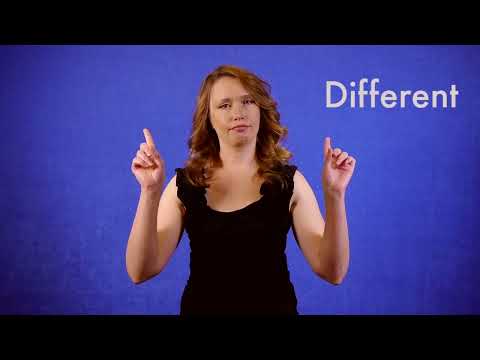
Definition: Used to introduce an exception.
Sign for BUT in ASL

Practice Activities:
To practice the sign for BUT in ASL, start by isolating the sign and repeating it in front of a mirror. Focus on the handshape and movement: use both index fingers starting together and then move them apart horizontally. Repeat this motion slowly and then gradually increase speed while maintaining clarity.
Next, create short sentences using the sign for BUT in ASL. Practice signing, âI like pizza BUT not cheeseâ or âShe is friendly BUT shy.â Sign each sentence slowly, paying attention to your facial expressions, which should show contrast or emphasis when using BUT. Use a list of opposites or contrasting ideas and create your own contrasting sentences to reinforce usage.
For storytelling practice, create a short story that involves two conflicting ideas. For example, tell a story about someone who wants to go to the beach BUT itâs raining. This lets you practice contextual use of BUT and helps improve fluency in transitions between thoughts. Record yourself and watch your performance to improve clarity and natural flow.
Use partner activities to enhance understanding. One learner can sign a sentence like âI wanted to sleep in BUTâŠâ and the partner completes it with something like âI had to go to work.â Switch roles to build spontaneity and comprehension. These exercises are great for real-time responses and understanding the purpose of BUT in communication.
Another helpful activity is signing a list of personal preferences using BUT to show contrast. For instance, sign âI love coffee BUT not teaâ or âI like dogs BUT Iâm allergic.â Add expressive facial grammar for natural signing rhythm.
Practicing the sign for BUT in ASL in various contexts will strengthen your ability to identify and express contrast, a common need in both casual and formal conversations.
Cultural Context:
In American Sign Language (ASL), the sign for BUT in ASL carries more than just grammatical meaning. It’s a visual representation that distinguishes contrasting ideas or statements, making it essential for clear and effective communication in Deaf culture.
The sign for BUT in ASL is commonly used when separating two related yet opposing thoughts. It adds nuance and helps avoid misunderstandings by showing contrast without needing extra explanation. In Deaf conversations, clear contrasts are crucial, and this sign helps promote direct expression.
Understanding the cultural context of the sign for BUT in ASL goes beyond just copying the handshape. Itâs about timing, facial expressions, and context. Deaf and signing communities rely heavily on non-manual markers, and this simple sign can express a wide range of feelings and tones depending on its use.
Unlike in English, where the word “but” can subtly shift a sentence’s direction, in ASL the sign for BUT in ASL creates a clear boundary between two ideas. Itâs clear, intentional, and often accompanied by a slight pause or head movement to mark the contrast visually.
In the classroom, teachers use the sign for BUT in ASL to help students understand opposing concepts or rules. It’s also used in storytelling and casual conversations to shift viewpoints or narrative directions. Stories in ASL use a lot of space and movement, and contrast plays an important role in keeping audiences engaged.
In signed storytelling, for example, the sign for BUT in ASL can signal a twist or surprise, grabbing attention and increasing emotional impact. This allows for smoother transitions between positive and negative events or attitudes, enhancing the storyâs depth. Cultural appreciation of this narrative tool strengthens community connection.
Among Deaf and hard-of-hearing individuals, the ability to highlight contrast quickly and clearly is essential. Thatâs why the sign for BUT in ASL is learned early in ASL education. Itâs one of those foundational signs that support both grammatical structure and emotional expression.
In social interactions, this sign helps clarify misunderstandings or correct assumptions. For instance, saying “I like you BUT I canât go” uses the sign for BUT in ASL to respectfully disagree or shift a conversation without causing offense. This adds to the politeness and emotional clarity often seen in Deaf communication styles.
Facial expression is vital when using the sign for BUT in ASL. Raising the eyebrows, widening the eyes, or pausing briefly before signing adds depth to the contrast being made. This non-verbal communication is just as important as the sign itself and
Extended Definition:
The sign for BUT in ASL is a common and essential part of everyday American Sign Language conversations. It is used to introduce a contrast or exception, much like its English counterpart. Understanding this sign helps ASL users express more complex thoughts with clarity and nuance.
To produce the sign for BUT in ASL, both index fingers are extended and held parallel in front of the chest, palms facing in. Then, the fingers move apart in opposite directions in a short slicing motion. This movement represents the idea of separating two ideas or clauses, similar to how “but” works in English.
In conversations, the sign for BUT in ASL is often used to show contrast between two related ideas. For example, someone might sign âI like ice creamâ followed by the sign for BUT, then continue with âI canât eat it every day.â This helps signers show differences or opposing thoughts clearly and naturally.
Context is very important when using the sign for BUT. Facial expressions and body language play a major role in delivering the intended meaning. A slight head tilt or raised eyebrows can emphasize the contrast or show added emotion, like surprise or disappointment.
ASL does not always follow English grammar, but the need to connect and contrast thoughts still exists. The sign for BUT in ASL allows for this kind of connection. It functions much like a transitional word would in written or spoken English, helping to guide the flow of a sentence or narrative.
Interestingly, this sign is similar to the ASL sign for DIFFERENT, but users can tell them apart by context and subtle motion differences. When learning the sign for BUT in ASL, itâs helpful to practice both signs to become comfortable distinguishing them in conversation.
Children and beginner signers often learn this sign early in their ASL journey because it helps them express conflicting ideas and feelings. This can include statements like âI want to go outside, BUT itâs raining,â or âShe is my friend, BUT we had an argument.â It enables richer, more expressive communication in both casual and formal settings.
The sign for BUT in ASL appears frequently in dialogues, storytelling, and classroom settings. It acts as a bridge between opposing ideas and helps structure thought processes visually. Its simple movement makes it accessible, but its meaning is powerful and essential in linguistic development.
When looking for the sign for BUT in ASL online, it’s useful to find video demonstrations to observe the handshape and motion. Seeing it in context enriches comprehension and shows how it integrates with
Synonyms: However, yet, nevertheless, still, though
Educational resources: Find related learning materials in our course bank!
Want more? Check out some of our popular learning activities on the homepage!
Need to look up a sign? Use our highly rated dictionary: https://aslinteractive.com/best-asl-dictionary/
Follow us on tiktok: https://www.tiktok.com/@aslinteractive. More social media links at the bottom of this page!
Long-tail Keywords: what is the sign for but in asl, how do you sign but in asl, asl sign for but
Categories:
tags: language learning, vocabulary, basic grammar, gestures, negation
Parameters
*Handshape*:
The handshape used in the sign for BUT in ASL involves both hands forming 1-handshapes, where the index fingers are extended while the remaining fingers are curled into the palms. The thumbs rest gently alongside the fingers without sticking out.
To make the sign for BUT in ASL, bring both index fingers together, pointing straight out, then smoothly pull them apart sideways in opposite directions while keeping the hands level. This movement suggests a contrast or exception, which aligns with the meaning of the sign.
*Palm Orientation*:
For the sign for BUT in ASL, both index fingers start extended and pointing forward, with palms facing inward toward the body. The hands are held in front of the chest, and as the sign is made, the fingers move apart horizontally, maintaining the same palm orientation throughout the motion.
This consistent inward palm orientation emphasizes the contrasting nature expressed in the sign for BUT in ASL. The movement and positioning help clearly convey distinction or exception in conversation.
*Location*:
The sign for BUT in ASL is located in the neutral space in front of the chest. Both hands start together with index fingers extended and pointing forward, then move apart in opposite directions horizontally. This placement allows for clear visibility and ensures that the sign remains centered. The location of the sign for BUT in ASL keeps the meaning distinct and easy to identify in conversational flow.
*Movement*:
To perform the sign for BUT in ASL, start by holding both index fingers upright in front of your chest, close together, palms facing in. Move both hands apart to the sides in a short, simultaneous movementâalmost like you’re creating a division between ideas. This sign for BUT in ASL visually expresses contrast or exception, making it ideal for separating opposing thoughts or concepts in conversation. â â
*Non-Manual Signals*:
Eyebrows are typically neutral or slightly furrowed when using the sign for BUT in ASL, as it often introduces a contrast or exception in a sentence. The head may tilt slightly to one side to signal the shift in thought or opposition.
Eye contact should remain steady with the listener, showing engagement and clarity. A slight pause or pursed lips can naturally accompany the sign for BUT in ASL to emphasize contradiction or contrast.
*Prosody, Dominant/Non-Dominant Hand*:
The sign for BUT in ASL uses both hands. Start with the index fingers of both the dominant and non-dominant hands extended and touching at the tips in front of the chest, palms facing in slightly. Move the hands apart horizontally at the same time, creating a small separating motion that mimics a contrast or exception.
In the sign for BUT in ASL, both hands play equal roles and move symmetrically. This prosodic feature highlights the duality or contrast conveyed by the word “but,” marking a clear boundary between two ideas in conversation.
Tips for Beginners:
When learning the sign for BUT in ASL, focus on maintaining clear finger separation and clean motion. This sign is made by bringing both index fingers up in front of you, palms facing each other, then crossing them and pulling them apart in opposite directions. It’s crucial that your fingers stay straight and move smoothlyâsloppy motion can lead to confusion with signs like different or divide.
Begin with slow, deliberate practice in front of a mirror. This will help you watch your finger position and ensure that your hands aren’t drooping or tilting. A mirror can give real-time feedback, allowing you to compare your sign against video tutorials or instructorsâ demonstrations of the sign for BUT in ASL.
One common beginner mistake is not fully separating the fingers at the end of the sign. If your movement is too small or your fingers remain close together, it can look like another sign entirely. Exaggerating the motion slightly during early practice will help engrain the correct form. Just be careful not to make it overly dramatic or stiff.
Speed can be adjusted gradually. If you focus on getting the motion right first, fluidity and natural speed will come with repetition. Signing too quickly before developing muscle memory can cause miscommunication. Remember: clarity is always better than speed for learners.
Practice this sign in full sentences to understand its placement and grammatical function. The sign for BUT in ASL is often used to express contrast, so use it in real context like âI want to go, BUT Iâm tired.â This improves retention by linking the sign with meaning.
Watch native signers on social media or learning platforms demonstrate the sign in conversation. Pay attention to facial expressionsâthey often emphasize the contrast implied by the sign for BUT in ASL and help show how to deliver it with proper ASL grammar and emotion.
sign for BUT in ASL, sign for but ASL meaning, how to sign but in American Sign Language, meaning of BUT in ASL, ASL contrast conjunction BUT
Connections to Other topics:
The sign for BUT in ASL is closely related to contrastive structure, a foundational grammar principle in ASL. It is often used when setting up comparisons or stating exceptions, making it integral in sharing opinions, clarifying misunderstandings, or expressing nuanced ideas. This relational function links the sign to other conjunction signs like HOWEVER, ALTHOUGH, and EXCEPT.
In sentence structure, the sign for BUT in ASL frequently appears in compound statements and is essential in narrative transitions. For example, a signer might say âI LIKE PIZZA BUT DONâT LIKE CHEESEâ using clear topicalization and directional signing. These nuanced expressions allow for richer storytelling and logical flow in ASL discourse.
The sign also appears in modified forms within larger expressions or idiomatic phrases. For instance, signs like “NOT-BUT” or âONLY-BUTâ may be adapted in context to emphasize limitation or exclusivity. These compound constructions are particularly helpful for learners trying to master how emphasis shifts subtly during signing.
Semantically, the sign for BUT in ASL helps establish opposition or contrast, linking it to facial expressions which play a vital grammatical role. Raised eyebrows or slight head tilts often accompany it, reinforcing its function within a sentence. These facial cues connect the sign to broader ASL topics like nonmanual markers and grammatical facial expressions.
The signâs movement and palm orientation are similar to EXCUSE or DIFFERENT, emphasizing the importance of motion and contrast in related signs. These similarities build muscle memory and shape recognition, which help learners differentiate and internalize meaning through context and form.
Understanding the sign for BUT in ASL helps reinforce critical thinking and logical sequencing within ASL conversations. It provides learners with tools to debate, counter, or reposition points, enriching deeper cognitive engagement while signing.
Summary:
The sign for BUT in ASL is a key element of American Sign Language grammar. It is used to show contrast, opposition, or contradiction between two ideas or clauses. In ASL, conjunctions like “but” are not only functional; they also play a vital role in sentence structure and clarity.
To produce the sign for BUT in ASL, begin with both index fingers extended, palms facing in toward your body. Bring the fingers together as if they are touching or crossing, then move them apart horizontally in opposite directions. The movement should be smooth and slightly sweeping to show contrast.
This sign may appear simple, but context and tone play a role in how it’s perceived. The force or angle of the movement can subtly alter the meaningâmore exaggerated motions can suggest a stronger contradiction or surprise.
The sign for BUT in ASL is used across all registers of communication, whether in casual conversation or formal discourse. It’s frequently seen in storytelling, debates, and academic discussions. The ability to use this sign fluently supports robust expressive skills in ASL.
Sometimes confused with the sign for DIFFERENT, both signs start in a similar manner with extended index fingers. However, DIFFERENT ends with the fingers crossing and separating diagonally, typically showing two distinct, unrelated items. BUT often signals contrast within a single narrative line of thought.
The sign for BUT in ASL often functions in subordinate clause structures, typically appearing between independent clauses. For example, “I like pizza BUT I don’t eat meat” shows how contrasting ideas can be joined fluidly in ASL using this sign.
When learning ASL grammar, grasping connector signs like BUT is essential. ASL does not always follow English word order because it is a visual-spatial language. So the sign for BUT in ASL helps situate concepts in contrast visually and spatially, bypassing English syntax.
Understanding the sign for BUT in ASL also enriches comprehension of negation and contradiction. It ties into broader linguistic themes like pragmaticsâthe way we use context and shared knowledge to enhance meaning.
In bilingual ASL-English environments, the sign for BUT in ASL becomes a bridge between visual grammar and spoken logic structures. This bridging allows more nuanced interpretations, especially for Deaf and hard-of-hearing individuals navigating both worlds.
The cultural importance of the sign for BUT in ASL cannot be overstated. Like many signs, it’s used naturally within Deaf culture to express values like honesty, directness, and emotional contrast. It’s a compact way to signal that more is coming in a conversationâsomething that contradicts or clarifies.
Advanced signers often pair facial expressions with the sign for BUT in ASL. A raised eyebrow or a shake of the head enhances the contrast and delivers more meaning than the manual sign alone. This multimodal delivery is crucial in ASL communication.
Students often encounter BUT early in ASL courses because it teaches the conceptual nature of the language. Rather than translating word-for-word from English, learners must grasp the intent and flow of ideas in visual space.
In signed narratives, performers use signs like BUT to create tension or suspense. It helps keep viewers engaged because the contrast signals narrative development. This makes it useful in Deaf theatre and poetry.
Children acquiring ASL as a first language use signs like BUT in conversational turn-taking to show differences in opinion or correct misunderstandings. Its early acquisition reflects its utility and frequency in everyday use.
The sign for BUT in ASL is just one example of how conjunctions operate differently in visual languages. In spoken English, tone and timing deliver contrast; in ASL, physical space and movement take on that duty. This difference has fascinated linguists for years.
The grammatical role of BUT links closely with the use of classifiers and directional verbs. It prepares the visual pathway for clauses that follow, guiding the viewer’s attention to contrast or exception. This makes clause structure visibly cohesive.
In applied linguistics, studying how signs like BUT function informs strategies for bilingual education and interpretation. Knowing how native ASL users frame contrast improves interpretation quality and education materials.
When teaching the sign for BUT in ASL to students from spoken language backgrounds, instructors often emphasize visual markers like hand shape, position, and movement over vocabulary memorization. This shift helps learners internalize ASL’s visual grammar more deeply.
In Deaf literature, the sign for BUT helps highlight moral or emotional turning points. For instance, in personal stories or life testimony narratives, BUT transitions the story from a neutral event to an impactful revelation.
From a sociolinguistic lens, usage of the sign for BUT in ASL can show regional or community-based variations. Some signers may exaggerate the motion or combine it with mouthing to intensify the contrast.
Linguists studying ASL have noted that signs like BUT help reveal how ASL manages clause cohesion differently than linear spoken languages. Instead of relying on punctuation or voice modulation, ASL relies on timing, facial expressions, and spatial separation.
In everyday Deaf community interactions, the
Want more? Check out some of our popular learning activities!
ASL Interactive Resources
ASLInteractive YouTube Channel
Follow us on tiktok: @aslinteractive.com
Follow us on Instagram: aslinteractive
Facebook page: aslinteractive
Facebook group: aslinteractive
LInkedIn: ASL Interactive LLC
Twitter: @ASL_interactive
*Some information on this page is AI-generated. AI can make mistakes. Please check the information.


Responses