
Definition: Cake: A sweet, baked dessert made from flour, sugar, eggs, and other ingredients, often layered and frosted for celebrations.
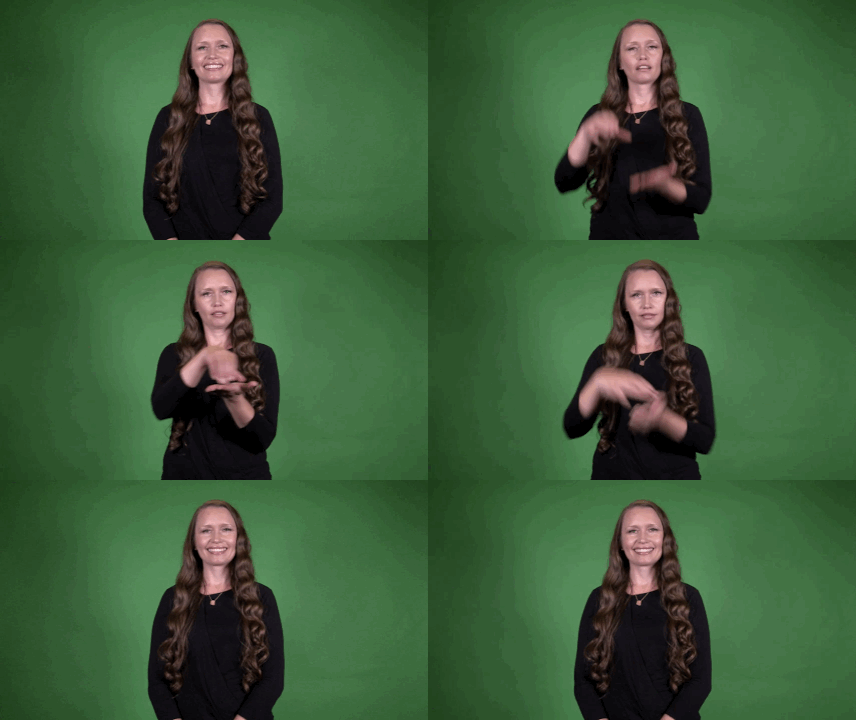
Sign for CAKE 2 in ASL

Practice Activities:
To start practicing the sign for CAKE 2 in ASL, stand in front of a mirror and repeat the sign slowly five to ten times. Focus on your handshape, movement, and facial expression. This version may include a different motion or hand position than other variations, so careful repetition helps build muscle memory.
After you’re comfortable signing it in isolation, try signing short phrases like “chocolate cake,” “birthday cake,” or “bake a cake.” This will help you transition smoothly from single signs to fluid expression. Repeat each phrase several times, paying attention to pacing and clarity.
Next, incorporate the sign for CAKE 2 in ASL into full sentences. Examples include “I made a cake,” “She wants cake,” or “They ate strawberry cake.” Say the full sentence in English, visualize the meaning, then sign it, making sure your facial expressions match the emotion. Practice each sentence a few times, switching pronouns or flavors to vary the content.
Use storytelling to reinforce the sign. Create a short story about a birthday party, a baking contest, or a bakery. Include details and sign it to a mirror or record yourself. Watch the playback to self-correct and refine your performance.
With a partner, play sign-and-guess. One person signs a phrase using the sign for CAKE 2 in ASL and the other guesses the sentence or context. This improves comprehension and expressive skills by adding spontaneity to the practice.
For receptive skills, watch videos that use the sign for CAKE 2 in ASL and try to identify it within the broader conversation. Write down the sentences you see and try to sign them yourself.
Finish your practice by signing a recipe step-by-step, pretend you’re showing someone how to make a cake using ASL. This immersive approach strengthens vocabulary retention and storytelling fluency.
Cultural Context:
In American Sign Language, cultural context is essential to truly understanding why certain signs are used and how they are interpreted within the Deaf community. The sign for CAKE 2 in ASL is one variation among multiple signs used by deaf signers to describe the concept of “cake.” Depending on region, age, and community, the sign for CAKE 2 in ASL may be preferred, especially during casual events or birthday parties .
Food signs in ASL often carry emotional or cultural associations. Cake, for instance, is not just a dessert—it’s often tied to significant life events like birthdays, weddings, or celebrations. Using the sign for CAKE 2 in ASL while talking about these events brings a shared cultural awareness that deepens communication between Deaf and hearing individuals or within the Deaf community itself.
The ASL sign for CAKE 2 can also differ from other food-related signs because of contextual use. For example, someone may choose this specific form when discussing preferences between types of cake or expressing excitement during storytelling. The sign for CAKE 2 in ASL is expressive, and expressive storytelling is a key part of Deaf culture, often used to illustrate vivid mental imagery and emotional experiences.
Additionally, the use of the sign for CAKE 2 in ASL may be influenced by regional dialects or family habits, much like in spoken language. A person growing up in a Deaf household might use the sign they saw most often from family or educators, and this version becomes their default. Because of this, the sign for CAKE 2 in ASL might resonate differently among signers depending on their specific background.
ASL is not a universal language—signs can have variations across states or even within local Deaf communities. That’s why understanding the sign for CAKE 2 in ASL means more than just copying handshapes; it involves recognizing the layers of cultural meaning and representation attached to it. This creates a richer, more meaningful form of communication .
It’s also common to see the sign for CAKE 2 in ASL used in Deaf storytelling events, including visual poetry and folktales that incorporate food like cake to symbolize joy or abundance. These events are not only entertaining but educative, showing how shared meanings develop around signs over time. Within those visual narratives, signs like the sign for CAKE 2 in ASL take on emotional tones that connect the audience through shared cultural experiences.
Teachers, parents, and interpreters benefit from knowing
Extended Definition:
The sign for cake 2 in ASL refers to a specific variation of the American Sign Language expression for the word cake. In this version, the sign incorporates subtle differences in handshape or motion, which can vary depending on the signer’s region, age, or specific context. Understanding these variations helps you recognize and use ASL fluently, especially when communicating with different Deaf communities.
To perform the sign for cake 2 in ASL, begin with your non-dominant hand flat, palm up to represent a plate or surface. Then use your dominant hand in a claw shape and tap it lightly down onto the palm of your base hand. Unlike the more traditional version, the motion here might be slightly more exaggerated or repeated for emphasis depending on context or individual preference.
Some signers may add a small circular movement with the dominant hand before tapping to convey the idea of decorative frosting or layers. This variation, as seen in the sign for cake 2 in ASL, enhances the visual description of a cake and offers more expressive detail. It’s especially common in casual conversations where visual storytelling plays an important role.
This version is also frequently used in ASL storytelling or children’s narratives to add flair and clarity. Because ASL is a visual and dynamic language, the way a sign is presented often depends on the context in which it’s used. That’s why the sign for cake 2 in ASL is valuable to learn alongside the basic version — it gives the signer more flexibility.
In Deaf culture, food signs like cake are used frequently in daily conversation, whether discussing birthdays, celebrations, or recipes. This makes it essential for learners to recognize different versions like the sign for cake 2 in ASL. Being able to understand multiple variations increases comprehension in real-life interactions and helps avoid confusion.
Learning this variation can also help you better understand regional dialects within ASL. Just as spoken languages have regional accents, ASL has regional signs, and the sign for cake 2 in ASL is a great example. It shows how sign language can evolve through different users and communities.
When practicing this sign, keep your movements fluid but controlled and pay attention to facial expressions, which are a key part of ASL grammar. Adding a look of celebration or happiness when signing cake 2 can communicate more than the word alone. The facial expression can indicate if you’re talking about a birthday cake, wedding cake, or even just exciting dessert plans.
Videos and visual resources are the best way to learn
Synonyms: dessert, pastry, baked good, confection, patisserie
Educational resources: Find related learning materials in our course bank!
Want more? Check out some of our popular learning activities on the homepage!
Need to look up a sign? Use our highly rated dictionary: https://aslinteractive.com/best-asl-dictionary/
Follow us on tiktok: https://www.tiktok.com/@aslinteractive. More social media links at the bottom of this page!
Long-tail Keywords: what is the sign for cake in ASL, how do you sign cake in ASL, ASL sign for cake
Categories:
tags: Birthday, Occasions, Celebrations, Food, Desserts
Parameters
*Handshape*:
The handshape for the sign for CAKE 2 in ASL uses a curved dominant hand, shaped as if holding a small, invisible ball. The fingertips are slightly spread and point downward, while the non-dominant hand stays flat, palm-up, representing a plate.
This curved hand represents the frosting or top of a cake being placed on the surface. The sign for CAKE 2 in ASL emphasizes the visual layering of a dessert, making it easy to associate with the real object .
*Palm Orientation*:
For the sign for CAKE 2 in ASL, the dominant hand forms a bent handshape with the palm facing down, while the non-dominant hand remains flat with the palm facing up. The dominant hand lightly taps the fingertips into the center of the non-dominant hand, simulating placing a cake on a platter. This palm orientation helps distinguish the sign for CAKE 2 in ASL from similar food-related signs .
*Location*:
The sign for CAKE 2 in ASL is typically produced in the neutral space directly in front of the torso, around chest level. Both hands move slightly over a flat, upward-facing non-dominant hand, indicating the shape or presence of a cake.
This central location helps clearly depict the concept for the sign for CAKE 2 in ASL and keeps it easy to see and replicate. The placement allows for natural visibility and smooth motion when forming the sign.
*Movement*:
The sign for CAKE 2 in ASL involves a gentle upward movement representing the placement of a cake. Start with your non-dominant hand flat, palm up to represent a surface or plate. With your dominant hand slightly curved like the shape of a cake, move it downward and rest it on the non-dominant palm.
This motion demonstrates the idea of setting a cake down, and helps convey the concept clearly. The sign for CAKE 2 in ASL may include a slight tapping motion to emphasize placement.
*Non-Manual Signals*:
When demonstrating the sign for CAKE 2 in ASL, use a soft, pleasant facial expression, as the concept is typically associated with something enjoyable or celebratory . Slightly raise your eyebrows and keep your gaze focused where the sign takes place, showing interest or delight in the subject of cake.
Avoid intense or exaggerated expressions, as they could change the meaning. The sign for CAKE 2 in ASL benefits from cheerful non-manual signals to stay contextually accurate.
*Prosody, Dominant/Non-Dominant Hand*:
The sign for CAKE 2 in ASL uses the dominant hand in a curved “C” shape while the non-dominant hand remains flat, palm-up like a plate. The dominant hand moves downward and slightly bounces on the non-dominant hand to show the idea of placing a soft item like cake .
When signing the sign for CAKE 2 in ASL, the movement is gentle and emphasizes the texture of a cake, adding expressiveness. This sign is typically performed in the signing space at chest level for clarity.
Tips for Beginners:
When learning the sign for CAKE 2 in ASL, it’s important to pay close attention to handshape and location. This version typically uses your dominant hand, shaped like a bent “C”, as if scooping something soft, and then tapping gently on the back of your non-dominant palm facing upward. Be sure to keep the motion smooth and avoid hitting the hand too forcefully.
One common mistake beginners make with the sign for CAKE 2 in ASL is having a stiff or awkward wrist motion. Practice keeping your wrist relaxed and your movement fluid. Face a mirror to check that the curvature of your “C” shape is visible to your conversational partner and make sure both hands are aligned so the contact is clear, not off-center.
Clarity in finger positioning goes a long way in making your sign easy to understand. Sometimes, the sign for CAKE 2 in ASL can be mistaken for similar food signs if your “C” shape is too loose or held at the wrong angle. Keep your bend consistent and touch down lightly to convey the texture of cake rather than a firm or flat object.
Timing matters a lot in ASL, so avoid rushing the sign. Take your time practicing the motion slowly so the visual concept is clear and well-paced. Repetition at a comfy speed will train your muscle memory to produce the sign naturally.
Also, context helps reinforce the sign for CAKE 2 in ASL. Use it while discussing birthdays, celebrations, or food contexts to anchor your understanding. Recording yourself or asking feedback from fluent signers can also refine your expression. Always practice in a natural signing space at shoulder level to maintain visual clarity. With patience and attention to detail, you’ll master this expressive and visual sign confidently.
Connections to Other topics:
The sign for CAKE 2 in ASL is closely linked to other food-related signs, especially baked goods like COOKIE, PIE, and BREAD. These signs often include similar handshapes and motion patterns that mimic the way such items are handled or served, helping learners build associations between different food categories in ASL. By comparing the motions, such as the slicing or shaping gestures, students can better understand visual-spatial grammar in food signs.
This sign also connects to signing within social contexts like BIRTHDAY, CELEBRATION, or PARTY. When used in phrases like “birthday cake” or “wedding cake,” the sign for CAKE 2 in ASL becomes part of compound or conceptually-rich sign groupings. In ASL, these phrases are often structured in topic-comment format, with context determining whether to rely on classifiers, modified movement, or facial expressions to emphasize meaning.
Another important connection is with classifier use. The sign for CAKE 2 in ASL can be supplemented by classifiers to describe size, slice, number of layers, or how the cake is being cut or served. This enhances expressive detail and gives the signer greater control over the narrative. For example, to indicate a multi-layered cake, one might follow up with a descriptive classifier that illustrates height or layers.
Learners can connect this sign to the broader topic of dining and hospitality. It frequently appears alongside signs like DESSERT, EAT, SERVE, and GIFT, especially in contexts like holidays or gatherings. Understanding how the sign for CAKE 2 in ASL fits into these larger cultural or situational conversations reinforces both fluency and cultural awareness.
Finally, it can be instructive to compare this specific variant of the CAKE sign to other versions across regional or generational uses. The differences can reflect personal style or regional influence, making it a great touchpoint for discussions on variation and adaptation within American Sign Language.
Summary:
The sign for CAKE 2 in ASL is a variation used to emphasize a certain stylistic or regional preference. This version typically involves using one hand as the base, representing a plate or table, while the dominant hand forms a bent “C” shape that taps the top of the base hand. This movement creates a three-dimensional feel, mimicking the shape and placement of a round cake.
In terms of visual representation, the dominant hand curves slightly, denoting the layered or rounded form of a cake. Some signers may gently bounce the hand once or twice, which adds a playful or celebratory quality. The sign’s motion and modified handshape make it visually distinct from its standard variant.
The concept behind the sign for CAKE 2 in ASL connects deeply with the idea of celebration and community. Cake frequently appears in social events like birthdays, weddings, and graduations. Therefore, this sign can carry emotional nuance, hinting at warmth, festivity, or indulgence.
Within Deaf culture, the visual imagery in signs like this plays an essential role in enhancing meaning and emotional tone. Playing with form and spatial movement allows signers to make concepts more lively and tangible. Signs like the sign for CAKE 2 in ASL often become staples in storytelling or shared narratives.
Grammatically, it functions as a noun and fits into ASL sentence structure without modification. Classifiers or topical markers may be used around the sign depending on context. For example, adding signs like “BAKE” or “EAT” helps situate CAKE in a timeline or process.
Linguistically, this version demonstrates the dynamic way that ASL adapts to societal and cultural changes. Variants like the sign for CAKE 2 in ASL reflect a broader spectrum of expression in signed language. They showcase how meaning can be modulated through subtle hand adjustments and placement.
In applied linguistics, one key theme is how gestures mirror conceptual metaphors. The upward arc and tapping seen in this sign evoke the image of placing or presenting something special. This type of iconicity—in which form hints at function or shape—is a core trait of sign languages worldwide.
The sign for CAKE 2 in ASL may reflect regional or generational variation. Certain Deaf communities might favor this sign over the more flattened standard version, especially in areas where emphasis on tactile or layered representation is culturally significant. This adds richness to the diversity within ASL use.
Educators often introduce both the standard and alternative signs for concepts like cake, encouraging learners to recognize variation as a normal part of language. In Deaf education, this sign can be used to highlight how ASL supports creativity and visual thinking. Students are often delighted to see signs that directly resemble the things they describe.
The bent-C handshape is typically used for round, thick objects, and here perfectly embodies a frosted or layered cake. That handshape appears in many food-related signs, connecting it to a larger semantic field within the language. The underlying cognitive mapping between handshape and perceived object categories reinforces memory and learning.
When learners encounter the sign for CAKE 2 in ASL, they are also exposed to how culture and occasion can influence sign formation. This learning moment can spark discussions about bilingualism, biculturalism, and social context. Students may begin to appreciate how visual grammar plays a part in shaping communication in ASL.
The sign allows expressive adaptation when storytelling. For example, when narrating a birthday celebration, signers may exaggerate the motion or combine it with facial expressions to add humor or drama. This flexibility confirms the creative storytelling potential embedded in ASL.
In terms of morphology, the sign stands alone but can interact with verbs or classifiers. It becomes even more vivid when expanded into compound signs like “BIRTHDAY CAKE” or “WEDDING CAKE.” Combinations like these allow users to build layers of meaning fluently and efficiently.
Deaf art and media frequently feature iconic representations of signs like this one. Community imagery, especially at events like Deaf expos or theater, often plays on food-related signs. These depictions are popular because they are visually resonant and shared across different ASL speakers.
The sign also reinforces how ASL makes use of spatial referencing. The base hand is not just passive—it anchors the scene as a metaphorical surface. This spatial logic is foundational in ASL grammar and contributes to its three-dimensional expressiveness.
Across online learning platforms and ASL dictionaries, the sign for CAKE 2 in ASL is increasingly recognized as a legitimate counterpart to other cake variants. Platforms like YouTube or TikTok feature it in song interpretations or cooking videos, expanding its audience and visibility.
Its broader thematic ties point to the role of food in forming cultural identity. In Deaf culture, communal meals—often consistent at back-to-school events, churches, or Deaf clubs—are vital. The sign for CAKE 2 in ASL becomes a shorthand expression for joy, sharing
Want more? Check out some of our popular learning activities!
ASL Interactive Resources
ASLInteractive YouTube Channel
Follow us on tiktok: @aslinteractive.com
Follow us on Instagram: aslinteractive
Facebook page: aslinteractive
Facebook group: aslinteractive
LInkedIn: ASL Interactive LLC
Twitter: @ASL_interactive
*Some information on this page is AI-generated. AI can make mistakes. Please check the information.
Responses