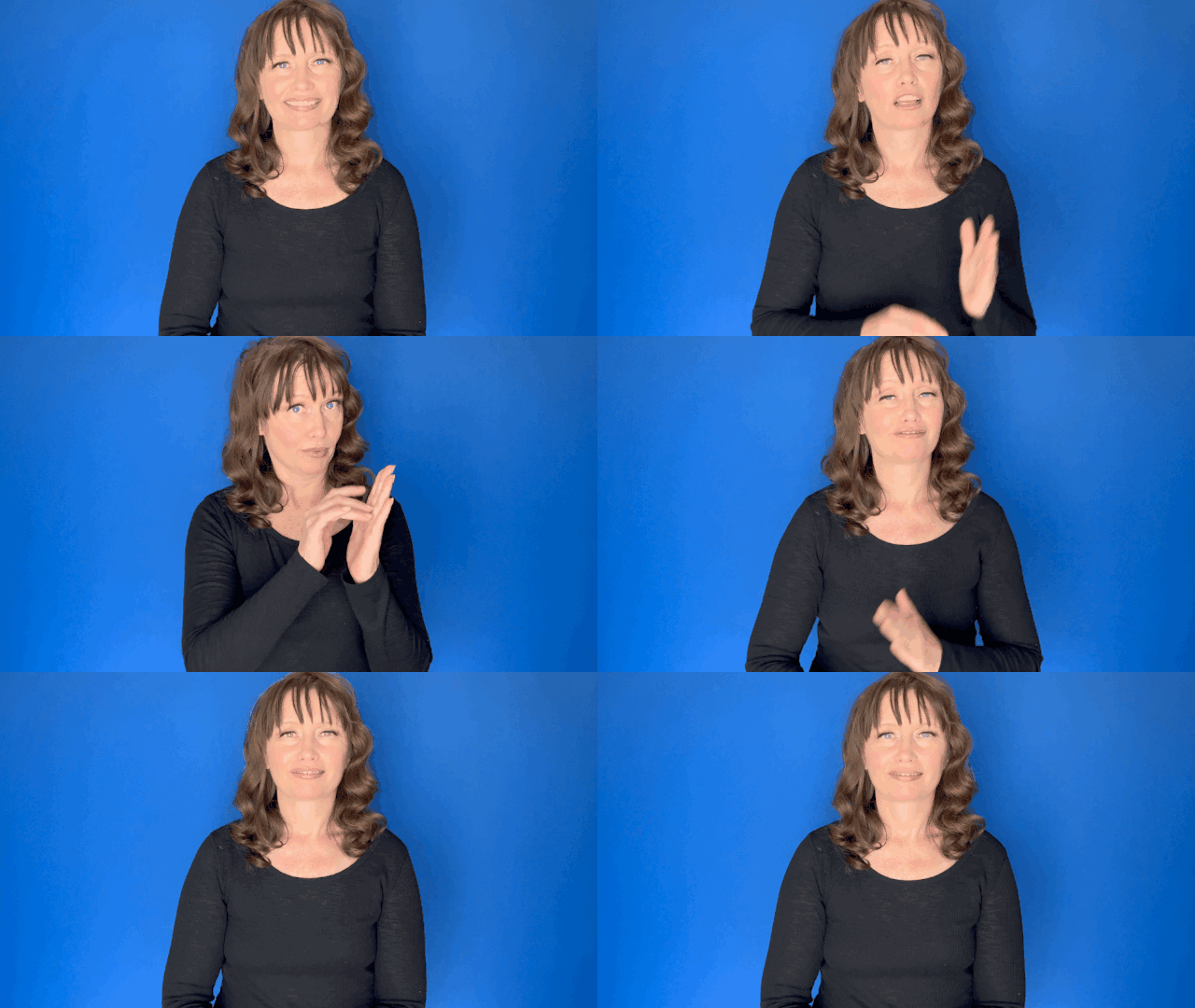
Definition: A device used for mathematical calculations.
Sign for CALCULATOR in ASL

Practice Activities:
Start by practicing the sign for CALCULATOR in ASL in isolation. Stand in front of a mirror and repeat the sign multiple times, focusing on handshape, movement, and facial expressions. Do this slowly at first, then gradually increase your speed and fluidity.
Next, use the sign in context by incorporating it into everyday sentences. Try phrases like: I need my calculator, Where’s the calculator?, or The calculator is broken. Practice these sentences both signed and voiced to reinforce language comprehension.
Create a list of related vocabulary to expand your practice. Include signs such as math, problem, add, subtract, and answer. Sign short math-related sentences such as: I use a calculator for math or Can you add this using your calculator? This builds confidence in using the sign for CALCULATOR in ASL fluently with connected concepts.
Practice with a friend or language partner. One person can give simple math problems and the other responds using the sign for CALCULATOR in ASL. For example, one person signs: You need to solve this. The other signs: I’ll use a calculator. Switch roles after a few turns.
Try storytelling to reinforce usage. Create a short story about a student in math class or someone working as an accountant and use the sign for CALCULATOR in ASL multiple times. Focus on fluency of transitions between signs and maintaining spatial agreement.
Record yourself signing sentences and watch back to evaluate clarity and accuracy. Pay attention to whether the sign is clearly visible and if it’s placed correctly in your signing space. This helps identify errors and track progress over time.
Review and repeat the sign daily for retention. Gradually increase the challenge by including the sign in spontaneous conversation or interpreting short math-related dialogues.
Cultural Context:
Understanding the sign for calculator in ASL offers a glimpse into how American Sign Language adapts modern technology for effective communication. ASL evolves with the needs of the Deaf community, incorporating tools like calculators into the language with visual precision and cultural relevance.
The sign for calculator in ASL is not just a direct translation of the English word. It reflects how Deaf culture values clarity, simplicity, and the ability to convey concepts visually. Devices used in school or work, such as calculators, have clear signs in ASL, allowing conversations about math, finances, and everyday tasks to flow seamlessly.
In many educational settings within the Deaf community, technology plays an important role. The sign for calculator in ASL is commonly used in classrooms, especially during math lessons or when discussing budgeting and accounting. Teachers and students alike rely on this sign to communicate effectively about these essential tools.
ASL signs for electronics often reflect their function or appearance. The sign for calculator in ASL may mimic the shape or motion of using a calculator, making it intuitive for Deaf users. This visual approach helps younger learners and new signers build their vocabulary more easily.
Understanding the cultural context of the sign for calculator in ASL also means recognizing the importance of accessibility. Deaf individuals use signs like this one to engage fully in conversations about academics and professional tools, breaking down barriers that spoken language may present. Everyday items like calculators become a part of fluent, expressive ASL conversations.
The development and use of the sign for calculator in ASL also highlight how the language keeps pace with changing technology. As more digital tools become common, ASL continues to adopt new signs, ensuring the Deaf and signing community can express modern ideas clearly. The sign for calculator reflects how language grows to fit the world’s needs.
When you see the sign for calculator in ASL, you’re witnessing how form and function come together in Deaf culture. The sign may vary slightly in different regions, which is a beautiful reminder of ASL’s diversity and richness. Still, the key idea remains the same — a shared visual sign that communicates function effectively.
The sign for calculator in ASL can be found in schools, offices, and homes across the country. It appears in discussions about doing taxes, calculating expenses, or helping kids with homework. Having a clear and easy-to-recognize sign for such daily-use technology helps ensure full participation in society for all ASL users.
In Deaf culture, the value placed on connection means that every device or tool frequently used in life gains
Extended Definition:
The sign for calculator in ASL is a visual representation of the concept of a device used for mathematical calculations. The sign usually mimics the act of pressing buttons on a calculator and can vary slightly depending on the region or the person’s signing style. In most cases, the movement is made with both hands to represent pushing keys.
When expressing the sign for calculator in ASL, facial expressions help provide additional context, especially if you’re referring to a physical calculator, a calculator app, or referring to the function in a broader educational or work-related setting. This makes the sign adaptable and versatile for both casual and academic use.
To produce the sign for calculator in ASL, many signers hold both hands out in front of them as if they are gripping a small, rectangular object. They then use their fingers to imitate pressing buttons, either with one hand tapping on the other or by mimicking both thumbs and fingers pressing down alternately. This handshape and movement clearly suggest the purpose and functionality of a calculator.
Learning how to sign calculator in ASL is beneficial in academic and professional environments where math and finance vocabulary are commonly used. STEM classes, especially math and science, often include the use of a calculator in assignments and tests, so understanding this sign can help students follow the conversation more easily and communicate their needs during class activities or exams.
ASL learners will find that incorporating technology-related vocabulary like the sign for calculator in ASL helps expand their overall vocabulary. As more educational tools and digital platforms evolve, the language continues to grow to match. Signing modern terms like calculator can help bridge gaps between deaf and hearing individuals in various settings, including classrooms, tutoring sessions, and offices.
The sign for calculator in ASL may be used when talking about simple arithmetic, complex scientific calculations, or even while accessing financial apps on smartphones. Since calculators exist in many forms today—from handheld devices to software—it’s useful to know how this sign can be modified or clarified with additional context.
Using classifiers or describing a specific type of calculator along with the sign provides greater accuracy. For example, if you’re referring to a graphing calculator used in high school algebra, you might sign calculator with a descriptor for graphing equipment. This helps your listener understand which kind of device you’re referencing.
In online education, especially virtual classrooms, it’s increasingly important to use correct and recognized ASL signs for academic tools like calculator. Incorporating the sign for calculator in ASL into your vocabulary ensures smoother communication and helps maintain accessibility for everyone,
Synonyms: calculator, computing device, calculation tool, arithmetic machine, digital calculator
Educational resources: Find related learning materials in our course bank!
Want more? Check out some of our popular learning activities on the homepage!
Need to look up a sign? Use our highly rated dictionary: https://aslinteractive.com/best-asl-dictionary/
Follow us on tiktok: https://www.tiktok.com/@aslinteractive. More social media links at the bottom of this page!
Long-tail Keywords: what is the sign for calculator in ASL, how do you sign calculator in ASL, ASL sign for calculator
Categories:
tags: calculator in American Sign Language, ASL sign for calculator, how to sign calculator in ASL, calculator sign language translation, learning calculator in ASL
Parameters
*Handshape*:
The handshape for the sign for CALCULATOR in ASL typically uses both hands in a bent “5” or claw-like position. The fingertips of both hands tap lightly against each other a couple of times, mimicking the action of fingers pressing calculator buttons.
This motion helps visually convey the concept behind the sign for CALCULATOR in ASL . The repetition of tapping gestures enhances the symbolic representation of using a calculator.
*Palm Orientation*:
In the sign for calculator in ASL, the palm orientation generally faces inward toward the chest. Both hands are used, with fingers slightly bent, mimicking the motion of pressing buttons on a calculator keypad.
Maintaining consistent palm orientation facing the body is key to clearly expressing the sign for calculator in ASL. This inward-facing direction helps convey the idea of a handheld device being operated close to the body.
*Location*:
The sign for calculator in ASL is typically made in front of the chest, slightly off-center toward the dominant side. This area allows for clear visibility of hand movements that mimic pressing buttons, which helps convey the concept of a calculator.
Because the sign relies on visual and spatial representation, keeping the location neutral and within the viewer’s line of sight is essential. The sign for calculator in ASL remains within the signing space close to the upper torso.
*Movement*:
To produce the sign for calculator in ASL, both hands form flattened “O” handshapes or slightly curved fingers. The fingertips of each hand tap together alternately in front of the body, as if pressing buttons on a small device.
This repeated motion simulates the action of using a real calculator. The sign for calculator in ASL incorporates clear, rhythmic tapping that conveys the concept of operating a keypad or device.
*Non-Manual Signals*:
When demonstrating the sign for calculator in ASL, the facial expression should remain neutral to slightly focused, reflecting concentration as if performing a task. Eyebrows may lower subtly to show engagement or attention while mimicking the act of inputting numbers.
The non-manual signals help emphasize the concept of calculation and digital processing. Slight head movement—such as a tilt or nod—can add clarity, enhancing the intent behind the sign for calculator in ASL.
*Prosody, Dominant/Non-Dominant Hand*:
The sign for CALCULATOR in ASL typically uses both hands to mimic the motion of pressing buttons on a device. The dominant hand, usually shaped like a bent “B” or flat “O,” taps rapidly over the non-dominant hand, which stays still and open to represent the calculator’s surface.
When showing the sign for CALCULATOR in ASL, the dominant hand performs most of the movement to suggest inputting data or numbers. This mimics how someone would interact with a real calculator.
Tips for Beginners:
When learning the sign for CALCULATOR in ASL, begin by becoming comfortable with the general concept of devices and technology in sign language. The sign usually mimics the idea of pressing buttons on a small keypad, using both hands in a movement that simulates calculation. Be sure your handshape and motion resemble pressing individual keys deliberately—avoid making the motion too fast or random, which can confuse the meaning.
A common challenge for beginners is lack of precision in hand movement. Since the sign for CALCULATOR in ASL often relies on subtle, repeated finger motions, it’s easy to blur the action into a vague gesture. Be sure your fingers are curved as if typing and use your dominant hand to mimic operating the device. Practice slowly until you feel confident in making a clear and purposeful motion.
Finger placement and hand orientation are also key. The non-dominant hand usually serves as the base or surface for the calculator, while the dominant hand simulates tapping the buttons. Make sure both hands are steady and held at chest level to keep the sign readable. If either hand shifts too much, your sign may be misinterpreted.
Try practicing in front of a mirror or record yourself signing. Watching your hand movements can highlight areas where your positioning or motion needs adjustment. Ask a fluent signer for feedback or work with a peer to practice back-and-forth questions using the sign for CALCULATOR in ASL to reinforce fluency.
Lastly, connect the sign with real-world usage. Use it when talking about math homework, a job that involves calculations, or budgeting. The more relevant the context, the easier it will be to remember. Consistent daily use helps the sign become a natural part of your vocabulary.
Connections to Other topics:
The sign for CALCULATOR in ASL connects deeply to mathematical and technological concepts. It ties in with other signs like MATH, COMPUTER, and ACCOUNTING, offering learners a broader understanding of how abstract academic or digital concepts are shown through movement and location. Often, the sign mimics the look of pushing buttons or tapping on a device, which reflects how ASL uses visual-spatial properties to mirror real-world interactions.
In academic or educational contexts, the sign for CALCULATOR in ASL is often used alongside terms like HOMEWORK, STUDY, or TEST. For example, within a sentence like “I use calculator for math homework,” the transition between these signs creates smooth visual grammar, helping learners understand topic-comment structure in ASL. These functional combinations support expressive fluency and context-driven learning.
The sign also connects to SCIENCE and ENGINEERING, especially in STEM conversations. When discussing professional or career-related topics, users might pair the sign with WORK or OFFICE, indicating that a calculator is part of their daily tools. These types of linguistic pairings show how ASL expresses function and utility in a visually intuitive way.
The sign for CALCULATOR in ASL is often compared to other digital tools like COMPUTER or TABLET, allowing learners to distinguish between similar but different technological signs. These comparisons enhance semantic differentiation, which is key for language retention and comprehension. Visual distinctions often rest on handshape and motion, which are essential aspects of ASL structure.
Additionally, this sign may be linked to FINANCE or ACCOUNTANT in contexts dealing with budgeting or business. Paired signs like MONEY, ADD, or SUBTRACT often follow CALCULATOR in conversations, building compound ideas. This kind of thematic fluidity is valuable for learners aiming to become proficient in topical discussions. Knowing how these signs interconnect can significantly increase a signer’s expressive range.
Summary:
The sign for CALCULATOR in ASL typically mimics the motion and visual of pressing buttons on a device. It often includes the use of both hands mimicking key presses, or one hand acting out a tapping or computing motion repeatedly on the non-dominant flat hand. Some signers may also fingerspell the word depending on the context, especially in technical or academic environments.
This sign is iconic in nature, drawing heavily from the visual resemblance between the act of using a calculator and the physical motion of the sign. This makes the sign intuitive for learners and accessible to those familiar with the object. Mimetic signs like the sign for CALCULATOR in ASL demonstrate ASL’s ability to convey meaning through visual and kinetic similarities.
ASL is a visual language grounded in space and motion, and signs for technology like CALCULATOR evolve as new devices become prevalent. Older signs for CALCULATOR may resemble devices with larger keys or resemble early electronic devices, while younger users may incorporate features of smartphones or smaller calculators. This reflects a dynamic linguistic system adapting to cultural changes.
The sign for CALCULATOR in ASL is often introduced early in academic or technical vocabulary modules. It’s relevant in educational settings, especially in classrooms where Deaf or Hard of Hearing students engage with math and science. Teachers in bilingual educational settings often pair this sign with fingerspelling or visual aids to reinforce the concept.
Grammatically, CALCULATOR functions primarily as a noun within ASL. When used in ASL sentences, it can be the subject, object, or even used adjectivally depending on the structure. ASL sentence structure is topic-comment, so you might see “CALCULATOR, I USE DAILY” to convey regular usage.
The sign for CALCULATOR in ASL is sometimes paired with action signs like USE, NEED, or BUY to form complete statements. This produces clear communication about not just the tool, but its purpose and use. These compound structures demonstrate the fluidity and creativity of ASL grammar.
Linguistically, the sign’s structure highlights the productive use of non-manual markers and classifiers. The tapping motion often includes subtle facial expressions suggesting effort, thinking, or precision. These non-manual signals enrich the sign, giving texture to the meaning conveyed.
Classifier use may come into play when describing large, physical calculators or using space to indicate multiple calculators or calculations. For example, using classifiers can help distinguish between hand-held calculators and graphing ones depending on the size indicated. This spatial usage is a signature principle of ASL’s grammar and storytelling techniques.
The sign for CALCULATOR in ASL has broader connections with other technology-related signs like COMPUTER, LAPTOP, and PHONE. These signs often share similar iconic elements and are rooted in the common practice of visually representing use. This visual etymology helps learners build thematic vocabulary efficiently.
In terms of applied linguistics, the sign for CALCULATOR in ASL demonstrates how Deaf signers connect abstract numerical concepts to real-world tools. Especially in educational contexts, conceptual mapping is vital. ASL leverages physical gestures and shapes to link devices with abstract ideas like operations, functions, and algorithms.
Deaf culture values accessibility and direct representation, and the sign for CALCULATOR in ASL aligns with this tradition. By shaping language in a way that resonates visually and experientially, ASL supports efficient and resonant communication. Such values emphasize representation and direct communication over abstraction.
Historically, as calculators evolved from mechanical to digital devices and then to apps, the ASL sign adapted accordingly. This reflects an overall pattern in ASL where technological evolution influences linguistic change. Signs for monitors, cell phones, and televisions have undergone similar shifts.
Because fingerspelling is sometimes used as a substitute or supplement to the sign for CALCULATOR in ASL, it’s important to highlight the role of the manual alphabet in ASL. Fingerspelling allows signers to express concepts not yet lexicalized or to convey high specificity. This is common in math environments where model names or brands may be relevant.
In STEM contexts, understanding the sign for CALCULATOR in ASL allows users to discuss tools for equations, graphs, and matrices. It opens up more specialized communication that is vital in academia and professional spaces. Technologies such as graphing calculators even have unique sentence structures involving setups like “GRAPH-CALCULATOR USE WHICH-TYPE?”
There is also pedagogical significance in how educators teach the sign for CALCULATOR in ASL. Many visual learners benefit from clear demonstrations and anchoring the sign to real-life devices. Teaching ASL signs in context with physical tools enhances memory retention and language acquisition.
Technological signs often serve as entry points into broader conversations about access to digital tools for the Deaf community. The sign for CALCULATOR in ASL, seemingly simple, exists within a larger narrative of tech advocacy and accessible education. Calculators symbolize not just math tools, but potential barriers or bridges to participation.
ASL
Want more? Check out some of our popular learning activities!
ASL Interactive Resources
ASLInteractive YouTube Channel
Follow us on tiktok: @aslinteractive.com
Follow us on Instagram: aslinteractive
Facebook page: aslinteractive
Facebook group: aslinteractive
LInkedIn: ASL Interactive LLC
Twitter: @ASL_interactive
*Some information on this page is AI-generated. AI can make mistakes. Please check the information.


Responses