Sign for CALM in ASL | 🪷 ASL Dictionary

Definition: To make or become quiet or still.

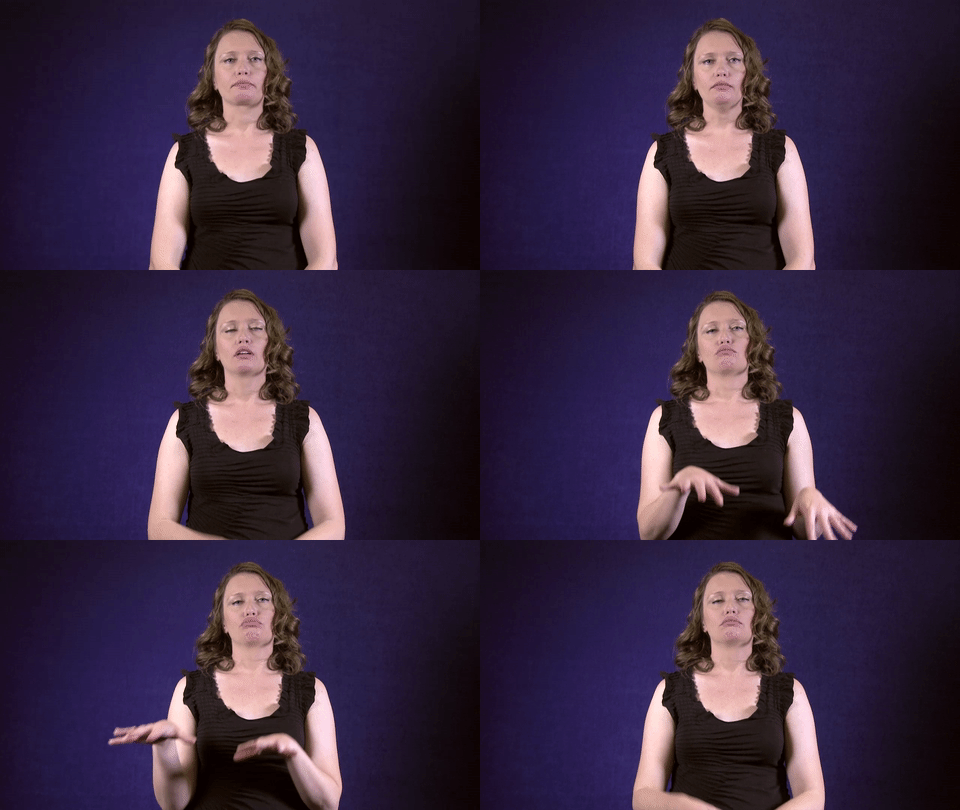
Sign for CALM in ASL

YouTube player

Practice Activities:

Start by practicing the sign for CALM in ASL in front of a mirror. Focus on smooth, slow movements and maintaining a relaxed facial expression. Try repeating the sign in isolation ten times, concentrating on fluid hand transitions and your overall body posture.

Once you’re comfortable signing it in isolation, begin using the sign in short sentences. For example, sign phrases like “I feel calm,” “Stay calm,” or “She is calm.” Use varying facial expressions to convey different emotional tones, such as peacefulness or reassurance.

Partner practice can help reinforce meaning and reception. Take turns signing different emotional states, and guess whether your partner is signing calm, nervous, or excited. This will highlight how different signs look and feel, encouraging accurate recognition of the sign for CALM in ASL.

Another fun exercise is storytelling. Create a short narrative that involves characters experiencing stress, then finding calm. For instance, you might sign a story about someone preparing for a big test who then takes deep breaths and becomes calm. Focus on clear transitions between emotional states using expressive signing.

Mindfulness-based activities can also be helpful. Practice the sign for CALM in ASL during breathing exercises or meditation. Each time you exhale, produce the sign slowly and mindfully to connect meaning with physical calmness.

Write a list of scenarios and act them out using ASL. Examples might include sitting beside a lake, reading quietly, or meditating. Sign short phrases using the word calm in each context, reinforcing different ways the sign can be used.

Finish by recording yourself signing and reflecting on your facial expressions and movement clarity. Re-watch the video to evaluate consistency and accuracy when using the sign for CALM in ASL. Repeat these activities regularly to build fluency and confidence.

Cultural Context:

Understanding the sign for CALM in ASL means more than just learning a handshape. American Sign Language is deeply connected to Deaf culture, where emotions are expressed not only through hand movements but also through facial expressions and body language. The sign for CALM in ASL reflects this cultural depth and emotional awareness.

Within Deaf culture, being calm or maintaining calmness can play a crucial role in social situations. Since ASL is a visual and expressive language, showing you are calm is not just about the sign itself. It’s also about how you present your facial expressions and control your body movements to reflect inner peace.

The sign for CALM in ASL typically mirrors the idea of peacefulness and composure. But just learning the hand gesture isn’t enough. Understanding how and when to use the sign requires awareness of the social and emotional context the Deaf community values greatly.

In settings like classrooms, group discussions, or during conflict resolution, using the sign for CALM in ASL can help create a more soothing and respectful environment. In Deaf culture, this kind of non-verbal communication can be more powerful than raising your voice or showing visible frustration. The sign sends a message that respects the shared values of harmony and understanding.

Facial expression plays a major role when using the sign for CALM in ASL. A neutral or peaceful expression reinforces the message and is just as important as the hand movement. Deaf culture emphasizes these visual cues, teaching that calmness is both shown and felt visually.

The sign for CALM in ASL can also reflect mental well-being. In the Deaf community, maintaining mental health is an ongoing conversation, and signs like CALM help support emotional intelligence through language. Signing CALM can be a reminder or even a tool for self-regulation and supporting others emotionally.

When watching signed storytelling or poetry in ASL, you’ll often see the sign for CALM used with great artistic expression. It may carry different layers of meaning, depending on the context or mood of the story. Deaf performers use the sign to convey a scene of healing, reflection, or peaceful transition, showing how deeply embedded emotions are in visual language.

The sign for CALM in ASL is also used in educational settings to support social-emotional learning. When young Deaf or Hard of Hearing students are taught how to identify and manage their emotions, the sign for CALM becomes part of that emotional toolkit. It helps create a safe space where students understand that it’s okay to feel and share those feelings through signing

Extended Definition:

The sign for calm in ASL is a peaceful and soothing movement that reflects the meaning of the word itself. It is often used to express tranquility, inner peace, or a desire for quiet. Whether you’re communicating emotions or giving someone a gentle reminder to relax, understanding how to sign this word correctly can help convey the right message in a respectful and sensitive way.

To perform the sign for calm in ASL, both hands are placed flat and face down, starting slightly apart with palms facing downward. The hands then move slowly and smoothly toward each other in a downward, gliding motion. This graceful movement captures the essence of calmness, making it easy to remember and universally understood within the ASL community.

This sign can be used in a variety of contexts, such as telling a child to remain calm or expressing a desire to stay composed during stressful situations. Whether you’re in a personal conversation or interpreting a public speech, the sign for calm in ASL is versatile and widely applicable. It’s especially useful in educational settings, therapeutic environments, or during moments of emotional regulation.

Learning the sign for calm in ASL allows you to communicate more clearly in moments that require sensitivity. It becomes especially valuable when working with people experiencing anxiety, overwhelm, or frustration. Using the appropriate gesture can foster comfort and trust in these interactions, especially when verbal speech might not be an option.

In some cases, the sign for calm in ASL may be paired with facial expressions that complement the peaceful intention of the word. A soft gaze or relaxed facial muscles can reinforce the meaning, adding nuance to your signing. ASL places a strong emphasis on facial grammar, and combining the correct hand movement with the right expression is essential for full understanding.

There are also variations in signing calm depending on the region or individual ASL users. Some may subtly alter the speed of the motion or use an expressive face to change the tone. However, the foundational gesture remains the same, ensuring recognition by most ASL users.

When searching for resources to learn the sign for calm in ASL, video references are highly recommended. Visual learning helps solidify hand shapes, movements, and expressions. Many online ASL dictionaries offer demonstrations that show how the sign is used in real-life scenarios, making it easier to master.

Using ASL in daily life can be incredibly enriching, and incorporating signs like the sign for calm in ASL helps expand your vocabulary in meaningful ways. It’s a sign that is gentle in motion and powerful in use. Whether you

Synonyms: peaceful, serene, tranquil, quiet, relaxed

Educational resources: Find related learning materials in our course bank!

Want more? Check out some of our popular learning activities on the homepage!

Need to look up a sign? Use our highly rated dictionary: https://aslinteractive.com/best-asl-dictionary/

Follow us on tiktok: https://www.tiktok.com/@aslinteractive. More social media links at the bottom of this page!

Long-tail Keywords: what is the sign for calm in asl, how do you sign calm in asl, asl sign for calm

Categories:

tags: Telling how one is, Emotions, Language Learning, Everyday activities, Responses

Parameters

*Handshape*:

The handshape used in the sign for CALM in ASL involves both hands in a flat “B” handshape , with fingers extended and together, thumbs laying flat against the side of each hand. The palms face downward, and the hands move smoothly across one another in a calming, downward motion.

In the sign for CALM in ASL, these “B” handshapes contribute to the gentle, soothing visual representation of the concept. The smooth overlap of the hands mimics the idea of serenity and peacefulness.

*Palm Orientation*:

The palm orientation for the sign for CALM in ASL begins with both hands open and slightly curved, palms facing each other. As the motion progresses, both hands move downward slowly while maintaining this orientation, symbolizing a calming or settling action.

Throughout the sign for CALM in ASL, the palms remain facing inward, toward each other, not rotating or turning outward. This consistent orientation helps convey the smooth and gentle nature of the sign.

*Location*:

The sign for calm in ASL is performed in the neutral space in front of the torso. Both hands start open with palms facing down, positioned slightly apart near the chest or upper abdomen.

As the movement begins, the hands slide downward and inward simultaneously, moving in a smooth, controlled motion. The location emphasizes a centered, relaxed area that aligns with the meaning of the sign for calm in ASL.

*Movement*:

The sign for calm in ASL involves both open hands, palms facing downward. Start with the hands separated and raised slightly in front of the chest, then move them slowly downward and toward each other in a smooth, gentle motion.

This soothing movement mimics the act of settling or quieting down. The sign for calm in ASL visually conveys peace and tranquility, which matches its meaning.

*Non-Manual Signals*:

The sign for calm in ASL is accompanied by a relaxed facial expression. Eyebrows should be in a neutral or slightly lowered position, and the eyes may gently close or appear soft to convey peacefulness.

Mouth movements are minimal, with lips gently pressed or slightly parted, emphasizing a sense of ease. Avoid tension in the jaw and face to match the soothing nature of the sign for calm in ASL .

*Prosody, Dominant/Non-Dominant Hand*:

The sign for calm in ASL uses both hands in open “B” handshapes, palms facing down. The dominant hand and non-dominant hand move smoothly and simultaneously down and slightly outward from the center of the chest, resembling a calming motion.

Both hands mirror each other in this fluid gesture. The movement and symmetry of the hands convey a peaceful or tranquil feeling, reinforcing the meaning behind the sign for calm in ASL .

Tips for Beginners:

When learning the sign for CALM in ASL, it’s important to focus on smooth, deliberate movements. The sign involves placing both open hands palm-down, one above the other, and then gliding them apart simultaneously across your chest. This should be done slowly and gently to convey a sense of peacefulness, which matches the meaning of the word.

A major tip for beginners is to maintain a relaxed facial expression while signing. Facial expression in ASL adds emotional context, and a strained or overly excited face can contradict the meaning of the sign. When doing the sign for CALM in ASL, your energy should naturally reflect the word—slow your breathing and be present with the movement.

Practice in front of a mirror to check that your hands move evenly and in the same direction. As you move your hands, keep them horizontal and avoid flapping or jerking. This can otherwise appear as a different sign or confuse your viewer.

Avoid placing your hands too high or too low on your torso. Chest level is ideal to keep the sign visible and to maintain accuracy. Some beginners make the mistake of doing the movement too quickly or not completing the glide, which can reduce clarity for your conversation partner.

When working with others, observe how native or fluent signers use the sign for CALM in ASL during conversations. Noticing the flow and pace can help shape your own expression and make it feel more natural. Watching videos and repeating the sign multiple times helps build automaticity.

Lastly, remember that the sign for CALM in ASL is also influenced by the context. In emotional conversations or storytelling, adjusting your pace or intensity slightly can add depth, but be sure to retain the core structure. Practice patiently and keep your movements mindful. ✋ ‍♂️

Connections to Other topics:

The sign for CALM in ASL is often contextually related to emotions, mental states, and social interactions. It is connected to signs like PEACE, RELAX, STILL, and QUIET, all of which share overlapping hand movements or conceptual meanings. These relationships help learners understand nuances in emotional expression and select the most fitting sign based on tone and situation.

The sign for CALM in ASL can be used as a base within compound signs or narratives involving emotional regulation. For example, in storytelling or educational settings, signs like STAY-CALM or CALM-DOWN may be used to convey instructions or character emotions. These compound signs are useful for interpreting phrases like “remain calm under pressure” or “he calmed down eventually,” where the message goes beyond a literal emotion and implies behavioral control.

Learning the sign for CALM in ASL can support understanding of contrasts between emotional states. For instance, pairing CALM with signs like ANGRY, EXCITED, or NERVOUS helps illustrate emotional shifts. Teachers and interpreters frequently use this contrast to build visual storytelling or teach emotional vocabulary to Deaf children or DeafBlind individuals.

Emotionally descriptive signs such as CALM also tie into cultural elements like mindfulness, meditation, or breathing exercises. In ASL yoga or therapy sessions, the sign for CALM may be introduced alongside signs like BREATH, MIND, or STRESS, reinforcing its role in wellness practices. This expands learners’ ability to discuss both abstract and concrete topics.

The sign for CALM in ASL serves as a key part of expressing interpersonal dynamics. In conflict resolution scenarios, it may appear with signs like TALK, LISTEN, RESPECT, or SOLVE. This connection supports communication strategies involving de-escalation, peaceful dialogue, and empathy, strengthening both vocabulary and cultural competence in ASL.

Summary:

The sign for CALM in ASL is visually smooth and peaceful, reflecting the meaning of the word itself. It is made by placing both open hands, palms facing down, at chest level, and then slowly lowering them while keeping the motion steady and symmetrical. This downward motion visually represents a calming or soothing action.

The movement and shape of the hands are intended to convey tranquility. The symmetrical motion is slow and graceful, which contributes to the graceful and peaceful feeling that the sign represents. This makes the execution of the sign particularly important to maintain its meaning.

In ASL, the sign for CALM in ASL can serve as a verb, adjective, or even a command depending on context. For example, one can use it to describe a person who is calm, a situation that is calm, or to tell someone to calm down. Grammar in ASL is context-driven, so facial expressions and surrounding signs play a key role.

Facial expression is crucial when signing this concept. A relaxed or serene face enhances the meaning, whereas furrowing the brow or raising the eyebrows might shift the meaning or create confusion. ASL is a visual language deeply tied to emotions and tone through non-manual markers.

The sign for CALM in ASL is closely related to other emotion-based signs such as PEACEFUL, RELAX, and SETTLE-DOWN. These signs also incorporate slow, deliberate movements starting around the chest or torso, reflecting similar emotional states.

In some conversations, users may choose synonyms like RELAX or SETTLE to convey a similar idea. Although the handshapes may overlap in these signs, the movement and facial expression help differentiate between them. This reflects how meaning is diffused across multiple channels in ASL.

The sign for CALM in ASL emphasizes the concept of stillness and reducing intensity. It is often used in both everyday and therapeutic settings where emotional regulation is discussed. Educators and counselors may incorporate this sign when teaching emotional intelligence.

From a linguistic view, this sign falls into the category of metaphorical iconicity. The gentle motion matches the cultural and emotional idea of calmness, tying the form directly to the meaning. This resemblance strengthens comprehensibility within and outside the Deaf community.

The use of both hands moving together symmetrically creates a sense of harmony. ASL often uses this type of dual-hand motion to symbolize balance or an even emotional state. This reinforces the internal stability implied by the term calm.

In ASL storytelling or poetry, the sign for CALM in ASL appears frequently to represent emotional or environmental themes. A character might experience inner peace, or a setting might be described as peaceful using this expressive sign. The delivery of the sign enhances visual storytelling power.

ASL users frequently use this sign in social interactions to regulate emotional tone. Parents or caregivers might sign it to children during moments of distress, using the motion as both a sign and a soothing physical gesture. The visual calmness of the sign can have a calming effect intrinsically.

In the broader lexicon of ASL, the sign for CALM in ASL interacts with time and intensity modifiers. Repeating the sign more slowly adds emphasis, while following it with NOW or FINISH can indicate when calmness is needed or achieved. ASL syntax allows for nuanced expression.

Culturally, the concept of calmness is highly valued in the Deaf community, which often emphasizes mindful communication. This gives the sign for CALM in ASL added relevance in mediating interpersonal situations. It allows communication to remain grounded and respectful.

In classroom environments, instructors might teach this sign when covering emotional vocabulary. It pairs well with signs like SAD, HAPPY, ANGRY, and NERVOUS in lessons about emotional literacy. Teaching this suite of signs supports holistic learner development, especially among young students.

There’s a subtle tactile component to how the sign feels when executed. The soft glide of the hands downward often mirrors breathing and can have a meditative quality. Some Deaf educators compare the motion to letting tension out of the body, reinforcing the somatic element.

Psychologists and therapists fluent in ASL may use the sign for CALM in ASL in sessions with Deaf clients. It serves both as a communicative sign and as part of grounding techniques in emotional regulation work. The sign’s visual and kinesthetic qualities create a sense of anchored awareness.

The sign can also be pluralized or generalized through slight variations. Broader hand placement or a sweeping motion across the area in front of the torso can suggest a group calming down or a collective atmosphere of peace. This flexibility enriches its semantic value.

Language acquisition studies show that learners grasp signs like this early due to their iconic nature. The idea and the motion are intuitively linked, helping both Deaf and hearing learners to internalize it more easily. This helps form the building blocks of ASL fluency.

The sign for CALM in ASL also integrates well into intercultural comparisons. For instance, gestural metaph

Want more? Check out some of our popular learning activities!

ASL Interactive Resources

ASLInteractive YouTube Channel

Follow us on tiktok: @aslinteractive.com

Follow us on Instagram: aslinteractive

Facebook page: aslinteractive

Facebook group: aslinteractive

LInkedIn: ASL Interactive LLC

Twitter: @ASL_interactive

*Some information on this page is AI-generated. AI can make mistakes. Please check the information.

Sign for CALM in ASL

Responses