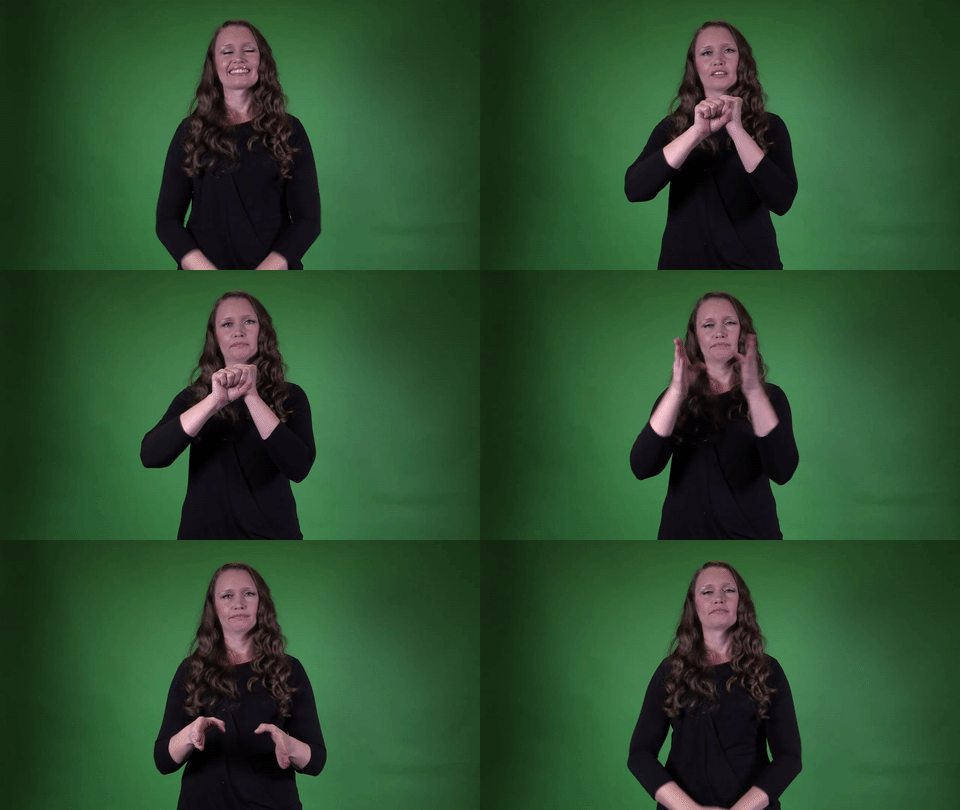
Definition: A person who actively promotes a cause.
Sign for CAMPAIGNER in ASL

Practice Activities:
To practice the sign for CAMPAIGNER in ASL, begin with isolated repetition. Stand in front of a mirror and produce the sign slowly and clearly five times, focusing on your handshape and movement. Then practice increasing speed while maintaining clarity. Record yourself signing and compare your video to native signers to adjust for accuracy.
Move on to using the sign in short phrases. Practice signing examples like “She is a campaigner for animal rights,” or “The campaigner gave a speech.” Try signing these with expressive facial grammar to emphasize passion or seriousness, depending on the context. Creating flashcards with simple sentences can be an easy go-to tool for at-home review.
For contextual understanding, write a short paragraph or monologue in ASL gloss and then sign it, including the sign for CAMPAIGNER in ASL at least twice. Example prompt: “Describe a person you know who is a campaigner for a cause. What do they do? Why do they care?” This forces you to integrate the sign fluidly into storytelling.
Pair up with a partner and role-play situations where one person is a campaigner and the other is a community member. Take turns signing phrases like “I’m a campaigner working to protect the environment” and responding appropriately. Practicing dialogues strengthens your sign recognition and improves conversational flow.
Try watching ASL videos related to activism or advocacy. Pause the video and repeat any time you see a signer use the sign for CAMPAIGNER in ASL or related vocabulary. Identify how facial expressions and context shift the meaning slightly. This will boost your receptive skills.
Finish your practice by teaching someone else the sign and its usage. Teaching reinforces memory and helps identify any gaps in your understanding of the sign for CAMPAIGNER in ASL.
Cultural Context:
In American Sign Language, the sign for campaigner in ASL reflects both the action and the identity of someone who actively promotes a cause. Whether political, social, or environmental, campaigners are individuals who work hard to spread awareness and rally support. The sign for campaigner in ASL captures the essence of this passionate and proactive role.
Campaigners often play a central role in organizing events, educating the public, and mobilizing communities. In Deaf culture, advocacy is deeply valued, and the sign for campaigner in ASL is frequently used during community meetings, educational workshops, and political rallies. It’s a powerful term that stands for more than just participation—it embodies leadership and commitment.
The sign for campaigner in ASL is commonly used in connection with elections, nonprofit initiatives, and movements for social justice. Deaf and hard-of-hearing individuals frequently engage in community efforts, and having a clear, culturally relevant sign for campaigner in ASL empowers more inclusive communication . Campaigns within the Deaf community are often grassroots and focused on achieving equity, making this sign especially meaningful.
Understanding the sign for campaigner in ASL also highlights the interconnectedness of activism and communication. ASL is a rich, expressive language, and signs like this one allow for precise representation of social roles. When someone identifies as a campaigner in ASL conversations, it immediately signals their engagement with a cause and their dedication to making a difference.
The Deaf community regularly celebrates individuals who serve as advocates and leaders. Using the sign for campaigner in ASL during awards, recognitions, or community shout-outs helps honor those who have contributed to important changes. Seeing and using this sign acknowledges the value of activism across all members of society.
In political and educational settings, teachers and interpreters frequently incorporate the sign for campaigner in ASL into curriculum and classroom discussions. It helps students understand careers in public service and social impact. Knowing how to sign campaigner in ASL encourages more dynamic and inclusive learning environments .
Social media movements and online campaigns have also brought increased use of the sign for campaigner in ASL. Whether it’s for climate action, accessibility rights, or elections, campaigners in the Deaf community use this sign to show their involvement and leadership in the digital space. It bridges traditional activism with modern platforms.
Because ASL is deeply influenced by cultural values, the sign for campaigner in ASL is rooted in the importance of visibility, impact, and community direction. It’s not just a
Extended Definition:
The sign for campaigner in ASL captures the idea of someone who actively supports or promotes a cause, policy, or candidate. In American Sign Language, the concept must be expressed visually using signs that describe the work or involvement of a campaigner. Since campaigner isn’t a commonly standardized sign, it is often signed using a combination of concepts like “person,” “support,” and “persuade” to describe the role contextually.
To show the meaning clearly, the sign for campaigner in ASL is usually adapted based on the type of campaign involved. For example, if the campaigner is involved in politics, signs for “vote,” “politics,” or “election” might be used before or after the classifier showing a person spreading information. If the campaigner supports social issues, signs like “help,” “change,” or “community” may also be included to give more context. This approach ensures the message is clear to ASL users.
ASL is not a word-for-word translation of English, so users often build the idea of a campaigner using descriptive signs and facial expressions. Non-manual signals like raised eyebrows or specific mouth movements help communicate whether the campaigner is enthusiastic, professional, or a volunteer. The combination of classifiers, handshapes, space, and facial grammar paints a full picture of the person’s role.
Because the sign for campaigner in ASL can vary depending on context, ASL users should be aware of the audience and setting when using or teaching this sign. Using additional signs for “organize,” “convince,” or “share information” can give more clarity when describing someone deeply involved in a campaign. This flexibility also reflects how ASL naturally evolves and adapts to new social and political roles.
In educational environments, teaching the sign for campaigner in ASL is often part of broader lessons on civics, advocacy, or political systems. ASL learners are encouraged to role play as campaigners to better understand the signs, facial expressions, and movements that convey persuasive speaking or outreach. This approach builds fluency and helps learners understand that signing is more than just hand movements—it’s a full-body communication experience.
On social media, Deaf campaigners often use ASL in videos to connect with audiences. Using accurate and expressive signs helps ensure their message reaches and resonates within the community. The sign for campaigner in ASL becomes a tool for activism, education, and leadership, helping bridge communication gaps and raising awareness about
Synonyms: activist, advocate, promoter, crusader, champion
Educational resources: Find related learning materials in our course bank!
Want more? Check out some of our popular learning activities on the homepage!
Need to look up a sign? Use our highly rated dictionary: https://aslinteractive.com/best-asl-dictionary/
Follow us on tiktok: https://www.tiktok.com/@aslinteractive. More social media links at the bottom of this page!
Long-tail Keywords: what is the sign for campaigner in ASL, how do you sign campaigner in ASL, ASL sign for campaigner
Categories:
tags: campaign, language learning, activities, people, major decisions
Parameters
*Handshape*:
The handshape for the sign for CAMPAIGNER in ASL typically uses open “C” or flat “B” handshapes, depending on the context and the signer’s style. The dominant hand might form a “C” handshape to represent active involvement or a flat “B” handshape to show representation or outreach.
When using the flat handshape interpretation, both hands can open as flat palms moving outward from the body, signifying outreach or influence. This variation reinforces the meaning behind the sign for CAMPAIGNER in ASL as someone actively promoting a cause or idea.
*Palm Orientation*:
The palm orientation for the sign for CAMPAIGNER in ASL begins with both hands in a “C” shape, facing each other with palms slightly angled inward. As the movement is executed in short, repeated circular motions near the mid-torso, the palms maintain this inward orientation, allowing interaction to symbolize organization or advocacy.
When fingerspelling CAMPAIGNER, each letter is formed with the palm generally facing out toward the viewer . The consistent orientation helps maintain clarity for each character, supporting the legibility and accuracy of the sign for CAMPAIGNER in ASL.
*Location*:
The location for the sign for campaigner in ASL typically takes place in the neutral space in front of the torso. The dominant hand moves in this area to form the base sign for “campaign,” often incorporating gestures that indicate advocacy or pushing a cause.
For the sign for campaigner in ASL, the signer may also use facial expressions and body orientation to emphasize determination or persuasion. The motion remains in front of the chest or slightly forward to stay clearly visible to the viewer.
*Movement*:
The movement for the sign for CAMPAIGNER in ASL begins by signing CAMPAIGN, where both flat hands, palms facing each other, move forward in a small circular motion as if pushing ideas outward. Then transition into the sign for PERSON by moving both hands downward in parallel from chest to waist level to show the agent or one who performs the action.
To show emphasis as a campaigner, facial expressions should be assertive, and the circular hand motion may be slightly more energetic. The sign for CAMPAIGNER in ASL combines concept and role, using movement to reflect active involvement in a cause or effort. ️
*Non-Manual Signals*:
When demonstrating the sign for campaigner in ASL, the signer usually maintains focused eye contact and a serious, determined facial expression . This non-manual signal reflects the strong sense of purpose and advocacy associated with someone who actively participates in a campaign.
Raised eyebrows may also be used when clarifying the role or context of the campaigner, especially during conversation or storytelling. These non-verbal cues help reinforce the meaning behind the sign for campaigner in ASL and ensure clear communication.
*Prosody, Dominant/Non-Dominant Hand*:
The sign for CAMPAIGNER in ASL typically uses the dominant hand to perform the motion associated with CAMPAIGN, often resembling two curved hands moving forward in a repeated motion indicating effort or advocacy. After signing CAMPAIGN, the agentive suffix is added, turning the person into a “campaigner.” The non-dominant hand helps establish spatial reference or supports symmetrical motion depending on the variation.
Facial expression, body orientation, and slight leaning forward may accompany the sign for CAMPAIGNER in ASL to convey determination or clear intent. This sign combines action and identity, making it easier to distinguish someone actively involved in a cause.
Tips for Beginners:
When learning the sign for CAMPAIGNER in ASL, it’s important to understand that this concept may be signed using a combination of the sign for “CAMPAIGN” followed by the agentive marker—the hands move downward parallel to the torso to indicate a person involved in the action. Make sure your movements are fluid and deliberate to accurately convey the meaning. If “CAMPAIGN” is unfamiliar, focus on learning it first before adding the agentive component (which turns it into “one who campaigns”).
A mistake beginners often make is trying to sign too quickly, which might lead to incomplete or confusing movements. Take your time during practice, prioritizing clarity over speed. Use a mirror or record yourself on video to better observe your hand shape, position, and motion. For the agent sign, both open hands should move downward in parallel lines on each side of the chest—avoid letting your hands drift inward or outward.
Because the sign for CAMPAIGNER in ASL typically builds on a base sign plus a suffix, it’s essential to distinguish between the noun form and other forms like verbs. A campaigner is a person, so remember to include the person-marker when necessary. Without it, you’re just signing “CAMPAIGN,” not “campaigner.”
Also, watch your facial expressions—they add vital context in ASL. When discussing someone who is passionate or active, show corresponding emotion. Don’t be afraid to overemphasize your expressions while learning; it helps bring more meaning to your communication.
Practice signing in full sentences to reinforce how the sign for CAMPAIGNER in ASL fits into broader conversations. Pair practice with receptive skills—watch how fluent signers use this sign in real contexts. Exposure and repetition will lead to muscle memory and more natural signing
sign for campaigner in asl, asl sign for campaigner, campaign-related signs in ASL, how to sign campaigner in American Sign Language, campaigner person-sign in ASL
Connections to Other topics:
The sign for CAMPAIGNER in ASL is closely related to the signs for ACTIVITY, PROMOTE, and ADVOCATE. These foundational signs build the concept of an individual who is actively involved in pushing for social or political change. Understanding these connections helps learners recognize that the sign for CAMPAIGNER in ASL typically integrates the idea of promoting or advocating for a cause with an emphasis on ongoing effort or movement.
Because a campaigner is someone who engages in activities or efforts to influence others, it’s helpful to study compound signs like COMMUNITY + ORGANIZER or PROMOTE + PERSON. These combinations create a fuller picture of someone in an advocacy or activism role. For example, using ADVOCATE plus the person marker can describe someone who consistently pushes for rights or reforms, closely mirroring the function of a campaigner.
The sign for CAMPAIGNER in ASL also connects well with vocabulary centered around political and social action. Terms like VOTE, VOLUNTEER, EQUALITY, and JUSTICE often occur in the same conversations. Learners can build stronger ASL fluency by associating campaigner-related terms with real-world contexts such as election campaigns, community outreach, or non-profit work. These concepts frequently appear together in storytelling, news interpretation, and public speaking in ASL.
Another related concept is LEADER or ACTIVIST, as both overlap in meaning with CAMPAIGNER depending on the context. These signs encourage nuanced facial expressions and classifiers to indicate the type or intensity of the campaign. In narratives, classifiers like CL:1 to show a person walking door-to-door or CL:B to indicate crowds can support the visualization of campaign efforts.
Fingerspelling CAMPAIGNER may be used in legal or professional contexts, especially when referring to a specific title or role. Recognizing when to use fingerspelling versus conceptual signs helps improve clarity and linguistic appropriateness. All these connections make the sign for CAMPAIGNER in ASL part of a much broader network of activism and civic participation vocabulary.
Summary:
The sign for CAMPAIGNER in ASL often draws from a combination of signs that convey both the act of advocating and the role of an individual who engages in persuasive public action. Since there is no universally established single sign for the English word “campaigner,” native signers usually express it by combining related signs like WORK, SUPPORT, or ADVOCATE along with the person-inflectional suffix via the sign for PERSON. The resulting meaning clearly communicates the idea of someone actively working toward a cause or promoting a certain agenda.
To sign CAMPAIGNER in ASL, one common strategy is to use a descriptive form constructed from the sign for CAMPAIGN or ADVOCATE, followed directly with the PERSON classifier. This approach aligns with the grammar of ASL, which often builds meaning through layered conceptual cues. The motion and expression involved in the sign convey seriousness, passion, and consistency—core traits commonly associated with campaigners.
The sign for ADVOCATE in ASL often involves one hand pushing forward atop the palm of the other hand, signaling the action of pushing for or promoting something, which metaphorically suits the context for a campaigner. When you include the sign for PERSON—created by moving both flat hands downward in parallel paths alongside the body—you’re literally identifying a person who performs a role or action. This compound construction allows for flexible expression while retaining clarity and purpose.
The concept behind the sign for CAMPAIGNER in ASL is rooted in functional morphology. Rather than imagining “campaigner” as a static noun, ASL treats it dynamically. The focus isn’t just the subject, but the verb and purpose surrounding what this person does. Someone doing outreach, arguing a viewpoint, knocking on doors, or collecting signatures is portrayed through signs that symbolize action before personification.
Context drives specificity. If the campaigner is political, the signer might instantiate the sign for POLITICS alongside the construction to emphasize that nature. Similarly, if the campaigner is a healthcare advocate or environmentalist, specific signs relating to that field might precede or follow the overall expression. This modularity represents one of ASL’s most elegant design features: extensibility.
In discourse contexts, the sign for CAMPAIGNER in ASL is often supported by facial expressions and body posture. A raised eyebrow, deliberate hand movement, and forward body lean signal insistence, urgency, and earnestness—modulating tone the way intonation might in spoken English. These non-manual features are essential in transmitting both emotional and semantic content.
Since much ASL is used in community and activist circles, describing someone as a campaigner carries cultural significance. In Deaf advocacy, for instance, the sign may be elaborated by incorporating signs for RIGHTS or DEAF to clarify the person’s cause. A Deaf campaigner is often a visual presence at rallies or events, engaging in both spoken and signed advocacy, and this multicultural context enriches the sign’s usage.
The grammar underlying the sign for CAMPAIGNER in ASL is both derivational and inflectional. The root concept “campaign” is modified by suffixing with the agentive sign for PERSON. This is akin to affixation in English where adding -er to “campaign” yields “campaigner.” The ASL equivalent achieves similar precision through spatial-temporal sequencing and morphological construct.
From a semantic perspective, the sign implies more than passive association. It signifies active engagement—showing someone who invests labor and reputation to influence others. This sign gains depth when used in narratives about civic engagement or volunteering, especially as interpreted in ASL literature or storytelling.
Linguistically, this structure sheds light on how roles and occupations are formed in ASL. CAMPAIGNER shares patterns with other agent nouns like TEACHER, STUDENT, or ARTIST. Each combines core action lexemes with the person-identifier, constructing complex meanings efficiently. Such configurations reveal how ASL dynamically contours human identity using visual and spatial elements.
Applied linguistics benefits from studying how signs like CAMPAIGNER evolve. It tells us how Deaf communities adapt lexical choices to emerging cultural roles. As digital and grassroots campaigns spread across social media, new variations of this sign emerge, sometimes borrowing from gestures associated with digital outreach like CLICK or SHARE to frame a modern variant of campaign participation.
ASL pedagogy includes examples like campaigner to illustrate idiom-generation and lexical creativity. Since not every English word has a corresponding ASL single-sign translation, students learn to approximate meanings using root signs and classifiers, as seen in this case. This underscores both the visual-spatial foundation of ASL and its functional adaptability.
The use of classifiers in constructing descriptors around campaigner allows additional richness. For instance, showing how a campaigner hands out flyers, speaks to crowds, or gestures to banners can be represented through simulated classifier handshapes and motion. These classifiers add performative storytelling elements that purely lexical signs might miss.
Culturally, many in the Deaf community
Want more? Check out some of our popular learning activities!
ASL Interactive Resources
ASLInteractive YouTube Channel
Follow us on tiktok: @aslinteractive.com
Follow us on Instagram: aslinteractive
Facebook page: aslinteractive
Facebook group: aslinteractive
LInkedIn: ASL Interactive LLC
Twitter: @ASL_interactive
*Some information on this page is AI-generated. AI can make mistakes. Please check the information.


Responses