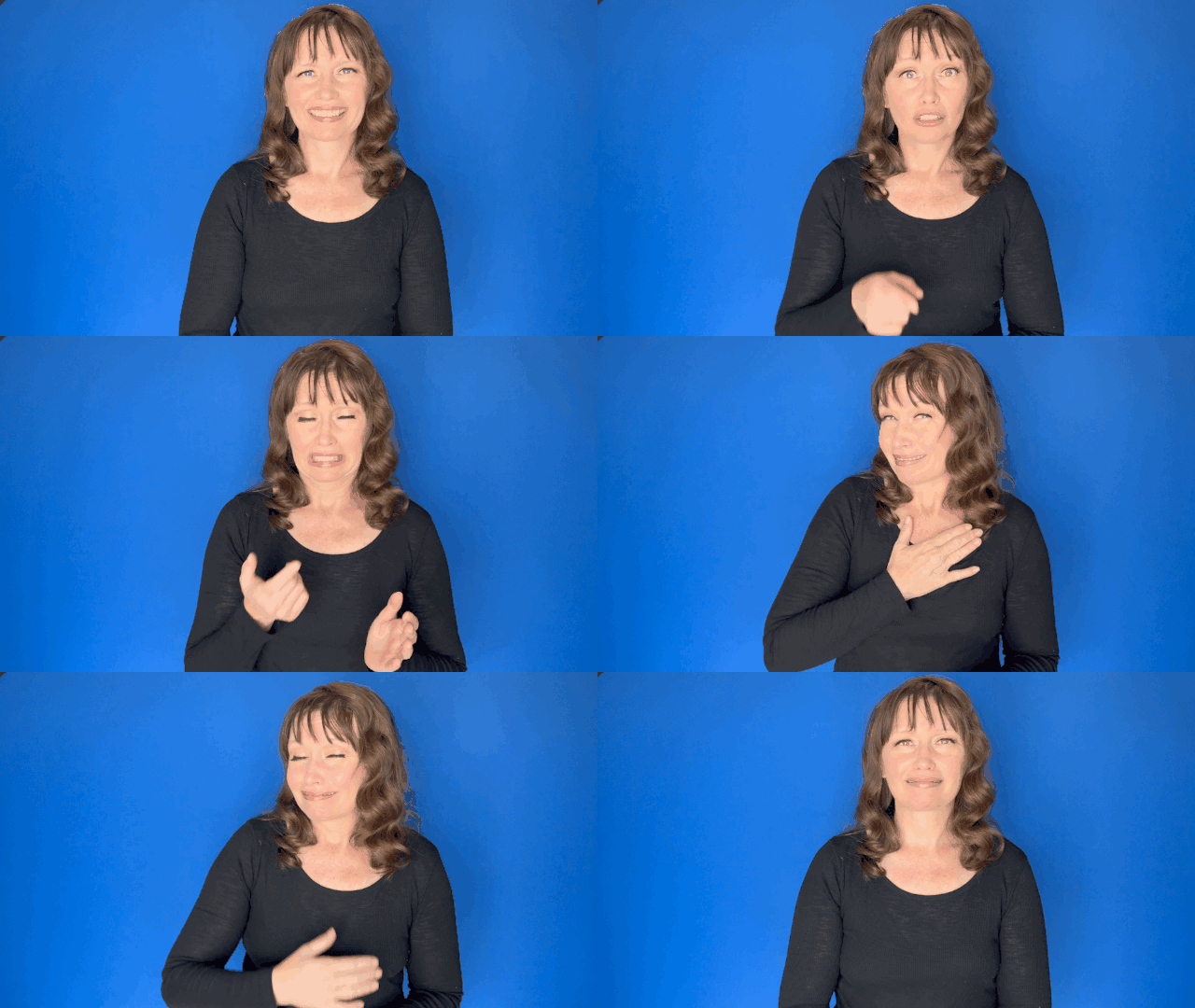
Definition: A request to say something again.
Sign for CAN YOU PLEASE SAY THAT AGAIN? in ASL

Practice Activities:
To practice the sign for CAN YOU PLEASE SAY THAT AGAIN? in ASL, begin by rehearsing each part of the phrase individually. Start with the sign for âcan,â then add the facial expression and polite tone for âplease,â and finally practice âsay again.â Once comfortable with each sign, combine them smoothly into one fluid phrase, keeping in mind the rhythm and non-manual signals that convey the tone of the question.
Use a mirror to monitor your facial expression, ensuring it shows sincerity and the request for repetition. Record yourself signing the full question and watch it back to check for fluidity and expression. Repeat the phrase while imagining different real-life scenarios that would call for clarification, such as during a noisy conversation or when speaking with someone who mumbles.
Practice full sentence drills using the sign for CAN YOU PLEASE SAY THAT AGAIN? in ASL. For example, sign: âI didnât catch that. Can you please say that again?â or âSorry, too fast! Can you please say that again?â Try these in different tonesâfrom urgent to politeâto get used to adjusting your facial expressions accordingly.
Engage in partner activities where one person signs a sentence softly or quickly, then the other uses the target phrase to request clarification. Role-play situations like taking an order at a restaurant, chatting with a new friend, or confirming classroom instructions. Each time, naturally incorporate the sign for CAN YOU PLEASE SAY THAT AGAIN? in ASL.
Storytelling prompts also encourage usage. Tell a story and have a partner interrupt using the sign any time they need clarification. This simulates real conversational interruptions and helps reinforce the phrase in context. End each session by reflecting on when this phrase might be useful in real interactions and how to use it effectively with appropriate politeness and intent.
Cultural Context:
In Deaf culture and American Sign Language (ASL), communication is visual and expressive. Gestures, facial expressions, and body language play an essential role in conveying meaning clearly. The sign for CAN YOU PLEASE SAY THAT AGAIN? in ASL is more than a simple requestâit’s a polite and visually rich way to ask for repetition.
When someone uses the sign for CAN YOU PLEASE SAY THAT AGAIN? in ASL, it often reflects a genuine need for clarity, not due to inattentiveness but to ensure accurate understanding. Visual noise, unclear signing, or unfamiliar signs can lead to the request for repetition. In Deaf culture, asking for something to be signed again is considered respectful and encouraged if it helps effective communication.
The sign for CAN YOU PLEASE SAY THAT AGAIN? in ASL is commonly used in casual and formal interactions. Whether in classrooms, work meetings, or social situations, it helps maintain smooth communication. Using this sign shows attentiveness and engagement, both valued traits in ASL-rich environments.
Unlike spoken languages where rephrasing might happen vocally without much thought, ASL values clarity and visual precision. When someone asks CAN YOU PLEASE SAY THAT AGAIN? in ASL, it signals that the signer is trying to grasp the complete message rather than just a word or two. This approach supports deeper understanding and builds mutual respect between signers.
Facial expressions matter a lot when signing CAN YOU PLEASE SAY THAT AGAIN? in ASL. A friendly or confused look can shift the meaning of the sign, making it more urgent or casual. Cultural understanding teaches that expression matters as much as handshapes and movement.
In Deaf culture, directness and honesty in communication are important. It’s not considered rude to ask for information to be repeated. The sign for CAN YOU PLEASE SAY THAT AGAIN? in ASL helps keep communication flowing respectfully and effectively.
This sign reinforces the value placed on clear and accessible communication in the Deaf community. It signals that both parties aim to understand each other completely, showing cooperation. The sign for CAN YOU PLEASE SAY THAT AGAIN? in ASL reflects a cultural norm that respects everyone’s right to full access in any conversation.
Learning to use this sign correctly means understanding not just the hand movements but also when and how to use it appropriately. Going beyond just mimicking movements, signers should know the social rules that come with it. The sign for CAN YOU PLEASE SAY THAT AGAIN? in ASL teaches about patience, respect, and community values in Deaf culture.
Whether someone
Extended Definition:
The sign for can you please say that again? in ASL is a useful and polite expression often used in everyday conversations. It helps clarify communication when someone didn’t catch what was said or needs repetition for better understanding. This phrase is especially important for ASL learners and Deaf individuals engaging in fast-paced discussions or noisy environments.
To express the sign for can you please say that again? in ASL, you typically break it down into a series of signs, including signs for âyou,â âplease,â âsay,â and âagain.â These signs are combined with facial expressions and body language to convey politeness and the need for repetition. This phrase may also be signed in a slightly abbreviated form depending on context, such as just signing âagain pleaseâ while raising eyebrows to indicate a question.
Facial expression plays a key role in the delivery of the sign for can you please say that again? in ASL. A raised eyebrow or a slight head tilt can show that you’re politely asking for clarification. This is part of ASL grammar, and using these non-manual markers properly adds to the clarity and tone of your message.
Learning the sign for can you please say that again? in ASL not only helps with communication but also shows respect for the other person. It’s a courteous way to request repetition without interrupting the flow of conversation. Social interactions in ASL often rely on understanding when and how to ask for clarification in a respectful manner.
For beginners, mastering this phrase early can boost confidence during ASL conversations. It allows learners to stay actively engaged, even when they miss part of a sentence. The ability to ask someone to repeat themselves is a valuable skill whether you’re in a classroom setting, at work, or in a social situation.
In everyday situations, the sign for can you please say that again? in ASL might also be paired with pointing, pausing gestures, and attentive eye contact. These additions help the person you’re conversing with understand that you’re fully engaged and seeking clarification. ASL users often appreciate the effort to communicate clearly and respectfully.
The phrase can be adapted depending on the formality of the setting and familiarity between speakers. Among friends, it may be shortened or signed more casually. In professional or educational contexts, signing the full phrase with a polite facial expression is more appropriate.
Understanding the sign for can you please say that again? in ASL is also helpful for interpreters and educators. It ensures communication runs smoothly and shows a commitment to inclusion and accessibility.
Synonyms: Can you repeat that?, Could you say that again?, Would you mind repeating that?, Could you please repeat yourself?, Could you go over that again?
Educational resources: Find related learning materials in our course bank!
Want more? Check out some of our popular learning activities on the homepage!
Need to look up a sign? Use our highly rated dictionary: https://aslinteractive.com/best-asl-dictionary/
Follow us on tiktok: https://www.tiktok.com/@aslinteractive. More social media links at the bottom of this page!
Long-tail Keywords: what is the sign for can you please say that again in ASL, how do you sign can you please say that again in ASL, ASL sign for can you please say that again
Categories:
tags: ASL for can you say that again, how to sign can you repeat that in ASL, ask someone to repeat in American Sign Language, can you please say that again ASL translation, American Sign Language phrase for repeat that
Parameters
*Handshape*:
The handshape for the Sign for CAN YOU PLEASE SAY THAT AGAIN? in ASL typically involves a combination of handshapes due to its multi-part nature. The dominant hand begins with an index finger pointing outward to represent “you,” and then transitions into a flat hand with fingers together, palm facing up for “please,” which circles on the chest.
To express “say,” use a flat hand or index finger starting at the chin and moving forward slightly. “Again” is signed with the dominant hand in a bent-B handshape tapping the open base palm of the non-dominant hand. The handshapes used in the Sign for CAN YOU PLEASE SAY THAT AGAIN? in ASL communicate politeness and a request for repetition.
*Palm Orientation*:
The palm orientation for the sign for CAN YOU PLEASE SAY THAT AGAIN? in ASL varies depending on each part of the phrase. For “say,” the dominant hand typically faces outward with the palm angled slightly toward the listener, indicating speech being directed at someone. When signing “again” or “repeat,” the palm usually faces sideways, allowing the curved dominant hand to move toward the non-dominant flat hand.
For the full sign for CAN YOU PLEASE SAY THAT AGAIN? in ASL, the palms rotate subtly throughout the phrase. The orientation supports the directionality of communicationâfrom the signer to the person being addressedâhelping clarify the request for repetition in a polite manner.
*Location*:
The sign for CAN YOU PLEASE SAY THAT AGAIN? in ASL is performed in the neutral space in front of the torso. The dominant hand moves from near the mouth outward, typically starting with the sign for SAY, followed by the sign for AGAIN which is placed into the palm of the non-dominant hand.
This phrase is generally signed in a smooth, polite manner to reflect the tone of the question. The signs are kept within the chest and lower face area, ensuring clear visibility and emphasis. The sign for CAN YOU PLEASE SAY THAT AGAIN? in ASL uses this space for clarity and respectfulness in conversation .
*Movement*:
To sign the phrase, first point toward the person youâre addressing using your index finger (for “you”). Then, sign “please” by making a flat hand and circling it on your chest. For “say”, tap your chin with the tip of your index finger. Finally, for “again”, place one open hand palm up while the bent fingertips of the other hand tap the center of the palm.
The movement in the Sign for CAN YOU PLEASE SAY THAT AGAIN? in ASL flows from the front of the body toward the listener in a polite manner. Facial expression is importantâraise your eyebrows slightly and lean forward to show the requesting tone. This helps convey the need for repetition clearly and respectfully.
*Non-Manual Signals*:
For the sign for CAN YOU PLEASE SAY THAT AGAIN? in ASL, raise your eyebrows slightly and lean your head forward to show interest or confusion. Maintain soft eye contact and a polite facial expression, possibly showing curiosity or a gentle question. These non-manual signals help convey that you’re respectfully requesting repetition. When using the sign for CAN YOU PLEASE SAY THAT AGAIN? in ASL, your expression should match the polite tone of the request.
*Prosody, Dominant/Non-Dominant Hand*:
The Sign for CAN YOU PLEASE SAY THAT AGAIN? in ASL uses the dominant hand for most movements. The dominant hand forms a flat hand for “please,” making a circular motion over the chest, while “say” uses the index finger tapping from the mouth outward. “Again” is signed with the dominant hand in a bent shape tapping into the palm of the non-dominant hand. Prosodic emphasis is shown through repetition or facial expression based on context.
In the Sign for CAN YOU PLEASE SAY THAT AGAIN? in ASL, the non-dominant hand serves as a base for “again,” steady and slightly angled. The dominant hand initiates most of the movements with intention and flow. Facial expression and head tilt enhance the prosody, making the request polite and clear .
Tips for Beginners:
When learning the sign for CAN YOU PLEASE SAY THAT AGAIN? in ASL, itâs important to break it down into parts rather than trying to learn it as a single phrase. You can combine signs for CAN, YOU, PLEASE, SAY, and AGAIN to form the full sentence. Practice each sign individually until you are confident with the handshape, movement, and facial expressions, then start linking them with smooth transitions.
Finger placement and palm orientation are key when building fluency with this phrase. For example, the sign for AGAIN involves a curved hand tapping onto your non-dominant palm. Make sure your movements are controlled and deliberate, especially when transitioning from SAY to AGAIN. Donât rush the sequenceâclarity is more important than speed, especially for beginners.
One of the most common mistakes when signing the phrase is using neutral or blank facial expressions. In ASL, facial expressions are essential. When you’re asking someone to repeat something, your face should show confusion or a polite request depending on how it’s used. Raising your eyebrows and tilting your head slightly forward can help convey the question.
To sign CAN YOU PLEASE SAY THAT AGAIN? in ASL naturally, observe native signers or video examples. Try practicing in a mirror to notice your facial expressions and hand movement. Record yourself and compare it to fluent ASL users. This helps catch any unintentional stiffness or errors.
Using this sign in real life improves your engagement with Deaf signers and promotes inclusive communication. Donât be shy about making mistakesâasking someone to say something again is a very human need, and the sign offers a respectful way to do that. With sufficient repetition and awareness of body language, the sign for CAN YOU PLEASE SAY THAT AGAIN? in ASL will become part of your confident signing toolkit.
sign for CAN YOU PLEASE SAY THAT AGAIN? in ASL, ask again in ASL, how to sign can you say that again in ASL, repeat that please in ASL, can you sign that again in American Sign Language
Connections to Other topics:
The sign for CAN YOU PLEASE SAY THAT AGAIN? in ASL connects closely with other essential signs like REPEAT, SAY, AGAIN, and PLEASE, which are foundational in many conversational contexts. This phrase is an excellent example of how ASL users build polite requests using a series of individual signs strung together with natural facial expressions, typically showing a questioning or apologetic expression for politeness and clarity.
In ASL, the sign AGAIN serves many functions and often pairs with other verbs to create compound or cohesive phrases. For example, AGAIN combined with SEE becomes SEE AGAIN, clearly communicating the need for something to be repeated or revisited visually. Similarly, signs like EXPLAIN AGAIN or SIGN AGAIN are related uses, showing repetition with complementary actions. This illustrates how the structure of the sign for CAN YOU PLEASE SAY THAT AGAIN? in ASL showcases ASLâs flexibility in adapting simple signs for more nuanced meaning.
This phrase also ties into broader communication strategies in ASL, such as clarification, active listening, and self-advocacy. The sign PLEASE in this context reinforces cultural norms around politeness and respect, which are integral when requesting help or repetition. In classroom or interpreter settings, the ability to sign this phrase allows Deaf individuals and signers to maintain the flow of communication without losing critical information.
The sign SAY, though a simple verb, can shift in meaning depending on non-manual markers like mouth movement and facial expressions. When used in the sign for CAN YOU PLEASE SAY THAT AGAIN? in ASL, it emphasizes spoken repetition but is also useful in asking for signed repetition, depending on context. This shows how ASL accommodates both auditory and visual communication modes, enhancing mutual understanding and inclusivity.
Using this phrase also builds fluency with WH-questions and sentence constructions in ASL, reinforcing grammar and syntax learning. It’s a meaningful step for learners aiming to participate more fully in dynamic conversations.
Summary:
The sign for CAN YOU PLEASE SAY THAT AGAIN? in ASL combines several individual concepts into a fluid, respectful request for repetition. It integrates the signs for CAN, YOU, PLEASE, SAY, THAT, and AGAIN into a complete phrase with clear intent and tone. Each component has its own sign, but when combined, certain elements may be dropped or blended depending on the context.
Grammatically, American Sign Language often omits some English words to simplify communication while keeping the core message intact. For the sign for CAN YOU PLEASE SAY THAT AGAIN? in ASL, signers may choose a more condensed form, such as combining the signs PLEASE and AGAIN to convey the request depending on the social or conversational situation. Lip movement and facial expressions help clarify any reduced forms.
The sign for CAN in this phrase uses a straightforward motion. Both hands closed into fists, palms down, push downward slightly from the wrists. This sign expresses ability or permission in many ASL contexts.
YOU is signed by pointing directly at the person being addressed using the index finger extended forward. This sign is contextually flexible and can match the spatial orientation of the person you’re communicating with.
PLEASE is typically signed with a flat hand moving in a small circle over the chest. This polite gesture signals humility or courteousness, which aligns well when making a respectful request like repeating something.
SAY can be signed by tapping the chin with the pad of the index finger near the mouth. It may also be expressed with a gesture that extends outward from the mouth to suggest speaking. SAY is often replaced by related signs such as TELL or SHOW depending on the sentence structure.
THAT is a demonstrative sign and may involve pointing or emphasizing a location or object previously identified. In this context, the sign may not be strictly necessary but can be included for clarity or to maintain English word order.
AGAIN is an essential anchor in the sign for CAN YOU PLEASE SAY THAT AGAIN? in ASL. It is signed with the dominant hand in a bent shape (like a curved five) tapping lightly into the palm of the non-dominant hand, which remains flat, palm-up. This motion visually reinforces the concept of repetition.
Facial expressions are critical in sign for CAN YOU PLEASE SAY THAT AGAIN? in ASL. One might raise their eyebrows slightly and tilt their head while maintaining an open, inquisitive expression. These non-manual markers play a vital role in softening or intensifying the query.
The cultural importance of polite repetition in ASL reveals larger values around direct but respectful communication. In Deaf culture, expressing confusion or the need for clarification is encouraged over pretending to understand for the sake of social smoothness. This promotes deeper understanding and authentic connection.
The sign for CAN YOU PLEASE SAY THAT AGAIN? in ASL is often seen in classrooms, professional settings, or new language learning environments. It serves as a valuable tool for learners or communicators in noisy spaces or when clarity is essential. Honoring the request emphasizes mutual respect and inclusivity.
Because ASL prioritizes meaning over exact English translations, learners may need to adapt the sign for CAN YOU PLEASE SAY THAT AGAIN? in ASL to different scenarios. For example, a teacher may use a more formal or complete variant when addressing a group, while a friend might use shortened forms casually.
In applied linguistics, this phrase offers insight into turn-taking and repair in signed dialogues. Asking for repetition is a metalinguistic behavior that helps manage interaction flow and comprehension. It shows the sophistication of ASLâs pragmatic structures.
The linguistic elements of the sign for CAN YOU PLEASE SAY THAT AGAIN? in ASL include space, facial expression, classifier use (when applicable), and movement precision. Learners must balance clarity of each sign with fluid expression to maintain natural signing rhythm.
For example, the signs CAN, SAY, and AGAIN involve directional or palm orientation shifts. Incorrect movement can result in misinterpretation or confusion. For this reason, proper handshape and spatial accuracy are critical.
The sign for PLEASE in this question emphasizes the importance of politeness strategies in ASL. While tone in English is often vocal, politeness in ASL must be expressed visually. This includes gentle signing speed, non-aggressive movements, and positive facial affect.
Socially, repeating a statement for someone and receiving that request signals patience and shared understanding. Deaf culture emphasizes accessible communication, and the sign for CAN YOU PLEASE SAY THAT AGAIN? in ASL reflects these values beautifully. It fosters patience and inclusivity between signers.
Educationally, this sign supports deaf and hard-of-hearing students in asking peers or instructors to repeat key concepts. It empowers students to advocate for clearer understanding with confidence. Hearing individuals learning ASL can also use this phrase to show engagement.
The phrase connects to related signs like REPEAT, CLARIFY, WHAT, or UNDERSTAND?. Understanding these relationships helps learners choose the most context-appropriate way to ask about information they missed. This improves conversational efficiency and
Want more? Check out some of our popular learning activities!
ASL Interactive Resources
ASLInteractive YouTube Channel
Follow us on tiktok: @aslinteractive.com
Follow us on Instagram: aslinteractive
Facebook page: aslinteractive
Facebook group: aslinteractive
LInkedIn: ASL Interactive LLC
Twitter: @ASL_interactive
*Some information on this page is AI-generated. AI can make mistakes. Please check the information.


Responses