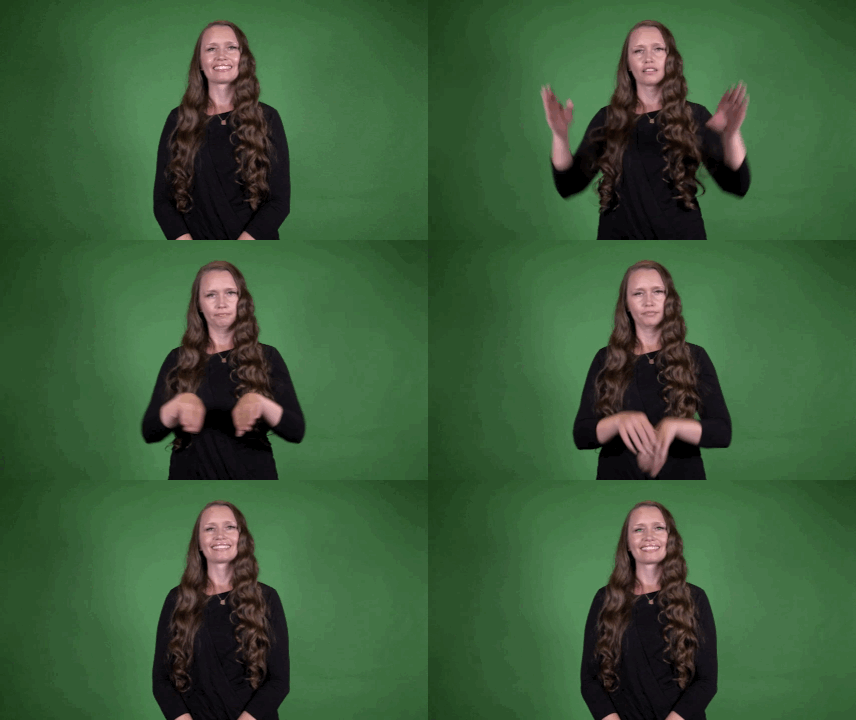
Definition: A canyon is a deep, narrow valley with steep sides, often carved by a river over millions of years.
Sign for CANYON in ASL

Practice Activities:
To build fluency with the sign for CANYON in ASL, begin by practicing the sign in isolation in front of a mirror. Focus on handshape, movement, and spatial awareness, as the sign mimics the steep, narrow divide of cliffs or walls. Try signing it at different speeds to build muscle memory.
Next, incorporate the sign for CANYON in ASL into simple ASL sentences. For example, practice “I saw a canyon” or “The canyon is beautiful.” Record yourself signing these sentences and compare them to fluent signers or instructional materials to fine-tune your production.
Create a visual storytelling prompt by describing a hike or travel experience where a canyon plays a key part. Use signs like MOUNTAIN, WALK, STOP, SEE, and BEAUTIFUL alongside the sign for CANYON in ASL. This helps strengthen your ability to use the sign naturally within longer narratives.
Engage in a partner activity where one person describes a landscape, and the other sketches it out, identifying when they hear the sign for CANYON in ASL. This strengthens receptive skills and reinforces the visual connection between the sign and its meaning.
Flash card drills are helpful for quick recall. Mix the sign for CANYON in ASL with related signs like RIVER, DESERT, HILL, and VALLEY. Use each in visual scenarios, asking yourself or a practice partner to identify and sign them rapidly.
Lastly, watch nature videos or documentaries with beautiful landscapes and practice describing the terrain in ASL. Pause during scenes of gorges or geological features and use the sign for CANYON in ASL to describe what you see. This promotes real-world application and visual literacy.
Cultural Context:
The sign for canyon in ASL reflects the geographical features that inspire curiosity, exploration, and storytelling. In American Deaf culture, presenting natural landscapes visually is a vital part of expressing experiences. Using ASL to convey these grand outdoor features allows signers to be descriptive and culturally rich in their communication.
When learning the sign for canyon in ASL, it’s helpful to understand how Deaf culture values environmental expression. Signers often use space, hand shapes, and direction to bring natural features to life. The use of classifiers to shape the visual experience is integral to how ASL depicts canyons and other landmarks.
Canyons are often tied to stories about travel, hiking adventures, or cherished family memories. Sharing these stories in ASL uses spatial awareness and visualization that bring the scene directly into the conversation. The sign for canyon in ASL reflects that spatial element, mimicking how steep cliffs or deep valleys are experienced visually.
In Deaf storytelling traditions, nature plays a strong role in creating dynamic narratives. When a signer uses the sign for canyon in ASL, they’re not just labeling a place—they’re recreating the environment. This mirrors how Deaf individuals engage with the world around them and share that experience with the Deaf community.
Nature signs like canyon are often introduced in Deaf education programs to encourage children to connect with the environment through language. Understanding the sign for canyon in ASL helps learners build vocabulary tied to geography and adventure. These signs also empower students to talk about field trips or national parks with authenticity and vivid detail.
Using the sign for canyon in ASL can also connect Deaf individuals with cultural or ancestral heritage. Many Native American communities have Deaf members who use ASL to describe sacred land formations. Canyon signs can capture both the spiritual and visual essence of these places, building deeper cultural ties.
Social media and storytelling among Deaf influencers often highlight outdoor adventures. When content creators use the sign for canyon in ASL in their videos, it builds shared visual experiences for viewers. These moments create ASL-rich environments online that celebrate Deaf identity and scenic exploration.
For many in the Deaf community, traveling to places like the Grand Canyon becomes even more meaningful when sign language is used to describe the setting. ASL signs like canyon help transform sightseeing into shared visual dialogue. Describing the depth and width of a canyon in ASL adds a powerful dimension of inclusion and accessibility.
The sign for canyon in ASL is more than a translation—it’s a linguistic bridge to nature, experience, and culture. As Deaf individuals
Extended Definition:
The sign for canyon in ASL uses spatial referencing to represent the deep, steep walls of a canyon. It typically involves both hands held upright, with palms facing each other, moving outward and downward to show the steep, carved-out sides of a canyon. This visual approach in American Sign Language helps communicate the unique depth and shape that defines a canyon.
When learning the sign for canyon in ASL, it’s helpful to imagine how a canyon appears from a bird’s-eye view. The hands mimic the rising rock formations on either side of a narrow valley. That type of iconic representation is common in ASL, where shapes and movements reflect real-world visual concepts.
The sign for canyon in ASL, like many geography-related signs, taps into the broader category of natural landmark signs. It shares some elements found in signs like valley, mountain, or river, but is distinct in the way it focuses on vertical depth and separation between two steep sides. Conveying natural locations visually makes these types of signs intuitive for native and new signers alike.
In educational settings, the sign for canyon in ASL is often used when discussing earth science or geography. It’s taught alongside signs for landforms and natural features to help build vocabulary related to the environment. This helps both deaf and hearing students engage more deeply with descriptive language and real-world knowledge.
When describing a famous site like the Grand Canyon, signers might combine the sign for canyon in ASL with fingerspelling or a proper noun sign. This is a common strategy in ASL to keep communication clear and specific. It allows the signer to indicate both the general concept of a canyon and the exact place being discussed.
Facial expressions are also an important part of the sign for canyon in ASL. You might see raised eyebrows or widened eyes to emphasize the scale and grandeur of the location. These non-manual signals help give context, like awe or size, enhancing the meaning of the sign without adding extra words.
Because sign language is visual and spatial, the sign for canyon in ASL is especially effective in storytelling or descriptive narratives. Whether talking about a hike through a desert canyon or sharing travel memories, this sign helps paint a vivid picture that’s easy to understand. It engages the viewer by mimicking natural forms right in front of them.
Regional variations of the sign for canyon in ASL may exist depending on the area or community using it. Some signers may incorporate more dramatic hand movements, while others may keep it subtle. These variations are normal in
Synonyms: gorge, ravine, valley, chasm, gulch
Educational resources: Find related learning materials in our course bank!
Want more? Check out some of our popular learning activities on the homepage!
Need to look up a sign? Use our highly rated dictionary: https://aslinteractive.com/best-asl-dictionary/
Follow us on tiktok: https://www.tiktok.com/@aslinteractive. More social media links at the bottom of this page!
Long-tail Keywords: The leading international sporting event featuring summer and winter sports competitions.
Categories:
tags: canyon, Arizona landmarks, geography, nature, travel
Parameters
*Handshape*:
The handshape used in the sign for CANYON in ASL typically involves both hands in a curved “C” formation. These “C” hands represent the steep walls of a canyon and are held upright with palms facing each other.
To produce the sign for CANYON in ASL, move the “C” hands downward and slightly apart to show the depth or spacing of the canyon walls. This creates a clear visual representation of a canyon’s formation.
*Palm Orientation*:
The palm orientation for the sign for CANYON in ASL involves both hands held in a vertical position with palms facing each other. The hands are typically placed several inches apart to represent the narrow walls of a canyon.
As you perform the sign for CANYON in ASL, your hands move downward simultaneously, mimicking the descending walls of the canyon. The consistent inward-facing palms help illustrate the deep and narrow space between cliffs .
*Location*:
The sign for canyon in ASL is produced in the neutral space in front of the torso. Both hands start near each other, slightly below chest level, and then move outward to each side, mimicking the shape of two cliffs or canyon walls. This sign visually represents the wide space and separation of canyon walls.
When using the sign for canyon in ASL, keep your hands just in front of your body and at mid-torso height. This neutral area allows for clear visibility and natural movement, which helps in depicting the vastness and depth associated with a canyon.
*Movement*:
The sign for CANYON in ASL uses both hands in curved 5-handshapes, starting in front of the body with palms facing each other. The hands move downward and outward simultaneously, creating a visual space between them to represent the steep sides and depth of a canyon.
This widening motion helps convey the idea of geological separation seen in canyon formations. The sign for CANYON in ASL visually matches the landscape feature it describes, enhancing clarity .
*Non-Manual Signals*:
While performing the sign for canyon in ASL, the facial expression should reflect awe or a sense of vastness, often with slightly widened eyes and raised eyebrows. This NMS helps convey the immense size and depth typically associated with a canyon ️.
A slight head nod or lean to either side enhances the visual space created between the hands, supporting the structure of the sign for canyon in ASL. Keep the face relaxed but engaged to maintain clarity and emphasis.
*Prosody, Dominant/Non-Dominant Hand*:
The sign for CANYON in ASL uses both hands to mimic the shape of a canyon. The dominant hand and non-dominant hand are typically in flat “B” handshapes, positioned palm-in facing each other. Both hands move downward simultaneously while separating slightly, representing the walls of a canyon.
This symmetrical movement helps visually depict the geographical structure referenced by the sign for CANYON in ASL. Ensure consistent spacing and fluid motion for clarity.
Tips for Beginners:
When learning the sign for CANYON in ASL, it’s important to pay attention to handshape, placement, and movement. This sign typically involves the use of both hands to visually represent the two tall sides of a canyon. Beginners should focus on keeping the hands upright and in a parallel position while slowly pulling them apart to show depth and distance. Maintaining equal spacing and fluid movement helps convey the visual structure clearly.
A common mistake when practicing the sign for CANYON in ASL is not maintaining even spacing between the hands or moving them at inconsistent speeds. It’s essential to keep both hands aligned vertically and ensure your motion is steady. Exaggerated or uneven movement can confuse the meaning, so practice in front of a mirror to monitor your symmetry.
Facial expressions also help clarify meaning in ASL. When signing a large geographical feature like a canyon, your facial expression should reflect something expansive or awe-inspiring. This non-manual marker adds context and emotion to the sign, helping the viewer interpret your message more naturally and effectively.
Practice signing in front of others or with a partner to get feedback on accuracy. Sometimes subtle changes in hand orientation or movement can change the meaning, so real-time corrections will help prevent the formation of bad habits. Recording yourself can also offer insight into how your signing appears from a viewer’s perspective.
As you become more comfortable, try using the sign for CANYON in ASL within longer sentences or descriptive phrases. This will help you internalize its use and make it easier to recall during conversations. Focus on the visual metaphor of the sign—understanding what your hands are representing makes it easier to remember and produce confidently when signing in real life.
Connections to Other topics:
The sign for CANYON in ASL is closely related to other geographical and topographical signs in the language. It often pairs contextually with signs like MOUNTAIN, RIVER, or DESERT when describing natural landscapes. Understanding how to transition between these signs smoothly can help create vivid, spatially accurate depictions in storytelling or educational settings.
This sign visually represents the cliffs or walls of a canyon, often made using both hands to show the depth and separation typical in canyons. It can be closely connected to directional or spatial classifiers, which are frequently used in ASL to show the size and orientation of landforms. For example, a signer might use classifiers before or after the sign for CANYON to further specify width, depth, or movement through the space.
Learners will benefit from seeing how the sign for CANYON in ASL fits into compound or descriptive phrases. When telling stories or providing information about famous landmarks like the Grand Canyon, one might pair CANYON with the sign for BIG, BEAUTIFUL, or FAMOUS. This allows for rich visual storytelling, which is a valued feature of ASL narratives.
This sign also connects to educational ASL conversations, especially in science or geography topics where physical landforms are discussed. Teachers might use the sign for CANYON in ASL alongside signs like VALLEY, HILL, or CLIFF to compare features. These connections help build a comprehensive vocabulary set for describing natural environments.
Using this sign can spark deeper engagement with three-dimensional space in ASL. Because ASL is a visual-spatial language, using body orientation and hand positioning helps to paint a mental map for the viewer. This is particularly important in environmental descriptions and Deaf community storytelling traditions where precision and imagery are key.
Summary:
The sign for CANYON in ASL is both poetic and spatial, capturing the essence of natural formation through a visual-spatial representation. The movement of the hands mimics the contours and depth of a canyon, typically using both hands to create the idea of opposite cliff faces with a space in between. This spatial arrangement helps convey not just the object, but its scale and grandeur—a defining characteristic of canyons.
To produce the sign, the dominant and non-dominant hands generally start in vertical flat handshapes, facing each other, palms inward, and spaced apart. The hands then move downward in a slightly wavy path to indicate the steep walls of a canyon. The motion and shape visually suggest the descent and natural carving of a canyon, as if tracing the geological formation with the fingers.
The sign for CANYON in ASL leans heavily on iconicity, a linguistic feature where the form of a sign resembles its meaning. This is a common trait in ASL and other signed languages, particularly for terms tied to the natural world. Iconicity provides immediate context and intuitive understanding for users, making geographic and landscape signs such as this more accessible.
In contextual use, the sign for CANYON in ASL appears primarily when discussing geography, travel, or environmental features. It is commonly used in stories, educational settings, and travel-related conversations. Visual storytelling in ASL lends itself naturally to signs like this, where size classifiers and movement can dramatically illustrate the vastness of a canyon.
There can be variation in how individuals sign CANYON depending on regional differences or the level of detail the signer wishes to express. Some may incorporate classifier structures (CLs) to expand on the basic sign, adding gestures to specify width, depth, or whether the canyon has layered rock faces. This adaptability ensures that the sign can grow with conversational or storytelling needs, adding richness and precision.
The classifier use in ASL related to the sign for CANYON highlights ASL’s morphological complexity. Classifiers are an essential part of ASL grammar and allow speakers to describe spatial relationships and physical characteristics in a compact and efficient way. For canyons, classifiers can depict winding pathways, curved cliff faces, or wide-open gaps depending on their usage.
Grammatically, the sign functions as a noun and fits syntactically in locations where a noun phrase would appear. It can be modified with adjectives like “deep,” “narrow,” or “beautiful” through facial expressions and changes in movement or classifier use. In a sentence, the sign for CANYON can stand alone or become part of a larger referential space that builds an entire scene.
There’s a strong cognitive component to the way spatial concepts are represented non-linearly in ASL. Where English might describe sequential steps or layers, ASL can create a momentary three-dimensional construction of the canyon and its surrounding landscape. This visual-spatial logic enhances comprehension and expressive detail, especially for abstract or grand formations like a canyon.
Related signs include MOUNTAIN, RIVER, VALLEY, and ROCK, which may often accompany CANYON in storytelling or education. These signs can work together to paint comprehensive images of landscapes. They demonstrate the semantic fields in ASL where heuristically linked concepts cluster, allowing for rich, environmental descriptions.
The sign for CANYON in ASL also serves as a cultural marker, connecting the Deaf community to geography and outdoor experiences. Whether recounting travel experiences to places like the Grand Canyon or discussing climate and geology, the sign reflects Deaf engagement with the natural world. Outdoor education programs serving Deaf youth make use of signs like CANYON to build knowledge and communication around ecological environments.
In literature and Deaf folklore, nature plays an important role, and signs like CANYON are part of that symbolic language. When used in visual storytelling or poetry, the sign can take on more than just a literal meaning—invoking themes of vastness, solitude, division, or grandeur. Thus, the sign for CANYON in ASL can operate metaphorically as well as descriptively.
From a pedagogical standpoint, teaching the sign for CANYON in ASL offers opportunities to integrate geography and visual language learning. In bilingual education environments, students can explore not only the physical representation but also how the sign connects to broader Earth science topics. This intersection between ASL and academics supports multi-modal learning and deeper engagement.
Technology has influenced how signs like CANYON are taught and shared. ASL dictionaries and video platforms give visual access to the sign, sometimes offering multiple variations or classifier subsets for clearer context. Through these platforms, new learners can observe how the sign adapts in real-time examples and how expressive it can become depending on narrative style.
Linguistically, the sign for CANYON in ASL belongs to a category of signs that rely on spatial metaphors. This is a hallmark of signed language: grounding meaning in the body and the use of three-dimensional space to represent
Want more? Check out some of our popular learning activities!
ASL Interactive Resources
ASLInteractive YouTube Channel
Follow us on tiktok: @aslinteractive.com
Follow us on Instagram: aslinteractive
Facebook page: aslinteractive
Facebook group: aslinteractive
LInkedIn: ASL Interactive LLC
Twitter: @ASL_interactive
*Some information on this page is AI-generated. AI can make mistakes. Please check the information.


Responses