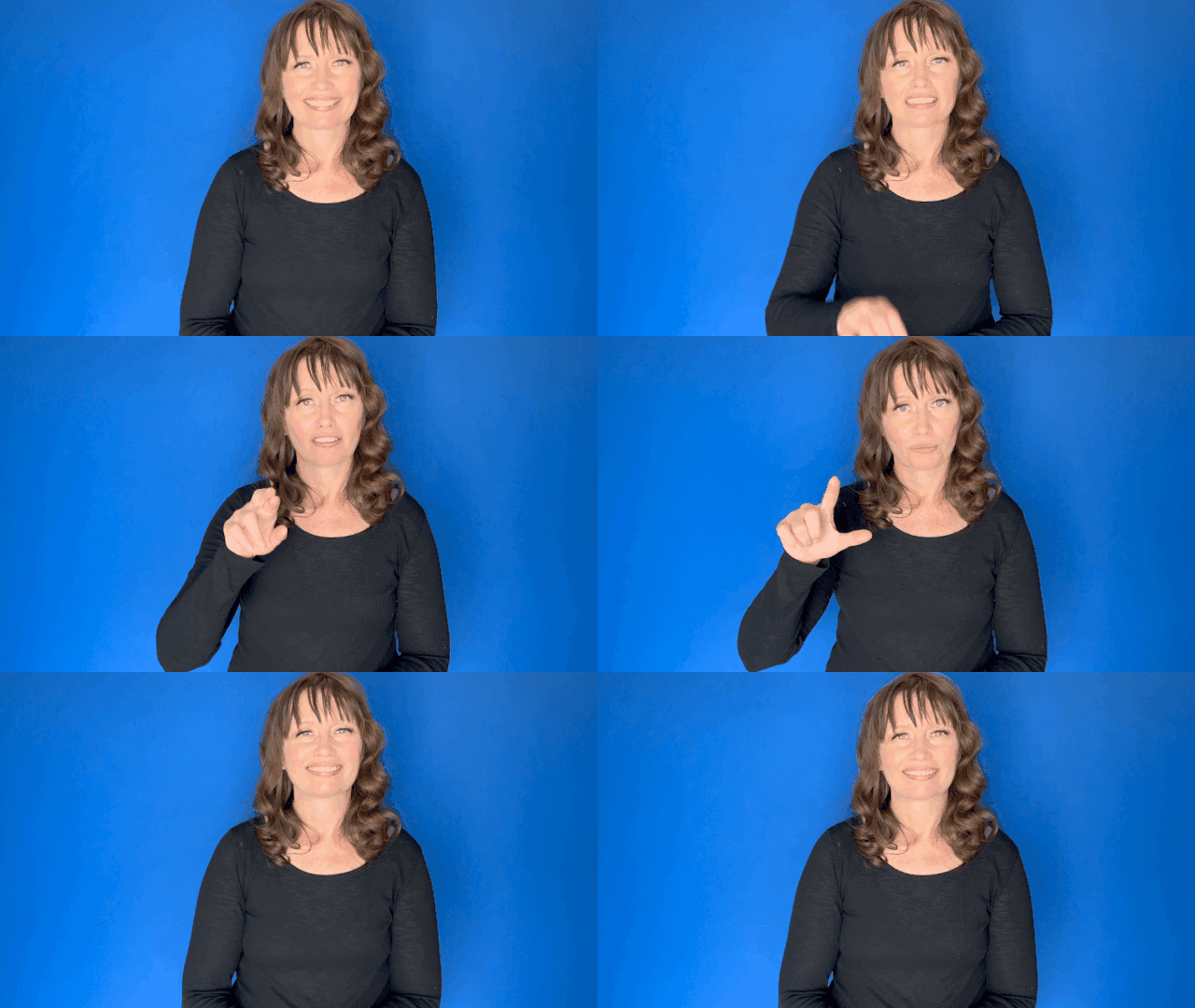
Definition: A system where people share rides.
Sign for CARPOOL 1 in ASL

Practice Activities:
To practice the sign for CARPOOL 1 in ASL, begin by isolating the sign and repeating it multiple times in front of a mirror. Focus on handshape, movement, and facial expressions. Record yourself and compare it to a native signer to ensure accuracy. This repetition helps build muscle memory and confidence in using the sign correctly.
Use the sign for CARPOOL 1 in ASL within short phrases like “I carpool every morning” or “We carpool to work.” Sign these sentences slowly at first, then increase your pace as you grow more comfortable. Reinforce learning by signing while imagining real-life scenarios such as discussing a morning routine or planning a ride-sharing schedule.
Pair up with another learner and role-play common carpooling dialogues. One partner can ask, “Do you want to carpool today?” and the other responds appropriately. Take turns initiating conversations, and vary the contexts such as work, school, or weekend events. Add in signs for time, location, and number of people for natural practice.
Try creating a simple story involving multiple people carpooling to an event. Incorporate details like who is driving, where they are going, and why they are sharing the ride. This narrative approach builds fluency and helps you see how the sign for CARPOOL 1 in ASL fits within broader communication.
Watch vlogs or ASL videos discussing transportation or commuting, and identify the sign each time it appears. Pause and copy the sign, then try to summarize what you saw using your own signs. This helps with receptive as well as expressive skills.
Label different roles in a carpool setup such as driver, passenger, and schedule using signs or written prompts. Then, practice signing your responsibilities or typical carpool routine using the sign for CARPOOL 1 in ASL multiple times throughout.
Cultural Context:
Understanding the sign for carpool 1 in ASL allows members of the Deaf community to clearly express an important aspect of daily life. Carpooling is more than just a means of transportation; it reflects shared responsibility, environmental awareness, and community cooperation. Being able to communicate this concept in American Sign Language reflects the value placed on inclusion and accessibility in modern society.
In American culture, the idea of sharing a ride to work, school, or events is common. The sign for carpool 1 in ASL helps Deaf individuals engage in this conversation with their peers, employers, or friends. Whether planning a rideshare or organizing a commute, this ASL sign ensures clear and efficient communication.
Deaf culture places high importance on clarity and visual communication, which is why learning the sign for carpool 1 in ASL is essential. It allows for quick coordination between friends or family members who are traveling together. For Deaf individuals who rely on ASL as their primary way of interacting with the world, having a distinct sign helps bridge the gap in everyday logistics.
In urban areas where carpooling is encouraged to reduce traffic congestion and lower environmental impact, knowing the appropriate ASL signs becomes even more relevant. Public campaigns and employer incentives for carpooling often involve active participation from everyone—including Deaf professionals. The sign for carpool 1 in ASL empowers Deaf individuals to advocate for themselves and participate fully.
Understanding American driving culture also helps explain the need for the sign for carpool 1 in ASL. With long commutes and high fuel costs, many opt to carpool as an economic and social strategy. This sign helps describe not just the act of sharing a vehicle, but also promotes sustainability and teamwork within the Deaf community.
Educational environments often promote ridesharing to save resources and build community among students or faculty. Using the sign for carpool 1 in ASL ensures that Deaf participants are included in these important conversations. It supports autonomy by enabling Deaf individuals to ask for or offer carpool options with ease.
In community events or group travel situations, carpooling is frequently coordinated quickly and informally. The sign for carpool 1 in ASL helps streamline this communication in Deaf spaces. It enhances efficiency and helps promote seamless involvement in group logistics.
Deaf culture emphasizes mutual support, a value echoed in the concept of carpooling. The sign for carpool 1 in ASL helps reinforce this cultural norm of helping others through shared space and responsibility. Whether traveling to
Extended Definition:
The sign for carpool 1 in ASL is a useful addition to everyday American Sign Language, especially for conversations about transportation and commuting. This version of the sign focuses on a common interpretation of shared car travel, where individuals take turns driving or ride together to reduce costs and environmental impact. The sign typically uses a combination of handshapes and movements that suggest the interaction between people and a vehicle.
In this version, the sign for carpool 1 in ASL begins with a flat hand to represent the vehicle or car. Then, a modified movement involving clasping or alternating fingers may indicate the group nature of the arrangement. This sign visually conveys the concept of multiple people gathering in one vehicle to travel somewhere together.
The concept of a carpool is rooted in resource sharing and eco-friendly living. The ASL version 1 of the sign captures the practical and communal nature of this idea. When learning the sign, it’s important to also grasp how expression and situational context support the physical gesture.
ASL users often modify signs depending on the context or the number of participants involved. The sign for carpool 1 in ASL reflects a standard or simpler form that can be easily understood across different signing communities. This makes it an effective and accessible choice for learners just starting out with transportation-related vocabulary in ASL.
When signing carpool 1 in ASL, it helps to think about the idea of inclusion and shared space. The movement might also be accompanied by facial expressions that mirror the feeling of cooperation among travelers. This way, you communicate not only the idea but also the intent behind the concept.
In real-life usage, you might use the sign for carpool 1 in ASL when discussing plans with coworkers, schoolmates, or friends about shared rides. It appears in contexts like workplace discussions, school transportation plans, and community sustainability efforts. This makes it a valuable sign for both formal and informal conversations.
Learning the sign for carpool 1 in ASL enables more effective communication around essential daily habits. It supports social interactions that involve routine activities such as going to work, shopping, or traveling to events. The ability to express this clearly makes a big difference in organizing shared travel plans in the Deaf community.
In ASL, visual clarity and hand positioning are key. Take the time to practice the sign facing a mirror or with a conversation partner. By understanding the sign for carpool 1 in ASL, learners build vocabulary that belongs to a larger group of transportation and lifestyle
Synonyms: ride-share, ride together, shared ride, car-sharing, commuting together
Educational resources: Find related learning materials in our course bank!
Want more? Check out some of our popular learning activities on the homepage!
Need to look up a sign? Use our highly rated dictionary: https://aslinteractive.com/best-asl-dictionary/
Follow us on tiktok: https://www.tiktok.com/@aslinteractive. More social media links at the bottom of this page!
Long-tail Keywords: What is the sign for carpool in ASL, how do you sign carpool in ASL, ASL sign for carpool
Categories:
tags: carpool in ASL, how to sign carpool in ASL, ASL sign for carpool, American Sign Language carpool, learn carpool in ASL
Parameters
*Handshape*:
The handshape used in the sign for CARPOOL 1 in ASL typically involves both hands. The dominant hand forms an open 5-handshape while the non-dominant hand also uses a 5-handshape, representing multiple people or participants.
This sign shows individuals coming together, similar to the concept of sharing a ride. The sign for CARPOOL 1 in ASL visually reflects the idea of multiple passengers commuting together using open, inclusive handshapes. ️
*Palm Orientation*:
In the sign for CARPOOL 1 in ASL, both hands typically take on a modified “C” shape, mimicking the concept of multiple people sharing one vehicle. The palm orientation of the dominant hand usually faces inward, while the non-dominant hand may also face inward or diagonally upward, depending on the variation of this sign.
This hand positioning supports the visual metaphor of people being connected in a shared space. The sign for CARPOOL 1 in ASL conveys the concept of collective travel with palm orientations that guide the movement and relationship between hands.
*Location*:
The sign for CARPOOL 1 in ASL is typically produced in the neutral space in front of the torso, slightly closer to the body. Hands are positioned at chest level, allowing comfortable articulation of the movement and interaction between handshapes. This central location supports clarity and visibility for conversational signing.
During the sign for CARPOOL 1 in ASL, the signer maintains hand positioning within the mid-torso area to visually represent the concept of shared vehicle use. This consistent location enhances recognition and reinforces the shared nature of a carpool.
*Movement*:
To sign the Sign for CARPOOL 1 in ASL, begin with your dominant hand in the “C” handshape and your non-dominant hand in the same shape. Place the hands side by side slightly in front of your chest. Then move both hands forward in a short, simultaneous bouncing motion, mimicking multiple people riding together. This movement represents the shared ride concept central to the Sign for CARPOOL 1 in ASL.
*Non-Manual Signals*:
When demonstrating the sign for CARPOOL 1 in ASL, use a neutral expression or a slight nod to indicate action or agreement, depending on context. Slight eye movement may accompany the sign to show the involvement of others or to spatially reference passengers.
Eyebrows are typically in a neutral position unless clarifying questions are involved, in which case they may raise slightly. The sign for CARPOOL 1 in ASL benefits from natural eye gaze following the dominant hand movement to show direction or participation.
*Prosody, Dominant/Non-Dominant Hand*:
The sign for CARPOOL 1 in ASL uses both hands. The dominant hand forms a modified “C” shape, while the non-dominant hand remains stationary, palm facing inward. The dominant hand moves as if clasping or grouping, symbolizing individuals sharing a ride. Depending on the variation, both hands may interlock slightly or mimic grabbing motions to emphasize the shared aspect.
This formation visually conveys the meaning of carpooling through group inclusion. The use of both hands reinforces the communal nature of the sign for CARPOOL 1 in ASL, where movement and positioning work in tandem to communicate shared transportation.
Tips for Beginners:
When learning the sign for CARPOOL 1 in ASL, it’s important to first observe how role-shifting and classifiers play into the movement. ASL often uses a handshape that mimics gripping or people being in the same vehicle, so keep your hands relaxed but deliberate when practicing this sign. Don’t rush the motion; maintain control and consistent timing so the movement doesn’t appear sloppy.
Begin by watching fluent signers demonstrate the sign for CARPOOL 1 in ASL several times. Videos from native ASL users are especially helpful. Try to mirror their movements exactly as you practice. Record yourself and compare with reference material to catch subtle errors in hand shape or palm orientation.
One common beginner mistake is making the handshape too stiff or too loose, which can make the sign unclear or visually confusing. Also, be sure your facial expressions match the context—whether you’re describing a daily commute or an occasional ride-share. This extra context provides clarity and depth to your communication and helps others understand more easily.
Practice the transition between each part of the sign for CARPOOL 1 in ASL in slow motion at first, then gradually increase your speed. Signing too fast while learning can lead to mistakes and cement bad habits. Slow and accurate beats fast and sloppy every time.
Use a mirror to check whether you’re maintaining proper hand alignment and spacing. The sign involves spatial awareness, so it’s crucial not to sign too close to your body or too far from your neutral space.
Finally, try using the sign in phrases or full sentences to increase fluency. The more you embed the sign for CARPOOL 1 in ASL in real-world contexts, the better your retention and understanding will be. Consistent daily practice is key . Ask Deaf friends or ASL mentors for feedback to make steady progress .
Connections to Other topics:
The sign for CARPOOL 1 in ASL connects closely with signs related to transportation, such as CAR, DRIVE, and SHARE. This relationship helps learners build a semantic network of related vocabulary, which can strengthen retention and understanding. Since carpooling inherently involves multiple people sharing a vehicle, the concepts of TOGETHER, GROUP, or PEOPLE are also relevant and can be combined thematically in conversation.
This sign also ties into broader discussions around environmentalism and community living in Deaf culture. For instance, when discussing eco-conscious travel options, the sign for CARPOOL 1 in ASL may be used alongside signs like SAVE, EARTH, and GAS to emphasize the benefits of sharing rides. In educational or workplace settings, this sign is also useful when talking about schedules, planning, or transportation logistics with signs like TIME, MEET, or WORK.
Compound signs built from similar base signs include concepts like RIDESHARE or VANPOOL, although some of these may use classifiers to describe the number of people and type of vehicle. For instance, a signer may use a classifier for a group of people entering a car to clarify carpooling visually, even if the sign for CARPOOL 1 in ASL has already been established in the conversation. These classifiers support spatial referencing and create more detailed depictions of action.
The sign for CARPOOL 1 in ASL can also be connected to everyday dialogues about school and family routines, especially when discussing picking up children or commuting with coworkers or neighbors. Related signs like SCHOOL, FAMILY, or FRIEND are frequently used in these conversations. Using CARPOOL in sentences with GO, COME, or HOME helps beginners form full expressions while applying situational context.
Understanding this sign’s relationship to other transport and group-based concepts contributes to more fluid conversations in ASL and supports thematic learning, which enhances memory and daily use.
Summary:
The sign for CARPOOL 1 in ASL involves a specific movement demonstrating shared transportation. It usually begins with one hand representing a vehicle and the other indicating people getting in together. This motion conveys the collaborative nature of carpooling visually through spatial grammar.
This sign is a good example of visual metaphor in ASL, where actions mimic real-life events. The movement and space used underscores the idea of unity and community effort in riding together. It visually paints the act of strangers or coworkers joining to commute.
In ASL, signs are often modified depending on context or emphasis. The sign for CARPOOL 1 in ASL can be paired with signs for work, school, or home to clarify where the ride is going. Modifiers like these help the signer explain daily routines more precisely and naturally.
Grammatically, the sign for CARPOOL 1 in ASL can be a noun or incorporated into a verb phrase. For instance, one might sign CARPOOL combined with GO or PICK-UP to describe picking someone up. Context always plays a key role in shaping how the sign fits into the sentence.
The sign for CARPOOL 1 in ASL reflects the practical, time-saving culture often found in urban and suburban areas. Signers in cities where carpool lanes are a thing may use this sign with a stronger sense of familiarity. It’s tied not just to transportation, but to the lifestyle of a shared commute.
Culturally, the idea of carpooling can evoke environmental activism. The Deaf community, like the wider world, increasingly values actions that lower carbon footprints. Using the sign for CARPOOL 1 in ASL could expand into a broader conversation about eco-conscious transportation.
This sign also fits within a cluster of transportation-related vocabulary in ASL. Related signs include RIDE, DRIVE, PICK-UP, DROP-OFF, and HOME. Together, they help one describe a complex trip or commute in ASL without needing fingerspelling.
The sign for CARPOOL 1 in ASL uses lexicalization when the meaning is understood without explaining the concept. A Deaf native signer may perform it quickly, assuming others understand the concept. For learners, breaking down the sign helps with accurate usage.
Applied linguistics reveals how this sign is iconic, utilizing ASL’s spatial and kinetic advantages. The signer shows multiple people entering a shared vehicle, embodying the concept in motion. This helps make the meaning self-evident even to those new to the sign.
ASL uses classifiers to show relationships between people, objects, and movement. The sign for CARPOOL 1 in ASL typically integrates a vehicle classifier. The motion accompanying the classifier shows shared occupancy, reinforcing the meaning visually.
Technological evolution also shapes ASL vocabulary. As apps for carpooling grow (like Uber Pool), the sign for CARPOOL 1 in ASL might broaden to include these new meanings. With time, a more specific variation might arise to distinguish traditional carpooling from commercial rideshare.
This adaptability is what makes ASL so unique—it’s always changing. The sign for CARPOOL 1 in ASL today might evolve as commuting behaviors shift in society. Signers find new ways to capture cultural relevance in existing signing structures.
Classroom discussions about transportation often include the sign for CARPOOL 1 in ASL. Teachers use it to illustrate how ASL adapts functional concepts effortlessly. For Deaf students, this sign becomes an anchor for discussing weekly routines and scheduling.
Socially, carpooling can imply coordination and mutual reliance. Within the Deaf community, coordination and planning are central themes. The sign for CARPOOL 1 in ASL may then carry secondary social values like loyalty and time management.
The role of plurality is also key when analyzing the sign. ASL rarely uses a separate plural suffix. Instead, repetition or directional motion toward multiple imaginary people shows that several people are riding together in the sign for CARPOOL 1 in ASL.
Phonologically, the sign uses handshape, location, palm orientation, and movement in tandem. A closed or loose fist might represent the car, while fingers or other hands join in. These elements align to make a complete, meaningful unit.
Dialectal differences may exist in how the sign for CARPOOL 1 in ASL is produced. Some regions may prefer more compact or elaborate versions. Slight differences in palm orientation or movement range may indicate regional variation.
In fast-paced conversation, this sign might be abbreviated or blended. Such blending shows how native signers economize motions for fluid discourse. The sign for CARPOOL 1 in ASL might be reduced in size or partially coarticulated depending on context.
Bilingual ASL-English speakers may use this sign while code-switching. They could say “carpool” aloud but sign simultaneously to bilingual audiences. This reflects the dynamic interplay of language modes in environments like schools or families.
The sign also appears in workplace contexts. People coordinating employee transportation use this sign while organizing team rides
Want more? Check out some of our popular learning activities!
ASL Interactive Resources
ASLInteractive YouTube Channel
Follow us on tiktok: @aslinteractive.com
Follow us on Instagram: aslinteractive
Facebook page: aslinteractive
Facebook group: aslinteractive
LInkedIn: ASL Interactive LLC
Twitter: @ASL_interactive
*Some information on this page is AI-generated. AI can make mistakes. Please check the information.


Responses