
Definition: A system where people share rides.
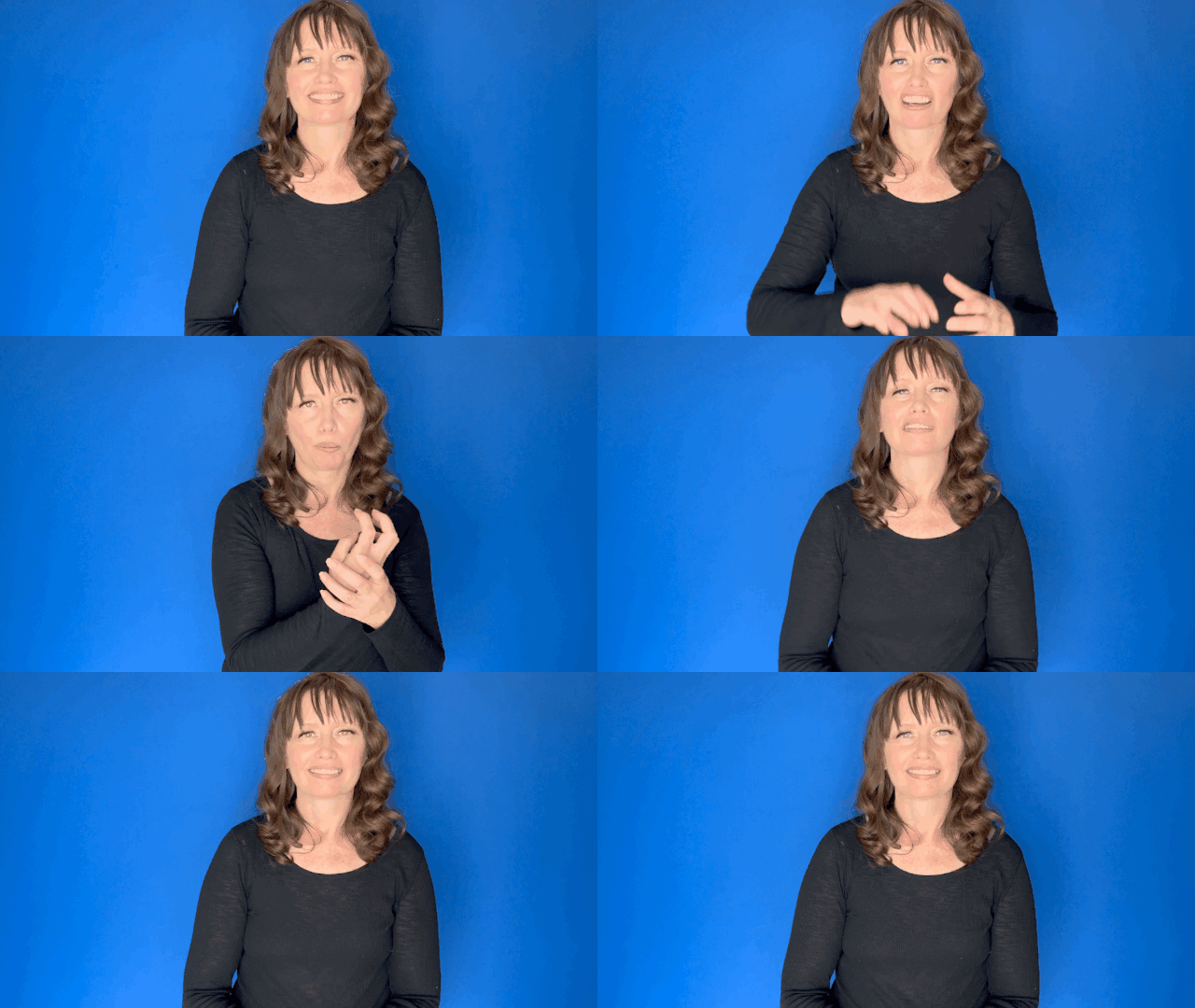
Sign for CARPOOL 2 in ASL

Practice Activities:
To practice the sign for CARPOOL 2 in ASL, begin by signing it repeatedly in isolation while watching yourself in the mirror. Focus on the handshape, movement, and placement. Repetition will help build muscle memory and allow for more natural use in conversational signing.
Next, practice incorporating the sign for CARPOOL 2 in ASL into short phrases. For example: “I CARPOOL SCHOOL,” “THEY CARPOOL WORK,” or “WE CARPOOL EVERY MONDAY.” Say the sentence out loud while signing to reinforce comprehension and clarity.
Try creating example sentences using different pronouns and time indicators. This gives you the chance to master the grammatical structure of ASL while using the sign for CARPOOL 2 in ASL in context. Alternate between first person and third person to keep your language flexible.
Pair up with a practice partner and take turns asking and answering questions. Ask, “YOU CARPOOL WHO?” or “WHEN YOU CARPOOL?” This encourages back-and-forth conversation and helps reinforce vocabulary in a useful setting. Switch roles often to practice both asking and responding.
Use storytelling prompts such as, “Describe a day when you carpooled to a special event,” or “Tell a story about meeting new friends through carpooling.” These narratives help you integrate temporal words, location references, and classifiers alongside the sign for CARPOOL 2 in ASL.
Watch a short video clip about carpooling and try to summarize it using ASL. Pause the video and sign each idea or event using the sign for CARPOOL 2 in ASL when relevant. Focus on signing smoothly and using facial expressions to highlight meaning.
To expand your fluency, sign a dialogue that involves coordinating a carpool schedule. Include time references, locations, and who is involved. This helps build both vocabulary and signing confidence while reinforcing the contextual use of CARPOOL 2.
Cultural Context:
In American Sign Language (ASL), understanding the cultural context behind concepts like the sign for CARPOOL 2 in ASL is essential for fluency. Signs don’t just mirror English translations—they reflect the social practices and values embedded in the Deaf community.
The sign for CARPOOL 2 in ASL symbolizes more than just a method of transportation. It reflects community values, shared responsibilities, and resourcefulness. In many Deaf spaces, like schools, workplaces, and community events, carpooling is a frequent topic and necessary part of daily life.
Deaf culture emphasizes connection and support systems. This is especially true in transportation, where access can be limited due to communication barriers. The sign for CARPOOL 2 in ASL is rooted in the idea of collective action and mutual benefit—a reflection of interdependence within the Deaf community.
Carpooling is often essential for attending Deaf social events, interpreting appointments, or ASL classes. When two people arrange to ride together regularly, the concept of CARPOOL 2 becomes more relevant, and so does the need for an expressive and efficient sign to convey it clearly.
Using the sign for CARPOOL 2 in ASL helps streamline conversations about planning and transportation among Deaf peers. It removes the need for lengthy explanation and allows for smooth social interactions. The sign itself is practical, like the concept it represents—conserving resources and fostering community.
ASL signs often evolve based on regional use and technological advances. The sign for CARPOOL 2 in ASL might vary slightly depending on where you’re located or the generational influence of the signer. However, the underlying cultural significance remains the same: trust, cooperation, and working together.
In family settings, parents often use the sign for CARPOOL 2 in ASL to coordinate rides for school or activities. The same goes for Deaf professionals organizing carpools to conferences or advocacy meetings. Through sign, these plans become accessible and inclusive, reinforcing the power of visual language.
Using specific number-based variations in ASL, like CARPOOL 2, allows for clarity when multiple carpool situations are being discussed. Whether it involves two, three, or more people, the specificity enhances communication within personal and professional circles in the Deaf community.
The sign for CARPOOL 2 in ASL plays a small but significant role in affirming shared experience. It isn’t just about reducing fuel costs or traffic—it’s about traveling together, building relationships, and navigating life side by side in a way that’s linguistically
Extended Definition:
The sign for carpool 2 in ASL represents the concept of shared transportation between two or more people using a car. This version of the sign focuses specifically on the idea of two people participating in a carpool, which is common in work or school commutes. It emphasizes both the vehicle itself and the shared aspect of the ride between individuals.
In American Sign Language, numerical variations like the sign for carpool 2 in ASL help clarify how many people are involved in a shared activity. This sign differs slightly from a general carpool sign, as it visually indicates a smaller group. Usually, signs that include numbers help add clarity and context to real-life situations, such as carpooling with just one other person.
The sign for carpool 2 in ASL typically involves signing the concept of car followed by a movement or formation that shows the number two. You might also see variations depending on region or personal signing style, especially among native signers. Still, the key idea remains that two individuals are riding together in one car.
ASL often uses spatial referencing to show relationships, and the sign for carpool 2 in ASL is no exception. The positioning of each person in the sign can help the viewer visualize the shared ride more clearly. This makes the communication more dynamic and easy to understand.
Carpooling is a popular concept and has become an essential topic in conversations about sustainability and commuting. Knowing how to express the sign for carpool 2 in ASL allows Deaf individuals and signers to stay involved in these discussions. Whether planning a daily ride or organizing a shared trip, this specific ASL term is both relevant and practical.
Including the sign for carpool 2 in ASL in your signing vocabulary showcases an understanding of both transportation topics and number-specific ASL usage. It’s also useful for interpreters who need to convey detailed information about groups traveling together. By using precise signs, messages become easier to interpret and less confusing.
For ASL students and educators, learning the sign for carpool 2 in ASL offers a chance to practice combining number signs with contextual vocabulary. It also opens the door to discussing related terms like drive, commute, or passengers. The ability to break down complex ideas into visually clear elements is one of ASL’s strongest features.
In everyday life, scenarios like school pick-ups, work shuttles, or quick errands often involve informal carpooling. Using the sign for carpool 2 in ASL makes these
Synonyms: ride-sharing, car-share, car ride pool, vehicle sharing, shared commute
Educational resources: Find related learning materials in our course bank!
Want more? Check out some of our popular learning activities on the homepage!
Need to look up a sign? Use our highly rated dictionary: https://aslinteractive.com/best-asl-dictionary/
Follow us on tiktok: https://www.tiktok.com/@aslinteractive. More social media links at the bottom of this page!
Long-tail Keywords: what is the sign for carpool in ASL, how do you sign carpool in ASL, ASL sign for carpool
Categories:
tags: Carpool 2 in American Sign Language, how to sign carpool 2 in ASL, ASL carpool 2 tutorial, learn carpool 2 in ASL, carpool 2 sign language explanation
Parameters
*Handshape*:
The handshape for the sign for CARPOOL 2 in ASL uses the dominant hand in a modified C-handshape while the non-dominant hand forms a similar C. The fingertips of the dominant hand are inserted into the open space of the non-dominant C-hand, symbolizing the idea of people coming together in one vehicle.
This representation visually mimics sharing a car ride, reinforcing the meaning behind the sign for CARPOOL 2 in ASL . The movement and specific hand position make the sign easily distinguishable and contextually clear.
*Palm Orientation*:
In the sign for CARPOOL 2 in ASL, the palm orientation typically features both hands with fingers slightly curved, resembling a claw shape. The dominant hand moves inward toward the non-dominant hand, which remains stationary—palms generally facing each other or slightly angled depending on the signer’s position.
This palm orientation in the sign for CARPOOL 2 in ASL helps convey the idea of joining or grouping people into one car. It visually mimics the action of collecting or gathering individuals together for shared transportation .
*Location*:
The sign for CARPOOL 2 in ASL takes place in the neutral space in front of the torso, typically at chest level. This location helps maintain clear visibility as multiple hand movements interact to indicate the concept of shared or group travel.
Because the sign for CARPOOL 2 in ASL involves a combination of directional movements between individuals, keeping the location away from the body ensures clarity. The signer’s hands stay within a medium signing space to allow for interaction between movement and orientation.
*Movement*:
The sign for CARPOOL 2 in ASL uses both hands to represent multiple people sharing a ride. The dominant hand, in a closed “C” shape, moves toward the nondominant hand, which is also in a “C” shape, symbolizing the concept of people joining together in a vehicle.
This movement is usually repeated slightly to emphasize the idea of sharing. The sign for CARPOOL 2 in ASL combines elements of “car” and “share,” reinforcing the collaborative nature of the action.
*Non-Manual Signals*:
For the sign for CARPOOL 2 in ASL, maintain a slight head tilt combined with focused eye gaze to indicate group involvement or shared activity. Light eyebrows may raise to express the cooperative nature of carpooling, while lips can be mildly pursed or neutral to show it’s a routine or neutral action. These facial cues help emphasize that the sign for CARPOOL 2 in ASL refers to mutual transportation or shared rides. ♂️
*Prosody, Dominant/Non-Dominant Hand*:
The sign for CARPOOL 2 in ASL typically uses both hands in a movement that mimics multiple people riding together. The dominant hand, shaped like an open claw (C handshape or loose 5), joins or encloses the non-dominant hand in a grouping motion near the center of the body, symbolizing shared transportation.
This prosodic movement indicates the communal aspect of a carpool. The sign for CARPOOL 2 in ASL is often accompanied by facial expressions that emphasize group action or multiple persons involved.
Tips for Beginners:
When learning the sign for CARPOOL 2 in ASL, it’s important to notice the slight variation this version has compared to other variations of carpool. This sign uses a two-person concept, typically involving two “C” handshapes interlocking or showing a passenger relationship using directional movement. Begin slowly, watching the dominant hand’s motion to ensure it mirrors the visual concept of carpooling with two individuals.
Use a mirror to practice the sign for CARPOOL 2 in ASL, ensuring your hand orientations are correct and the movement is clean and deliberate. A common mistake beginners make is sloppy transitions between the handshapes or rushing the motion, making the sign difficult to understand. Consistent practice while watching fluent signers, either in person or via trusted ASL video sources, can help polish your motion and facial expression.
Facial expressions play a role in reinforcing meaning in ASL—pairing the sign for CARPOOL 2 in ASL with the appropriate expression helps convey logistical or emotional context. Relax your shoulders and keep your arm movements fluid, not stiff or robotic. The sign relies more on clarity than speed; rushing through it can lead to unintentional confusion with similar signs like “ride” or “drive.”
Remember spatial referencing—position the signing space in a way that indicates two people involved in the carpool. It’s helpful to establish the people involved in the conversation beforehand for the sign to make sense contextually. Be aware of your audience’s signing fluency; slight modifications might be necessary when signing in casual vs. formal contexts.
Keep exploring real-life conversations to see how native signers use the sign for CARPOOL 2 in ASL naturally. Immersive practice helps you understand how this sign fits fluidly into longer sentences, especially those about transportation and daily routines. With consistency and observation, you’ll be more confident and accurate in your signing.
Connections to Other topics:
The sign for CARPOOL 2 in ASL connects to broader transportation and commuting-related vocabulary. It is related to signs like DRIVE, PICK UP, and WORK because these concepts often occur together in conversations about daily routines. Understanding the sign for CARPOOL 2 in ASL provides insight into how personal and group transportation is expressed in a visual language.
This sign can also connect to compound sign structures involving multiple actions or roles, such as DRIVER-PICKUP-FRIEND or GO-TO-WORK-TOGETHER. In these contexts, carpooling is often indicated as part of a narrative sequence, showing how ASL builds meaning through concept stacking rather than linear grammar. These compound structures help tell more detailed stories about how people get from place to place.
The sign for CARPOOL 2 in ASL also builds on localization and spatial referencing concepts, which are cornerstone features of ASL. When signing about multiple people sharing a ride, signers can use space in front of the body to show who sits where in the car, visually representing relationships and movement. This provides learners with a deep understanding of how ASL uses space grammatically.
It’s also connected to time-related signs, like EVERYDAY, MORNING, or WEEK, especially when discussing regular carpool schedules. By combining these signs, you can express routine activities such as “I carpool every morning with coworkers,” making the sign for CARPOOL 2 in ASL essential for building common narratives and schedules.
Vocabulary related to family or social roles like FRIEND, COWORKER, or KID may also appear near this sign in conversation. These role-based connections highlight who is typically involved in carpooling and expand learners’ ability to describe social dynamics visually.
Summary:
The sign for CARPOOL 2 in ASL represents a nuanced variation tied closely to real-life contexts where carpooling involves different people coordinating transportation. This version typically incorporates classifiers, depicting multiple people riding together. The sign’s structure emphasizes community and shared responsibility, mirroring real-world values.
In the sign for CARPOOL 2 in ASL, the dominant hand grasps the non-dominant hand in a movement that mimics enclosures or linking. Some variations emphasize the number of people involved using number incorporation or role shifting depending on context. Vertically layered movements help convey the idea of multiple passengers.
This sign builds on foundational ASL concepts, including spatial referencing and classifier systems. Classifier handshapes show a small group getting into or out of a vehicle. These classifiers reflect how location and orientation shift meaning dynamically in ASL grammar.
Signers often use modified movement or facial expressions to indicate time, frequency, or relationship. For instance, furrowing the brow can stress obligation, while a relaxed look may imply friendliness or informality. This layered meaning makes the sign adaptable to different situations.
The sign for CARPOOL 2 in ASL typically contrasts with signs for bus, taxi, or general commuting by denoting sharing rather than public service or individual action. It highlights collaboration through body shifting and directional verbs. This shift visually reinforces that more than one party is involved.
In usage, the sign functions as a noun or a verb depending on sentence structure and classifier choice. When used as a verb, directionality may indicate who carpools with whom. As a noun, it gains meaning from sentence placement and contextual cues.
Within cultural contexts, the rise of carpooling as a sustainable practice gives this sign more relevance. Environmental activism, especially in Deaf communities advocating climate awareness, influences how frequently this sign appears in educational content. It signals community participation and responsibility.
In regional dialects of ASL, the sign for CARPOOL 2 in ASL might display small differences. West Coast signers may use slight variations in tempo or facial expression. East Coast versions can differ in handshape fluidity or intensity based on local signing norms.
In bilingual environments, fingerspelling still holds a place when new signers are unsure of the sign. Some may begin with C-A-R-P-O-O-L and then shift into a classifier setup. This transitional space between fingerspelling and set signs helps with comprehension and learning.
Code-switching between English and ASL users adds dimensions to how the sign is deployed. Deaf professionals in mixed-language offices often toggle between formal ASL and more English-influenced signing. The ability to shift registers ensures inclusivity and communication efficiency.
Technological contexts, such as ride-sharing apps, have influenced how signers talk about carpooling. New gestures referencing phone use or digital selection now accompany the core sign. For example, indicating tapping or selecting partners might come before the carpool sign.
Emotionally, the sign can convey trust or hesitation depending on delivery. Slow or incomplete signing may signify unfamiliarity or discomfort in the carpool process. Quick, sharp signs signal routine and comfort between familiar groups.
The sign fits within the broader kinesthetic grammar of ASL. Signers must use the body spatially to show participation roles, such as driver or passenger. Role-shifting allows one signer to simulate the presence of multiple individuals without needing another person.
Deaf culture often values clarity and directness, and transportation signs play into this. The sign for CARPOOL 2 in ASL sharpens the concept of mutual travel rather than vague descriptions. It exemplifies how ASL streamlines complex ideas into compact visual sequences.
Intersectionality surfaces when discussing transportation options with DeafBlind individuals or those with mobility impairments. Adjustments in size, movement, or tactile signing adapt this concept for equitable understanding. Accessibility in signing preserves autonomy.
In classrooms, educators may use the sign for CARPOOL 2 in ASL within environmental science discussions or social studies topics related to economics. It becomes a building block for more complex sign diagrams that detail urban planning or climate concerns. ASL’s design makes high-level content more accessible.
For children learning ASL, classifiers associated with carpooling often link to familiar experiences, like going to school in a family’s car. Teachers scaffold understanding by using pretend play and referential role shifts. This concreteness anchors new vocabulary in memory.
Linguistically, this sign embodies multiple dimensions—lexical, classifier-based, and directional grammar. The convergence of these levels in a single sign reveals ASL’s richness. It showcases how manual languages distill meanings into efficient, spatial-linguistic units.
The morphology of the sign is process-based, starting with the hands apart, moving together in a linked-enclosure motion to mark the notion of people coming together. This progression reflects compound word formation in signed languages. It also supports metaphorical analysis of group synergy.
Deaf communities have increasingly used the sign for advocacy. Campaigns about reducing
Want more? Check out some of our popular learning activities!
ASL Interactive Resources
ASLInteractive YouTube Channel
Follow us on tiktok: @aslinteractive.com
Follow us on Instagram: aslinteractive
Facebook page: aslinteractive
Facebook group: aslinteractive
LInkedIn: ASL Interactive LLC
Twitter: @ASL_interactive
*Some information on this page is AI-generated. AI can make mistakes. Please check the information.
Responses