Sign for CASUAL in ASL | 🩳 ASL Dictionary

Definition: Informal and relaxed.

Sign for CASUAL in ASL

YouTube player

Practice Activities:

To practice the sign for CASUAL in ASL, start by using a mirror to observe your handshape, movement, and palm orientation. Repeat the sign slowly at first, then increase speed as you feel more confident. Focus on relaxed movements to convey the natural tone of the word.

After mastering the sign in isolation, place it into simple sentences. For example: “My clothes are casual,” “The party is casual,” or “Work is casual today.” Sign each sentence while emphasizing the flow and ease typical of everyday, relaxed communication. This helps reinforce both vocabulary and sentence structure.

Try storytelling to incorporate the sign for CASUAL in ASL more organically. Think of a time when you attended a casual event and describe who was there, what you wore, and how the atmosphere felt. Use other signs to describe people, feelings, or clothing in order to explore natural combinations.

Practice with a partner by taking turns describing settings that are casual versus more formal. One person signs a scenario and the other has to identify if it’s casual or formal based on visual cues. This helps reinforce comprehension and quick thinking.

Use the sign for CASUAL in ASL while reviewing adjectives in a vocabulary review game. Mix in signs like fancy, strict, fun, or boring and sort them into categories describing different settings—school rules, dress codes, or weekend plans.

Watch short dialogues or vlogs in ASL where people describe events or routines, then identify when the tone is casual. Pause and try to retell the scene using the sign for CASUAL in ASL and describing what makes the situation relaxed or informal.

Record yourself signing sentences with the target word to evaluate clarity and natural motion. Share with a peer or tutor for feedback and suggestions to improve accuracy.

Cultural Context:

In American Sign Language (ASL), the sign for CASUAL reflects more than just a fashion style or laid-back attitude—it represents a cultural value rooted in principles of openness, equality, and relaxed interaction. When you use the sign for CASUAL in ASL, you’re tapping into a patterned way of expressing ease or informality common in many Deaf social spaces. Just like tone of voice in spoken language, the way you deliver a sign influences how it’s received. This is especially true with the sign for CASUAL.

In Deaf culture, casual interactions are often seen as more inclusive and welcoming. The sign for CASUAL in ASL can be used when describing relationships, dress codes, everyday plans, or informal meetings. It’s especially common in school, social clubs, and community events where formality isn’t required. Using this sign communicates that the situation is stress-free and not bound by strict rules.

The sign for CASUAL in ASL can also relate to social tone. Deaf conversations are often direct but friendly, and people appreciate open, unpretentious communication. When someone signs CASUAL, they’re also sharing that expectations should remain laid-back. It might suggest that people can show up as they are, without needing to impress anyone.

This sign is also commonly used in educational contexts when instructors describe classroom environments or assignments that don’t require formal structure. For example, a teacher may sign that an upcoming project or presentation can be done in a CASUAL way. In these cases, the sign for CASUAL in ASL prepares students to feel more relaxed and expressive, which is an important part of language learning.

Clothing and dress code is another area where the sign for CASUAL in ASL is relevant. When discussing daily outfits, indicating that something is casual helps people decide what level of formality is appropriate. It’s handy when planning events too—like stating that the dress is CASUAL at a get-together, barbecue, or Deaf community potluck.

The sign also appears in workplace conversations. Deaf employees or interpreters might describe a job site or company culture as CASUAL during interpreting sessions or job orientation. It helps set the right expectations about communication style, attire, and social dynamics at work.

Understanding the sign for CASUAL in ASL and when to use it helps create meaningful and respectful interactions in the Deaf community. It’s not just about vocabulary—it’s about understanding the context behind communication. Signing CASUAL reinforces boundaries of comfort and authenticity that are deeply important in Deaf spaces.

Teaching this sign

Extended Definition:

The sign for casual in ASL is used to describe a laid-back, relaxed, or informal approach, attitude, or dress style. This term often applies to social situations, personal demeanor, or environments that do not require formality. Understanding how to express casual in ASL is helpful for everyday conversations when describing someone’s personality, atmosphere, or attire.

To sign the concept of casual in ASL, signers often use a movement or handshape that reflects something easygoing or low-pressure. While there may be variations depending on the region or individual signer, the meaning remains focused on the relaxed nature of the topic. This flexibility in expression shows how ASL adapts to the cultural and social context around a word like casual.

The sign for casual in ASL might include repetitive or loose movements to match the meaning of the word. Since casual suggests an informal tone, signers can visually represent this by using relaxed body language and facial expressions. ASL relies on both manual signs and non-manual markers to convey meaning accurately.

In social settings, the sign for casual in ASL can describe how someone carries themselves or how an event is being held. For example, if you’re attending a party and want to say that it’s a casual gathering, the sign helps deliver that tone. It’s especially useful in distinguishing casual from formal, a contrast that’s often important in communication.

You might also use the sign for casual in ASL to talk about someone’s clothing choice, such as wearing jeans and a t-shirt instead of a uniform or dress clothes. It sets the expectation that the situation does not call for extra effort or seriousness. Whether discussing a workplace culture or weekend plans, identifying something as casual can shape how others respond or prepare.

In conversation, using facial expressions is key when signing casual in ASL. A relaxed smile or laid-back posture reinforces the tone and matches the meaning you’re trying to express. This is part of what makes ASL a rich and expressive language—it pairs movement with emotion and context.

Regional usage can sometimes influence how the sign for casual in ASL is performed. It’s always a good idea to observe how native signers in your area use and understand this term. Learning from fluent signers or teachers can help you master both the form and the nuance of the sign.

When describing a lifestyle or personality, casual is often linked to ease and simplicity. The sign for casual in ASL matches that vibe, helping you paint a picture of someone who is easygoing or prefers

Synonyms: informal, relaxed, laid-back, nonchalant, easygoing

Educational resources: Find related learning materials in our course bank!

Want more? Check out some of our popular learning activities on the homepage!

Need to look up a sign? Use our highly rated dictionary: https://aslinteractive.com/best-asl-dictionary/

Follow us on tiktok: https://www.tiktok.com/@aslinteractive. More social media links at the bottom of this page!

Long-tail Keywords: what is the sign for casual in ASL, how do you sign casual in American Sign Language, casual in ASL meaning and usage

Categories:

tags: Clothing, Everyday activities, Casual wear, Appearance, Language Learning

Parameters

*Handshape*:

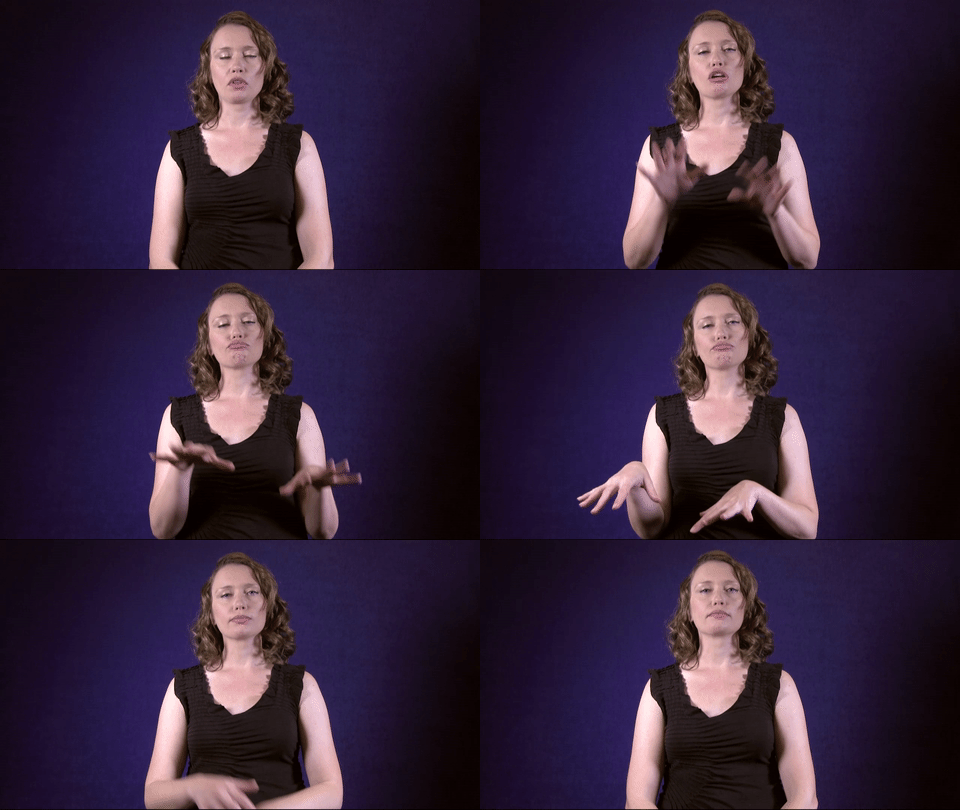
The handshape for the sign for CASUAL in ASL uses open relaxed hands, with fingers spread slightly apart and extended. Both hands take this natural, loose handshape to reflect the informal concept behind the word.

In performing the sign for CASUAL in ASL, the relaxed position of the hands contributes to the overall easygoing feeling. The hands may gently brush or move in a casual motion across the upper chest, reinforcing the laid-back tone.

*Palm Orientation*:

For the sign for CASUAL in ASL, the palm orientation generally faces downward or slightly outward, depending on the signer’s variation. The hands are typically relaxed, reflecting the laid-back nature of the meaning.

During the motion, fingers may lightly brush against the chest area in a nonchalant manner. This open, neutral palm orientation suits the relaxed tone conveyed by the sign for CASUAL in ASL.

*Location*:

The sign for casual in ASL is performed in the upper chest area, close to the collarbone. The dominant hand uses a relaxed, bent-handshape and makes a brushing motion across the chest from one side to the other.

This location reflects the laid-back, easygoing nature of what the sign for casual in ASL represents. Keeping the motion and location central supports visibility and clarity when signing in conversation.

*Movement*:

The sign for casual in ASL begins with both hands in relaxed open hands, palms facing down, resting near the upper chest. The hands make small, alternating circular movements—one hand moves forward while the other circles slightly backward, then they switch.

This smooth, lazy circular motion reflects a relaxed, easygoing vibe, matching the meaning of casual. The sign for casual in ASL uses minimal force and maintains a loose, informal look throughout.

*Non-Manual Signals*:

The non-manual signals for the sign for CASUAL in ASL typically involve a relaxed facial expression with slightly raised eyebrows and a soft demeanor. The eyes should appear calm or unfocused, and the body posture is loose to reflect the laid-back nature of the concept.

When using the sign for CASUAL in ASL, avoid sharp or intense facial movements. A subtle head tilt or nod can help convey a mellow or easygoing attitude .

*Prosody, Dominant/Non-Dominant Hand*:

The sign for CASUAL in ASL uses both hands in a relaxed posture. The dominant hand typically starts near the upper chest area with the fingers slightly spread and relaxed, brushing downward twice over the non-dominant side of the chest in a gentle motion. This casual movement suggests an informal or easygoing attitude.

In the sign for CASUAL in ASL, both hands remain loose and relaxed, reflecting the essence of the word. Facial expression is easy and neutral to match the tone of the sign.

Tips for Beginners:

When learning the sign for CASUAL in ASL, aim to keep your movements relaxed and natural—this matches the tone of the word itself. The most accurate way to convey this sign is by brushing both hands softly across your shoulders or chest in a smooth, nonchalant motion. Keep your facial expression easygoing, as conveying the right mood is just as important as moving your hands correctly.

A common mistake beginners make with the sign for CASUAL in ASL is being too stiff or mechanical. Because the concept itself is tied to being laid-back or informal, overly rigid hand movements or tense expressions can change the meaning or make your signing look unnatural. Practice letting your hands glide comfortably, like you’re adjusting loose clothing or brushing lint off a jacket.

Consistency helps seal the learning process. Try practicing the sign for CASUAL in ASL in front of a mirror to observe your body language and flow. Compare your motions to native signers if videos or in-person examples are available. This helps you bridge the gap between knowing the motion and making it look fluent.

Another tip is to avoid overexaggerating the motion. While it’s important to be visible and clear, overly dramatic gestures might make the sign look like something else entirely. Remember, subtle and fluid transitions give your signing confidence and authenticity.

Use the sign in daily contexts to lock in muscle memory. Whenever you talk about dress style, mood, or informal settings, incorporate the sign casually during conversation. Repetition paired with real-life interaction will help you retain it for the long term. With consistency and attention to natural expression, mastering the sign for CASUAL in ASL becomes second nature.

sign for casual in asl, casual style sign in asl, how to sign casual in american sign language, asl sign for casual clothing

Connections to Other topics:

The sign for CASUAL in ASL connects closely with signs related to mood, attitude, and social contexts. Signs such as RELAX, CHILL, and EASY share a similar undertone, and often appear alongside the sign for CASUAL in ASL when someone is describing atmosphere or demeanor. It also relates to body language and facial expressions, which help convey the easygoing or laid-back tone intended by the sign.

This sign is often used in conversational ASL when discussing dress codes, attitudes about rules, or informal situations. For example, the phrase “casual clothing” may involve using the sign for CASUAL along with the sign for CLOTHES or DRESS to indicate laid-back attire. The sign for CASUAL in ASL might also be used to describe events like “casual meeting” or “casual dinner,” paired with MEET or EAT respectively, relying heavily on context to clarify meaning.

The sign can form part of compound expressions, especially in discussions about contrasting types of behavior or style, such as comparing FORMAL and CASUAL. Learners will benefit from seeing how the sign for CASUAL in ASL shifts depending on topics like education, work, or social interactions—adding a rich layer of nuance to vocabulary about tone and setting.

Understanding this sign also builds a foundation for interpreting or expressing personality traits. Signs such as LAID-BACK or FLEXIBLE may be used in similar contexts, influencing how the sign for CASUAL in ASL is interpreted depending on facial grammar. Its similarities to these and other adjectives help users broaden their expressive range when discussing people or environment.

The sign also supports visual storytelling common in ASL, where setting and character are described through both signs and affect. Whether using it to describe a setting, behavior, or dress code, incorporating the sign for CASUAL in ASL adds depth and clarity to signed conversations, especially in social, professional, or educational settings.

Summary:

The sign for CASUAL in ASL can vary slightly based on regional dialects and context, but a commonly accepted version involves a relaxed movement using both hands. The dominant hand uses a loose open-5 handshape and brushes lightly across the shoulder in a smooth, nonchalant downward motion. This motion conveys a sense of ease or informality, matching the meaning conveyed in English.

This sign’s loose, unrefined movement contrasts with signs denoting rigidity or formality. The sign for CASUAL in ASL expresses a mood or atmosphere as much as a descriptive label. The fluid motion on the shoulder is key to understanding the sign’s tone and nuance.

Culturally, the sign for CASUAL in ASL embodies more than informality; it often implies a laid-back personality or environment. Deaf community members might use it to describe people, social events, or work environments that are easygoing in nature. It signifies more than just clothing style—it connects with behavioral expectations.

The grammar surrounding the sign for CASUAL in ASL often places it post-nominally in a sentence for emphasis. For example, describing a person might involve stating “PERSON CASUAL” with appropriate facial expressions. This conveys identity rather than simply describing attire.

Facial expressions and body posture significantly shape how this sign is received. A relaxed face and open body stance accentuate the tone when signing CASUAL. This bodily linguistic element enhances the authenticity and clarity of the communication.

There are related signs that can connect with or contrast the sign for CASUAL in ASL. For example, the sign for FORMAL involves a more upright torso posture and structured hand movements, often referencing attire like a tuxedo or dress. These contrasts reveal ASL’s visual-spatial richness and ability to mark register through gesture.

Linguistically, the sign’s features highlight iconicity—a core trait in ASL. The sweeping hand motion suggests simplicity and lack of formality, making the sign easy to interpret even for novice users. It’s a clear example of how abstract concepts can take concrete form through movement and placement.

Semantically, CASUAL aligns with other signs indicating tone, style, or mood. It belongs to a semantic field involving emotional undertones and situational formality. The sign operates alongside signs like RELAXED and EASY to frame broader conversations.

In applied linguistics, the sign for CASUAL in ASL provides insight into signed language register and how social context shapes linguistic choices. Just like tonal shifts in spoken English, signed languages modulate by degree, adjusting signs like CASUAL to suit specific registers. Educators can use this sign to help learners understand register shifts.

The sign is often accompanied by classifier expressions when embedded in narratives. To describe a casual passerby, a signer might use a person classifier while modifying movement fluidity to reflect that laid-back attitude. These linguistic layers further enrich ASL interactions.

Stylistically, the sign for CASUAL in ASL can mark social alignment. For instance, using this sign during group discussions may bond participants by asserting shared norms of openness and ease. It signals comfort levels and group identity subtly through visual markers.

In pedagogy, the sign for CASUAL in ASL serves as a useful anchor for discussing informal language, slang, or relaxed discourse modes. It can open dialogue about code-switching between conversational ASL and more formalized registers like Signed Exact English. Its presence in educational environments allows for authentic engagement.

The sign also intersects with Deaf culture in its reflection of the community’s values. Many Deaf spaces emphasize authenticity, comfort, and relational accessibility—traits that the word CASUAL encapsulates. Signing CASUAL, then, may invoke more than aesthetic preference; it echoes cultural priorities.

Analyzing the sign’s morphology reveals that it’s a one-movement sign, typically with the dominant hand leading and an optional secondary hand mirroring or resting motionless. The lack of abrupt stops in the movement mirrors the concept of flexibility and informality. Morphologically, its simplicity matches its conceptual load.

Pragmatically, the sign for CASUAL in ASL changes tone based on signed conversation flow. In storytelling, it can set the emotional frame or signal downtime in the narrative. In discussions, it might soften criticism or set an approachable precedent.

Iconicity also reappears in how the hand brushes lightly along the side of the shoulder. That tactile representation stands in for “brushing off” constraints—symbolically linked to casualness. It offers a form of gestural metaphor rarely found in spoken languages.

In everyday use, the sign for CASUAL in ASL often describes clothing styles. For example, stating “MY CLOTHES CASUAL TODAY” conveys a simple, non-formal outfit without needing extensive elaboration. Context and non-manual markers complete the meaning concisely.

The sign frequently appears in digital discourse among ASL users, especially in vlogs or Zoom calls. Signers often use it to set expectations for virtual space conduct: i.e

Want more? Check out some of our popular learning activities!

ASL Interactive Resources

ASLInteractive YouTube Channel

Follow us on tiktok: @aslinteractive.com

Follow us on Instagram: aslinteractive

Facebook page: aslinteractive

Facebook group: aslinteractive

LInkedIn: ASL Interactive LLC

Twitter: @ASL_interactive

*Some information on this page is AI-generated. AI can make mistakes. Please check the information.

Sign for CASUAL in ASL

Responses