Sign for CATEGORIES 1 in ASL | 🙆‍♂️ ASL Dictionary

Definition: Categories 1.

Sign for CATEGORIES 1 in ASL 

YouTube player

Practice Activities:

To practice the sign for CATEGORIES 1 in ASL, begin by repeating the sign multiple times in front of a mirror, paying attention to handshape, movement, and facial expressions. Say the English word aloud or silently think of it while signing to reinforce the connection between concept and sign. Use flashcards with various topics like animals, colors, or furniture, and sign the category before listing specific items within it using ASL.

Create short phrases or sentences that use the sign for CATEGORIES 1 in ASL such as “These are food categories” or “I like all music categories.” Practice fingerspelling a few item names, and then sign their category to focus on the broader grouping. For example, fingerspell “pear” and then use the sign to indicate it belongs under the fruit category.

A useful storytelling practice involves choosing a theme and grouping related objects in a short narrative. For instance, tell a story about visiting a zoo and label animal groups using the category sign—mammals, reptiles, birds. This helps reinforce both vocabulary and grammar structures in context while strengthening classifier usage.

Partner activities are also beneficial. One person signs a group of items—like “blue,” “green,” and “purple”—while the other responds with the correct sign for CATEGORIES 1 in ASL, identifying the group as colors. Alternatively, play a matching game where one person gives a category, and the other signs matching items they know.

Record yourself using the sign for CATEGORIES 1 in ASL in various sentences and review for accuracy. Try making weekly video logs where you talk about category-based topics, like classifying your favorite books or foods. Regular repetition and contextual variation will deepen your fluency and comfort with this foundational concept in ASL grammar.

Cultural Context:

In American Sign Language, understanding how to organize and group ideas is essential for full fluency. The sign for categories 1 in ASL reflects this need by providing a way to communicate the grouping or classification of things based on shared traits. This concept often appears in educational settings, especially when teaching subjects like science, language, or math .

Using the sign for categories 1 in ASL promotes clearer and more efficient communication within the Deaf community. Whether in a classroom, business meeting, or casual conversation, being able to describe and distinguish items by category helps streamline discussions and minimize confusion. The ability to classify ideas is a foundational part of organizing thoughts and concepts in both spoken and signed languages .

Culturally, the sign for categories 1 in ASL is rooted in the language’s visual and spatial nature. ASL depends heavily on visual cues to express abstract ideas, and categorization is a key concept in that expression. By using specific handshapes and movements, signers can show how items are related or grouped, which is especially helpful for teaching children or assisting with comprehension in any learning environment .

In Deaf culture, there is a strong emphasis on education, community learning, and shared knowledge. The sign for categories 1 in ASL is often used during group learning sessions, Deaf Studies courses, and visual learning activities in Deaf schools. This supports collaborative engagement, where individuals can visually see connections between ideas expressed through signs ‍ ‍ .

Deaf teachers and interpreters rely on signs like categories 1 in ASL to reinforce structured vocabulary and cognitive development. It helps young learners grasp the differences and similarities between groups of objects or concepts. This sign is a useful tool when teaching new topics or explaining different elements of a subject .

Furthermore, the sign for categories 1 in ASL can be adapted creatively depending on context. For example, when signing topics in a presentation, a speaker can visually break down the information into categories to make it easier for the audience to follow. This practice underscores the unique flexibility and expressiveness of ASL ✨.

In situations where abstract thinking is needed, such as philosophy or higher education, the sign for categories 1 in ASL helps make complex thoughts accessible. The ability to visually sort ideas into defined groups carries over to various societal and community contexts, making the concept universally useful across many areas of Deaf life .

The development of signs like categories 1 in ASL marks

Extended Definition:

The sign for categories 1 in ASL refers to the specific American Sign Language sign used to indicate a broad classification system, particularly the first-level grouping or category in a set. In many conversations, especially educational or professional settings, being able to express a category or group helps convey ideas more clearly. Understanding how to sign this concept is helpful when organizing information or discussing topics that fall into different groups.

In ASL, the sign for categories 1 in ASL can vary slightly depending on context, but it typically involves a classifier or general sign for “category” combined with an index or visual reference to the first in a list. This may involve holding up the index finger while signing category or using a spatial setup that indicates the first item. Clear facial expressions and body language help reinforce numerical order within signed lists.

When discussing multiple items or concepts, the sign for categories 1 in ASL lets the signer visually establish that something belongs in the first group. This is useful when explaining things like types of animals, food groups, or levels in a course. Using this sign accurately helps organize signed information and ensures your meaning is understood.

If you’re telling a story or giving a lecture in ASL, you can use the sign for categories 1 in ASL to set up your first point or group. Once category one is introduced, subsequent categories or groupings can follow spatially. This structure makes your signing more natural and helps your audience keep track of the conversation.

In classroom settings, teachers often use the sign for categories 1 in ASL to help students understand beginning concepts in science or social studies. For example, a science teacher may use the sign to introduce the first classification of living organisms. This builds a foundation for learning deeper, more specific topics later.

When signing categories in general, palm orientation and hand shape may differ based on regional sign variations or individual teaching methods. The key part of the sign for categories 1 in ASL is to clearly indicate that it’s the first group in a series. You can do this by using listing strategies like numeric ordering with your non-dominant hand.

Storytelling in ASL also involves frequent use of categories, especially when introducing characters or describing objects. The sign for categories 1 in ASL can play a key role in laying out this structure, making stories easier to follow and more engaging. For example, you might sign “category one” to introduce human characters before moving on to animals or other elements.

In professional settings,

Synonyms: group, classification, type, groupings, category

Educational resources: Find related learning materials in our course bank!

Want more? Check out some of our popular learning activities on the homepage!

Need to look up a sign? Use our highly rated dictionary: https://aslinteractive.com/best-asl-dictionary/

Follow us on tiktok: https://www.tiktok.com/@aslinteractive. More social media links at the bottom of this page!

Long-tail Keywords: What is the sign for Categories in ASL?, How do you sign Categories in ASL?, ASL sign for Categories

Categories:

tags: Clothing, Language Learning, Classroom Objects, Everyday Activities, Wh-words

Parameters

*Handshape*:

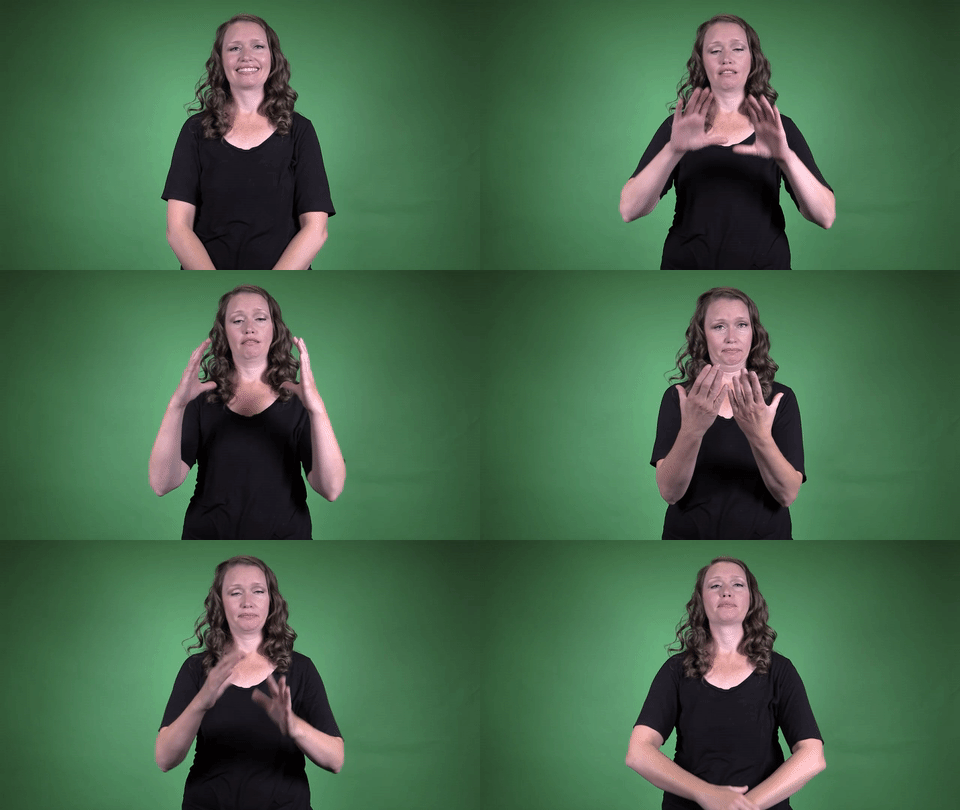
The handshape for the sign for CATEGORIES 1 in ASL uses open “C” hands , which represent various groups or sets. Both hands begin in a neutral space in front of the chest and move slightly apart as if organizing or categorizing objects. This movement reflects the classification idea behind the sign for CATEGORIES 1 in ASL.

The palms face each other, showing separation between different groups. The open “C” handshape is essential for conveying the concept clearly in the sign for CATEGORIES 1 in ASL.

*Palm Orientation*:

The palm orientation for the sign for CATEGORIES 1 in ASL begins with both hands in a claw-like shape, palms facing each other. The hands start close together near the center of the chest and then move outward horizontally in opposite directions.

This orientation helps visually represent sorting or grouping, central to the concept behind the sign for CATEGORIES 1 in ASL . The palms generally remain facing inward throughout the motion, emphasizing the idea of classification or organization.

*Location*:

The sign for CATEGORIES 1 in ASL is produced in the neutral space in front of the torso, at chest level. Hands typically begin slightly apart and are brought together in an organizing or grouping motion, emphasizing the idea of classifying.

In the sign for CATEGORIES 1 in ASL, the location helps clarify the concept by centering the movement where it is easily visible and clear to the viewer. This central chest-level position is common for abstract concepts like types or classifications.

*Movement*:

To express the sign for CATEGORIES 1 in ASL, begin with both hands in flat “C” handshapes, palms facing each other. Start with the hands apart at about shoulder width near chest level. Then move them inward in a small arc, stopping when the fingertips nearly meet, suggesting the grouping or classification of items.

The movement in the sign for CATEGORIES 1 in ASL conveys the concept of organizing or sorting things into types. It visually represents different items being brought together under common characteristics .

*Non-Manual Signals*:

When demonstrating the sign for CATEGORIES 1 in ASL, the facial expression typically reflects a neutral or slightly inquisitive look, as if organizing or sorting items in your mind. Slight eyebrow raises may be included to emphasize grouping or classification.

Maintaining good eye contact and appropriate head nods adds clarity to the sign for CATEGORIES 1 in ASL. These non-manual signals help convey the concept of dividing information into clearly understood sets.

*Prosody, Dominant/Non-Dominant Hand*:

The sign for CATEGORIES 1 in ASL uses both hands in a curved “5” shape, palms facing each other. The dominant and non-dominant hands start apart and move towards one another in a grouping motion, symbolizing the act of categorizing or classifying.

This symmetrical movement shows organization into sets or groups, essential when expressing the sign for CATEGORIES 1 in ASL. Facial expression may include focused brows to emphasize sorting or logic.

Tips for Beginners:

When learning the sign for CATEGORIES 1 in ASL, it’s important to remember that this sign primarily involves both hands forming loose “C” shapes. Start out by placing your dominant and non-dominant hands in front of you, with the palms facing each other and fingers curved slightly inward. Then, gently move the hands in an arc or semi-circle motion to the sides, keeping them parallel and symmetrical. This motion mimics the idea of separating or organizing items into groups, which is the essence of “categories.”

A helpful tip is to maintain fluid motion without exaggerating the arc. Beginners often struggle with making the sign look too stiff or robotic. Practice smooth, controlled hand movements to ensure the sign for CATEGORIES 1 in ASL reads clearly and naturally. Keep handshapes precise—if the “C” becomes too tight or shifts to another shape like an “O” or open hand, the meaning could be confusing .

Watch fluent signers to understand the pacing and flow of the sign in context. Context matters, especially with abstract concepts like “categories.” You might see facial expressions emphasizing thoughtfulness or comparison, which enhances clarity. Adding the right non-manual signals helps express broader ideas such as “types of” or “groupings.”

Another common challenge is spatial awareness. Make sure your hands don’t drift too close together or too far apart. Consistent spacing gives visual structure while avoiding ambiguity. Repetition and muscle memory are key, so practice often and use mirrors to check alignment . Also, fingerspelling the word first can help provide context before signing in fluent, expressive conversation.

The sign for CATEGORIES 1 in ASL becomes easier with consistent practice and immersion. The more you see it used in real conversation, the better you’ll grasp its nuances and variations depending on context.

Connections to Other topics:

The sign for CATEGORIES 1 in ASL connects closely to concepts like GROUP, CLASS, and TYPE. These signs are semantically linked, as they all reflect organizing or grouping items based on shared features. Understanding the sign for CATEGORIES 1 in ASL lays a foundation for grasping the broader concept of classification, which is helpful in both academic and everyday contexts.

This sign is especially relevant when discussing topics in education, science, and even daily routines. For example, when sorting foods into fruits, vegetables, and grains, or sorting books by genre, the sign for CATEGORIES 1 in ASL is used to clarify and visually represent the act of sorting. It’s frequently paired with signs like LIST or EXAMPLES to show subdivisions or specific items within a category.

Learners will also observe that the sign can be incorporated into more complex phrases such as ANIMAL CATEGORIES or MUSIC CATEGORIES, further emphasizing its utility across various fields. It shares movement and structure with signs like ORGANIZE and ARRANGE, demonstrating how spatial awareness in ASL helps convey abstract concepts. These similarities enrich a learner’s sign vocabulary and comprehension.

Teachers and interpreters often use the sign for CATEGORIES 1 in ASL when explaining systems or hierarchies. Instructors teaching subjects like biology may pair it with signs like GROUP, CLASSIFY, or DESCRIBE to portray scientific organization. This builds both subject literacy and fluency in ASL descriptives.

Moreover, this sign illustrates how ASL uses visual metaphors for abstract thinking. The concept of placing things into groups is depicted clearly through handshape and movement, helping learners understand how ASL mirrors thought organization. Exploring concepts linked to the sign for CATEGORIES 1 in ASL allows students to express nuanced ideas efficiently within diverse contexts .

Summary:

The sign for CATEGORIES 1 in ASL involves both hands being used in a flat “C” handshape. The hands are placed in front of the body and then moved apart in a grouping motion, indicating the organization or classification of items into distinct groups. This visual metaphor reflects sorting or categorizing, aligning with physical and conceptual groupings.

The motion of separating or organizing mimics the logical arrangement of information. This sign can be applied in various contexts, such as academics, science, education, and everyday sorting scenarios. The clarity of the sign supports understanding between diverse users and helps bridge abstract concepts with visual schemas.

The sign is iconic in nature, as its shape and movement closely represent the concept of categorizing. ASL often uses iconicity to make abstract ideas more tangible. In this case, showing categories unfolds like assigning items into labeled boxes.

This sign mirrors cognitive processes found in language acquisition, namely schema development and hierarchical organization. Children and language learners often learn vocabulary through categorical groupings like animals, colors, or food. The sign for CATEGORIES 1 in ASL makes that mental model visual and accessible.

Culturally, categorization plays a role in identity, education, and even debate or storytelling in the Deaf community. These groupings help define boundaries, similarities, and differences. Therefore, using this sign correctly supports participation in meaningful discourse.

The sign for CATEGORIES 1 in ASL is typically used as a noun but can function as a part of compound constructions in ASL grammar. For example, one might sign “CATEGORIES FOOD” to refer to food types. ASL syntax allows flexibility within topic-comment structure, helping convey categorical information efficiently.

ASL allows the use of classifiers, which often work alongside the sign for CATEGORIES 1 in ASL. Classifiers enhance its application by showing the types of items within each category. For instance, a classifier might describe the shape or location of each item being grouped visually.

The sign supports educational instruction, making it easier to explain concepts in science and social studies. Teachers often use it while introducing subjects like species distinctions, political parties, or historical periods. Its clarity ensures all students, including Deaf students, access the structure of knowledge.

In applied linguistics, the sign reflects a cross-linguistic need for categorization, seen in virtually all world languages. Its presence in ASL supports theories of universal grammar, which include classification as a cognitive necessity. The sign shows how language gives form to mental constructs through gestural means.

The subject of categories is closely tied with memory architecture. Humans tend to store and retrieve information in groups, which enhances learning and recall. The sign for CATEGORIES 1 in ASL thus communicates much more than labeling; it expresses a key feature of how people think.

The directional movement of the sign can be altered slightly to indicate inclusivity or exclusivity. A more expansive gesture implies broader categories, while close-together movements might show subcategories or more limited groupings. These variations showcase ASL’s spatial richness and flexibility.

The sign and concept also intersect with digital conversations about information architecture. Whether organizing blog posts, videos, or databases, categorization helps structure digital content. The visual nature of the sign supports understanding this complex concept without needing technical vocabulary.

Related signs include LIST, GROUP, TYPE, and CLASS. These all share conceptual overlap with the sign for CATEGORIES 1 in ASL. Depending on the sentence context, these signs may be used interchangeably or in tandem for greater precision.

The sign encourages metacognitive awareness in ASL users. Not only is a user saying “this is a category,” but they are demonstrating how thinking is organized into structured mental frameworks. This bridges visual language and higher-order thinking skills.

Within ASL referring to categories helps define and distinguish identity. In discussions about ethnicity, disability, age, or profession, this sign offers structure for respectful and nuanced dialogue. It allows for careful discussion of group belonging and difference.

The sign for CATEGORIES 1 in ASL can be tied to storytelling traditions in ASL poetry and narrative. Characters and themes are often organized into types, which the sign can help describe. This enables the audience to track plotlines or character arcs based on type or role.

Social media usage has introduced the need for signs that capture hashtags and thematic labels. As people tag content by themes, this sign helps conceptualize the relationship among related posts. It may appear when summarizing video content or describing common topics.

For interpreters, the sign for CATEGORIES 1 in ASL frequently appears in academic and professional settings. It is essential for interpreting lectures that depend on structured outlines or comparative analyses. Interpreters use the spatial space around them to reproduce categorical ideas effectively.

Non-native signers may take time to grasp the full weight of the sign. While it looks simple in form, its applications are broad and essential to deeper meaning. This makes teaching it crucial in any linguistic or bilingual education program involving ASL

Want more? Check out some of our popular learning activities!

ASL Interactive Resources

ASLInteractive YouTube Channel

Follow us on tiktok: @aslinteractive.com

Follow us on Instagram: aslinteractive

Facebook page: aslinteractive

Facebook group: aslinteractive

LInkedIn: ASL Interactive LLC

Twitter: @ASL_interactive

*Some information on this page is AI-generated. AI can make mistakes. Please check the information.

Sign for CATEGORIES 1 in ASL 

Responses