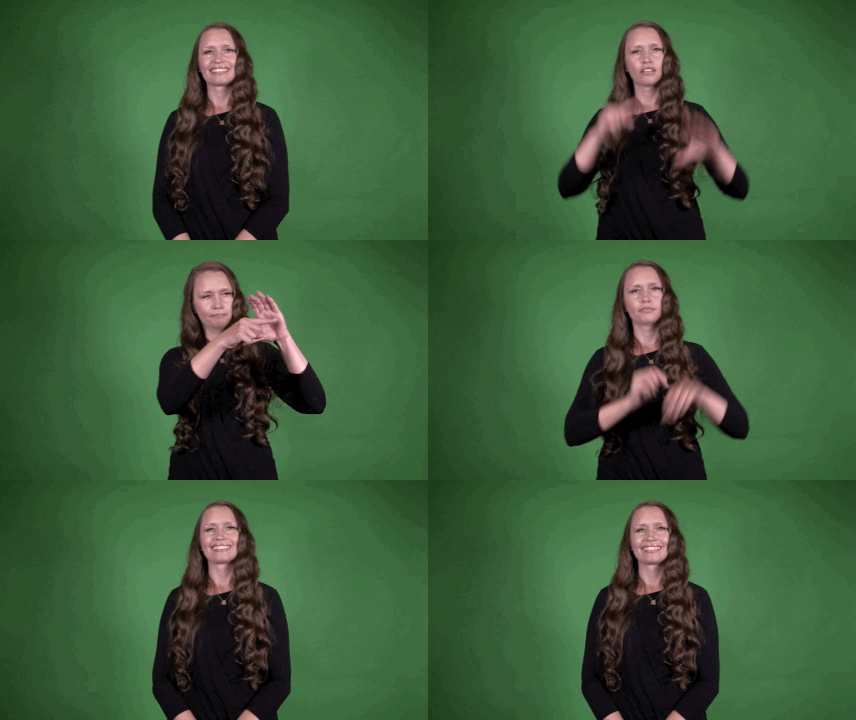
Definition: A cave is a natural underground hollow or chamber typically formed by erosion, often large enough for a person to enter.
Sign for CAVE in ASL

Practice Activities:
Start by practicing the sign for CAVE in ASL in isolation. Use a mirror or video yourself so you can observe handshape, palm orientation, and movement. Repeat the sign multiple times slowly, then gradually increase speed while maintaining clarity.
Move into contextual practice by pairing the sign for CAVE in ASL with descriptive signs. For example, practice signing phrases like “dark cave,” “big cave,” or “I see a cave.” This helps reinforce vocabulary connections and sentence structure in ASL.
Use flashcards or images of nature scenes, including mountains, forests, and caves. When shown a picture of a cave, immediately sign what you see, focusing on clean, confident production. Add additional signs around it to describe what’s inside or around the cave, such as “rock,” “bat,” or “cold.”
Try storytelling small narratives that feature a cave. For example, narrate a short story about a person hiking and discovering a cave. Include spatial concepts and directional signs to create a vivid, visual-based story. Retell the same story from a different perspective for added practice.
Partner with another learner and take turns describing imaginary places where caves could exist. One person signs a description, and the other draws it or picks a photo that matches. This helps improve expressive skills and sign recognition.
Incorporate receptive skills by watching short ASL videos that include the sign for CAVE in ASL. Write down or record yourself repeating what you understood, making sure to identify the context in which the sign for cave appeared.
Finally, try a category sorting activity where you list natural formations like river, hill, mountain, and cave. Sign each of them and practice contrasting their features, reinforcing nature-related signs alongside the sign for CAVE in ASL for deeper retention.
Cultural Context:
The sign for cave in ASL captures more than just a physical feature; it connects with storytelling, geography, and Deaf culture. Caves often appear in narratives, legends, and visual descriptions, making a clear need for a unique and descriptive sign within American Sign Language.
In the Deaf community, the sign for cave in ASL is often used in educational and cultural spaces—especially in science lessons or when discussing natural landmarks. Caves are also common in children’s books, where expressive signs help vividly bring stories to life. ASL thrives on visual clarity, and the sign for cave in ASL supports the full sensory experience in storytelling.
Caves symbolize mystery, adventure, and discovery. For Deaf individuals sharing experiences or memories from outdoor adventures or national parks, the sign for cave in ASL allows for accurate and expressive communication. It contributes not only to vocabulary, but also to bonding moments through shared visual language.
The structure of the sign for cave in ASL reflects how caves form—opening images using handshapes that mimic natural openings. The visual-spatial nature of ASL allows the user to show size, shape, and even movement while using the sign for cave in ASL. Teachers and interpreters often use it with context when discussing place names or geology, enriching classroom instruction.
In museums or tours that offer ASL interpretation, the sign for cave in ASL makes it easier for Deaf visitors to engage fully with exhibits about prehistoric times or natural history. Whether it’s discussing ancient cave paintings or animal habitats, the sign is essential in giving diverse access to information.
ASL storytelling, known for its strong visual metaphors, often uses locations like caves to evoke emotion or suspense. When used in visual narratives, the sign for cave in ASL adds depth and tension, helping shape environments for characters. It becomes a foundational part of visual descriptions and spatial storytelling in ASL poetry and performance.
When Deaf hikers or nature lovers describe their outdoor experiences, the sign for cave in ASL becomes second nature. It adds richness to vlogs, travel logs, and social media posts created in ASL, helping to raise awareness and appreciation for accessible adventure. It’s not just a sign—it’s part of a larger dialogue about inclusion in outdoor spaces.
In classrooms where both hearing and Deaf students learn side by side, teaching the sign for cave in ASL supports inclusivity. It provides equal access to academic content while reinforcing respect for Deaf language and culture. The cultural value of using accurate signs like the sign
Extended Definition:
The sign for cave in ASL uses a combination of hand movements to represent the physical structure and shape of a cave. To demonstrate this concept, the signer uses both hands to mimic the entrance or tunnel-like formation of a cave. The motion and shape of the hands suggest going into or showing the hollow or curved interior of a cave.
When showing the sign for cave in ASL, the hands come together to create an arch or dome-like shape, symbolizing how caves are formed in nature. This visual and spatial representation aligns with how caves appear, often carved into landscapes or inside mountains. The sign captures this structure by shaping the hands to represent depth and enclosure.
The context of the sentence can help clarify whether you mean a natural cave, a small tunnel, or even a play tunnel for children, as ASL is a visual language that relies on expression and context. The facial expression and body shift can convey whether the cave is mysterious, dark, large, or even symbolic. Using these non-manual signals helps provide a more complete meaning when signing.
ASL uses classifiers and spatial agreement to help show where an object or location exists in the environment. In addition to the standard sign for cave in ASL, a signer might use classifiers to show the size, depth, or curve of the cave. For example, wide open caves versus narrow passageways can be created visually by adjusting how far apart the hands are and the curve they make.
Describing a cave also invites the opportunity to include other environmental features such as rocks, stalactites, or water features. When signing in ASL, these descriptive elements help build a detailed image in the viewer’s mind. So, the sign for cave in ASL might be part of a larger scene or story, making it an important building block in communication.
The meaning and use of the sign may also depend on whether you’re referring to a specific location, like Mammoth Cave, or just describing a cave in general. Proper nouns or names of famous caves might need to be fingerspelled, while the sign for cave in ASL gives the general concept. Fingerspelling can be used before or after the generic sign to clarify what type of cave is being discussed.
Because ASL is a three-dimensional language, positioning the hands in space mimics how a cave truly exists in the world—a hollowed-out area that can be explored or entered. The hands moving slightly forward or downward can show distance or depth. These spatial details reinforce the realism
Synonyms: cavern, grotto, hollow, cavity, underground chamber
Educational resources: Find related learning materials in our course bank!
Want more? Check out some of our popular learning activities on the homepage!
Need to look up a sign? Use our highly rated dictionary: https://aslinteractive.com/best-asl-dictionary/
Follow us on tiktok: https://www.tiktok.com/@aslinteractive. More social media links at the bottom of this page!
Long-tail Keywords: What is the sign for love in ASL, How do you sign love in ASL, How to sign the word love in American Sign Language
Categories:
tags: caves, nature, geography, locations, exploration
Parameters
*Handshape*:
The handshape for the sign for CAVE in ASL uses both hands in a curved “C” shape, resembling the opening of a cave. The hands face each other with palms in, positioned in front of the body at chest level.
This iconic handshape visually represents the rounded, enclosing structure of a cave. To convey the sign for CAVE in ASL, the curved hands slowly move forward, mimicking walking into a deep, hollow space ️.
*Palm Orientation*:
For the sign for CAVE in ASL, both hands are typically in curved 5-hands, resembling the shape of a cave opening. The palms face each other, with the fingers arched inward, creating a semi-enclosed space. This palm orientation mimics the natural curve of a cave and helps convey the concept visually. The sign for CAVE in ASL relies on spatial representation to suggest depth and enclosure ️.
*Location*:
The sign for CAVE in ASL is typically produced in the neutral space in front of the body, at chest level. Both hands begin with curved, open handshapes, such as a bent “5” or “C” formation, and move toward each other to indicate the concave walls of a cave.
This position in front of the torso allows for clear visibility and natural movement, helping to convey the hollow, enclosed nature of a cave. The sign for CAVE in ASL takes advantage of spatial referencing to represent the physical structure effectively.
*Movement*:
Both hands start in curved 5-handshapes, palms facing each other and fingertips pointing forward, as if modeling the shape of a rounded arch. The hands are positioned shoulder-width apart in front of the body.
To show the sign for cave in ASL, the hands move slowly inward toward each other while also moving slightly forward, mimicking the formation of a tunnel or cavern. This demonstrates the idea of entering or forming a cave-like opening ️.
*Non-Manual Signals*:
When using the sign for CAVE in ASL, the non-manual signals typically include a neutral or focused facial expression, reflecting the idea of exploring a space or opening. Slight eyebrow lowering may accompany the sign to convey spatial awareness or depth.
The sign for CAVE in ASL is often used in descriptive or storytelling contexts, so the signer may lean slightly forward with engaged eyes to show interest or indicate entering a deep space. These visual cues help enhance the meaning of the sign for CAVE in ASL .
*Prosody, Dominant/Non-Dominant Hand*:
The sign for CAVE in ASL uses both hands. The non-dominant hand forms a curved wall shape facing in, held steady to represent the side of a cave. The dominant hand mirrors this curved shape and moves slightly inward, creating a rounded tunnel-like space. Together, the hands resemble the enclosed depth of a cave, visually capturing the meaning.
The sign for CAVE in ASL emphasizes spatial understanding. The movement mimics the round, hollow interior of a natural rock formation. It’s important to maintain curved handshapes and a slight forward motion to fully depict the concept of a cave.
Tips for Beginners:
When learning the sign for CAVE in ASL, it’s helpful to visualize the physical structure of a cave to guide your hand movements. Typically, you shape both hands into curved outlines, as if forming a tunnel, showing the layered or hollowed entrance of a cave. This sign relies heavily on spatial use, so practicing in front of a mirror will help ensure your gesture clearly resembles the intended meaning.
One common challenge with the sign for CAVE in ASL is creating equal hand curves without letting your hands drop or collapse halfway through the motion. Consistency and intentional motion are key. Keep your movements smooth and make sure the space between your hands accurately resembles a hollow space or tunnel—just like a cave.
If you’re just starting out, avoid rushing through the gesture. Slower, deliberate practice helps your muscle memory adjust and gives your brain time to associate the movement with its meaning. Many beginners try to overcomplicate the movement or add unnecessary flair. Remember, ASL values clarity over complexity—aim for natural, readable forms.
Consider incorporating this sign into your daily vocabulary practice by describing nature scenes or storytelling. The more contexts in which you use the sign for CAVE in ASL, the quicker it becomes second nature. Practice signing in different positions and angles to simulate how the sign could look during conversation from various viewpoints.
Lastly, don’t be discouraged if your hands feel stiff or awkward at first. This is completely normal and improves with time. Watch videos of native signers using the sign for CAVE in ASL and try to mirror their hand placement, pacing, and facial expressions. Facial grammar can enhance the visual of the cave concept, so be expressive. Keep asking for feedback and stay consistent .
Connections to Other topics:
The sign for CAVE in ASL has connections to a variety of spatial and environmental concepts, as it typically depicts the idea of an enclosed, hollow area surrounded by rock. This sign uses classifiers to show the arching space, making it visually and conceptually similar to signs like TUNNEL and MOUNTAIN. These signs all rely on handshape and motion to convey depth, shape, and natural structure, emphasizing how ASL uses spatial metaphors to articulate the physical world.
In narrative storytelling, the sign for CAVE in ASL often appears in nature or adventure themes. It can be used in compound expressions such as SECRET CAVE, combining the sign for SECRET (often a modified “A” hand over the mouth) with CAVE to describe hidden or mysterious places. This aligns with common ASL practice of blending concepts to add rich, visual layers to communication.
The sign for CAVE in ASL is also related to concepts that involve exploration or protection. For example, when discussing animals like a bear or a bat, the word CAVE might be combined with signs for SLEEP or HOME to indicate those animals’ habitats. This reflects how classifiers and conceptual blending work in ASL to expand vocabulary with dynamic, visually connected meanings.
Learners can deepen their understanding of the sign for CAVE in ASL by exploring its connections to earth science, geography, or history terms within ASL. It complements signs such as ROCK, STONE, UNDERGROUND, and even SHELTER. These related signs show how the visual-spatial nature of ASL gives users the ability to build complex geographical ideas from simple, related concepts.
Using the sign for CAVE in ASL as part of descriptive scenes helps learners practice spatial grammar and visual storytelling. It encourages awareness of depth, size, and enclosure, which are not only linguistic but also cognitive constructions in ASL communication.
Summary:
The sign for CAVE in ASL uses a visual-gestural representation resembling the structure of a cave. It typically involves two B-hands or C-hands held in a curved shape, starting apart and then brought forward and slightly together to show the formation or hollow of a cave. This sign strongly incorporates spatial mapping, using classifiers to show the contour and shape of a cave opening.
This is a dynamic and spatial sign that engages the visual modality, which is the core of ASL meaning-building. The shape created by the hands visually mimics the concave interior or a tunnel-like passage, giving it strong iconicity. A signer may adapt the size and movement of the sign depending on whether describing a small cave, like an animal burrow, or a large cavern.
In some contexts, signers may use classifiers such as “CL: Bent V” or “CL: C” shapes to depict walking into a cave or the interior depth of the space. These structures layer meaning grammatically and semantically. ASL allows for size and location adjustments during a narrative about traveling through or discovering a cave.
The sign for CAVE in ASL is often used in geological, natural science, or environmental discussions. It appears frequently in educational contexts where physical spaces such as mountains, valleys, or caves are described. In a classroom or interpretive setting like a nature center, the sign plays a crucial communicative role in conveying spatial environments.
Grammatically, the sign fits as a noun and can be paired with verbs such as EXPLORE, ENTER, or GO. For example, one might sign: “WE EXPLORE CAVE” using directional verbs and time indicators. The flexibility of this sign within the sentence structure highlights how spatial logic underpins ASL grammar.
From a linguistic standpoint, the sign for CAVE in ASL is an example of high transparency—meaning it closely resembles the concept it represents, which aids comprehension. It’s an excellent case of the language’s iconic capacity. This is especially helpful for new learners who rely on visual cues to bridge meaning.
Culturally, caves can carry mythological or symbolic meaning—such as places of mystery or revelation. When these themes appear in Deaf storytelling or ASL poetry, the sign for CAVE may evoke more than just a physical location; it could suggest depth, isolation, protection, or hidden truth. This demonstrates ASL’s eloquence in expressing abstract narrative themes.
Within folklore or children’s storytelling, the concept of a cave appears frequently—think of animal dens, dragons’ lairs, and hidden treasure caves. In these tales, the sign achieves layered meaning, collaborating with facial expressions and classifiers to dramatize the story. This reflects the deeply visual and performative aspect of ASL storytelling.
When interpreting mythological or religious topics involving caves, such as the allegory of Plato’s cave or stories about prophets retreating into caves, the sign takes on a philosophical depth. It allows discussion of introspection or perception—how caves might represent inner truth or shelter. These deeper meanings are expressed through nuanced sign choice, facial grammar, and use of space.
Classifiers further expand the capabilities of the sign for CAVE in ASL. By adjusting handshape, placement, and movement, signers convey the entrance angle, passage depth, and even texture—rocky, smooth, or damp. This morphological flexibility is essential in helping ASL maintain syntactic economy while maximizing spatial context.
Students of deaf education and ASL interpretation often study signs like CAVE to understand how classifiers bridge cognition and communication. The study of how signers perceive depth and structure reveals important information about visual-spatial processing. It also reveals how ASL users mentally map environments through gesture.
In bilingual conversations where spoken English is present, CAVE may be fingerspelled if the audience requires clarification or if the precise sign is unknown. This occurs occasionally with younger or less experienced signers. Nonetheless, the established sign is widely understood across dialects of ASL.
Speaking of dialectal variations, the sign for CAVE in ASL remains consistent across regional usages in the United States. However, the dimensions expressed can greatly vary depending on region-specific gestural habits. Additionally, alternative strategies like using combination signs or mimetic classifiers may reflect local variation.
In DeafBlind communication, the sign for CAVE is adapted using tactile methods. Signers trace the shape of the cave using hand-over-hand signing, effectively conveying the three-dimensional quality for tactile receivers. This adaptation underscores the flexibility of ASL across accessibility needs.
Related signs include TUNNEL, ROCK, MOUNTAIN, and UNDERGROUND. Each of these shares spatial classifiers and may be co-expressed with the sign for CAVE to describe complex environments. For example, combining MOUNTAIN and CAVE expresses the idea of a cave within a mountain.
The sign may also co-occur with signs like ANIMAL, HIDE, or SHELTER when used narratively. This enables a
Want more? Check out some of our popular learning activities!
ASL Interactive Resources
ASLInteractive YouTube Channel
Follow us on tiktok: @aslinteractive.com
Follow us on Instagram: aslinteractive
Facebook page: aslinteractive
Facebook group: aslinteractive
LInkedIn: ASL Interactive LLC
Twitter: @ASL_interactive
*Some information on this page is AI-generated. AI can make mistakes. Please check the information.


Responses