
Definition: The central point 2.
Sign for CENTER 2 in ASL

Practice Activities:
To build fluency with the sign for CENTER 2 in ASL, begin by practicing it in isolation. Stand in front of a mirror to observe your handshape and placement. Repeat the sign slowly and then at a conversational pace. Focus on accuracy and movement, ensuring the dominant hand touches the center of the non-dominant palm precisely.
Once the basic motion feels comfortable, transition into short phrases. Pair the sign with common descriptors like “shopping center,” “learning center,” or “center of attention.” Create five original sentences that use the sign for CENTER 2 in ASL within a realistic context. Sign them slowly, then again at a conversational pace. Record yourself to assess clarity and fluidity.
Practice storytelling where you describe a location such as a mall or campus. Mention where the center is in relation to other landmarks. For example, “The café is in the center of the plaza.” Use classifiers and directional signs to add depth and realism. Repeatedly incorporate the sign for CENTER 2 in ASL to reinforce its role in spatial descriptions.
With a partner, do a map labeling activity. One person describes a simple layout using ASL, placing key spots like the bookstore, library, and food court. The other person listens and signs back where the center is located. Switch roles to ensure mutual practice and comprehension.
Another fun activity is to take pages from a magazine or website and point out items that appear in the center of the image. Sign each identification using full ASL sentences. Add complexity by explaining why something is in the center or how it draws attention.
Wrap up your practice by reviewing all phrases and signs from your sessions. Use small visual markers or sticky notes as prompts throughout your environment to remind you to sign center during daily routines. Consistent repetition of the sign for CENTER 2 in ASL will build retention and fluency.
Cultural Context:
Understanding the sign for CENTER 2 in ASL offers insight into how space and location are expressed in Deaf culture. In American Sign Language, every sign is more than a word—it reflects the community’s way of seeing and interacting with the world. The sign for CENTER 2 in ASL captures spatial relationships with clarity and purpose, often emphasizing motion and orientation.
The sign for CENTER 2 in ASL commonly highlights spatial awareness, a vital aspect of ASL communication. It can be used to describe where something is located in a building, in a room, or within a broader context like a town or city. This version of the sign often includes specific directionality or a modified handshape to indicate centrality.
In Deaf culture, these spatial references are not just visual tools; they are part of the language’s grammar. The sign for CENTER 2 in ASL helps define locations without relying on spoken explanations. People fluent in ASL make use of space in a three-dimensional way, treating the signing area as a map to describe positions and relationships.
The importance of location in ASL goes beyond the literal. Using the sign for CENTER 2 in ASL can also emphasize being at the heart of an activity or situation. Whether describing the center of a group, the focus of attention, or a physical middle point, the sign holds flexible meaning based on the context.
ASL users frequently use facial expressions and body orientation to enhance the meaning of the sign for CENTER 2 in ASL. It’s not just about hand movements—it’s a full-body expression that contributes to the accuracy and clarity of the message. This layered communication style is deeply rooted in Deaf culture’s visual nature.
The sign for CENTER 2 in ASL may be used in educational settings when describing positions in classrooms, seating areas, or common gathering spots. It’s also common in community discussions or storytelling, where describing a central meeting point or the core of an issue requires visual precision.
In storytelling, the sign for CENTER 2 in ASL can symbolize much more than a geographic center. It can be a metaphor for emotional focus, family dynamics, or social positions. The visual nature of ASL allows for abstract concepts to be deeply personal and culturally rich.
Learning to use the sign for CENTER 2 in ASL correctly requires understanding its placement within spatial grammar. This knowledge comes from cultural immersion and interaction with fluent signers. In the Deaf community, these signs are passed down through both formal instruction and everyday experiences.
The
Extended Definition:
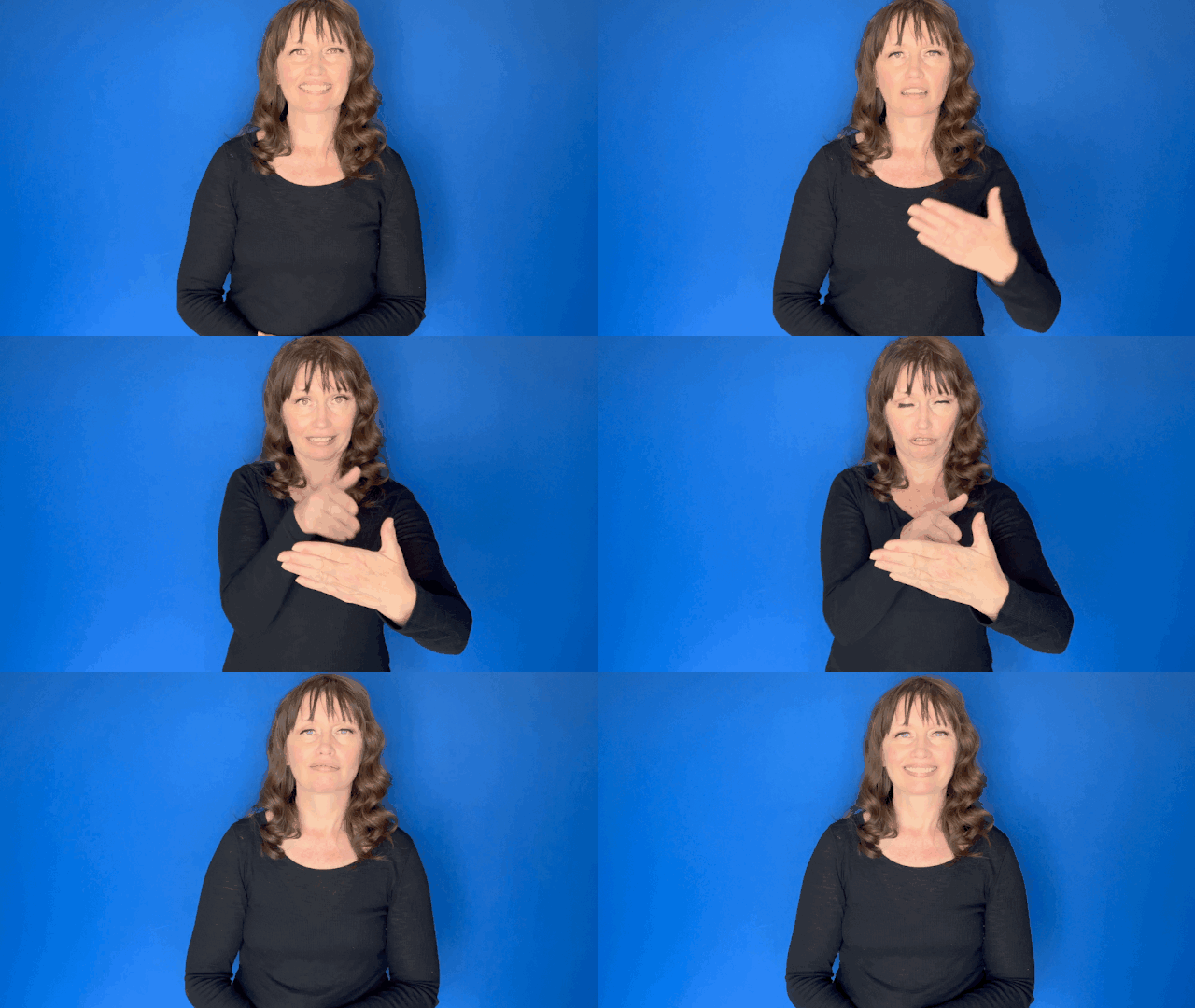
The sign for CENTER 2 in ASL is a common variation used in different regions or contexts. In this version, the dominant hand forms a flat hand or a “B” handshape, while the non-dominant hand also forms a flat surface. The dominant hand circles around above the non-dominant hand before lightly tapping the middle of the palm, showing placement at the center point.
In American Sign Language, there are multiple variations for many words, and CENTER 2 is one of them. This variation retains the core meaning of being in the middle or central part of something but changes slightly in how the motion is performed. It can be used in geographic, emotional, or location-based contexts depending on the conversation.
For example, if you’re referring to a downtown area or the center of a circle, the sign for CENTER 2 lets you describe those ideas clearly. You might also use this variation when talking about a community center, recreation center, or any centralized place people gather. Understanding when to use CENTER 2 over other variations depends on familiarity with regional signs and the speaker’s preference.
The sign for CENTER 2 in ASL emphasizes spatial awareness. It demonstrates that something is not just in a location but specifically at the midpoint. Signing CENTER 2 correctly requires awareness of hand positioning and the accuracy of the movement to match native fluency.
This version is visually iconic, helping learners intuitively tie the movement to the concept of a center. ASL often uses spatial referencing to illustrate ideas, and CENTER 2 fits into that visual and kinetic language structure effectively. This is especially useful for describing central areas in visual maps or conceptual spaces.
While both CENTER and CENTER 2 basically mean the same thing, it’s valuable to know both signs. ASL is a diverse language with many acceptable variants, and exposure to multiple options broadens one’s understanding and communication skills. Depending on who you’re signing with, CENTER 2 may be more familiar or appropriate.
Some instructors or interpreters may use CENTER 2 when teaching spatial concepts during classroom discussions. It’s also frequently seen in storytelling or visual explanations where clarity around location and movement is important. Practice will help you become more confident and fluent in using the CENTER 2 variation naturally.
When learning or teaching about the sign for CENTER 2 in ASL, visual demonstration is key. Watching videos or working with fluent signers can help reinforce the subtle differences between signage styles. Signing accurately and understanding the purpose behind each variation ensures effective communication in conversation and
Synonyms: middle, core, hub, focus, nucleus
Educational resources: Find related learning materials in our course bank!
Want more? Check out some of our popular learning activities on the homepage!
Need to look up a sign? Use our highly rated dictionary: https://aslinteractive.com/best-asl-dictionary/
Follow us on tiktok: https://www.tiktok.com/@aslinteractive. More social media links at the bottom of this page!
Long-tail Keywords: what is the sign for Center in ASL, how do you sign Center in ASL, ASL sign for Center
Categories:
tags: Center 2 ASL meaning, how to sign Center 2 in ASL, ASL dictionary Center 2, Center 2 sign language, learn Center 2 in American Sign Language
Parameters
*Handshape*:
The handshape used for the sign for CENTER 2 in ASL involves forming the dominant hand into a flat “B” shape. The non-dominant hand is held flat, palm up, representing a surface or base.
The dominant “B” hand moves in a small circular motion above the palm and then gently taps the center of the non-dominant hand. This precise motion visually represents the idea of “center” in the sign for CENTER 2 in ASL.
*Palm Orientation*:
The palm orientation for the sign for CENTER 2 in ASL involves the dominant hand with fingers extended and together, palm facing down or slightly inward toward the non-dominant hand. The non-dominant hand is flat, palm facing up or slightly angled, remaining stationary during the sign.
During the motion of the sign for CENTER 2 in ASL, the dominant hand moves in a small arc toward the center of the non-dominant hand’s palm. The orientation allows for a clear depiction of one point moving toward a centralized target.
*Location*:
The sign for CENTER 2 in ASL is produced at the center of the signer’s upper torso. The dominant hand starts slightly outward and circles in toward the middle of the chest, landing lightly on the palm of the non-dominant hand.
This location emphasizes precision and balance, enhancing the visual meaning of the sign for CENTER 2 in ASL . It also keeps the sign within the neutral space near the body, improving clarity and visibility.
*Movement*:
The sign for CENTER 2 in ASL begins with the dominant hand in a flat “O” shape, hovering above the non-dominant palm held flat and horizontal. The dominant hand moves in a small circle above the palm, then ends by tapping the center of the non-dominant palm.
This circling motion symbolizes finding a point of focus or middle area. The sign for CENTER 2 in ASL uses fluid movement to emphasize centrality or balance within a location or context .
*Non-Manual Signals*:
When performing the sign for CENTER 2 in ASL, the facial expression should remain neutral but focused, demonstrating intent and clarity. Slight eyebrow lowering and an attentive gaze toward the location being indicated help emphasize the central position being referenced.
To support the sign for CENTER 2 in ASL, subtle head tilting in the direction of the placement can add spatial accuracy. Keeping the face composed helps visually support the meaning of central alignment or positioning .
*Prosody, Dominant/Non-Dominant Hand*:
The sign for CENTER 2 in ASL uses the dominant hand in a modified open “5” shape, slightly cupped. The non-dominant hand is held in a flat, non-moving “5” shape, palm up, representing a surface or area. The dominant hand circles slightly above before gently landing the fingertips in the center of the non-dominant palm, suggesting precision and focus.
In the sign for CENTER 2 in ASL, both hands work together to indicate a central point, with the dominant hand guiding the attention inward. This prosodic structure helps emphasize location or importance in spatial references .
Tips for Beginners:
When practicing the sign for CENTER 2 in ASL, it’s important to focus on the motion and placement of your dominant hand. This sign often mimics the idea of something being centralized or at the core. Begin with your hand in a flat “B” shape, then move it in a circular motion and land it in the center of your non-dominant palm. The clarity of the circle and where you land is crucial for accuracy.
A great tip for beginners learning the sign for CENTER 2 in ASL is to think of centering a target. Use your non-dominant hand as a stable base to make the concept more intuitive. Practicing near a mirror can help ensure that you’re truly hitting the center point and not off to one side. Alignment is key for being understood clearly.
One common mistake learners make with the sign for CENTER 2 in ASL is rushing the circular motion and missing the center. Take your time to create a smooth, controlled motion ending directly on the non-dominant palm. Jerky or flat motions can confuse the person you’re signing to. Try practicing slowly until your muscle memory develops.
Don’t forget about palm orientation—your dominant hand should face downward at the end of the motion. Make sure both hands are at a comfortable level to avoid awkward angles. Keeping your hands relaxed will make the movement look natural and polished over time.
Finally, context matters. Use the sign for CENTER 2 in ASL when talking about locations, concepts like “main point,” or centering principles. Rehearse it in phrases, not just in isolation, to build real-world fluency . Practice consistently and watch native signers whenever possible to build confidence and subtle nuance in your signing ✨.
sign for CENTER 2 in ASL, asl sign CENTER 2, how to sign CENTER 2 in ASL, CENTER 2 in American Sign Language
Connections to Other topics:
The sign for CENTER 2 in ASL is connected to spatial and location-based vocabulary in American Sign Language. It is often used alongside signs like MIDDLE, BETWEEN, or AREA to describe placement or orientation in environments, such as a room, a city, or even a conversation topic. Learners can benefit from understanding how spatial referencing works in ASL, since many signs rely on clear use of the signing space to show relationships.
This sign shares structural similarities with directional signs and classifiers that indicate the central point or location within a space. It’s frequently employed in educational or instructional settings to convey the central idea of a concept or lesson. This helps reinforce the use of signs in academic vocabulary, such as CENTER OF ATTENTION or FUNCTIONAL CENTER.
The sign for CENTER 2 in ASL also connects to emotion-based or cognitive vocabulary—phrases like CENTER OF INTEREST or CENTER OF THOUGHT make use of similar sign foundations, simply altered by context or non-manual markers. When used metaphorically, it aligns with signs like FOCUS or MAIN POINT to highlight importance or prioritization in conversation.
In compound or derived forms, this sign often blends with location indicators, forming expressions like COMMUNITY CENTER or WELLNESS CENTER. In these cases, CENTER becomes the second part of a compound, relying on the initial sign to establish the context, which is a common pattern in ASL. This makes the sign adaptable across different topics such as health, learning, and social services.
Understanding the sign for CENTER 2 in ASL also opens doors to mastering various classifiers, especially those representing circular or centralized locations. It strengthens learners’ ability to visualize spatial dynamics in ASL, enhancing communication fluency in complex discussions.
Summary:
The sign for CENTER 2 in ASL typically uses the dominant hand in a flat, open B-handshape, which is placed into the non-dominant palm B-hand, aligning the fingertips of the dominant hand with the center of the palm. This movement represents something being placed directly in the middle of something else, symbolizing balance or focus. The motion is deliberate and centered, conveying spatial and metaphorical “centrality.”
This version of the sign differs from the more commonly seen sign for center that rotates slightly before meeting the opposite palm. The sign for CENTER 2 in ASL omits the circular motion and instead emphasizes a precise central placement, making it useful for discussing things located specifically at a central point. The sign linguistically isolates the idea of exactness and core positioning, reflecting specificity.
The context in which the sign appears often determines whether CENTER 2 is selected over other variations. It might be used in academic or technical discussions that call for defining a midpoint, such as when explaining charts, building layouts, or alignment between points. This specificity assists in differentiating it from broader spatial indicators.
The sign for CENTER 2 in ASL has grammatical flexibility, allowing it to function as either a noun or a modifier depending on sentence structure. For example, it can describe the center of a city or focus on the main idea being conveyed. The ability to naturally blend into sentence structure without altering the syntax of ASL makes this form quite dynamic.
Cultural understanding of spatial relationships holds high relevance in Deaf culture, and therefore, the clarity introduced by CENTER 2 is appreciated. The precision embedded in the sign reflects the cultural importance of visual data and spatial reasoning. It aligns with a broader Deaf focus on clarity and concise visual representation.
The usage of CENTER 2 in ASL is often found in educational settings, such as when explaining anatomy (e.g., the center of the body), math (center point, axes), or physical location (center of stage). Educators use this version when an accurate placement point is critical to the concept being expressed. This makes it a valuable educational tool.
Linguistically, the sign for CENTER 2 in ASL shows how classifiers and spatial referencing merge to create a highly visual grammar system. It provides an example of how ASL transforms abstract concepts like “centrality” into concrete handshapes. This is a testament to ASL’s unique modality and its use of space as a grammatical feature.
The dominance of the B-handshape reflects ASL’s tendency to use flat, neutral handshapes for conceptual signs rather than mimetic gestures. These flat handshapes enhance legibility and maintain consistency across related signs. In this way, CENTER 2 connects to other B-hand related signs like area, region, and surface.
CENTER 2 can also be semantically linked to the sign for MIDDLE, although they are not always interchangeable. Where MIDDLE might involve a rotating motion to represent “somewhere in between,” CENTER 2 targets exact positioning. This distinction has implications for linguistic precision and clarity.
Related signs include CORE, MAIN, and FOCUS—all of which emphasize a centralized theme but vary in form and meaning. Each has a slightly different angle of emphasis—spiritual, cognitive, or structural—but CENTER 2 keeps attention on the spatial literal mid-point. This makes it more suitable for technical usage.
Deaf discourse tends to value high levels of visual-spatial expression, and CENTER 2 fits neatly into that structure. Rather than relying on metaphor or figurative speech, it visually defines boundaries and positioning. This appeals to the visual grammar preferences seen in ASL.
In applied linguistics, CENTER 2 highlights how ASL operates as a spatial language, using the 3D signing space as a grammatical landscape. The hand functioning as a location (palm upward) becomes the referential base, while the active placement reflects the concept being described. It models subject-object relationships spatially rather than linearly.
ASL teachers and interpreters may reserve CENTER 2 for formal, geographic, medical, or architectural explanations to retain accuracy. In contrast, “center” with a more fluid motion might be used more casually. This variation allows speakers to adjust register and formality through simple sign choice.
Some might use center and CENTER 2 interchangeably in casual signing, but within professional spaces, the distinction offers meaningful granularity. For example, when signing about the center of gravity in physics, or the center point in graph coordinates, CENTER 2 offers better specificity. Nuance, here, enhances comprehension.
The handshapes used in CENTER 2 can also foster beginner learning for spatial referencing in ASL. Early ASL learners benefit from understanding that the signing space functions as a map or field of reference. This instills better cognitive organization for language processing and construction.
Semantically, CENTER 2 suggests not only space but emphasis. It can visually represent importance, as in “central idea” or “main concern,” transforming
Want more? Check out some of our popular learning activities!
ASL Interactive Resources
ASLInteractive YouTube Channel
Follow us on tiktok: @aslinteractive.com
Follow us on Instagram: aslinteractive
Facebook page: aslinteractive
Facebook group: aslinteractive
LInkedIn: ASL Interactive LLC
Twitter: @ASL_interactive
*Some information on this page is AI-generated. AI can make mistakes. Please check the information.
Responses