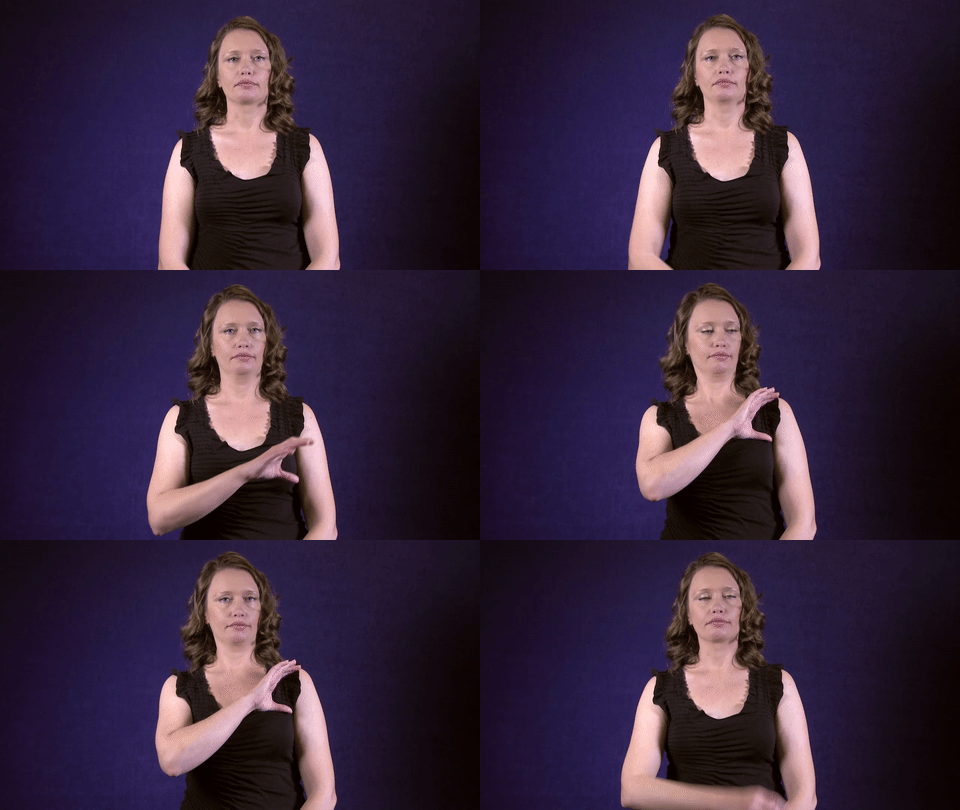
Sign for CHARACTERISTIC in ASL | 💁‍♀️ ASL Dictionary

Definition: A feature or quality of a person or thing.

Sign for CHARACTERISTIC in ASL 

YouTube player

Practice Activities:

To begin practicing the sign for CHARACTERISTIC in ASL, start with signing in isolation. Stand in front of a mirror and focus on handshape, location, and movement. Try signing the word slowly at first, then gradually increase speed while maintaining accuracy. Repeat the sign 10-15 times in a row, paying attention to your non-manual markers, especially a focused or neutral facial expression.

Use flashcards that contain personality traits or qualities, such as honest, brave, shy, or generous. Practice signing each word and then adding the sign for CHARACTERISTIC in ASL afterwards. For example, sign “BRAVE” followed by CHARACTERISTIC to reinforce how this sign connects to descriptive features. This approach helps reinforce vocabulary association and flow in sentence construction.

Try practicing full sentences that include the sign for CHARACTERISTIC in ASL, such as “WHAT YOUR CHARACTERISTIC?” or “HER CHARACTERISTIC PATIENT.” Create your own examples or translate simple sentences from English to ASL. Practice signing with both assertive and neutral tones to recognize how facial expression can change meaning.

Work with a partner to engage in a descriptive activity. Take turns describing a famous person or fictional character using 3–5 traits. The listener tries to guess who the person is based on the characteristics signed. This reinforces both expressive and receptive skills and helps you use the sign for CHARACTERISTIC in ASL fluidly in conversation.

Write a short story or paragraph about yourself or a friend, identifying key characteristics. Translate the story into ASL and perform it in front of a camera for self-evaluation. Rewatch your video, paying attention to how smoothly you incorporated the sign. You can also use emojis like , , and to associate common traits with the visual elements of the sign.

Cultural Context:

In American Sign Language, cultural context plays a major role in how concepts like the sign for CHARACTERISTIC in ASL are understood. While English may offer synonyms or subtle nuances to the word “characteristic,” Deaf culture values directness and specificity, which shapes how this sign is used and interpreted.

The sign for CHARACTERISTIC in ASL often overlaps with meanings like trait, quality, or feature. However, instead of focusing on abstract academic definitions, signers use visual-spatial elements to express personal or identifying features. The sign is typically used when describing someone’s personality or recognizable traits, giving it a more social and interactive role in ASL conversations.

Understanding the cultural intention behind the sign for CHARACTERISTIC in ASL helps avoid misinterpretation. In Deaf culture, it’s common to describe someone by their visible or known attributes, such as being friendly, funny, or creative. These are not judgments but identifiers that create a full picture of who someone is within a community.

When using the sign for CHARACTERISTIC in ASL, the signer may emphasize visual or behavioral traits that are unique to a person. This aligns with ASL’s reliance on facial expressions and body language. These aspects add layers of meaning and intention to the sign, making it much more than just a direct lexical translation.

In ASL storytelling, a characteristic can take on symbolic value. For example, a character in a story might consistently show bravery or honesty. Rather than just telling this, signers show it through facial expressions and body movement along with the sign for CHARACTERISTIC in ASL to reinforce the message.

Deaf culture places high importance on identity markers, whether they relate to personality, visual traits, or community roles. This is why the sign for CHARACTERISTIC in ASL can frequently appear in conversations where identity or reputation is being discussed. It can help convey subtle meanings without needing lengthy explanations.

ASL learners should know that the sign for CHARACTERISTIC in ASL is most impactful when paired with contextual facial expressions. In Deaf culture, eye gaze, head tilt, and mouth movements are integral to the full meaning of the sign. These details make communication clear and vivid, helping signers connect on a deeper level.

While spoken languages may use intonation to stress certain traits, ASL uses space and movement. This gives the sign for CHARACTERISTIC in ASL a unique visual dimension that mirrors how Deaf culture values clarity and visual storytelling. Signers learn to control these elements to match the cultural norms of ASL communication.

In

Extended Definition:

The sign for characteristic in ASL is a clear and expressive way to describe traits, qualities, or features that define a person, object, or concept. This sign is commonly used in both casual and academic conversations to talk about someone’s personality, the nature of an item, or even the unique qualities of a concept or idea.

When signing the word characteristic in American Sign Language, context matters. It’s often used alongside other descriptive signs to give complete information. For example, you might describe a person’s characteristic as kind, strong, or intelligent by following the sign with matching adjectives.

The sign for characteristic in ASL can be particularly useful when teaching or discussing personality types, distinguishing between similar objects, or identifying qualities that make something stand out. It helps provide clarity when comparing two items or analyzing a person’s behavior or typical responses in various situations.

In educational and classroom settings, the sign for characteristic in ASL helps students learn more effectively by pairing spoken English with visual cues. Teachers use it when explaining definitions, traits in literature, or scientific properties. This sign bridges communication gaps and helps elevate comprehension for deaf and hard-of-hearing students.

When using the sign for characteristic in ASL, facial expressions and body language add meaning. These non-manual markers help convey whether the characteristic being discussed is positive, neutral, or negative. This nuance is an essential part of effective ASL communication.

This sign is also useful in storytelling, both in formal presentations and casual narratives. Describing a character’s defining traits with the sign for characteristic in ASL helps make stories more engaging and easier to follow. It provides depth and helps the audience connect with the subject on a more personal level.

Parents often use the sign for characteristic in ASL when teaching children how to recognize strengths and differences in themselves and others. It encourages social-emotional learning by helping kids describe feelings, behaviors, and personality traits. This vocabulary expands their ability to express themselves in complex ways.

The sign for characteristic in ASL can also be used in professional contexts, such as interviews or performance reviews. It allows for clear discussions about job traits, employee strengths, or needed improvements. This sign supports inclusive communication strategies in diverse workplaces.

In the arts and creative fields, discussing the characteristic of an image, dance movement, or piece of music becomes more precise with the sign for characteristic in ASL. Artists and art educators use it to highlight elements such as style, emotion, and form. It supports interpretation and critique in visual and performing arts.

Using

Synonyms: trait, feature, attribute, quality, property

Educational resources: Find related learning materials in our course bank!

Want more? Check out some of our popular learning activities on the homepage!

Need to look up a sign? Use our highly rated dictionary: https://aslinteractive.com/best-asl-dictionary/

Follow us on tiktok: https://www.tiktok.com/@aslinteractive. More social media links at the bottom of this page!

Long-tail Keywords: what is the sign for characteristic in ASL, how do you sign characteristic in ASL, learn the ASL sign for characteristic

Categories:

tags: describing, adjectives, characteristics, language learning, vocabulary

Parameters

*Handshape*:

The handshape used in the sign for CHARACTERISTIC in ASL typically involves the dominant hand in the F-handshape, which resembles the “okay” gesture with the thumb and index finger touching to form a circle while the other fingers remain extended. This shape is positioned near the center of the chest.

In performing the sign for CHARACTERISTIC in ASL, the F-handshape is tapped slightly on the chest, indicating a personal trait or defining feature. The precise formation of the handshape is crucial for clarity in this conceptual sign.

*Palm Orientation*:

The palm orientation for the sign for CHARACTERISTIC in ASL involves the dominant hand forming a modified “F” or closed “OK” handshape. The palm faces downward or slightly inward as it taps the center of the chest, indicating an intrinsic quality or trait.

When using the sign for CHARACTERISTIC in ASL, ensure the hand stays steady, and the palm does not rotate outward. This consistency helps convey the meaning clearly and accurately.

*Location*:

The sign for CHARACTERISTIC in ASL is made at the upper chest area, typically over the sternum. This central chest location symbolizes the core or essence of a person, connecting to the meaning of a characteristic or trait.

In the sign for CHARACTERISTIC in ASL, the dominant hand touches the center of the chest with the thumb of a modified “F” handshape. This spot conveys ideas of identity and inner qualities, making it a visually meaningful location in the language.

*Movement*:

To produce the sign for CHARACTERISTIC in ASL, form the dominant hand into the letter “C” handshape. Place the thumb of the “C” hand on the upper chest near the sternum.

Then lightly tap the chest twice in the same location, creating a firm but brief contact with each tap. This movement emphasizes an internal or personal quality, which aligns with the meaning of the sign for CHARACTERISTIC in ASL.

*Non-Manual Signals*:

The non-manual signals for the sign for CHARACTERISTIC in ASL include a neutral or slightly inquisitive facial expression, depending on context. Slight narrowing of the eyes may be present if emphasizing a specific trait or asking about a particular characteristic.

Eyebrows typically remain in a neutral position unless framed as a question, in which case raised eyebrows may be used. The head remains steady or may tilt slightly for emphasis. These non-manual markers help clarify the meaning and intent behind the sign for CHARACTERISTIC in ASL .

*Prosody, Dominant/Non-Dominant Hand*:

The sign for CHARACTERISTIC in ASL uses the dominant hand in the thumb–fingers–all touching (open F-handshape). The dominant hand taps the center of the chest—a common location for signs related to personality or traits. The non-dominant hand remains down or relaxed. This sign emphasizes internal attributes or qualities, aligning well with the meaning behind the sign for CHARACTERISTIC in ASL . Repetition or slight emphasis in movement can add prosody and clarity.

Tips for Beginners:

When learning the sign for CHARACTERISTIC in ASL, beginners should start by focusing on handshape and movement. This sign uses a modified “thumb and index finger” handshape, similar to the handshape used for the sign for “typical” or “feature.” Make sure your thumb taps the center of your chest firmly but naturally. The sign should be smooth, not abrupt.

A common mistake is placing the hand too low or too high on the chest. Aim for the center of the upper chest—this helps to clearly communicate the intended meaning. The location is important in the sign for CHARACTERISTIC in ASL because changing the placement could lead to confusion with other signs.

Keep your facial expression neutral and natural unless emotional context is needed. Over-exaggerated expressions can be distracting or misleading for a basic descriptive term like characteristic. Practicing in a mirror can help you develop a natural balance and boost confidence.

The motion should be clean and deliberate. Repeating the movement or doing multiple taps is generally not required and may distract from the clarity of the sign. Try not to sign too fast if you’re a beginner—slow and accurate movement is better than fast and unclear.

Watching fluent signers use the sign for CHARACTERISTIC in ASL during conversations can be very helpful. ASL videos and online platforms are great resources, as they allow you to see the sign used in context. Pausing and mimicking what you see builds muscle memory over time.

Finally, always double-check that you’re not confusing the sign with similar ones like “habit” or “value.” These signs may look superficially similar but differ in location or handshape. To truly master the sign for CHARACTERISTIC in ASL, constant practice and feedback from experienced signers will go a long way.

sign for CHARACTERISTIC in ASL, sign for CHARACTERISTICS in ASL, ASL sign for trait, American Sign Language descriptive quality sign, how to sign feature in ASL, charactertistic sign ASL

Connections to Other topics:

The sign for CHARACTERISTIC in ASL is closely related to the concept of identity and qualities, making it useful in explaining a person’s nature, personality, or inherent traits. It often overlaps with the sign for PERSONALITY, which can sometimes be used in similar contexts, depending on the nuance intended. This makes the sign for CHARACTERISTIC in ASL helpful when discussing individual and cultural differences.

This sign is commonly seen in descriptions that combine other signs, such as combining it with STRONG or UNIQUE to express strong characteristics or unique traits. For example, one could sign STRONG combined with CHARACTERISTIC to emphasize a defining feature of a person or experience. It’s useful in narratives and introductions, especially when discussing core values or specific behavioral attributes.

The sign for CHARACTERISTIC in ASL also connects to signs like BEHAVIOR, TRAIT, and QUALIFY, which explore how someone acts or meets certain standards. These all fall under the broader category of personality or descriptive language in ASL grammar. Understanding this context is key to differentiating when to use this sign versus closely related ones.

Learners will also encounter compound signs built off CHARACTERISTIC. For instance, when discussing leadership qualities, a signer may incorporate terms like LEAD + CHARACTERISTIC or LEADER + TRAIT in more advanced sentences. These constructs help deepen descriptions beyond basic vocabulary.

In academic or formal discussions, the sign for CHARACTERISTIC in ASL can be used when talking about literary characters, scientific properties, or cultural features. It supports a wide range of discussions in social studies or science. When applied in these ways, the sign helps bridge abstract concepts with real-world applications in ASL discourse.

Using this sign also encourages signers to practice topic-comment structure, where the subject is introduced followed by its defining characteristic. This aligns with natural ASL syntax and reinforces grammatical fluency. Understanding its usage contributes to stronger communication skills and language depth in diverse conversation settings.

Summary:

The sign for CHARACTERISTIC in ASL is generally produced by forming the dominant hand into an open “C” handshape. This handshape taps or brushes the center of the chest, suggesting something internal or defining. The chest location indicates traits, qualities, or attributes commonly associated with a person.

This gesture has a close connection with signs like TRAIT and FEATURE, often used interchangeably depending on context. While subtle differences may exist based on regional dialect or expressive nuance, the fundamental concept remains about identity or qualities. The chest, as a signing space, symbolizes personal essence or self.

Grammatically, the sign for CHARACTERISTIC in ASL can function as both a noun and a descriptor depending on sentence structure. For example, if used in a topic-comment sentence, it can highlight a primary trait. It emphasizes a feature that defines the subject of conversation.

In ASL linguistics, this sign is considered semantically relational, grounded both spatially and symbolically in its location on the body. It involves a concept called iconicity—where the sign resembles the idea being expressed. Since characteristics are internal or evident personal features, the chest placement reinforces the embodiment.

Applied linguistics views the sign for CHARACTERISTIC in ASL as an example of how bodily space and handshape work together to build meaning in signed languages. Unlike spoken adjectives, which may rely on tone and modifiers, ASL presents descriptors visually and kinesthetically. Thus, a cultural embodiment of meaning takes place with every signing.

From a sociolinguistic standpoint, the sign for CHARACTERISTIC also invites viewers to think deeply about how language intersects with identity. Because characteristics relate to identity, this sign can open dialogues about self-description, culture, and inherent traits. It often emerges during conversations about people, values, roles, and expectations.

Culturally, the sign is vital to discussions of individuality. In Deaf culture, where identity is strongly tied to community and language, acknowledging someone’s characteristics is more than mere description—it builds respect and awareness. This makes the sign for CHARACTERISTIC in ASL a signpost of belonging and acknowledgment.

It also appears in educational and professional signing when explaining personalities, roles, or attributes in assessments, self-reports, or interpersonal contexts. For instance, in Deaf education, describing a student’s strength or learning style might call for this sign. It helps teachers and learners bridge communication about cognitive and social functions.

The sign for CHARACTERISTIC in ASL may undergo slight modifications in speed or emphasis depending on register. In more formal settings, the movement may be deliberate and clean, while casual conversations might present quicker articulation. These variations also provide emotional texture—reflecting enthusiasm, criticism, or neutrality.

This sign is often paired with adjectives in ASL such as GOOD, BAD, KIND, or SMART, adding depth to characterization. For example, the structure may be something like, “HER CHARACTERISTIC KIND,” which emphasizes kindness as a defining trait. This structure demonstrates the language’s theme-comment format and visual priority.

In discourse, the sign for CHARACTERISTIC in ASL helps mark personal narratives by highlighting key traits. When storytelling or sharing life history, signers often use this sign to anchor the telling to grounded ideas about why things happened a certain way, or how a person responded. It adds layers of meaning and emotional clarity.

It can also be used metaphorically—for example, suggesting a defining characteristic of a place or system. In these situations, the sign translates beyond the individual and moves into abstract qualities, such as complexity, structure, or atmosphere. This makes it a highly flexible lexical item in ASL vocabulary.

From a pedagogical perspective, the sign for CHARACTERISTIC in ASL is an ideal candidate for teaching students how morphology and semantics intertwine. The handshape “C” cues the English cognate, aiding bilingual education models. Its location and motion reinforce semantic associations without phonetic reliance.

This also makes it important for interpreters, especially in educational interpreting or psychological settings, where accurate attribute labeling is crucial. Interpreters must choose the correct variation of this sign and deliver it with clarity. Misinterpreting this sign can shift the tone or factual detail of an interpreted session.

In the comparative analysis of signed languages, this sign has parallels in many visual languages that also locate defining traits near the heart or chest. This underscores the physiological metaphor common in human expression—placing essential traits close to the core of the body. Universality plays a role in making concepts accessible across signed languages.

Emotionally, the sign for CHARACTERISTIC in ASL can carry significant tone, especially when layered with facial expressions. Intensity of motion, facial cues, and shoulder posture can turn this sign into an expression of pride, judgment, admiration, or humor. Thus, it operates semiotically on multiple levels beyond the handshape alone.

Variants also exist depending on the phrase, such as PERSONAL CHARACTERISTIC, COMMON CHARACTERISTIC, or PHYSICAL CHARACTERISTIC. Each compound phrase might use this base sign in tandem with

Want more? Check out some of our popular learning activities!

ASL Interactive Resources

ASLInteractive YouTube Channel

Follow us on tiktok: @aslinteractive.com

Follow us on Instagram: aslinteractive

Facebook page: aslinteractive

Facebook group: aslinteractive

LInkedIn: ASL Interactive LLC

Twitter: @ASL_interactive

*Some information on this page is AI-generated. AI can make mistakes. Please check the information.

Sign for CHARACTERISTIC in ASL 

Responses