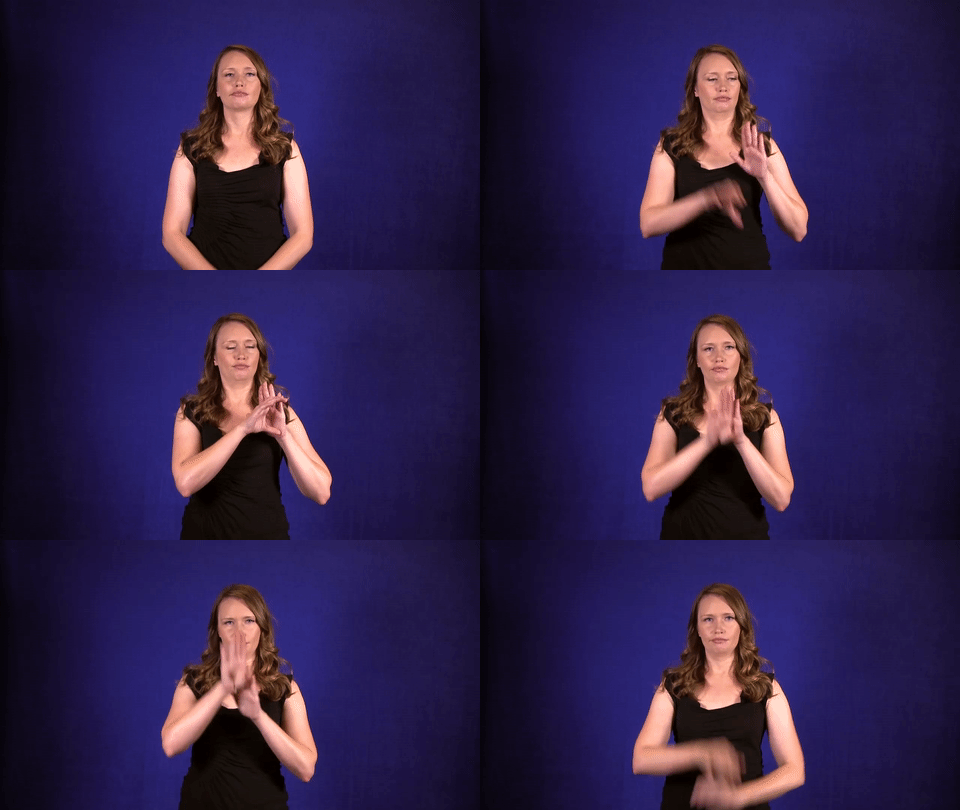
Definition: The process of creating a character.
Sign for CHARACTERIZATION in ASL

Practice Activities:
To build confidence using the sign for CHARACTERIZATION in ASL, start by practicing the sign in isolation. Repeat the sign several times in front of a mirror, focusing on consistent handshape and movement. Try signing it slowly at first, then increase your speed while still maintaining accuracy. This will help reinforce muscle memory.
Next, create basic phrases such as “her characterization is strong” or “good characterization helps a story.” Practice signing them smoothly, ensuring that your body language and facial expressions reflect the meaning. Add more variation by switching out related vocabulary like “actor,” “performance,” or “script” to embed the sign for CHARACTERIZATION in ASL into different contexts.
Use storytelling as a way to practice. Choose a simple short story or summarize a movie you’ve seen. As you describe the characters, include observations about their traits, using the sign for CHARACTERIZATION in ASL to explain what makes them unique. For example, describe how a villain’s cold nature is portrayed or how a hero’s kindness is shown through behavior.
Work with a partner and exchange short character bios. Take turns signing a description of a fictional or familiar character while the other guesses who it is. You can also act out a scene and have your partner describe the characterization of your character using ASL. This strengthens comprehension and expressive skills together.
Record yourself using the sign in both rehearsed and spontaneous sentences. Play it back to track improvement and correct hand placement or clarity. Use prompts like “Describe the characterization of your favorite movie character” to create short responses. Practicing with visual storytelling and dialogue will help you effectively use the sign for CHARACTERIZATION in ASL in real conversations and signed narratives.
Cultural Context:
In American Sign Language, the sign for characterization plays a meaningful role in describing behavior, identity, and personality. Understanding the cultural context of how Deaf people use the sign for characterization in ASL helps deepen comprehension beyond the basic handshape and motion.
The Deaf community often uses the sign for characterization in ASL when discussing roles, traits, or emotional depth. It’s especially important in storytelling, theater, and narratives where character development carries nuance and specificity. This sign connects ideas about personality types and behaviors directly to visual communication, reinforcing how ASL reflects lived identity.
In the cultural setting of Deaf theater and performance, the sign for characterization in ASL is vital for expressing layered portrayals. Deaf actors must rely on visual cues and physicality to craft relatable characters. As such, this sign underscores how Deaf performers rely on facial expressions and signing style to build characters fully and vividly.
Everyday conversations in the Deaf community also feature the sign for characterization in ASL, especially when explaining someone’s attitude, emotional habits, or consistent behaviors. This sign often pairs with others to build more colorful or dynamic descriptions. It facilitates a detailed view of a person’s character traits or motivations.
When interacting socially, Deaf individuals might use the sign for characterization in ASL to analyze someone’s behavior during an event or in a friendship. It’s a way to label or interpret social actions that help explain what kind of individual someone is. Within Deaf culture, these visual descriptions strengthen storytelling and interpersonal connections.
ASL poetry and storytelling depend heavily on this sign when characters are symbolic or when metaphors are used. The sign for characterization in ASL allows signers to set up consistent behaviors or emotions associated with a person or role, supporting a rich and layered narrative style that’s unique to visual language users.
In Deaf education and bilingual classrooms, this sign is useful when teaching students the value of self-awareness and personal identity. Teachers use the sign for characterization in ASL to help students reflect on who they are, as well as how to describe fictional or historical figures in expressive ways. It supports metacognition and self-expression across multiple contexts.
The sign for characterization in ASL is also frequently used in discussions about media representation and Deaf roles in movies, books, and television. Signers use this expression to unpack how characters are portrayed, whether authentically or stereotypically. In this way, the sign supports advocacy for accurate and respectful depictions of Deaf people.
Interpreters often use the sign for characterization in ASL when rendering dialogues or dramatic content in
Extended Definition:
The sign for characterization in ASL is used when discussing the process of expressing traits, roles, or qualities of a person, character, or persona. In American Sign Language, this concept typically appears in conversations related to drama, storytelling, or personality descriptions. Signers use this term when identifying how behavior, emotions, or identity are portrayed by an individual or within a narrative.
When learning the sign for characterization in ASL, it’s important to understand the context where it’s most commonly used. It often shows up in classroom settings where students are describing characters in literature or in theater programs preparing for a role. Deaf performers and storytellers may also use this sign when discussing how a character should be presented visually or emotionally.
The sign for characterization in ASL is usually made by combining concepts like character, personality, or traits, depending on regional variations or signer preference. ASL enjoys a lot of flexibility, so the sign might involve classifiers, facial expressions, and body movement to emphasize the specific traits of the character being discussed. The exact sign may change slightly depending on the focus—whether it’s physical appearance, emotional qualities, or behavioral style.
Using the sign for characterization in ASL is a great way to explore more advanced language skills. It encourages signers to combine expressive tools such as body language, space, and facial grammar. When used in storytelling, it helps add depth and vivid imagery, allowing the audience to better understand the character’s role or purpose in the story.
Parents, teachers, and interpreters may all benefit from knowing the correct sign for characterization in ASL for helping learners develop narrative abilities. It also helps students analyze people or fictional roles more clearly in detailed discussions. Teachers can use it to ask students to describe character motivation or personality shifts over the course of a story.
You’ll often encounter the sign for characterization in ASL when attending ASL theater performances, educational narratives, or storytelling competitions. These events highlight the creative expression that comes through in signed languages. Understanding this term opens the door to appreciating how ASL can convey subtle and complex aspects of human behavior.
In filmmaking or media discussions, the sign for characterization in ASL plays a role in describing how a person is portrayed on screen. It may also come up in critiques or reviews where the traits or depth of a character are being explored. Deaf and hearing communities both work together in such projects, making it vital to have shared and accurate signs for key artistic concepts.
Using this sign regularly can help learners fluently express evaluations
Synonyms: portrayal, depiction, description, representation, profile
Educational resources: Find related learning materials in our course bank!
Want more? Check out some of our popular learning activities on the homepage!
Need to look up a sign? Use our highly rated dictionary: https://aslinteractive.com/best-asl-dictionary/
Follow us on tiktok: https://www.tiktok.com/@aslinteractive. More social media links at the bottom of this page!
Long-tail Keywords: what is the sign for characterization in ASL, how do you sign characterization in ASL, ASL sign for characterization
Categories:
tags: Characterization, Language Learning, Activities, Wh-words, Education
Parameters
*Handshape*:
The handshape used in the sign for CHARACTERIZATION in ASL involves both hands using the “C” handshape . These curved handshapes are commonly used when referring to concepts related to traits, roles, or qualities.
In the sign for CHARACTERIZATION in ASL, the dominant “C” hand often moves across or taps the chest area, symbolizing the internal attributes of a character. This specific handshape supports the idea of capturing a person’s core characteristics or identity.
*Palm Orientation*:
In the sign for CHARACTERIZATION in ASL, the palm orientation begins with both hands in a “C” handshape. The dominant hand typically faces inward toward the center of the chest, while the non-dominant hand remains stationary with its palm slightly angled outward.
As movement occurs, the dominant hand circles or makes a specific shape in relation to the body, maintaining its original orientation. Proper palm direction is essential to clearly convey the intended meaning in the sign for CHARACTERIZATION in ASL.
*Location*:
The sign for CHARACTERIZATION in ASL is typically produced in the neutral space in front of the torso. The signer brings both hands slightly forward from the chest area, depending on the variation used. This location ensures clear visibility and maintains the sign’s connection to the conceptual realm of traits and attributes.
Using the neutral space helps convey abstract ideas, making the sign for CHARACTERIZATION in ASL easily distinguishable. It’s important that the movement and orientation remain centered and deliberate in this spatial zone.
*Movement*:
The sign for CHARACTERIZATION in ASL typically begins with both hands forming the letter “C” and positioned in front of the chest. The dominant “C” hand taps the center of the non-dominant palm twice, similar to the sign for CHARACTER. This motion emphasizes the personal traits or qualities associated with a person or concept.
In the sign for CHARACTERIZATION in ASL, facial expression plays a role in giving the sign more depth. Some signers may follow this motion with a slight outward spreading gesture to show the concept of adding features or details, further illustrating the idea of characterization.
*Non-Manual Signals*:
When using the sign for CHARACTERIZATION in ASL, the signer typically maintains a focused and slightly analytical facial expression , as if breaking down the elements of a character or trait. The brows may be slightly raised to show specification or description.
Non-manual signals help emphasize the idea of exploring qualities or attributes. Depending on the context, slight head tilts or nods can show emphasis or comparison, reinforcing the purpose behind the sign for CHARACTERIZATION in ASL.
*Prosody, Dominant/Non-Dominant Hand*:
The sign for CHARACTERIZATION in ASL typically involves both hands, where the dominant hand uses the “C” handshape and moves in a small circular motion on the chest to indicate attributes or traits. The non-dominant hand often stays neutral but may mirror the movement depending on emphasis or context.
In the sign for CHARACTERIZATION in ASL, prosodic features like facial expression and the intensity of the movement help convey depth or complexity of the personality being described. This sign can be used when discussing characters in stories, plays, or human traits .
Tips for Beginners:
When learning the sign for CHARACTERIZATION in ASL, one of the first things to focus on is understanding the base sign for CHARACTER. Start by using the sign for CHARACTER, which mirrors how you might sign PERSONALITY or IDENTITY, combining a flat “C” handshape that touches and rotates on the center of the upper chest. Then, incorporate expressive facial cues to extend the meaning toward CHARACTERIZATION, indicating the process or quality of defining a character or trait.
Practice your facial expressions, as they carry much of the meaning in the sign for CHARACTERIZATION in ASL. Since ASL relies heavily on non-manual markers, showing how a character behaves or develops through your brows, eyes, and mouth movements is crucial. Try to visualize a specific character while signing to help channel the right expression.
Avoid rushing the motion or dropping your handshape. A clear “C” is important, and smooth, confident movement helps make your sign unmistakable. Repetition in front of a mirror can help you fine-tune both handshape consistency and emotional expression. Don’t forget to engage your body slightly, which adds more depth to the portrayal and makes your depiction more vivid.
Make sure to distinguish fingerspelling when appropriate if SIGN for CHARACTERIZATION in ASL is done in an academic or technical setting. In some contexts where no widely recognized compound sign is used, fingerspelling CHARACTERIZATION is appropriate. Be confident in your speed and clarity while fingerspelling this longer word — break it into visual syllables to prevent hesitations or misreadings.
Lastly, exposure to ASL storytelling videos is helpful. Watch how native signers portray character development and behavior in narrative contexts. This immersion can deepen your grasp of how the sign for CHARACTERIZATION in ASL works in real communication, beyond just isolated vocabulary.
Connections to Other topics:
The sign for CHARACTERIZATION in ASL is closely linked to concepts like identity, personality, and traits. It often builds on the base sign for CHARACTER, combined with non-manual markers or added elements to express detailed qualities. Since ASL relies heavily on context, characterization can be conveyed through facial expressions, classifiers, and role-shifting to show various dimensions of a character.
This sign often appears in storytelling, literature interpretation, and theatre-related discussions in ASL. In these contexts, the sign for CHARACTERIZATION in ASL may be used alongside signs for EMOTION, ROLE, or ACTING. Facial expressions and classifiers enhance the delivery of this sign, making the meaning richer and more descriptive than in English alone.
It connects to other descriptive signs such as PERSONALITY, ATTITUDE, and TRAIT. These signs help describe the internal or behavioral aspects of a character, supporting a fuller depiction of characterization. In drama or narrative signing, the sign for CHARACTERIZATION in ASL often combines with signs like DEVELOP or EVOLVE to show how a character changes over time.
In educational or linguistic settings, the sign is used when analyzing literary texts or characters in ASL literature. It has important ties to the sign STORY and can occur in discussions of character arcs or thematic development. When discussing different forms of storytelling, the sign may be paired with VISUALIZATION or ANALYZE to interpret how a person or fictional figure is portrayed.
The sign for CHARACTERIZATION in ASL also supports abstract discussions about self-representation and identity in Deaf Studies. When exploring how individuals present themselves or are interpreted by others, this sign is an essential tool. Combined with signs like PERCEPTION, CULTURE, and REPRESENT, it opens up conversations about deeper meanings in communication.
Summary:
The sign for CHARACTERIZATION in ASL incorporates conceptual layering from both the idea of “character” and the process of describing qualities. It often builds visually on the sign for CHARACTER, then integrates descriptive motion or classifiers to convey deeper traits. This flexibility reflects how character traits aren’t always fixed and might evolve depending on context.
When producing the sign for CHARACTERIZATION in ASL, you might see the dominant hand form a “C” handshape. This often touches the center of the chest, a location tied to personal identity in ASL. The hand may then move out or change into a descriptive classifier depending on how traits or roles are being portrayed.
In some interpretations, signing CHARACTER followed by a descriptive verb such as SHOW, DESCRIBE, or REPRESENT supports the notion that characterization is an ongoing process. This highlights how ASL’s grammar allows for layering of concepts. Rather than one isolated sign, the meaning emerges through connected constructions.
The sign for CHARACTERIZATION in ASL often appears in educational, literary, and theatrical contexts. It is common in classrooms discussing literature where analyzing characters’ motives, behaviors, and traits matters. Storytelling in ASL also heavily utilizes characterization to build emotional depth and narrative drive.
Deaf theater especially values strong uses of the sign for CHARACTERIZATION in ASL. Performers often embody their characters fully, using nuanced non-manual signals and space to show internal thoughts and social dynamics. This physical vocabulary allows for a rich form of visual storytelling unique to signed performance.
Linguistically, the sign for CHARACTERIZATION in ASL shows how iconicity plays a role in ASL structure. The initial “C” for character links directly to the English word through visual form. From there, ASL grammar layers classifiers to represent traits or changes, mimicking how attributes attach to identity.
This sign also makes use of spatial referencing and constructed action. A signer might describe a character, then “become” that character using gaze, posture, and facial expression. This embodies the differentiation of characterization—making traits visible, dynamic, and felt.
Applied linguistics offers insights into how the sign for CHARACTERIZATION in ASL reflects cognitive empathy. The ability to interpret character traits and motivations requires perspective-taking. ASL users exhibit this through physical engagement, embodying different characters in a narrative space.
In Deaf Studies, characterization is not only a linguistic function but a cultural process. ASL storytelling pulls from Deaf experience, and the portrayal of character reflects common themes of resistance, identity, and community. Using the sign for CHARACTERIZATION in ASL connects users to broader cultural expression.
Related signs include PERSONALITY, ROLE, CHARACTER, DESCRIBE, and BEHAVIOR. These are often linked depending on semantic emphasis. When emphasizing traits, PERSONALITY may be used. When focusing on a theatrical part, ROLE fits better. This reveals the adaptability of the sign for CHARACTERIZATION in ASL.
Grammatically, ASL allows for decomposition and recombination of signs to tailor meaning. One might fingerspell C-H-A-R-A-C-T-E-R and follow with a descriptive phrase using classifiers or facial expressions. This blends formal precision with narrative richness.
Students learning ASL and exploring literature often encounter the sign for CHARACTERIZATION in ASL while discussing novels or films. Educators may model storytelling techniques using signs like REACT, FEELINGS, and SHOW to build vivid character descriptions. This encourages learners to think in three dimensions—visually, spatially, and affectively.
For educational interpretation, the sign for CHARACTERIZATION in ASL may depend on the audience. Deaf students with strong visual literacy often benefit from language that imitates psychological nuance through body language. Interpreters must read tone and intent carefully to match the speaker’s approach to characters.
Children’s storytelling in ASL shows how early learners grasp the building blocks of characterization. Signs like CHARACTER, followed by gestures for traits such as KIND, MEAN, or FUNNY, foster emotional vocabulary. Through mimicry and narrative play, they learn to ground abstract personality terms in motion.
Deaf artists in visual and performing arts use the sign for CHARACTERIZATION in ASL as part of their expressive toolkit. In poetry, visual vernacular, and theater, signs carry flavor and personality through space and form. The idea of characterization becomes embodied perception.
In translation work, ASL interpreters often encounter challenges when working with culturally unfamiliar character norms. Concepts of honor, social status, or internal monologue may require adaptation. The sign for CHARACTERIZATION in ASL anchors these qualities through expressive sign clusters.
The sign allows for rich discourse analysis. For instance, spoken English might flatten a character trait into a single adjective. In ASL, a trait emerges through framed action, repeated markers, and visual metaphor. This underscores how the sign for CHARACTERIZATION in ASL aligns with performative language.
In signed fiction or Deaf literature, characters evolve over time within the narrative’s layers. ASL offers tools for time shifting and psychological depth—eye
Want more? Check out some of our popular learning activities!
ASL Interactive Resources
ASLInteractive YouTube Channel
Follow us on tiktok: @aslinteractive.com
Follow us on Instagram: aslinteractive
Facebook page: aslinteractive
Facebook group: aslinteractive
LInkedIn: ASL Interactive LLC
Twitter: @ASL_interactive
*Some information on this page is AI-generated. AI can make mistakes. Please check the information.


Responses