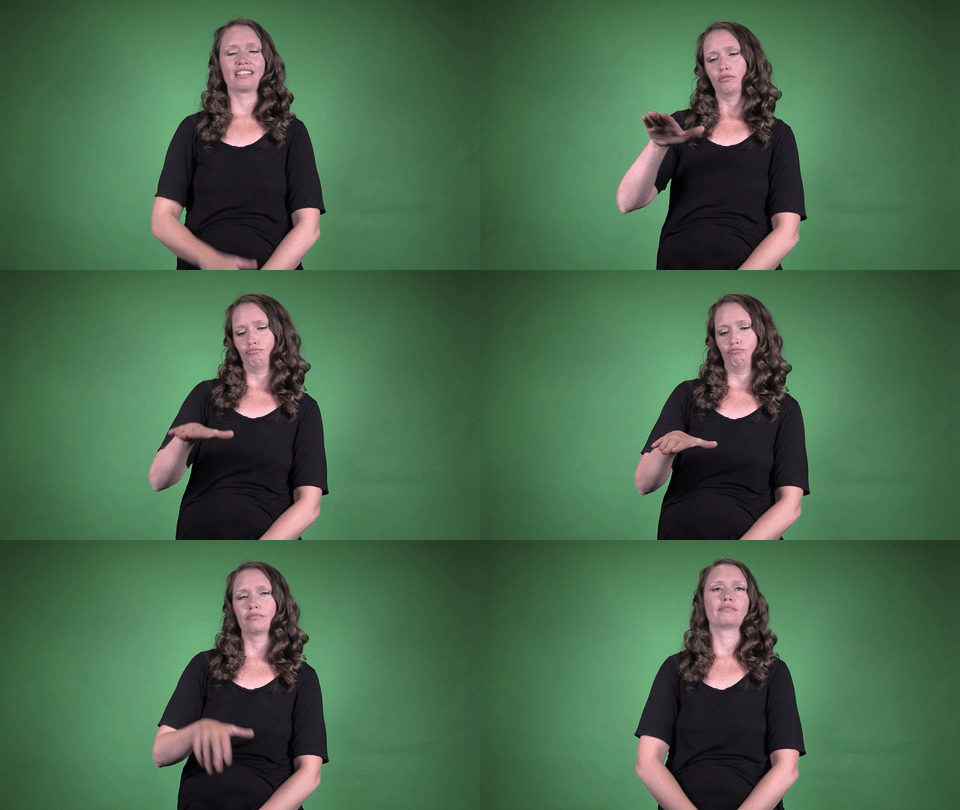
Sign for CHILD in ASL | 👧 ASL Dictionary

Definition: A young human.

Sign for CHILD in ASL

YouTube player

Practice Activities:

To practice the sign for CHILD in ASL, begin by signing it in front of a mirror. Focus on handshape and placement—this sign is usually made by patting the top of an imaginary child’s head with a flat hand. Repeat the sign slowly then build up to a natural speed. Say the English word in your head as you sign to cement the association.

Next, sign the word in a series of isolated repetitions, alternating with related signs such as BABY, PARENT, and SCHOOL. You can practice creating quick comparisons using signs like BIG CHILD, SMALL CHILD, or MANY CHILDREN. Practicing in this way helps with clarity and fluency when using the sign for CHILD in ASL in full sentences.

Use short phrases like “That CHILD is running,” “I saw a CHILD,” or “Where is the CHILD?” Sign each sentence smoothly, emphasizing the placement and movement of CHILD. You can increase complexity by connecting more signs such as “The CHILD reads a book,” or “My sister has one CHILD.”

Storytelling is helpful for strengthening recall. Imagine a simple scene at a playground and describe what the CHILD is doing using multiple signs. For example, “The CHILD slides, the CHILD laughs.” Keep the story in the present tense and try to maintain consistent facial expressions to match the context.

Practice with a partner by taking turns acting out roles. One person can ask “Where is the CHILD?” or “Is the CHILD happy?” and the other can respond appropriately in full signed sentences. You can also play a game like “Guess who?” using descriptions such as “The CHILD with a red shirt,” using classifiers and location indicators alongside the sign for CHILD in ASL.

Finish each session by reviewing and repeating the sign, adding it to your daily vocabulary practice.

Cultural Context:

The sign for CHILD in ASL carries deep cultural significance within the Deaf community. It goes beyond just a translation; it reflects how Deaf culture views family, growth, and the importance of clear communication from an early age. Using the correct sign shows respect for those values and helps bridge gaps between Deaf and hearing communities.

In ASL, facial expressions and hand movement are essential to conveying meaning. When using the sign for CHILD in ASL, the motion often resembles patting the head of a small child, symbolizing youth in a visual way. This motion is intuitive and highlights how ASL is closely tied to lived experiences and visual representation.

Many families in the Deaf community encourage using the sign for CHILD in ASL as early as possible. Signing with babies and toddlers helps develop language skills and strengthens bonds between parents and children . It’s not uncommon to see Deaf children confidently using this sign long before they can speak aloud.

Including the sign for CHILD in ASL during story time or learning activities is part of everyday life in Deaf households and schools. It is more than vocabulary; it becomes part of the child’s identity. This sign marks an important stage in life, and often, children love learning it because it relates directly to them.

Teachers and interpreters also use the sign for CHILD in ASL often when discussing lessons that involve young people. Whether it’s in schools, family counseling, or pediatric care, knowing this sign enriches communication and makes interactions smoother for everyone. Culturally, this highlights how ASL accommodates real-life scenarios with expressive and functional signs.

Social gatherings, church services, and Deaf community events often involve many young children. The sign for CHILD in ASL is commonly used in these settings, reinforcing its importance in everyday dialogue. It’s a sign that helps include children in conversations and ensures they are seen and heard.

Because ASL is a visual language with its own grammar and style, each sign, including the sign for CHILD in ASL, is shaped by culture and community practices. It is not simply a gesture but a symbol of how Deaf people share their world. Understanding the cultural layers behind the sign adds meaning for anyone learning ASL.

The sign for CHILD in ASL also reflects values such as care, protection, and development. It may be used in parenting classes, educational games, or wellness programs that aim to support young learners in the Deaf community. Its recurring use in these meaningful contexts deepens its cultural relevance.

When someone new to ASL begins to

Extended Definition:

The sign for CHILD in ASL is a foundational sign used early and often when learning American Sign Language. It represents the concept of a child or children and is commonly used in both casual and educational settings. This sign is useful in conversations about family, age, growth, and teaching.

To make the sign for CHILD in ASL, you typically mime patting the head of a small person, using one hand with a downward motion near the height of a child’s head. It visually reflects the idea of a young, shorter person, capturing the essence of youth. This sign is one of the core signs individuals learn when discussing relationships or human development in sign language.

In daycare environments, family interactions, or classrooms, the sign for CHILD in ASL is frequently used to talk about kids. Teachers incorporate it in daily activities, especially when addressing groups or singling out individual children. Parents also learn and use this sign early on, particularly when raising Deaf or hard-of-hearing children.

This sign is often combined with other signs to describe more detailed concepts such as CHILDREN, SCHOOLCHILD, or BEHAVIOR. Signing clearly and at the appropriate height is important to ensure proper communication. Consistency in hand movement and facial expression helps reinforce the meaning of the sign in conversations.

Learning the sign for CHILD in ASL helps build vocabulary around age and relationships. It opens the door to learning related signs like PARENT, BABY, MOTHER, and FATHER. Through repetition and conversation, understanding of these family-related signs deepens.

In group settings, when signing to a number of people, signing CHILD can also signal a shift in the topic to youth-specific activities or announcements. For example, at community events, teachers and interpreters may sign CHILD before giving directions for youth activities or classes.

The sign for CHILD in ASL is also part of many compound words and phrases. Signs like CHILDCARE, CHILD SUPPORT, or CHILDHOOD draw from the root sign. This makes it a building block for more advanced vocabulary in ASL.

Understanding how to sign CHILD correctly also involves observing facial expressions, which help convey tone and emotion. A stern or serious expression may communicate discipline, while a warm smile can indicate affection or playfulness. These visual cues enhance the communication of ideas involving children in ASL.

Parents who use the sign for CHILD in ASL early in language development help encourage language access for Deaf children. It’s one of the first signs introduced to toddlers and infants in signing environments.

Synonyms: child, kid, youngster, youth, minor

Educational resources: Find related learning materials in our course bank!

Want more? Check out some of our popular learning activities on the homepage!

Need to look up a sign? Use our highly rated dictionary: https://aslinteractive.com/best-asl-dictionary/

Follow us on tiktok: https://www.tiktok.com/@aslinteractive. More social media links at the bottom of this page!

Long-tail Keywords: what is the sign for child in ASL, how do you sign child in ASL, what is the ASL sign for child

Categories:

tags: Children, Family, People, Relationships, Language Learning

Parameters

*Handshape*:

The handshape for the sign for CHILD in ASL typically uses a flat hand, also known as the “B” handshape. This hand is open with the fingers straight and together, with the thumb tucked alongside the palm. The palm generally faces downward during the motion.

When performing the sign for CHILD in ASL, the dominant hand makes a patting motion downward, as if indicating the height of a small child. The flat hand shape helps convey this concept clearly and naturally.

*Palm Orientation*:

The palm orientation for the sign for CHILD in ASL is typically downward, with the dominant hand held flat and palm facing the ground. The hand moves slightly down in front of the body, mimicking a patting motion on the head of an imaginary child.

This palm position helps clearly convey the size or height of a child. The sign for CHILD in ASL uses a natural gesture that represents a smaller person, making the palm orientation crucial for clarity.

*Location*:

The sign for CHILD in ASL is typically made at the front of the body, around waist level, to indicate the height of a child. This location reflects the relative size of a child in comparison to an adult.

When signing the word, the dominant hand lightly pats or gestures downward at the mid-abdomen area. Consistently using this spatial placement helps convey the meaning clearly for the sign for CHILD in ASL.

*Movement*:

To perform the sign for CHILD in ASL, place your dominant hand in a flat open position, palm facing downward. Move your hand slightly forward and downward as if patting the top of a small child’s head, at about the height a child would be.

The repeated small downward pat mimics the action of indicating child height, helping reinforce the meaning. The sign for CHILD in ASL is simple and iconic, making it easy to remember .

*Non-Manual Signals*:

The non-manual signals for the sign for CHILD in ASL typically include a soft facial expression, often gentle or nurturing . The brows stay relaxed, and the overall demeanor is calm to reflect the subject of a child.

When using the sign for CHILD in ASL in storytelling or conversation, slightly tilting the head or using a fond smile can reinforce affection or tenderness. These subtle cues help convey emotional context naturally.

*Prosody, Dominant/Non-Dominant Hand*:

The sign for CHILD in ASL uses only the dominant hand. Hold your dominant hand flat and palm-down, as if patting the top of a child’s head. Move your hand downward in a single small patting motion near waist height. The non-dominant hand remains still and does not participate in the sign. The sign for CHILD in ASL is typically done with a gentle and relaxed motion to reflect the meaning of the word.

Tips for Beginners:

When learning the sign for CHILD in ASL, it’s important to focus on the motion and hand placement. The sign typically mimics the idea of patting the head of a small child, using a flat hand palm-down about child-height in front of you. Don’t overthink this gesture — it’s a natural representation and should be expressed with a relaxed movement.

A common mistake beginners make while doing the sign for CHILD in ASL is either raising the hand too high or not maintaining the correct palm orientation. If the hand is too high, it may convey a different meaning or resemble the sign for adult. Keeping the motion at the proper height adds to the sign’s clarity.

Try practicing the sign while imagining the top of a child’s head so your hand naturally lands in the correct position. Using a mirror or recording yourself can help you track the accuracy of your signing motion. This is helpful for seeing if your gestures are becoming too exaggerated or inconsistent with frequent repetition.

Consistency in speed and size will help others understand you more quickly. The sign for CHILD in ASL doesn’t need to be rushed or overemphasized. Let your hand naturally move in a gentle downward patting motion to symbolize a child’s presence or height.

When constructing sentences, placing the sign properly in context with facial expressions improves overall comprehension. Combining the sign for CHILD in ASL with appropriate non-manual markers like raised eyebrows when asking a question will enhance your fluency. Facial grammar is critical in ASL and shouldn’t be neglected.

Lastly, remember that practice in conversation is more effective than isolated repetition. Use the sign in various contexts — talking about your family, teaching, or storytelling — and the meaning will stick. The more real-life use you get, the easier it becomes to internalize the sign for CHILD in ASL.

Connections to Other topics:

The sign for CHILD in ASL serves as a foundational vocabulary word that connects with many other family and developmental signs. It typically involves a single patting motion at about waist level, representing the height of a small child. This location and movement share similarities with other child-related signs, offering insight into how spatial metaphor works within ASL.

This sign forms the base for many compound signs such as GRANDCHILD, STEPCHILD, and even CHILDREN. GRANDCHILD is made by combining the sign for GRAND with the sign for CHILD, visually demonstrating generational relationships. The plural concept in CHILDREN is often expressed by repeating the movement of the sign for CHILD, enhancing learners’ understanding of ASL pluralization through movement and repetition.

In educational contexts, the sign for CHILD in ASL often appears in signs like CHILDCARE or CHILD DEVELOPMENT. These compound signs extend the meaning of the base sign and reflect how ASL can efficiently convey complex concepts using a series of related morphemes. Signs such as SCHOOL or CLASSROOM often appear alongside the sign for CHILD, especially when discussing environments or services intended for young people.

Moreover, understanding the sign for CHILD is instrumental when learning age-related structures in ASL. For example, instead of speaking “a 5-year-old child,” ASL users may sign the age followed by the sign for CHILD to tell someone about the person’s demographic. This helps language learners become more proficient in structuring age-related and descriptive statements.

The sign for CHILD in ASL also links closely with signs grouping people by developmental stage, such as INFANT or TEENAGER. Contrast between these signs reinforces the importance of classifier use, hierarchy, and physical space in ASL. This layered understanding allows learners to express family dynamics, age, and caregiving roles with precision and clarity.

Summary:

The sign for CHILD in ASL mimics the natural gesture of patting a child on the top of the head. This is done with a flat hand positioned palm down, made to lightly press in a downward motion at about waist height. This iconic representation reflects the general height of a young child.

This sign is spatially iconic, tying visual size cues with real-life references. The height at which the hand is placed helps differentiate it from signs like ADULT, which appear higher in space to denote greater height and maturity. ASL often utilizes spatial height to encode age and social hierarchy.

The sign for CHILD in ASL carries deep cultural resonance. In Deaf culture, children represent both a connection to the future and a reaffirmation of identity through language. Teaching this sign to young children or beginning language learners is common due to its conceptual clarity and ease of acquisition.

In signed conversations, the sign for CHILD in ASL can be used independently or followed by modifiers. You might see signs like SMALL CHILD, SCHOOL CHILD, or SIBLING followed by CHILD to build more nuanced meaning. This allows for flexible yet clear expression without reliance on spoken language structures.

This sign has a plural counterpart: CHILDREN. To pluralize, a signer performs the same downward patting motion sequentially in a horizontal arc—suggesting a row of children. This motion helps to visually and conceptually connect with the singular form while clearly indicating multiple individuals.

Grammatically, the sign for CHILD in ASL functions as a noun, and it often appears at the beginning of a sentence or phrase in ASL’s topic-comment syntax. ASL’s flexible sentence structure allows signs like CHILD to appear either before or after descriptive verbs or adjectives, depending on what’s being emphasized. This positions the sign for clear interpretive meaning.

ASL uses classifier systems to embed signs like CHILD into more complex representations. For example, to describe a child running, the classifier for a small person may be employed in space along with movement to express action. This adds depth and nuance beyond what the base sign can convey alone.

The linguistic roots of the sign for CHILD in ASL are grounded in both visual metaphor and cognitive mapping. The physical depiction of height correlates with real-world schema, supporting easy memory retention. It’s an example of how ASL leverages bodily experience to form meaningful expressions.

First exposure to the sign for CHILD in ASL often occurs in early education settings, especially in bilingual-bicultural Deaf programs. This sign becomes one of the foundational signs for children learning to communicate in ASL. It is a building block of identity and expression within the Deaf community from an early age.

Among Deaf families, the sign for CHILD is not only a functional label but can resonate with emotional tones. When paired with facial expressions and sign speed, it can convey affection, concern, pride, or urgency. Non-manual markers often shape how the sign is interpreted in context.

The sign is visually distinct and does not resemble other commonly signed nouns, making it less prone to confusion. However, it can be unintentionally mistaken for signs like SHORT or SIZE when performed without clear movement or positioning. Clear articulation is critical in such situations.

The sign for CHILD in ASL is often accompanied by signs denoting environments where children are found. These include SCHOOL, PLAY, or HOME. This tells a broader story when communicating about behavior, location, or actions involving children.

It is worth noting that the sign for CHILD in ASL intersects with broader themes of language development. Studies in applied linguistics often reference childhood sign acquisition to understand how early exposure impacts fluency and grammar structure. CHILD, as a sign and concept, plays a key role in these investigations.

Bilingual research shows that the sign for CHILD in ASL is often one of the earliest learned by hearing children raised in signing households. Its early appearance correlates with caregiving routines and frequency of use in day-to-day instruction and interaction. Repetition plays a key role in its mastery.

When layered with emotional tone and situational context, the sign for CHILD becomes more than just a referential noun. It is often used to shape moral or ethical narratives in storytelling. Folktales and life stories in ASL may center around a child character to emphasize innocence or transformation.

In storytelling and dramatic performances, CHILD is often signed with particular care and rhythm. Its visibility and simplicity allow audiences to instantly recognize character roles. This contributes to its high frequency in expressive signing contexts.

Across dialectical variations in ASL, such as Black ASL or regional variants, the sign tends to remain fairly consistent. This may be due to its intuitive movement and cultural importance across communities. Nonetheless, some subtle variations in hand shape or movement intensity may be observed.

In discussions of accessibility, the sign for CHILD in ASL becomes vital across medical, legal, and educational settings. Interpreters use it when discussing pediatric care, family law, or school environments. Its clarity ensures high comprehension during critical communication.

During interpre

Want more? Check out some of our popular learning activities!

ASL Interactive Resources

ASLInteractive YouTube Channel

Follow us on tiktok: @aslinteractive.com

Follow us on Instagram: aslinteractive

Facebook page: aslinteractive

Facebook group: aslinteractive

LInkedIn: ASL Interactive LLC

Twitter: @ASL_interactive

*Some information on this page is AI-generated. AI can make mistakes. Please check the information.

Sign for CHILD in ASL

Responses