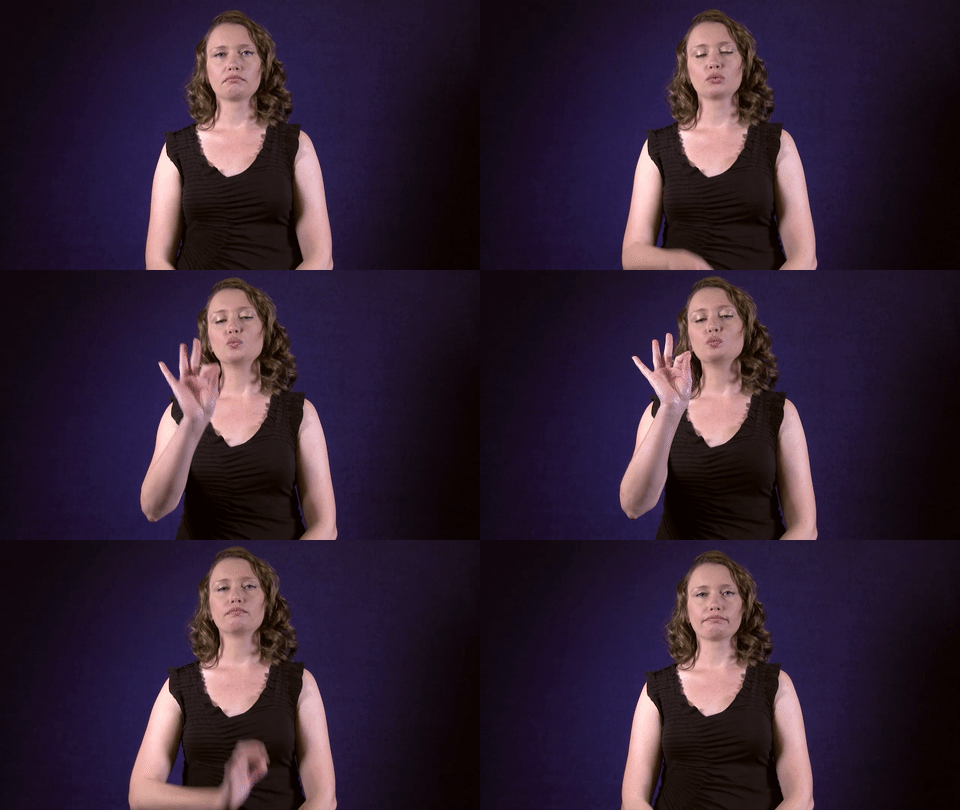
Sign for CHOOSE in ASL | 👍 ASL Dictionary

Definition: To select.

Sign for CHOOSE in ASL

YouTube player

Practice Activities:

To practice the sign for CHOOSE in ASL, start by signing it in front of a mirror. This will help you ensure correct handshape and movement. Use repetition drills to become comfortable with forming the sign both slowly and at conversational speed. Alternate between your dominant and non-dominant hand performing the movement to strengthen muscle memory.

Next, create a list of words that commonly pair with the sign for CHOOSE in ASL, such as “job,” “food,” “color,” or “activity.” Use each word in a short sentence while signing. For example, sign “you choose color” or “choose one apple.” Repeat these basic phrases while changing the object each time to vary the practice.

Practice creating and signing simple scenarios. For example, describe a visit to an ice cream shop and sign yourself choosing between different flavors. “I choose chocolate” and “you choose vanilla” are great practice lines. Imagine different contexts—like shopping, deciding weekend plans, or picking a movie—and narrate your decisions using the sign for CHOOSE in ASL.

If practicing with a partner, take turns offering each other “choices” using items around you or written down. Your partner can present two or three options silently while you respond by signing your choice. Then switch roles to reinforce comprehension.

Use emojis, flashcards, or drawings to stimulate quick responses. Show a and , and sign which one you would choose. Turning this into a game with speed rounds can make your practice session engaging and build fluency.

Finish each session by telling a short story. For example, a narrative about your day that includes different choices you made. Make sure to sign the decision points clearly, reinforcing the sign for CHOOSE in ASL throughout your storytelling. Repeat the story later, adding more complexity as you improve.

Cultural Context:

In American Sign Language, the sign for choose in ASL represents more than simply making a decision. Understanding how Deaf culture expresses the concept of choosing can deepen your appreciation for how ASL communicates subtle meaning with body language, facial expressions, and context. The sign for choose in ASL often reflects situational decisions, values, and cultural traditions.

The Deaf community emphasizes visual clarity and intentional communication. When using the sign for choose in ASL, it’s not just about picking an option—it’s about visually indicating selection in a way that matches the social and cultural setting. Choosing where to sit, who to sign with, or what topic to discuss can all carry layered meanings in Deaf spaces.

In Deaf culture, conversation flow is highly valued. When someone uses the sign for choose in ASL during a discussion, it’s usually followed by a clear and respectful indication of the selected choice. Visual engagement, like eye contact and facial emotion, are key to making the sign effective and culturally appropriate.

Choices in the Deaf world can also involve decisions about language preferences, educational settings, or interpreting services. Signing choose in ASL within these contexts can symbolize deeper cultural values and community bonds. It may also reflect advocacy for communication rights.

When a Deaf person uses the sign for choose in ASL, they may also include classifiers or directional gestures to clarify options. The choice is communicated with precision, showing an understanding of space and how it relates to linguistic clarity. This spatial awareness makes the sign powerful in both casual and formal environments.

Social interactions often depend on inclusive gestures. When making plans, offering support, or selecting activities, the sign for choose in ASL helps ensure every person is fully included. It’s not just a sign—it’s a gesture of respect and awareness.

In educational settings where ASL is the primary language, students learn early how to use the sign for choose in ASL intentionally. It doesn’t just help with vocabulary—it fosters decision-making and critical thinking through visual language. Educators model the sign in ways that reflect community priorities and learning goals.

The linguistic structure of ASL encourages expressive signing. That means the sign for choose in ASL can be adjusted in speed, repetition, and intensity to match different situations. These shifts bring out emotion and cultural nuance in ways that aren’t always possible in spoken language.

Choosing is a daily, universal experience. But within the Deaf community, how you sign choose in ASL reflects deep cultural respect and awareness. This everyday sign helps people

Extended Definition:

The sign for choose in ASL is a commonly used sign in educational, personal, and professional contexts. It expresses the act of selecting one or more options from a group, an idea easily conveyed through a simple yet meaningful hand movement. This sign is essential for making decisions, indicating preferences, and participating in everyday conversations.

To make the sign for choose in ASL, typically, the dominant hand uses the thumb and index finger to mimic a picking or selecting motion. This movement can vary slightly depending on context or regional preferences, but the overall motion remains widely understood. Some variations involve a quick pinch movement between two imaginary options to indicate selection.

In American Sign Language, choose can be both literal and metaphorical. It may refer to choosing a flavor of ice cream or choosing between two life paths. The flexibility of this sign makes it valuable when discussing freedoms, making plans, or expressing opinions.

The sign for choose in ASL supports broader discussions about independence and decision-making. Whether someone is explaining a choice they’ve made or asking someone to make a decision, this sign helps navigate social interactions. It plays a role in self-advocacy and identity, especially in stories or discussions about personal journeys.

Teachers and interpreters regularly use the sign for choose in ASL when guiding students or facilitating in-class activities that involve voting or selection. It helps clarify tasks and allows students to express their choices effectively. Parents and caregivers of deaf children also use this sign to encourage decision-making skills early on.

Cultural representation and access to language are important, and the sign for choose in ASL embodies this by enabling users to explore their voice in the Deaf community. It supports autonomy and inclusion, giving every person the basic right to decide. This sign illustrates how ASL communicates complex ideas visually and beautifully .

Phrase combinations that include the sign for choose in ASL add richness to conversations. Phrases like choose wisely, let’s choose one, or I can’t choose all use this core vocabulary word. Understanding these multi-sign phrases requires fluent signers to place the basic sign in appropriate context.

When learning ASL, it’s helpful to practice the sign for choose in realistic scenarios. For example, during meals, signs like choose your favorite or choose a drink can reinforce memory and usage. Interactive learning tools or games that involve choice-making can also encourage frequent use and mastery.

Video demonstrations and live-practice sessions often help learners perfect the sign for choose in ASL. Observing facial expressions and body language used with

Synonyms: select, pick, opt for, decide on, elect

Educational resources: Find related learning materials in our course bank!

Want more? Check out some of our popular learning activities on the homepage!

Need to look up a sign? Use our highly rated dictionary: https://aslinteractive.com/best-asl-dictionary/

Follow us on tiktok: https://www.tiktok.com/@aslinteractive. More social media links at the bottom of this page!

Long-tail Keywords: what is the sign for choose in ASL, how do you sign choose in ASL, ASL sign for choose

Categories:

tags: Choose, Commands, Actions, Decision Making, Language Learning

Parameters

*Handshape*:

The handshape used in the sign for CHOOSE in ASL typically features the dominant hand forming the “F” handshape, where the index finger and thumb touch to make a circle, while the remaining fingers are extended. This hand then moves downward lightly, as if selecting something from imaginary options.

In the sign for CHOOSE in ASL, the motion mimics the act of picking or selecting an item from a group, visually reinforcing the meaning. The handshape is precise and helps convey intention clearly in everyday conversations.

*Palm Orientation*:

The palm orientation for the sign for CHOOSE in ASL typically begins with the dominant hand in a flat “F” handshape, palm facing downward or slightly inward. The thumb and index finger come together as if picking something small off the non-dominant hand, which is open and facing up.

This movement mimics the action of selecting something specific, reinforcing the meaning of the sign for CHOOSE in ASL. Palm orientation may subtly shift with different regional variations, but it generally stays consistent with this selection gesture. ️

*Location*:

The location for the sign for CHOOSE in ASL takes place in the neutral space in front of the body, around chest height. One hand typically hovers in front of the torso while the other executes the picking or selecting motion. This spatial positioning helps clarify directionality and connection between options when signing.

For the sign for CHOOSE in ASL, keeping the sign in front of the torso makes it easily visible and accessible for smooth movement transitions. This centralized location supports natural flow whether signing in isolation or within full sentences.

*Movement*:

Start with the dominant hand in a modified F-handshape (thumb and index finger pinched together) above the non-dominant open hand. To produce the sign for choose in ASL, the dominant hand touches one option on the open palm, lifts slightly, and then moves to touch another point—showing selection from a group.

The motion is deliberate, mimicking the act of selecting something specific. This movement helps visually convey the meaning behind the sign for choose in ASL ️ .

*Non-Manual Signals*:

The non-manual signals for the sign for CHOOSE in ASL typically include a neutral or slightly concentrated facial expression. Eyebrows are often furrowed softly to show deliberation or decision-making.

Eye gaze may shift between imaginary options or stay focused on the dominant hand as it selects, helping to visually convey the concept of choosing. When signing the sign for CHOOSE in ASL, the mouth may stay in a relaxed position or form a slight “mm” expression to show thoughtfulness.

*Prosody, Dominant/Non-Dominant Hand*:

The sign for CHOOSE in ASL uses the dominant hand in an F-handshape while the non-dominant hand remains in a relaxed open hand or also in an F-handshape, palm up. The dominant hand moves downward to touch and slightly twist at two points on the non-dominant hand, as if selecting from options.

This motion emphasizes picking or choosing specific items. The sign for CHOOSE in ASL visually represents making a decision between alternatives, reinforcing the concept of selection through repeated finger movements. ️

Tips for Beginners:

When learning the sign for CHOOSE in ASL, it’s essential to focus on handshape and movement. This sign typically uses the “F” handshape, where the thumb and index finger form a circle, mimicking a picking motion. Start with your dominant hand and use it to pretend you’re picking something from an array or list—this helps capture the correct concept visually. ✨

Beginners often confuse the sign with similar ones like PICK or SELECT. To master the sign for CHOOSE in ASL, pay close attention to the subtle wrist movement and the way your fingers grasp the invisible option. Practicing in front of a mirror or recording yourself can help you spot and correct misalignments or exaggerated gestures. Make sure your hand motion stays controlled and deliberate.

A common mistake is using too loose or too stiff a motion, which can make the sign look awkward or unclear. Keeping your movements fluid, but intentional, will increase your clarity. Viewing videos of native ASL signers performing the sign for CHOOSE in ASL can give you a clearer mental model to imitate.

Context is also important. Use facial expressions to enhance meaning—such as raising your eyebrows when offering someone a choice, or furrowing them when making a difficult decision. These expressions work alongside the sign and add important emotional storytelling.

Practice the sign within full sentences rather than in isolation. Try using the sign for CHOOSE in ASL during daily conversations, like picking a movie or selecting food. Repetition in real-world settings builds fluency faster.

Finally, don’t be afraid to ask feedback from Deaf friends, tutors, or instructors. They can catch small details that are easily missed when self-studying. Consistent feedback and patient repetition are your best tools in mastering the sign for CHOOSE in ASL.

Connections to Other topics:

The sign for CHOOSE in ASL is closely related to signs representing decision-making processes, such as SELECT, DECIDE, and PICK. Each of these signs is connected thematically through the concept of choice, but they vary slightly in movement or handshape depending on formality or intent. For example, SELECT often uses a similar movement but can be used in more specific or academic contexts, whereas PICK may imply a more casual or specific selection from options in front of the signer.

ASL frequently builds compound ideas using CHOOSE. One example is combining the sign for CHOOSE with CAREER or JOB to indicate “career choice” or “job choice.” These compound expressions are useful in educational or counseling settings where someone may be asked to express preferences or long-term plans. They reflect the layered and efficient structure of ASL, where abstract concepts can be merged through sign order and context.

The sign for CHOOSE in ASL is also connected to vocabulary involving responsibility and autonomy. When used in narratives, it underscores the subject’s agency or decision point. For instance, in storytelling or personal experience sharing, it often appears alongside signs like THINK, PLAN, and FUTURE to show intentional planning or reflection.

In educational contexts, the sign for CHOOSE in ASL may be taught alongside opposites like IGNORE or AVOID to provide contrast in meaning. This reinforces comprehension through semantic networks. Because choice is fundamental in dialogue, the sign regularly appears in classroom settings, surveys, and everyday decision-making explanations involving children and adults.

The sign for CHOOSE in ASL also connects naturally with interrogatives like WHICH and WHY. Signers use CHOOSE to set up scenarios where a question is implied, such as “You choose which?” or “Why choose this over that?” These interactions deepen understanding and promote more nuanced discussions in ASL communication.

Summary:

The sign for CHOOSE in ASL involves a picking motion, as if selecting from a group of options. It uses a dominant hand in an F-handshape making a plucking motion from a non-dominant F-handshape, which may represent a range of choices.

This visual metaphor resembles someone picking a ripe fruit or pulling an item from a list. It vividly conveys the mental and physical action of selecting one thing out of many. The sign is intuitive, making it easy to remember and use in conversation.

Linguistically, the sign for CHOOSE in ASL falls under the category of verb signs that demonstrate action. It also leans into classifier-like visual imagery because it makes logical use of handshapes that resemble objects being handled.

Grammatically, CHOOSE functions as a verb but is often placed contextually to serve broader syntactic roles. It may be used with time indicators or as part of conditional phrases depending on the signer’s intent.

The sign for CHOOSE in ASL frequently appears in imperative sentences. Deaf signers may use it to offer decisions, ask about preferences, or indicate responsibility for making a selection. For example, a signer might say, YOU CHOOSE MOVIE or I NEED CHOOSE CLOTHES.

Emotionally, choosing is associated with autonomy and reflection, and the sign reflects those themes. The deliberate pulling motion emphasizes intentionality and care in the decision-making process. This gives it a reflective, personal depth.

Culturally, the ability to choose has symbolic significance. In Deaf culture, autonomy and affirmation of identity are especially valued, and the sign aligns with those themes. It’s not just about options—it’s about asserting control and voice.

The sign often appears in educational and personal development contexts. Signers might encounter it when discussing life goals, academic paths, or even food preferences. It commonly appears in stories, teachings, or decision-based dialogues.

Advanced users of ASL might layer facial expressions to enhance the meaning of CHOOSE. Raised brows or narrowed eyes change the tone—from inquisitive to pressured to decisive. This adds complexity and subtle flavor to its delivery.

In narrative signing, the sign for CHOOSE in ASL can operate metaphorically. Storytellers may use it to suggest fate, destiny, or ethical dilemmas. Its visual nature allows rich storytelling, similar to cinematic cuts between decisions and outcomes.

The sign blends well with directional signing. For instance, the signer can direct the CHOOSE motion toward a person or object, clarifying who is making the choice. This embedded sense of agency enhances communicative flow.

CHOOSE is related to signs such as DECIDE, PICK, and SELECT. Each has subtle differences, often determined by handshape and semantics. DECIDE implies judgment, while PICK or SELECT may suggest randomness or limited options.

The sign for CHOOSE in ASL plays a vital role in comparative sentence structures. It helps construct phrases like THIS OR THAT YOU CHOOSE, which scaffolds comprehension for new learners. This also builds cognitive connections to bilingual logic systems.

In terms of applied linguistics, interpreting the sign for CHOOSE can vary slightly across regions. Some Deaf communities may favor slight variations in movement or pace. This reflects sociolinguistic variation typical of natural languages.

ASL classifiers aren’t technically involved in the core form of CHOOSE, but the use of F-handshapes mimics classifier behavior. The sign represents mental interaction with abstract items much like how classifiers spatially organize entities.

In classroom environments, instructors frequently use CHOOSE to elicit feedback or decision-making. Having the ability to select from categories is an essential skill in both expressive and receptive ASL communication drills.

Technological applications in teaching ASL now often include animated portrayals of the CHOOSE sign. These tools allow new learners to mimic movement and timing effectively. They also reinforce choice-making as a conceptual framework for language use.

In thematic discussions about identity, the sign for CHOOSE in ASL supports expressions like I CHOOSE BE DEAF or CHOOSE SIGN. These express pride and affirmation, often stated in contexts of Deaf gain or linguistic empowerment.

Children learning ASL recognize CHOOSE early due to its clear gesture and frequent use. Signing about choosing a toy or snack becomes a powerful moment of agency. It ties into broader developmental concepts like preference, autonomy, and expression.

Interpreters use CHOOSE thoughtfully to match register and affect in source language. For emotionally charged content, subtle changes in speed and facial grammar can drastically affect tone. This skill helps preserve original meaning with cultural nuance.

In tactile ASL, such as used with DeafBlind signers, the sign for CHOOSE gets adjusted for clarity. The hands may be more deliberate, and guiding signals may preface the action. Despite these changes, the core picking motion remains recognizable.

The sign interacts uniquely with modality. When combining with non-manual markers like head tilt or shoulder shifts, CHOOSE can also signify conditional actions, such as IF YOU CHOOSE,

Want more? Check out some of our popular learning activities!

ASL Interactive Resources

ASLInteractive YouTube Channel

Follow us on tiktok: @aslinteractive.com

Follow us on Instagram: aslinteractive

Facebook page: aslinteractive

Facebook group: aslinteractive

LInkedIn: ASL Interactive LLC

Twitter: @ASL_interactive

*Some information on this page is AI-generated. AI can make mistakes. Please check the information.

Sign for CHOOSE in ASL

Responses