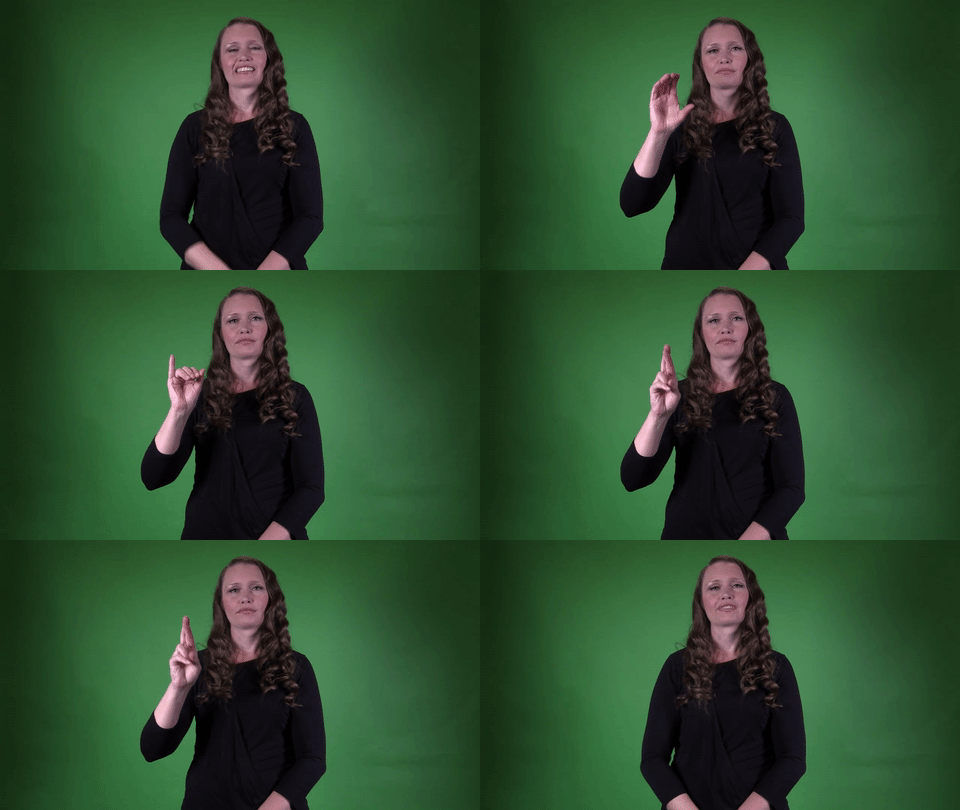
Definition: A circular road or cul de sac
Sign for CIRCLE (ADDRESS) in ASL

Practice Activities:
To practice the sign for CIRCLE (ADDRESS) in ASL, start by familiarizing yourself with the handshape and movement in front of a mirror. Practice making the sign slowly, paying attention to the circular motion that represents the street name or type. Repeat the sign in isolation until it feels natural and consistent.
Once you’re comfortable producing the sign alone, try pairing it with common address components in ASL such as house numbers, street names, and city names (fingerspelled). For example, combine the sign for CIRCLE (ADDRESS) in ASL with signs like “123,” “MAIN” (FS), and “STREET” to create complete addresses. Fingerspell different names with the sign in short phrases like “My friend lives on Oak Circle.”
Try writing a few simple sentences in English and then translate them into ASL using gloss. Examples include “I live on Forest Circle” or “Is your house on Maple Circle?” Practice signing these sentences out loud to build fluidity and confidence. Record yourself or practice in front of a friend for feedback on clarity and accuracy.
Use storytelling prompts to build context. Tell a short story about giving someone directions to your home using the sign for CIRCLE (ADDRESS) in ASL. Include street names, landmarks, and turns to make your narrative more engaging. For added challenge, sign the directions without pausing and keep steady eye contact as you would in a conversation.
Partner activities can include address guessing games. One partner signs a partial address using the CIRCLE (ADDRESS) sign, and the other guesses the full address. Switch roles to reinforce memory and comprehension. Practice with a variety of street names and settings, like urban or suburban descriptions, to extend vocabulary and expand real-world understanding of the sign for CIRCLE (ADDRESS) in ASL.
Cultural Context:
In American Sign Language (ASL), signs often carry more than just a literal meaning. They incorporate cultural and contextual elements that help deliver a full message. The sign for CIRCLE (ADDRESS) in ASL is no exception, offering a functional way to express location while reflecting how addresses are understood within the Deaf community.
The sign for CIRCLE (ADDRESS) in ASL is typically used when describing a specific type of street layout. Many American neighborhoods include streets called circles, courts, or cul-de-sacs, and the Deaf community has adopted distinct signs to make those differences clear while communicating. This helps ensure clarity when giving directions, filling out forms, or chatting about where someone lives.
Context is especially important in ASL because of its reliance on visual spatial grammar. The sign for CIRCLE (ADDRESS) in ASL includes a motion that mimics the round shape of a circle, which is different from signs for road, avenue, or boulevard. Visual learners and native ASL users quickly pick up on these subtle differences, and they become critical when providing a complete and accurate address.
When learning signs like the sign for CIRCLE (ADDRESS) in ASL, it’s helpful to understand the surrounding context where the sign might be used. For instance, someone might say they live on Rose Circle. In ASL, using the sign for CIRCLE (ADDRESS) along with fingerspelling the street name helps give complete and precise information. This mirrors the same kind of specificity you’d find in spoken or written English.
The Deaf community often values efficiency and clarity in sharing address details, especially in educational, medical, or emergency situations. The sign for CIRCLE (ADDRESS) in ASL has developed as part of this need to communicate fast and with high understanding. It also plays a role in storytelling, casual conversation, and in school environments where students reference their home addresses.
Cultural sensitivity and linguistic accuracy both come into play with geographic terms in ASL. The use of the sign for CIRCLE (ADDRESS) in ASL avoids the possible confusion between a geometric circle and a street type. Using this specialized sign instead of a general gesture maintains accuracy and shows language fluency in a culturally respectful way.
In classrooms and interpreter training, the sign for CIRCLE (ADDRESS) in ASL is often introduced alongside other address-related signs. This helps learners build a complete vocabulary around location terminology. Educators stress the importance of differentiating between similar-looking signs, so the correct meaning gets across every time.
Extended Definition:
The sign for circle (address) in ASL refers specifically to how the word “circle” is shown when it’s used as part of a street address or location. In ASL, context is incredibly important. The same English word might have different signs depending on how it’s used. When talking about street names, such as “Maple Circle” or “Sunset Circle,” the sign changes compared to the shape “circle” used in geometry.
To sign circle (address) in ASL, you typically begin by fingerspelling the name leading up to “circle.” Then, instead of using the sign for the shape, you sign C-I-R-C-L-E using the manual alphabet. This helps clarify that “circle” is part of the street name and not a geometric term. This kind of fingerspelling is common for street suffixes like “avenue,” “boulevard,” or “drive” when a standardized street sign doesn’t exist.
The sign for circle (address) in ASL can sometimes also be interpreted using fingerspelling followed by a classifier or directional sign, depending on what the signer prefers or the complexity of the location being discussed. However, in most casual or everyday use, fingerspelling remains the most accurate and clear choice. It avoids confusion with the sign for a shape or motion-based circle.
Understanding the correct way to sign circle (address) in ASL is important for clear communication. Clarity in addresses helps avoid potential misunderstandings, especially in directions, navigation, and giving contact details. ASL uses precise methods to distinguish between location-based meanings and other uses of common words.
The sign for circle (address) in ASL may seem basic, but it plays a major role in real-life situations like emergency calls, deliveries, or filling out official forms with an interpreter present. This accuracy keeps communication efficient and error-free. When giving an address in ASL, always consider using complete fingerspelling for unusual or less common suffixes like “circle.”
Fingerspelling is a foundational part of ASL that provides flexibility in representing English words that don’t have an established sign. This is true for many street names across the United States, which often use terms like “circle,” “court,” or “lane.” The consistent approach for dealing with these words in ASL helps maintain understanding across various settings and regions.
When learning this sign, it’s helpful to practice fingerspelling “circle” smoothly and clearly. The handshapes for C-I-R
Synonyms: loop, ring, round, cycle, circuit
Educational resources: Find related learning materials in our course bank!
Want more? Check out some of our popular learning activities on the homepage!
Need to look up a sign? Use our highly rated dictionary: https://aslinteractive.com/best-asl-dictionary/
Follow us on tiktok: https://www.tiktok.com/@aslinteractive. More social media links at the bottom of this page!
Long-tail Keywords: what is the sign for Circle in ASL, how to sign Circle in ASL, what is the ASL sign for Circle
Categories:
tags: Shapes, Geometry, Objects, Classroom, Language Learning
Parameters
*Handshape*:
The handshape used in the sign for CIRCLE (ADDRESS) in ASL usually begins with the dominant hand in an index finger (pointing) position . This handshape traces a circular path in the air, mimicking the shape of a circle. The motion is smooth and consistent.
To convey the sign for CIRCLE (ADDRESS) in ASL clearly, maintain a steady handshape throughout the motion. This helps depict the round form accurately while keeping the meaning distinct in a contextual address reference.
*Palm Orientation*:
For the sign for CIRCLE (ADDRESS) in ASL, the palm orientation typically begins with the dominant hand open and facing down toward the non-dominant hand, which remains stationary. As the dominant hand traces a circular motion over or near the palm of the other hand, the palm turns slightly inward, maintaining a consistent orientation throughout the gesture.
This motion represents the concept of a circle in the context of locations like street addresses. The sign for CIRCLE (ADDRESS) in ASL visually conveys circular pathways or areas with the palm generally facing downward and slightly inward.
*Location*:
The sign for CIRCLE (ADDRESS) in ASL is produced in the neutral space in front of the body, typically at chest level. This location provides clear visibility for the circular motion that represents the concept of “circle” in the address context.
When signing the sign for CIRCLE (ADDRESS) in ASL, the dominant hand moves in a small circular motion, allowing the shape to be clearly understood within the signing space. The neutral area helps maintain clarity and avoids obstructing facial expressions, which can help emphasize the meaning.
*Movement*:
To produce the sign for CIRCLE (ADDRESS) in ASL, begin by forming the index finger of your dominant hand into an extended position while the rest of the fingers remain closed. With this handshape, trace a medium-sized circle in the air, as if outlining a circular shape like a roundabout or neighborhood feature.
The movement should be smooth, continuous, and follow a clockwise or counterclockwise direction depending on your signing preference. The sign for CIRCLE (ADDRESS) in ASL emphasizes the shape’s form, representing its unique address structure in a spatial context. ️ ️
*Non-Manual Signals*:
When using the sign for CIRCLE (ADDRESS) in ASL, the eyebrows remain neutral and the head stays still or slightly tilted forward for emphasis. The facial expression is calm and focused, showing attention without strong emotional cues.
Using appropriate non-manual signals helps clarify the geographic context of the sign for CIRCLE (ADDRESS) in ASL, especially when distinguishing it from other meanings of circle. Maintain composed facial muscles to keep the emphasis on the location-related aspect of the sign.
*Prosody, Dominant/Non-Dominant Hand*:
The sign for CIRCLE (ADDRESS) in ASL uses the dominant index finger to trace a full circle in the air, mimicking the shape of a circle. The non-dominant hand generally remains at rest or may vaguely indicate a location depending on context.
In the sign for CIRCLE (ADDRESS) in ASL, facial expressions and body posture can help convey whether it’s a street name or a general shape. This sign is context-dependent, so make sure to clarify its use when referring specifically to an address.
Tips for Beginners:
When learning the sign for CIRCLE (ADDRESS) in ASL, begin by focusing on your hand shape and the spatial trajectory. This sign is usually drawn with your dominant index finger making a circular motion in the air, resembling the shape of a circle, which directly reflects the meaning. Keep your hand relaxed and use a consistent speed to maintain clarity.
Don’t rush the motion. One common mistake is making the circle too small or uneven, which can confuse the meaning. Make sure the circle is fairly large and smooth. Practice in front of a mirror so you can monitor your hand’s path and ensure it’s clear and easy to understand.
Since the sign can be context-dependent, especially in addresses, it’s helpful to familiarize yourself with common usage of the sign for CIRCLE (ADDRESS) in ASL. Think of how addresses often include “Circle” as part of a street name. You should pair this sign with other address-related signs, like “street,” “avenue,” or “drive,” to improve fluency during real conversations.
If you’re fingerspelling “Circle” as part of an address, make sure each letter is crisp and well-paced. Don’t blend the letters too closely together. Slow and steady fingerspelling improves accuracy and reduces the chance of miscommunication.
Repetition is key. Watch videos of native signers using the sign for CIRCLE (ADDRESS) in ASL in actual address contexts. Mimic their rhythm and expand your vocabulary by also learning related geographical terms.
Lastly, ask your instructor or fluent signers for feedback. Practicing in front of others can boost confidence and helps identify small corrections that make a big difference in clarity. Consistency and intentional practice will strengthen your ability to use the sign correctly in everyday conversation.
Connections to Other topics:
The sign for CIRCLE (ADDRESS) in ASL connects to a broader understanding of how addresses, locations, and community-related terms are expressed in ASL. CIRCLE (ADDRESS) is typically used to convey the word “Circle” when it appears in a street or road name, such as “Palm Circle” or “Oak Tree Circle.” This sign is location-specific and differs from the generic CIRCLE sign used to describe the geometric shape. It reflects ASL’s efficiency in creating visual distinctions between general and specialized uses of similar English words.
The sign for CIRCLE (ADDRESS) in ASL is often used in combination with other signs when giving full addresses or discussing navigation. It can form compound expressions with ROAD, STREET, LANE, or numbers to clarify directions. This mirrors how signers may combine CITY or TOWN with specific place signs to establish a visual representation of a complete address. Signs like DRIVE, AVENUE, and BOULEVARD also follow this pattern, creating an entire semantic system around mapping and physical spaces.
Learning the sign for CIRCLE (ADDRESS) in ASL deepens a signer’s ability to describe personal addresses, neighborhood layouts, and even provide directions using spatial referencing. It also ties into classifier use, where handshapes and movements indicate different types of roads, curves, and intersections. This builds into a richer understanding of how spatial grammar enhances clarity in ASL conversations.
There is also a cultural aspect when using the sign for CIRCLE (ADDRESS) in ASL, especially when discussing Deaf community spaces, schools, or centers located on “Circle” streets. Mastering such context-specific signs helps in storytelling, engaging in phone or video-based communication, and navigating events within the Deaf community. This sign contributes to fluency in real-world scenarios where location matters ️.
Summary:
The sign for CIRCLE (ADDRESS) in ASL refers to the way a circular street designation, such as “Maple Circle” or “Greenwood Circle,” is represented in American Sign Language. This specific sign is used in contexts related to identifying a street name or address location where the term “Circle” is part of the official name. It’s crucial for clear communication, particularly when describing physical addresses or giving navigational information.
To sign CIRCLE (ADDRESS), one typically uses the index finger of the dominant hand to draw a small circle in the air. The circular motion mimics the shape of a round street or cul-de-sac. It is usually preceded by fingerspelling the street name or another sign to provide context, and the sign for CIRCLE follows to complete the full address element.
This motion is simple but purposeful. The size and clarity of the circle should be distinct enough to avoid confusion with similar spatial signs that involve circular or sweeping finger movements. Facial expressions may remain neutral during the sign but can shift depending on whether the sign is part of a broader inquiry or statement.
The concept of CIRCLE (ADDRESS) in ASL reflects the spatial nature of the language. ASL expresses physical orientation, directions, and location features naturally using visual-spatial modality. When indicating a street or location, this modality becomes especially powerful for precise and intuitive communication.
The sign for CIRCLE (ADDRESS) in ASL connects to signs like STREET, AVENUE, and BOULEVARD, each having their visual semantic markers. While STREET may involve parallel lines or directional gestures, CIRCLE relies on curvature to demonstrate the unique layout feature of a circular roadway. These distinctions are important for fluent signers and interpreters to maintain clarity.
In terms of grammatical structure, the sign is often situated at the end of a noun phrase when expressing addresses. For example, one might fingerspell “MAPLE” and then sign CIRCLE to complete the full street name. The spatial designation comes after identifying elements, conforming to typical ASL syntactic patterns where locations follow descriptive units.
The visual cue of a circle is iconic in ASL, evoking the actual shape of a street that loops or curls to a central point. This iconicity helps reinforce meaning and memorability for both learners and fluent users. Signers often recognize and engage with such visual-spatial representations more easily than abstract or arbitrary sign forms.
The sign for CIRCLE (ADDRESS) in ASL also plays a role in community-specific conversations. Addresses are often used in storytelling, in sharing directions, and even in emergency communication. An accurate rendering of the address type, including whether it is a street, avenue, or circle, is essential for safety and clarity.
In Deaf culture, accurate address communication reflects broader values of inclusion, accessibility, and full participation. Ensuring one can communicate names like Orchard Circle or Belmont Circle with precision fosters independence and interaction in both personal and civic contexts. It also supports the authenticity of place-based storytelling and descriptive language use.
Linguistically, the sign aligns with classifier structures in ASL that represent roads, paths, and boundaries. While the sign may be performed as a lexical item, variations exist depending on the signer’s location and community dialect. Some regions might adopt slightly different gesture styles while still conveying the same referent.
Applied linguistics sheds light on the multimodal nature of ASL when applied to something as standard as an address label. For learners transitioning from English-based address forms, it’s vital to understand how ASL handles spatial descriptors organically rather than translating word-for-word. The transition involves grasping how space, movement, and iconicity function linguistically.
The sign for CIRCLE (ADDRESS) in ASL can also enter formal register in interpreting contexts. Interpreters render hearing clients’ spoken address details into fluid, culturally appropriate ASL motions that reflect the intended meaning. This highlights the importance of the sign’s accuracy and the need for sharp spatial awareness.
Historically, naming conventions such as “Circle” for streets derive from urban planning trends. In the ASL community, representing these in discourse has required constructing visual-language equivalents that carry the same distinctions. This contributes to the evolving ASL lexicon and reflects how the language adapts to urbanization and civic life.
Cross-linguistically, similar signs for roads exist in other sign languages like BSL or LSF, though the specific sign for a circular address form might vary. Comparisons show how ASL’s version is tailored for geographic and cultural familiarity within the American context. The repetition of this term in modern naming bolsters the need for consistent dissemination within teaching materials.
Teaching the sign for CIRCLE (ADDRESS) in ASL often occurs within vocabulary units focused on directions, travel, or community engagement. It pairs well with signs for NEIGHBORHOOD, BUILDING, and possible classifiers to describe layouts. Teachers emphasize accuracy of motion and placement within sentence structures.
When using the sign in casual conversation, register
Want more? Check out some of our popular learning activities!
ASL Interactive Resources
ASLInteractive YouTube Channel
Follow us on tiktok: @aslinteractive.com
Follow us on Instagram: aslinteractive
Facebook page: aslinteractive
Facebook group: aslinteractive
LInkedIn: ASL Interactive LLC
Twitter: @ASL_interactive
*Some information on this page is AI-generated. AI can make mistakes. Please check the information.


Responses