Sign for CLASSROOM in ASL | 👩‍🏫 ASL Dictionary

Definition: A room for classes.

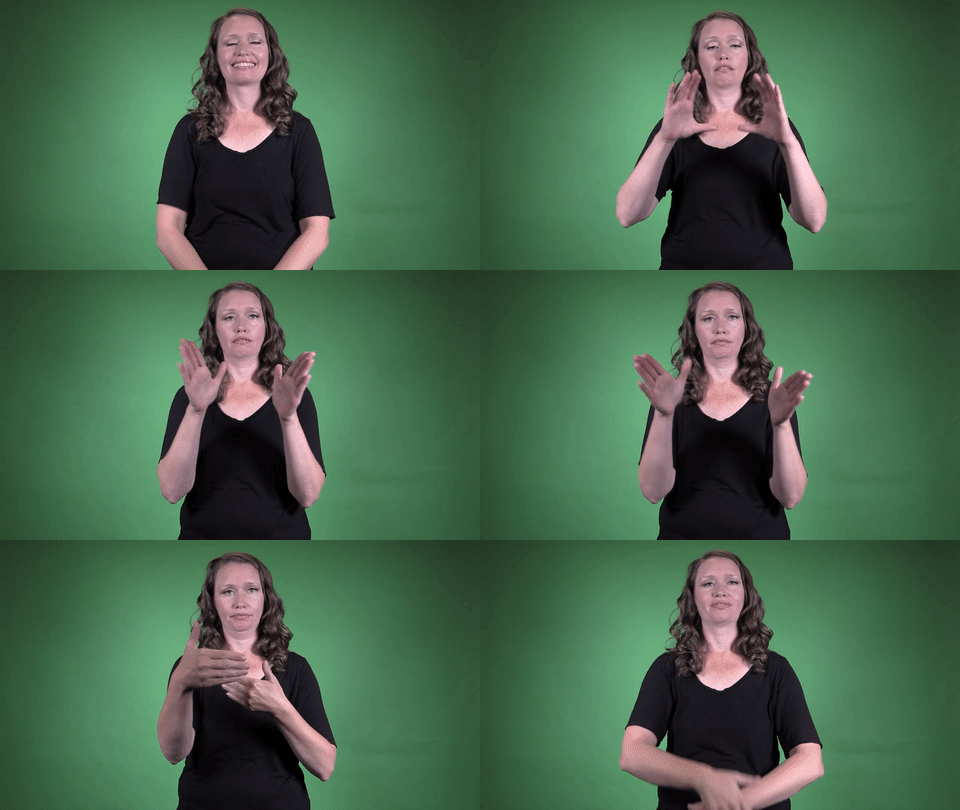
Sign for CLASSROOM in ASL 

YouTube player

Practice Activities:

To begin practicing the sign for CLASSROOM in ASL, warm up by isolating each component of the compound sign: CLASS and ROOM. Start by signing CLASS repeatedly until it feels fluid, then practice ROOM separately. Once you’re comfortable, combine the two signs smoothly into one motion. Use a mirror to check for clarity and facial expressions.

Practice using the sign for CLASSROOM in ASL within short phrases and questions such as “My classroom is big,” or “Where is your classroom?” Try fingerspelling the name of a subject (like M-A-T-H or E-N-G-L-I-S-H), followed by the sign for CLASSROOM to express ideas like “Math classroom.” These combinations enhance fluency and comfort in contextual usage.

Engage in a storytelling exercise where you describe your ideal classroom. Include details about size, color, who is in the classroom, and what happens there. For example, sign sentences like “My classroom has ten students” or “The classroom is next to the library.” Practicing storytelling helps reinforce vocabulary and sentence structure.

Create flashcards with pictures of school settings, and use them to prompt yourself or a partner to use the sign in a sentence. You could also play a guessing game where one person signs a description including the sign for CLASSROOM in ASL, and the other guesses what is being described. This adds variety to your practice and reinforces memory.

With a partner, role-play classroom scenarios such as entering the room, introducing yourself, or asking to borrow a pencil. Make sure to consistently use the sign for CLASSROOM in ASL in each situation. These real-life simulations build confidence and improve conversational signing.

Finally, use a short video recording tool to sign a daily vlog about your classroom experience. Watch the recording to evaluate your clarity and fluency with the sign. Self-assessment supports ongoing growth in ASL.

Cultural Context:

The sign for classroom in ASL represents more than just a physical space; it reflects the values and structures of Deaf education. In many Deaf schools and programs, the classroom is a central space for learning not only academic content but also sign language and Deaf cultural norms. The sign for classroom in ASL captures this important environment where language and identity are nurtured .

In Deaf culture, a classroom is often one of the first places where young Deaf children are introduced to ASL in a structured and supportive setting. Because of this, the sign for classroom in ASL carries emotional and cultural significance. It symbolizes empowerment, communication, and the beginning of a lifelong relationship with the language and community.

Many Deaf individuals remember the classroom as the place where they first began fully comprehending and participating in learning through their own language. The sign for classroom in ASL can evoke memories of Deaf role models, engaging lessons, and shared experiences with peers. It’s not just about academics—it’s about connection and community .

Historically, access to ASL in the classroom was limited due to oralism and mainstreaming practices that discouraged sign language use. The sign for classroom in ASL reminds the community of the progress that has been made toward linguistic equality in education. It reflects the ongoing efforts to create accessible and inclusive learning spaces for Deaf students.

Deaf education has undergone significant changes over the years, and the importance of using ASL in the classroom is now widely supported by educators and researchers. The sign for classroom in ASL has become a tool for advocacy, representing the right to language access and culturally appropriate education. It demonstrates the value of bilingual education—ASL and English—for Deaf and hard-of-hearing students.

ASL classrooms are dynamic environments where students engage with a rich visual language. The natural use of the sign for classroom in ASL within these settings reinforces the visual-spatial nature of the language. It enables better comprehension and encourages students to fully participate in the educational process using their first language.

Parents of Deaf children also find meaning in the sign for classroom in ASL. Learning this sign helps families support their child’s learning journey and bridge home and school communication. When Deaf culture is honored in the classroom, children thrive and develop a strong sense of identity and pride .

The sign for classroom in ASL doesn’t just describe a room—it represents a legacy of struggle, advocacy, and triumph within the Deaf community. As more schools adopt ASL-inclusive policies, this sign becomes

Extended Definition:

The sign for classroom in ASL is a combination of two signs: class and room. To express this concept, you first sign “class” by forming both hands into the letter “C,” then circle them around together. After that, you sign “room” by forming your hands into flat palms and outlining a box shape in the air to represent the walls of a room.

The sign for classroom in ASL can be broken down into meaningful parts. “Class” refers to a group of students and “room” defines the physical space they are in. By combining both, the ASL sign for classroom accurately reflects both the group and the location where learning takes place.

In some teaching environments, the sign for classroom in ASL may be modified slightly for fluidity and context. However, the basic combination of signs remains consistent and widely recognized in Deaf communities. This structure allows for clear communication in both academic and casual settings.

Knowing the proper sign for classroom in ASL is important for students, teachers, and interpreters. It’s a frequently used term in educational settings, making it one of the foundational vocabulary words for ASL learners. Using it correctly ensures clarity and improves overall fluency in the language.

The sign integrates cultural and linguistic elements that are essential to the Deaf community. It reflects how ASL often builds complex ideas through combining simpler signs. Because classroom is a common setting, this sign naturally becomes part of early ASL curriculum and everyday conversation.

When learning the sign for classroom in ASL, it helps to practice each part separately before combining them. Mastering the movement and handshape for “class” and “room” will make the final sign smoother and more expressive. Watching ASL videos and practicing with fluent users can also improve precision and confidence.

In storytelling or more expressive conversations, the sign for classroom in ASL can be adjusted for tone or emphasis. Signers may change the pace or size of their movements to express emotion or context. This flexibility shows the richness and dynamic nature of ASL.

Children learning ASL often use visual aids and repetition to grasp vocabulary. The sign for classroom in ASL is often taught using pictures of classrooms and group activities to reinforce understanding. Signing while pointing to a real classroom can also provide helpful context for young learners.

Online dictionaries and video references are great tools for reinforcing this vocabulary. By including videos of native signers demonstrating the sign for classroom in ASL, learners can better understand the proper form and usage. This visual support is

Synonyms: class, learning space, study room, teaching room, instructional space

Educational resources: Find related learning materials in our course bank!

Want more? Check out some of our popular learning activities on the homepage!

Need to look up a sign? Use our highly rated dictionary: https://aslinteractive.com/best-asl-dictionary/

Follow us on tiktok: https://www.tiktok.com/@aslinteractive. More social media links at the bottom of this page!

Long-tail Keywords: what is the sign for classroom in ASL, how to sign classroom in American Sign Language, how do you say classroom in ASL

Categories:

tags: Classroom, Languages, Language Learning, Objects in the Classroom, Educational Environments

Parameters

*Handshape*:

The handshape for the sign for CLASSROOM in ASL begins with both hands forming the letter “C” handshape, with curved fingers and thumb, as if holding imaginary cups. These “C” handshapes represent the concept of a “class.”

Next, the hands transition into flat “B” handshapes, fingers together and extended, palms facing each other, then turn outward to indicate an enclosed area, symbolizing a “room.” This combination effectively represents the sign for CLASSROOM in ASL .

*Palm Orientation*:

The palm orientation for the sign for CLASSROOM in ASL begins with both hands forming a “C” shape, palms facing each other in front of the body. This represents the sign for CLASS, a foundational part of the full phrase. Hands move in a circular motion outward, maintaining the palm orientation as inward-facing.

For the second part of the sign for CLASSROOM in ASL, which is ROOM, both hands assume flat “B” handshapes with palms facing each other, indicating the shape of a room. Hands move away from each other and then back, forming the outline of a room. Throughout the entire sign, palm orientation shifts only slightly to indicate spatial reference.

*Location*:

The location for the sign for CLASSROOM in ASL begins in the neutral space in front of the torso, at chest level. This positioning helps clearly demonstrate the sign’s movement and shape, ensuring visibility for the receiver.

The sign for CLASSROOM in ASL incorporates a circular hand motion that ends near the body, still within chest-level space. This consistent use of personal signing space keeps the meaning clear and appropriate for educational context.

*Movement*:

The sign for CLASSROOM in ASL combines the signs for CLASS and ROOM in sequence. To sign CLASS, form both hands into the “C” handshape, palms facing each other, then move them in a horizontal arc outward until they face each other again, suggesting a group.

Follow this by signing ROOM: transform your hands into flat “B” handshapes, held parallel to each other, and move them from front to back as if outlining the walls of a square. The sign for CLASSROOM in ASL should flow smoothly from one part to the next, showing the concept of a designated educational space .

*Non-Manual Signals*:

When signing the sign for CLASSROOM in ASL, maintain a neutral and attentive facial expression, showing engagement without exaggerated emotion. Slight eyebrow raise or natural eye movement may support the meaning depending on context, such as if you’re asking about a classroom or stating where it is.

The non-manual signals for the sign for CLASSROOM in ASL should show clarity and focus, reflecting the organized and structured concept of a learning space . Head movement can slightly follow your hands during the circular motion, emphasizing the sign’s directional aspect.

*Prosody, Dominant/Non-Dominant Hand*:

The sign for CLASSROOM in ASL uses both hands symmetrically. The dominant and non-dominant hands form the letter “C” and move together in a circular motion in front of the body to represent “class.” Then, the hands transition into a closed shape resembling a room or box, indicating “room.” This two-part sign combines the concepts artfully.

When using the sign for CLASSROOM in ASL, the hands stay on the same plane and move smoothly from the first concept to the second. Both hands mirror each other throughout, making this a balanced, two-handed sign that clearly conveys the full meaning.

Tips for Beginners:

When learning the sign for CLASSROOM in ASL, it’s helpful to break it into two parts: “class” and “room.” Each part has its own distinct motion, and combining them ensures overall accuracy. Start by practicing the sign for “class” using both hands in a C shape, coming together in a circular motion and finishing side by side. Follow this with the sign for “room” by forming the outline of a square space with your flattened hands, palms facing inward.

The sign for CLASSROOM in ASL requires attention to handshape consistency. A common beginner mistake is letting the C-handshape collapse or using one hand when both are needed. Another issue is blending the two-part motion too quickly, which can reduce clarity. Take time to pause slightly between “class” and “room” until you build natural fluency.

Watch yourself in a mirror or record videos to compare your use of space, hand positioning, and pacing. Adjust your motion to be clear and deliberate. If either “class” or “room” is rushed or misaligned, the whole sign can be misunderstood. Focus on symmetry and keeping your movements fluid, especially when transitioning from the circular motion into the rectangular frame.

Repetition is key. Practice the sign for CLASSROOM in ASL multiple times a day using flashcards or short dialogues. Try signing in context, like during school-related conversations or when identifying different spaces. The more location and situation-based connections you make, the quicker it will stick.

Lastly, remember to maintain proper facial expressions. While this sign doesn’t require exaggerated expressions, maintaining a neutral and focused look helps convey clarity and purpose. Pairing the sign for CLASSROOM in ASL with simple sentences like “I’m going to the classroom” can reinforce rhythm, meaning, and natural usage in real-life settings.

Connections to Other topics:

The sign for CLASSROOM in ASL is a compound sign combining the signs for CLASS and ROOM. This illustrates how ASL often builds new concepts by merging existing signs. The concept of combining two signs to form one compound is an important linguistic feature in ASL and helps in efficiently conveying more specific ideas.

The sign for CLASS feels closely related to other group-based signs such as FAMILY and TEAM, which also use curved handshapes moving in a circular motion. These signs group individuals into shared categories, showing how ASL uses visual-spatial features to represent collective concepts. ROOM, on the other hand, falls into spatial and architectural vocabulary and is commonly paired with other environment-based signs like HOUSE or OFFICE.

Understanding the sign for CLASSROOM in ASL opens up access to educational vocabulary. Learners can easily go from this sign to more specific contexts like SCHOOL, TEACHER, STUDENT, or LEARN. Each of these signs connects functionally, allowing for conversations around education, instruction, and academic activities.

The concept of a classroom also connects to signs related to activities happening within that environment. For instance, one might discuss HOMEWORK, TEST, or LESSON using closely associated signs. These terms frequently appear in the narrative dialogues of daily school life and form natural extensions of the classroom setting.

In expressive storytelling or discussions about routines, the sign for CLASSROOM in ASL is often used in descriptions of learning environments or to indicate transitions between places. Phrases like GO-TO CLASSROOM, FROM CLASSROOM TO GYM, or STAY-IN CLASSROOM show how spatial elements in ASL grammar link with location-based signs.

Lastly, classroom-based signs play a critical role in academic interpreting. Interpreters frequently use signs like CLASSROOM fluidly with subject-specific signs like MATH, SCIENCE, or ENGLISH, making it essential for learners to build vocabulary clusters around such foundational terms.

Summary:

The sign for CLASSROOM in ASL combines two essential concepts: “class” and “room.” Each part of the compound sign carries specific classifiers and spatial components that reflect the uniqueness of American Sign Language. The sign layers meaning not simply in vocabulary but through visual representation.

To produce the sign for “class,” both hands form the letter C. Starting with the C-handshapes facing each other, they move in a circular motion to show a formation or collective. This part of the sign visually conveys the gathering of people into a unit—what a class represents.

Immediately following that is the sign for “room” or “box,” made by outlining the shape of a square with flat hands facing each other horizontally and vertically. The hands mimic the dimensions of a space or literal room. This second component adds the idea of physical space to the concept of a class.

Put together, the sign for CLASSROOM in ASL composes a beautiful and intuitive compound that communicates both the grouping of students and the environmental context. The two signs performed in succession create layered, simultaneous meaning unique to ASL.

This compound sign is iconic and built around visual-spatial awareness, which is central to sign language grammar. Unlike English, where words are linear, ASL expresses ideas holistically, crafting a 3D visual schema. CLASSROOM, as a concept, embodies this by combining human grouping with spatial boundaries.

The sign reflects a broader theme in ASL—using space and movement to represent abstract and concrete ideas simultaneously. The C-handshapes joined in a circle show collectiveness, suggesting education is inherently social. The room dimension then grounds the idea into a tangible reality.

The sign for CLASSROOM in ASL can be modified to give more detail when needed. For example, incorporating directional signs or facial expressions can give the location of the classroom or specify its function—like “math classroom” or “science class.”

ASL syntax allows users to place the sign for CLASSROOM in various positions within a sentence to shift emphasis. It may appear at the beginning to establish setting or at the end to clarify where something occurs. This flexibility is part of ASL’s visual grammatical strength.

Linguistically, the morphology of the sign is fascinating. It portrays how compound signs in ASL often emerge from combining more simplistic forms. Over time, signs like CLASSROOM demonstrate how ASL evolves through constant usage and refinement.

The sign for CLASSROOM in ASL is also influenced by regional and generational variations. While the dominant version uses the C-hand followed by the room spatial reference, some users may slightly adapt the movement or pace depending on their local dialect or school tradition.

There’s a cultural layer embedded in the sign too. In Deaf culture, the classroom is revered as a pivotal environment for language acquisition, identity formation, and community bonding. Signing CLASSROOM evokes not just a place, but often a source of empowerment.

Classrooms in the Deaf community are historically significant. Deaf schools were among the first places where Deaf children encountered others like themselves, and formal ASL education often takes root there. So the sign carries emotional and communal weight.

When teaching the sign for CLASSROOM in ASL to beginners, instructors often break down the compound into its two parts. This teaching method follows ASL’s linguistic logic, where larger meanings are built from basic visual units. Layering gives the learner insight into how signs form organically.

The sign also provides opportunities to discuss how spatial orientation enhances meaning in ASL. The square-movement to denote “room” can be expanded or shrunk depending on the type of class—even virtual or outdoor classrooms can be abstracted through space.

In applied linguistics, the sign for CLASSROOM in ASL supports multimodal theories of language learning. Learners must coordinate hand movements, facial expressions, and spatial reasoning. This interactive process shows how language and cognition intertwine in signed languages.

The sign also appears frequently in educational settings, which provides learners and interpreters abundant opportunities for real-world practice. Whether talking about school schedules, special events, or daily routines, CLASSROOM is central to relevant, recurring conversations.

Semantically, the sign includes both literal and metaphorical interpretations. A classroom might not be bound within four walls. ASL allows this flexibility; signers can shift reference and context dynamically through role shift and spatial mapping.

Interpreters will note that fingerspelling “classroom” is rare except for clarity or introducing a term. The signed version is preferred for fluency, showing how ASL privileges visual morphology over transliteration. This adds to the language’s expressive efficiency.

The sign for CLASSROOM in ASL is also meaningful in legal and advocacy contexts, such as IEP (Individualized Education Program) meetings. Deaf professionals and interpreters use this sign to advocate for equitable access, using it as a key term in strategy and documentation.

Art and performance in the Deaf community often include images of classrooms as symbols of transformation. ASL poets and visual storytellers sign CLASS

Want more? Check out some of our popular learning activities!

ASL Interactive Resources

ASLInteractive YouTube Channel

Follow us on tiktok: @aslinteractive.com

Follow us on Instagram: aslinteractive

Facebook page: aslinteractive

Facebook group: aslinteractive

LInkedIn: ASL Interactive LLC

Twitter: @ASL_interactive

*Some information on this page is AI-generated. AI can make mistakes. Please check the information.

Sign for CLASSROOM in ASL 

Responses