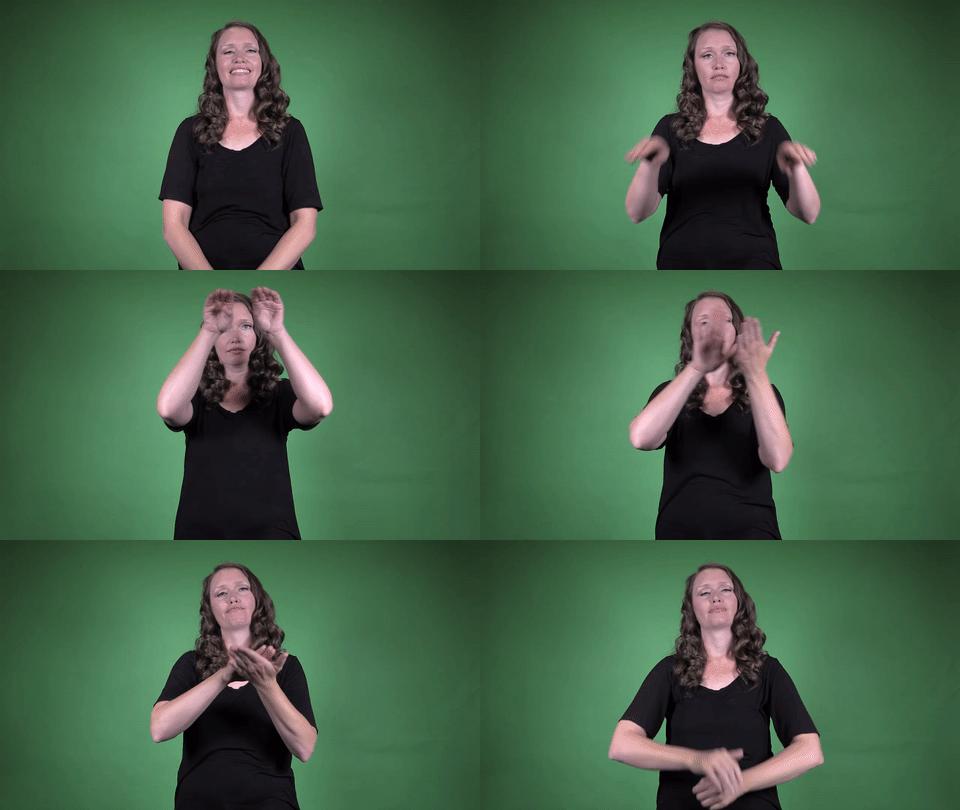
Definition: To clean the shelves.
Sign for CLEAN THE SHELVES in ASL

Practice Activities:
Begin by isolating each concept in the sign for CLEAN THE SHELVES in ASL. Practice the sign for CLEAN by using a flat dominant hand wiping across the palm of the non-dominant hand. Repeat five times to build muscle memory. Then review the sign for SHELVES, using both hands to mime placing or indicating horizontal surfaces. Practice showing one shelf, then add a second and a third to suggest multiple levels.
Move on to combining the two concepts. Use facial expressions to show the effort or attention to detail involved in cleaning. Sign CLEAN, then smoothly transition into SHELVES by showing multiple horizontal lines, adjusting hand placement for clarity. Try this sequence slowly, and then speed up for fluency.
Practice sentences like: I CLEAN THE SHELVES every week, or My job is to CLEAN THE SHELVES at the store. Sign these in front of a mirror to monitor your clarity and space usage. Record yourself and compare to native signers if possible. This will help refine your accuracy of handshape and movement.
Use role-play with a partner. One person plays the housekeeper while the other gives cleaning instructions. Include CLEAN THE SHELVES with other household chores like sweep floor or wash windows. This will help contextualize the sign and support retention.
Tell a short story about a messy room that needs attention. Describe walking in, deciding to CLEAN THE SHELVES, and noticing the dust. Add emotional signing to express being tired or satisfied with the results. Focus on signing fluently and clearly using spatial referencing for multiple shelves around the room.
Reinforce learning by signing silently during real-life cleaning tasks and associating the activity with the movement. This real-world connection will strengthen memory and improve the ease of signing the phrase. Repeat these exercises weekly to solidify retention of the sign for CLEAN THE SHELVES in ASL.
Cultural Context:
In American Sign Language, everyday activities often carry deeper cultural significance, especially when they reflect shared routines or tasks. The sign for clean the shelves in ASL is one such expression that combines practicality with cultural nuance. Whether at home, school, work, or community spaces, the action of cleaning and organizing shelves is familiar across many Deaf and signing environments.
The sign for clean the shelves in ASL typically involves a combination of movements that illustrate the act of swiping or wiping surfaces. These movements are based on the ASL signs for clean and shelves, visually representing the concept in a natural and easy-to-understand way. This type of visual storytelling is a cornerstone of ASL and reflects the language’s deep connection to physical space and interaction.
In Deaf culture, the appearance and maintenance of shared spaces are often communal responsibilities. This makes the sign for clean the shelves in ASL a useful and frequently used sign in community centers, schools for the Deaf, and residential programs. It carries a cultural undertone of teamwork and shared accountability, which are important values in Deaf spaces.
Because ASL is a visual language, signs that relate to chores and physical actions are often iconic and mimic the actual motion required. This is definitely the case for clean the shelves in ASL, where the handshape and directionality of the sign mirror the real-world task. Children and learners of ASL often see this sign demonstrated during classroom cleanup times or home routines, reinforcing both language learning and daily living skills.
This sign also reflects the visual and kinesthetic learning style preferred in the Deaf community. When teaching routines or assigning chores, the sign for clean the shelves in ASL is taught through demonstration. This not only helps establish routine but also promotes clear communication and understanding in group settings
Cleanliness and order in shared spaces are valued across cultures, and this is certainly true in Deaf culture. The sign for clean the shelves in ASL is part of a larger vocabulary set related to household tasks, which teachers, parents, and staff use to establish expectations and structure. Since ASL relies on depicting real-world concepts visually, signs like clean the shelves blend naturally into conversations about organization and responsibility.
In workplaces like offices and retail stores, Deaf employees or team members might use the sign for clean the shelves in ASL during tasks or assignments. It’s especially relevant in jobs involving restocking, organizing, cleaning, or custodial duties. Its clarity and ease of use make it an essential part of occupational ASL vocabulary.
De
Extended Definition:
The sign for clean the shelves in ASL is a combination of movements that represent both the concept of cleaning and the physical space of shelves. This sign often uses classifiers and descriptive signing to show the action of wiping or clearing off a surface, such as a shelf or tabletop. It blends the idea of cleanliness with spatial awareness.
To sign clean the shelves in ASL, the signer typically begins with the sign for clean, which involves one flat hand swiping over another flat palm to show the action of wiping. Then, the signer can include a directional sweep over an imagined row of shelves in the air. This gives visual context, showing that multiple horizontal surfaces are being cleaned.
If the shelves are at a specific level or contain items, the sign can be modified with additional classifiers. A common classifier would mimic the motion of removing or dusting off items on each shelf. This makes the sign more descriptive and tailored to the context being described.
Context is important in ASL, so the sign for clean the shelves might vary slightly depending on size, shape, or the layout of the shelves. For example, taller shelves would be indicated by adjusting the height of the hand movements. This flexibility allows ASL users to convey detailed and precise information visually.
Facial expressions and body language help support the meaning of the sign for clean the shelves in ASL. A focused expression or miming the effort involved in scrubbing can add depth to how the sign is interpreted. These visual cues help by giving extra context that spoken language might include vocally.
This sign falls into the category of compound signs or multi-part sentences in ASL. Each part—clean and shelves—can exist on its own, but when combined they create a complete idea. Signing it accurately requires spatial referencing and a clear understanding of object surfaces.
It’s also possible to finger spell the word shelf if you’re unsure about the specific sign, though this is less efficient. In general, native signers prefer the use of classifiers and gestures that communicate location and function. This helps the sign remain visual and contextual rather than just spelled words.
Learning the sign for clean the shelves in ASL is helpful in everyday settings like housekeeping, work environments, or school instructions. It’s a practical phrase used to convey tasks or responsibilities involving tidying up. It’s also a good example of how ASL combines motion and space to communicate more than just words.
Whether you’re a beginner or fluent in ASL, knowing how to express cleaning tasks like this one can be
Synonyms: dust the shelves, wipe down the shelves, clear the shelves, tidy the shelves, organize the shelves
Educational resources: Find related learning materials in our course bank!
Want more? Check out some of our popular learning activities on the homepage!
Need to look up a sign? Use our highly rated dictionary: https://aslinteractive.com/best-asl-dictionary/
Follow us on tiktok: https://www.tiktok.com/@aslinteractive. More social media links at the bottom of this page!
Long-tail Keywords: What is the sign for Clean the shelves in ASL, How do you sign Clean the shelves in ASL, ASL sign for Clean the shelves
Categories:
tags: cleaning, chores, everyday activities, verbs, commands
Parameters
*Handshape*:
The handshape for the Sign for CLEAN THE SHELVES in ASL uses a flat B-hand for both hands. One hand represents the surface of the shelf, staying palm-up and steady, while the other B-hand brushes across it with a sweeping motion symbolizing cleaning.
To convey the Sign for CLEAN THE SHELVES in ASL, repeat the sweeping motion across multiple invisible shelf levels. The use of flat, open hands emphasizes the wiping and cleaning action across each shelf space .
*Palm Orientation*:
For the sign for CLEAN THE SHELVES in ASL, the palm orientation begins with both hands in flat-B handshapes. Palms face downward as they sweep across an imaginary surface, representing the act of cleaning.
When transitioning to shelves, the hands shape into bent hands, with palms facing each other and then move outward in stacked motions to show levels. The palm orientation remains inward to represent shelf placement. This combined motion clearly conveys the sign for CLEAN THE SHELVES in ASL .
*Location*:
The sign for CLEAN THE SHELVES in ASL is produced in the neutral space in front of the torso. The sign CLEAN typically begins with one hand brushing across the palm of the other, and SHELVES is shown using classifiers or flat hands representing the horizontal lines of actual shelves.
Both parts of the sign for CLEAN THE SHELVES in ASL primarily occur at mid-torso level. This central location allows for clear visibility and natural movement when demonstrating the motion of cleaning shelves.
*Movement*:
To show the sign for CLEAN THE SHELVES in ASL, start by signing CLEAN: place the dominant flat hand palm-down on the non-dominant flat palm and slide it forward smoothly once, indicating wiping. Then, transition to SHELVES by using both flat hands, palms facing each other, and move them across in horizontal layers, mimicking shelf placement.
Repeat the SHELVES movement for multiple shelves if needed. The sign for CLEAN THE SHELVES in ASL combines these two parts fluidly, emphasizing the action of tidying horizontal surfaces .
*Non-Manual Signals*:
While demonstrating the sign for CLEAN THE SHELVES in ASL, use a focused and slightly concentrated facial expression, as if you’re visualizing the action of wiping surfaces. Slight mouth movements like “mm” or “th” (depending on exertion) can support the cleaning action, showing effort or attention to detail.
Keep your eyes directed toward the imagined shelves, showing spatial awareness. This enhances context and clarity, which is essential for the correct sign for CLEAN THE SHELVES in ASL. Avoid excessive emotion, as the task is neutral and routine.
*Prosody, Dominant/Non-Dominant Hand*:
The sign for clean the shelves in ASL uses both hands with prosodic emphasis on sweeping and placement. The dominant hand is flat and palm-down, mimicking a wiping motion across the non-dominant palm-up hand. After that, the dominant hand moves across an invisible horizontal surface, representing shelves, stacking or wiping multiple times.
This motion reflects the concept embedded in the sign for clean the shelves in ASL, visually showing successive cleaning. Facial expressions and deliberate movement help communicate the thoroughness of the action .
Tips for Beginners:
When learning the sign for CLEAN THE SHELVES in ASL, it’s helpful to start by mastering the individual concepts of “clean” and “shelves.” The sign for “clean” typically involves using the dominant hand in a flat B-handshape to wipe across the non-dominant palm, mimicking a cleaning motion. For “shelves,” you’ll place both B-hands palm down in front of you and move them outward in a horizontal line, like outlining where a shelf would be. You’ll want to chain these signs together smoothly to express the full phrase clearly.
A common mistake beginners make with the sign for CLEAN THE SHELVES in ASL is rushing the transition between the two concepts. Make sure each component of the sign is fully expressed so the visual meaning is maintained. Practice slow and controlled movements before speeding up, as clarity is more important than quickness when you’re starting out.
Facial expressions also play a role in helping convey context, so don’t forget to include a focused or neutral look while signing the phrase. If you’re pretending to clean literal shelves, you can use a mime-like movement afterward to show the action physically, enhancing your communication.
Hand placement and timing are crucial—especially with the “clean” part. Make sure your dominant hand glides smoothly over your open non-dominant palm like you’re wiping it off. Then clearly shift into the “shelves” sign to avoid blending them together awkwardly.
Repetition and video feedback are key tools in refining your sign for CLEAN THE SHELVES in ASL. Use a mirror or record yourself to self-correct any directional errors. Also, try practicing with a partner or in a classroom setting to get used to different viewing angles and feedback. With dedication and consistency, you’ll increase your fluency and confidence quickly.
Connections to Other topics:
The sign for CLEAN THE SHELVES in ASL combines concepts that are commonly used across various household and chore-related vocabulary. The sign for CLEAN often appears in phrases related to daily routines such as CLEAN HOUSE, CLEAN BATHROOM, or CLEAN ROOM. Understanding this foundational sign makes it easier to piece together more complex ideas related to cleaning or maintenance tasks.
SHELVES is typically signed using a classifier to show the concept of multiple flat surfaces, often mimicking the layout of actual shelves in space. This classifier strategy also shows up in signs related to storage or spatial arrangement, like CLOSE CABINET or PUT ON SHELF. Classifier use expands a signer’s ability to describe with precision and supports storytelling or giving detailed instructions.
The sign for CLEAN THE SHELVES in ASL not only teaches practical language for chores but also introduces learners to spatial placement and directional verbs. Depending on the context, the location and movement in space can change to convey meaning, such as indicating which shelves are being cleaned or the order of cleaning. This spatial syntax is a critical feature in ASL grammar and enhances communication of tasks and sequences.
This phrase also connects with other compound sign combinations like WASH DISHES, SWEEP FLOOR, or DUST BOOKSHELF. These signs often rely on pairing an action with a location or object, mirroring English verb-object constructions while still following ASL syntax. Learning how to build and understand these pairs supports greater fluency.
Using the sign for CLEAN THE SHELVES in ASL also reinforces topic-comment structure. For example, one might sign SHELVES – CLEAN to emphasize the topic-first nature of ASL grammar. Recognizing these building blocks helps learners express themselves more naturally and understand native signers better .
Summary:
The sign for CLEAN THE SHELVES in ASL is typically a compound sign, combining the concept of cleaning and shelves into a clear and visually iconic phrase. The sign CLEAN usually involves one flat palm swiping along another flat palm, indicating the removal of dirt or mess. The sign for SHELVES is often shown by placing both hands in front of the body, mimicking horizontal spaces where objects can be placed.
When combined, the sign for CLEAN THE SHELVES in ASL communicates both the action and the object being acted upon. This compound sign is done with clarity and purpose, stressing the act of physically wiping or tidying shelves. Depending on context, how much emphasis or repetition is given can show how thorough the cleaning is.
ASL is spatial and visually descriptive, and the sign for CLEAN THE SHELVES in ASL showcases that strength. Shelves are signed in multiple levels depending on how many shelves are being referred to, and then CLEAN is enacted across those planes. It creates a vivid image of someone scrubbing or organizing shelf spaces, which enhances comprehension.
Cultural context in the Deaf community reminds us that exactness in depicting actions gives weight to meaning. The sign for CLEAN THE SHELVES in ASL isn’t just about literal cleaning. It can suggest organization, responsibility, or even getting rid of the old to make space for the new .
In everyday conversation, this phrase might come up in topics like chore schedules, workplace upkeep, or decluttering advice. Parents in Deaf households, for example, might sign CLEAN THE SHELVES in ASL to assign tasks to children. In schools or communal spaces, the same sign structure could be used in announcements or instructions.
The linguistic roots of the sign illustrate conceptual blending. CLEAN is a verb that has both literal and metaphorical meanings. SHELVES as a noun convey a specific object but take on spatial characteristics in ASL. The motion of cleaning those shelves transforms the final sign into an action visually glued to physical space.
Directionality in ASL infuses meaning, and for CLEAN THE SHELVES in ASL, the direction of the swiping motion across the fronts of the mock shelves reinforces the act. For instance, a left-to-right motion implies a thorough clean. It’s a classic example of how ASL uses motion to give information about process and result.
Classifiers can also come into play. If someone wants to tell an elaborate story about what they cleaned off which shelf, they might switch to using CL:3 or other object classifiers to enumerate books, boxes, or items. The base structure of the sign for CLEAN THE SHELVES in ASL allows for this expansion.
Timing and pacing in the sign also matter. A quick once-over motion might suggest a light dusting, while a double or triple pass indicates deep cleaning . ASL conveys subtle intent through duration and repetition in such compound signs.
The modular nature of signs makes them adaptable to varying everyday needs. CLEAN THE SHELVES in ASL is frequently modified with facial expressions, which clarify the size of the shelves, how dirty they were, or how long it took. Someone could sign this with an exaggerated expression to denote exhaustion or frustration — often a humorous retelling.
Grammatically, CLEAN THE SHELVES in ASL may function in imperatives, past tense narratives, or conditional clauses without extensive sign adjustments. Facial grammar and body posture signal whether it’s a command, a recollection, or a plan for the near future. The structure remains anchored by the spatial placement of shelves and the wiping action.
This phrase emphasizes the role of space in preserving grammar. Locations in three-dimensional space serve as placeholders for the signed concept of SHELVES. Once these shelf-spaces are established in signing space, they can be referenced again with pointing, directional verbs, or classifiers.
Instructional media often reinforce the educational use of signs like CLEAN THE SHELVES in ASL. In ASL classes or YouTube lessons for Deaf children, tasks involving cleaning household items are often taught as practice signs. This dual purpose — educational and domestic — increases the semantic richness of the sign.
Learning signs for compound tasks also reflects how ASL structures its syntax differently from English. While English uses prepositions extensively, ASL integrates location and action into one fluid, spatially arranged unit. CLEAN THE SHELVES in ASL is a typical example where prepositional ideas are embedded into the physical motion.
Deaf professionals who work in home organization or janitorial roles often use this sign in daily instructions. It becomes a part of workplace ASL vernacular, structured and consistent, easily understood by colleagues. There’s a function-focused dignity in such signs — they express task-oriented language without abstraction.
The economy of motion in ASL also plays a role. Instead of signing each concept separately with a stop in between, CLEAN THE SHELVES in ASL flows naturally. The transition from one hand movement to another
Want more? Check out some of our popular learning activities!
ASL Interactive Resources
ASLInteractive YouTube Channel
Follow us on tiktok: @aslinteractive.com
Follow us on Instagram: aslinteractive
Facebook page: aslinteractive
Facebook group: aslinteractive
LInkedIn: ASL Interactive LLC
Twitter: @ASL_interactive
*Some information on this page is AI-generated. AI can make mistakes. Please check the information.


Responses