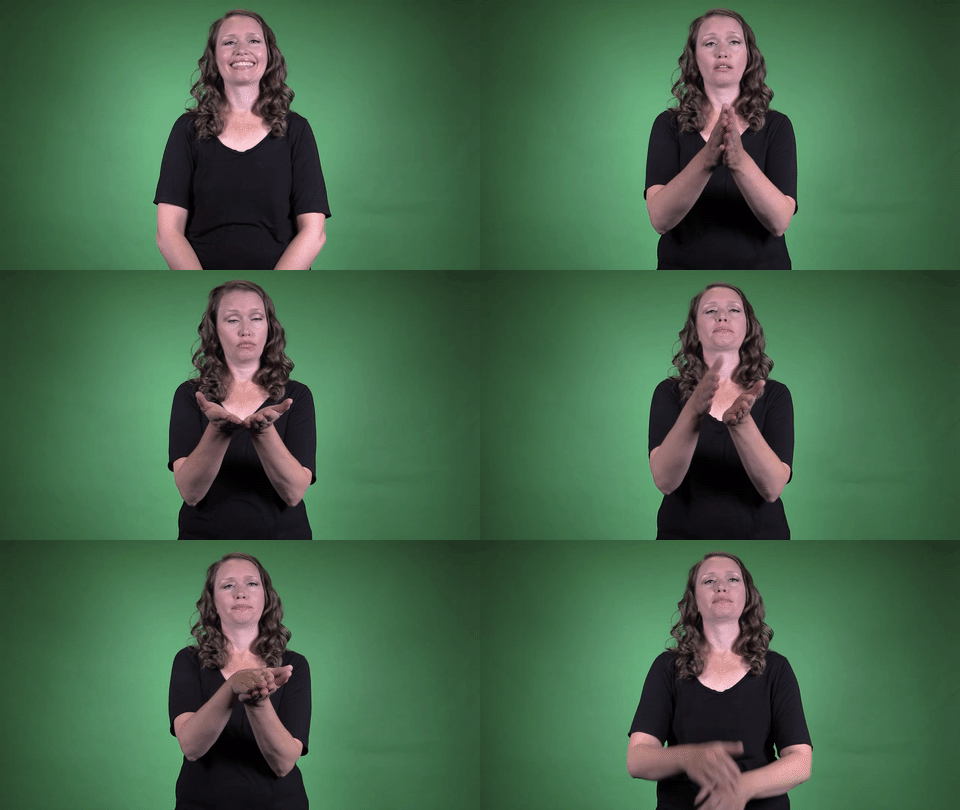
Sign for CLOSE BOOK in ASL | 📕 ASL Dictionary

Definition: To close a book.

Sign for CLOSE BOOK in ASL

YouTube player

Practice Activities:

Start by practicing the sign for CLOSE BOOK in ASL on its own. Open your non-dominant hand flat, palm up to represent the bottom cover of a book. Then bring your dominant hand, also flat, from an open position above and gently close it down on the non-dominant hand as if shutting a book. Repeat this action several times in front of a mirror to check clarity and smoothness.

Once comfortable with the sign in isolation, move on to using it in short phrases. Try phrases like “I close the book,” “Close book now,” and “Time to close the book.” Sign these slowly, then increase your speed as your confidence builds. Consider using props like an actual book to help reinforce the action visually.

Practice with example sentences such as “I close the book before bed,” “Teacher says close your books,” or “She always forgets to close her book.” Say each sentence aloud before signing it to mentally connect the English sentence with the ASL structure. Focus on proper facial expressions and natural transitions between signs.

Create a short story involving a book to deepen contextual understanding. Describe a student reading at the library, then finishing and needing to close the book before going home. Use signs such as READ, FINISH, HOME, and CLOSE BOOK in ASL throughout the story.

Try partner activities like miming opening and closing a book while your partner guesses the action. Alternatively, one person can act out a scene that ends with the need to use the sign for CLOSE BOOK in ASL, and the other provides the appropriate sign response.

Add flashcards to your review routine with visual cues for both the object (a book) and the action (close). Quiz yourself or a partner using prompts where the only correct response is the sign for CLOSE BOOK in ASL.

Cultural Context:

In American Sign Language, everyday signs often reflect cultural values around communication, learning, and community. The sign for CLOSE BOOK in ASL is a good example of how gestures mirror common activities in both Deaf and hearing cultures. Books are tools for education, storytelling, and sharing knowledge, making this sign both practical and symbolic.

The sign for CLOSE BOOK in ASL is commonly used in classrooms, tutoring environments, and during storytime. It’s a visual cue that a lesson is ending or that it’s time to transition activities. Deaf culture emphasizes visual and spatial awareness, and this sign provides a shared, clear signal that something is finishing.

Because ASL is a dynamic and visual language, signs like CLOSE BOOK carry more than just literal meaning. They help create routines and structure in educational settings, especially where visual communication is key. In Deaf schools and programs, the sign for CLOSE BOOK in ASL is often paired with other instructional signs to support smooth transitions.

In Deaf culture, education is valued not just for knowledge, but also for connection to community and identity. Signing CLOSE BOOK can represent the end of one learning moment and the preparation for another. This sign, while simple, contributes to the daily rhythm of Deaf education and communication.

The sign for CLOSE BOOK in ASL is useful beyond academic settings. Families use it during shared reading time, and it’s often included in baby sign language programs to teach young children how to express their environment. It’s also a helpful sign for interpreters working in school settings or during presentations.

ASL is not just a series of hand motions—it’s a full and rich language rooted in Deaf culture. The sign for CLOSE BOOK in ASL reflects how the Deaf community adapts visual language to represent common actions. This makes everyday communication efficient and expressive.

Classroom settings in particular benefit from signs like CLOSE BOOK. Teachers and students in Deaf education environments rely on clear visual signals to maintain focus and structure. The sign for CLOSE BOOK in ASL helps mark the end of one task and the beginning of another, supporting smooth and respectful transitions.

Deaf culture highly values storytelling and literature. Books are often used as shared experiences between teachers, students, parents, and children. The act of closing a book is more than just a physical gesture—it signals a moment of reflection or pause. The sign for CLOSE BOOK in ASL captures that moment with clarity.

Many ASL signs are intuitive, and CLOSE BOOK is no exception. This helps reinforce learning for new signers and allows for faster

Extended Definition:

The sign for close book in ASL is a common and useful phrase in both educational and everyday environments. It is typically used by teachers, students, and in conversation to indicate that it’s time to finish reading or studying from a book. Learning the ASL sign for close book can help you better understand classroom signs and follow directions more easily.

To perform the sign for close book in ASL, start with both hands held open and flat, palms facing each other vertically, as if forming the covers of a book. Then, bring the hands together to mimic the motion of shutting the book. This sign is iconic, which means it looks visually similar to the action it represents, making it easy to remember .

This ASL sign might also be used in metaphorical or casual contexts, such as suggesting the end of a conversation or topic. For example, just as a closed book can symbolize finishing a chapter, the sign can be used to express closure. Understanding when and how to use the close book sign in ASL can enhance your fluency and ability to follow nuanced communication in American Sign Language.

The sign for close book in ASL can appear in various settings beyond the classroom. Libraries, storytelling sessions, and even YouTube videos teaching basic signs often use this sign to indicate the end of a reading activity . It’s one of the many signs that bridge gestures and spoken concepts, making it particularly relevant for emerging deaf readers and ASL learners.

If you are teaching ASL or learning it as a second language, incorporating the sign for close book in your practice sessions can reinforce vocabulary retention. Because this sign directly relates to a daily activity, it’s a functional part of any beginner’s ASL vocabulary. Repetition of everyday signs like this helps solidify learning and boosts confidence among new signers.

In storytelling or classroom narratives, the sign for close book in ASL can serve as a transition cue. Just as a speaker might say “The End,” using the close book sign conveys a similar conclusion in a clear visual manner. This is helpful when working with children or those who are still developing their ASL comprehension skills.

This sign is also an example of how ASL uses visual and spatial references to create meaning. The motion of closing hands mirrors the motion of closing a real book, connecting the concept with a memorable gesture. Such visual connections are foundational to how ASL conveys information through the body and space.

When searching for ASL vocabulary for educational activities, the sign for close

Synonyms: shut book, finish reading, close the text, end the book, seal book

Educational resources: Find related learning materials in our course bank!

Want more? Check out some of our popular learning activities on the homepage!

Need to look up a sign? Use our highly rated dictionary: https://aslinteractive.com/best-asl-dictionary/

Follow us on tiktok: https://www.tiktok.com/@aslinteractive. More social media links at the bottom of this page!

Long-tail Keywords: what is the sign for close book in ASL, how do you sign close book in American Sign Language, ASL sign for close book

Categories:

tags: Commands, Classroom Picture, Objects in the Classroom, Language Learning, Activities

Parameters

*Handshape*:

Both hands start in a flat handshape (B-handshape), palms facing each other with pinky sides touching, resembling an open book. To produce the sign for CLOSE BOOK in ASL, bring the hands together like closing the covers of a book. This motion uses symmetrical movement and clearly mimics the action of shutting a book, which reinforces the Sign for CLOSE BOOK in ASL effectively .

*Palm Orientation*:

For the sign for CLOSE BOOK in ASL, the palms start facing upward and flat, mimicking the open pages of a book. Both hands move toward each other with palms still facing upward, as if closing the covers of a book together. This visual motion clearly illustrates the action described in the sign for CLOSE BOOK in ASL . It effectively communicates the concept through clear palm orientation and movement.

*Location*:

The sign for CLOSE BOOK in ASL is performed at chest level, just in front of the torso. Both hands are positioned in front of the body, palms facing each other, representing the open pages of a book. As the sign progresses, the hands come together as if closing the book, maintaining the location near the center of the chest throughout.

This central placement makes it easy for the sign to be seen clearly and mirrors the actual motion of closing a book held in front of the body. The location is consistent whether the sign is used alone or in a sentence, making the sign for CLOSE BOOK in ASL easy to recognize and understand.

*Movement*:

To produce the sign for CLOSE BOOK in ASL, start with both hands open, palms facing each other, and fingertips pointing forward, as if holding an open book. Then bring both hands together at the pinky sides, closing them like the cover of a book comes together .

This movement mimics the actual action of closing a book, offering a visual representation in the sign for CLOSE BOOK in ASL. Ensure the motion is smooth and clear to convey the concept accurately.

*Non-Manual Signals*:

When performing the sign for CLOSE BOOK in ASL, the facial expression is typically neutral and composed, matching the simplicity of the action. Your eyebrows remain in a resting position, and the eyes should be focused lightly on the hands as they move together, as if closing a real book . Slight head nodding can emphasize the action for clarity.

Maintain a look of mild attentiveness to convey the straightforward, literal concept represented by the sign for CLOSE BOOK in ASL. The non-manual signals work together with your hand movements to make the meaning clear and easily understood.

*Prosody, Dominant/Non-Dominant Hand*:

The sign for CLOSE BOOK in ASL uses both hands to mimic shutting a book. The non-dominant hand stays flat, palm up, to represent the bottom cover. The dominant hand, also flat, starts open above and then comes down flat onto the other hand, simulating the motion of closing a book.

This prosodic movement is smooth and deliberate, capturing the act of finishing something. The sign for CLOSE BOOK in ASL visually represents the concept well, making it intuitive for learners.

Tips for Beginners:

When learning the sign for CLOSE BOOK in ASL, it’s important to think visually. Use both hands flat, palms touching like an open book, then bring them together as if you’re closing a real book. Your movement should be smooth and clearly resemble the object being referenced. Keep your handshape consistent, flat and firm, to avoid confusion with other similar signs.

Beginners often rush the movement or don’t align their hands properly. A helpful tip is to practice in front of a mirror or with a partner to get feedback on your form and timing. The more natural the motion looks, the easier it will be for others to understand you. Precise hand placement and movement are key to mastering the sign for CLOSE BOOK in ASL.

Another great way to improve your confidence is to watch native signers or ASL instructors use the sign in context. YouTube videos, ASL dictionaries, and online tutorials can be a great supplement to in-person classes. When watching, note how much use of space and facial expression they incorporate, which helps make the sign more fluent and expressive.

It’s also useful to practice vocabulary in categories. Since the sign for CLOSE BOOK in ASL is part of educational and common daily activities, combine it with signs like READ, OPEN BOOK, or STUDY during your practice sessions. This builds fluency and helps you recall signs faster when having conversations.

Finally, don’t worry if your sign isn’t perfect at first. Repetition and consistency are far more important when starting out. Try to use the sign for CLOSE BOOK in ASL in your daily routine—after reading a book or in mock conversations. This repetition helps reinforce memory and muscle movement.

Connections to Other topics:

The sign for CLOSE BOOK in ASL is closely related to other signs that mimic physical actions, particularly those involving opening and closing objects. Similar verbs like OPEN BOOK, CLOSE DOOR, or CLOSE WINDOW also use spatial relationships between the hands to reflect real-world motion. The commonality lies in how these signs convert conceptual ideas into visual manual representations.

This sign is often used in educational and instructional contexts, especially in classrooms and learning environments. It can be used in compound commands like FINISH CLOSE BOOK or TEACHER SAY CLOSE BOOK NOW, linking it with timing and sequence signs like NOW, FINISH, or WAIT. These combinations create useful context-specific phrases for managing classroom dynamics.

In terms of conceptual connection, the sign for CLOSE BOOK highlights how ASL uses iconicity—where signs resemble the actions they describe. It also aligns with other signs representing tools or items with a clear physical function, such as CLOSE DRAWER or ZIP-UP. This allows learners to recognize patterns and transfer their understanding to signs for similar objects and actions.

The sign for CLOSE BOOK in ASL contributes to broader instruction of compound signs. For example, when combined with SCHOOL or STUDY, the full phrase may express common instructions given during lessons, emphasizing the integration of verbs and nouns in fluid sentence structures. These compound setups enrich expressive fluency.

Understanding the sign for CLOSE BOOK in ASL also provides insights into time-based actions and transitions in ASL discourse. This supports learning in narrative sequences, such as telling a story of a normal school day or recapping instructions. Recognizing how this sign fits into a narrative helps learners build cohesive signed sentences.

Overall, learning the sign for CLOSE BOOK in ASL reveals not only vocabulary but also patterns used to describe sequences, physical interactions, and educational activities. It represents a foundational building block for broad communicative competence in both formal and casual conversation.

Summary:

The sign for CLOSE BOOK in ASL is a dynamic and literal representation of the physical action it describes. It begins with your hands in a flat, open position, palms facing each other horizontally like the pages of an open book. The motion involves bringing the hands together, mimicking the motion of shutting a book.

This sign is closely tied to the concept of reading, learning, and completing a task. Culturally, the sign for CLOSE BOOK in ASL often marks the end of a session, such as finishing a storytime, lesson, or study group. It frequently appears in educational settings and storytelling environments within the Deaf community.

In grammatical context, the sign functions as a verb or part of an action phrase. It is commonly used after the sign for OPEN BOOK, creating a natural continuum of actions. The progression from OPEN BOOK to CLOSE BOOK in ASL offers a visually rich way of expressing the start and end of engagement with written material.

Linguistically, this sign makes effective use of classifiers and iconicity. The hands serve as classifier representations of the book’s physical structure, offering a transparent visual metaphor. The iconic quality of the sign helps early learners grasp the meaning more intuitively.

Applied linguistics acknowledges signs like CLOSE BOOK for their pedagogical strengths in teaching both language and concept at once. In early education, this sign supports language development by linking physical objects to conceptual closure. Educators often reinforce the sign with tactile experiences, such as asking students to close real books as they sign.

The sign also plays a subtle but important role in transitional cues in classroom management. Teachers in Deaf classrooms use the sign for CLOSE BOOK in ASL to signal changes in activity or to shift focus. This helps students understand both task boundaries and social rhythms without relying on voiced prompts.

Related signs include OPEN BOOK, READ, STUDY, and FINISH. These signs complement each other to define specific phases in an educational or narrative context. For instance, a sequence of READ, then CLOSE BOOK, conveys a full cycle of reading activity.

Culturally, the sign for CLOSE BOOK in ASL may also be symbolic of completion or closure beyond a literal reading event. In storytelling contexts, particularly in Signed Stories or visual vernacular, the gesture of closing a book at the end evokes emotional resonance. It can signify a powerful conclusion or a moment of reflection.

The fluidity of the sign aligns with ASL’s spatial and temporal grammar. The direction and speed of the motion can convey emphasis, such as closing a book slowly for emotional effect, or quickly to indicate urgency or frustration. This flexibility contributes to the richness of ASL expression.

Morphologically, the sign operates as a single lexical item but may combine with nonmanual signals for nuanced meaning. A sigh or a slight head tilt while signing CLOSE BOOK can suggest fatigue or satisfaction with the completed reading. These additions form a layered expression typical of ASL grammar.

In Deaf literature and theater, the sign for CLOSE BOOK in ASL punctuates narratives in powerful ways. Visual storytellers often use it in sync with dramatic pauses, reinforcing the storytelling arc. The gesture resonates with viewers as a visual cue for finality and emotional closure.

The sign also underscores the importance of visual learning in ASL environments. By enacting the motion of closing a book, learners reinforce motor memory alongside visual vocabulary. This multi-sensory approach is key to ASL pedagogy.

The sign isn’t limited to literal books either. In some contexts, CLOSE BOOK may metaphorically indicate ending a chapter of life or concluding a personal journey. This metaphorical use parallels the way English speakers say “turn the page” or “close the book” on something.

Language acquisition researchers note the sign’s high transparency, making it accessible to both Deaf and hearing learners. Its metaphoric and literal relevance makes it a useful anchor sign in ASL vocabulary development. Even young children can reproduce the sign accurately due to its straightforward motion.

The sign aligns well with ASL’s visual-spatial modality, translating a real-world object and action into legible hand movements. Unlike spoken language, where the word ‘close’ could apply to various contexts, ASL disambiguates through clearly defined classifiers and space.

Unlike spoken English, where intonation can signal finality, ASL relies on the sign’s execution and accompanying expressions. This visual clarity is central to its grammar. The same motion, modified with changes in tension or speed, can tell vastly different stories.

In storytelling or educational rituals, the sign for CLOSE BOOK in ASL often signals winding down and transition. This contributes to a sense of structure and rhythm in signed environments. It’s particularly beloved in ASL rhymes or bedtime stories, where it gives closure.

Body orientation also contributes to the sign’s full effect. Keeping the hands level and close to the chest can make the sign feel more intimate, especially in one-on-one reading settings. For public storytelling, larger, more theatrical movements make the sign visually impactful.

In bilingual educational

Want more? Check out some of our popular learning activities!

ASL Interactive Resources

ASLInteractive YouTube Channel

Follow us on tiktok: @aslinteractive.com

Follow us on Instagram: aslinteractive

Facebook page: aslinteractive

Facebook group: aslinteractive

LInkedIn: ASL Interactive LLC

Twitter: @ASL_interactive

*Some information on this page is AI-generated. AI can make mistakes. Please check the information.

Sign for CLOSE BOOK in ASL

Responses