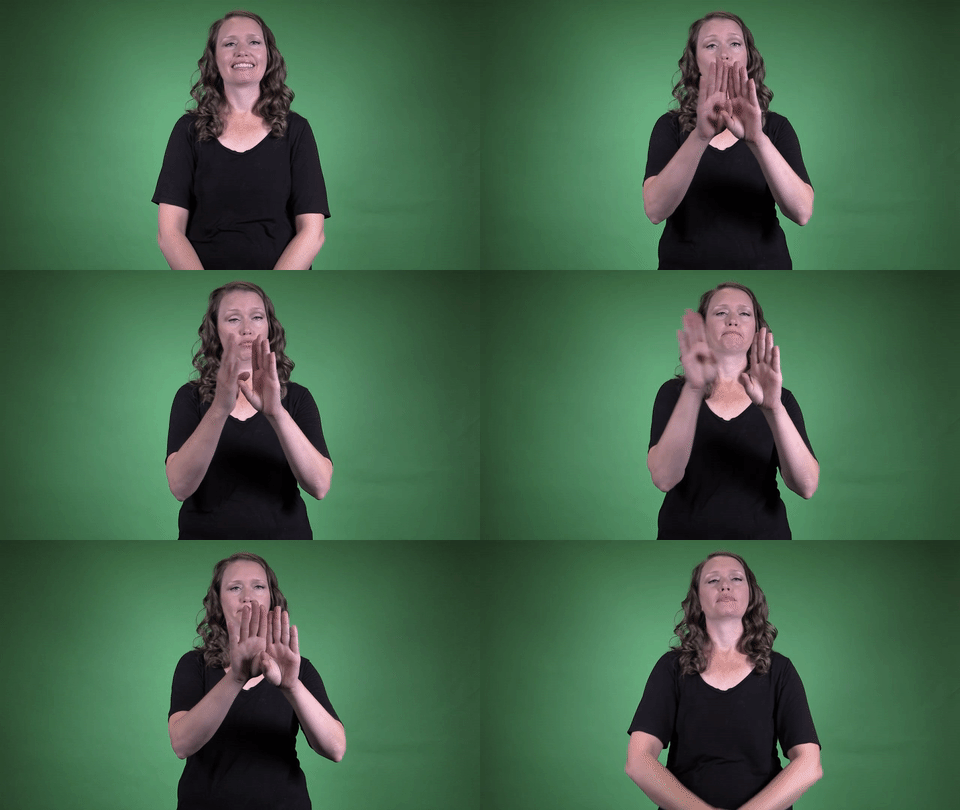
Definition: To close a door.
Sign for CLOSE DOOR in ASL

Practice Activities:
Start by practicing the sign for CLOSE DOOR in ASL in isolation. Do this in front of a mirror, focusing on handshape, movement, and facial expressions. Repeat the sign slowly at first, then gradually increase your speed for fluency. Record yourself and compare it with videos from reliable ASL resources to check for accuracy.
Next, explore using the sign in short phrases. For example: “Close door please,” “Close door now,” or “Can you close door?” Practice these with a partner or in front of a mirror. Focus on maintaining visual clarity and appropriate non-manual markers like eye contact and head movement to match the context of the sentence.
Use storytelling prompts to expand its use in context. Try a simple narrative like describing a morning routine: “I woke up. I walked to the kitchen. I closed the door.” This helps reinforce the sign for CLOSE DOOR in ASL in a natural setting. Add characters and varying outcomes for more fun and engagement.
For partner work, act out short scenarios where one person pretends to enter a room, and the other signs “close door” as part of the dialogue. Swap roles to get equal practice. Add variety by changing locations like a classroom, car, or refrigerator door.
Labeling objects around the house that have doors is another great way to reinforce the sign. Go on a “door hunt” and each time you touch or interact with a door, sign the phrase. This builds real-world associations.
Lastly, play a charades-style game where someone silently acts out a scene involving a door, and others guess using the correct ASL sign. This adds fun and teamwork while helping reinforce the correct sign for CLOSE DOOR in ASL in spontaneous contexts.
Cultural Context:
In American Sign Language, understanding the sign for close door in ASL carries more significance than simply learning a motion. ASL is deeply rooted in visual-spatial language and cultural context, and signs often reflect the interactions of everyday life in the Deaf community. When using the sign for close door in ASL, it’s not just about conveying the action of closure but also about expressing it appropriately within a cultural and situational context.
The sign for close door in ASL uses both hands to mimic the motion of closing a double door in front of you. This mimetic gesture is easily understandable to those fluent in ASL because of how physical movement mirrors real-life actions. While the literal meaning of this sign is straightforward, there is an emphasis on clarity and visual accuracy, which is a key part of Deaf culture.
When someone uses the sign for close door in ASL in conversation, it can refer to an actual door or carry metaphorical meanings, such as ending a conversation or concluding an event. Context is everything in ASL, and tone is shown through facial expressions and body movement. A sharp motion might show urgency, while a slower movement with a smile might signal something more casual.
In Deaf culture, it’s common to use space and body language to enhance the meaning of a sign like close door. This cultural tendency helps communicate more detailed information, such as who is closing the door, why, and where. Someone might shift their body slightly to show directionality, which is essential in ASL communication.
The sign for close door in ASL is often introduced early in ASL learning since it reflects a common, everyday action. It also serves as a foundation for related signs like open door or close window. This creates an opportunity for learners to expand their vocabulary while staying grounded in the daily experiences of Deaf individuals.
Deaf community interactions often happen in environments tailored to visual communication. Doors and their states—open or closed—carry practical importance for visual access and awareness. Using the sign for close door in ASL might alert someone to changes in the space, such as someone leaving or a change in privacy.
In broader storytelling or narrative uses within ASL, the sign for close door in ASL may be used symbolically. It can imply choosing to end something, stepping away from a situation, or creating boundaries. These metaphorical uses are intuitive to ASL users, who blend literal and symbolic language seamlessly.
Respecting and understanding the cultural weight behind simple signs such as the sign for close door
Extended Definition:
The sign for close door in ASL is commonly used to represent closing a door physically, figuratively, or to convey the end of an event or meeting. In American Sign Language, it combines straightforward directional movement with spatial awareness to clearly express the idea of a door being shut. This phrase often appears in conversations about routines, safety, or arriving and leaving locations.
To perform the sign for close door in ASL, both hands start open and spread apart in front of the body, palms facing each other. Then, the hands move toward each other to mimic the action of sliding or swinging doors closing. It’s a visual representation that closely matches how doors actually close in real life, making the sign easy to remember and understand.
This sign is useful in various daily situations, such as telling someone to close the door when entering or asking children to shut the door behind them. It’s also used in schools, offices, and homes by people who rely on visual communication. Incorporating the sign for close door in ASL into regular conversations can help Deaf and hard-of-hearing individuals engage more easily in everyday interactions.
Context matters when using this sign. When combined with facial expressions or additional signs, it can convey urgency, politeness, or specific instructions. For example, a serious facial expression may indicate a strong request, while a casual look may suggest an everyday reminder.
Parents and educators teaching Deaf children often use the sign for close door in ASL as part of routines to reinforce both vocabulary and appropriate behavior. It is one of the basic environmental signs that are introduced early on because of how commonly it is used in different settings. Signing this phrase regularly not only builds language skills but also encourages independence and responsibility among children.
It’s important to note that ASL grammar doesn’t always follow English structure. So while an English speaker might say “Could you please close the door?”, in ASL the structure would be simplified and rearranged, possibly just using the sign for close door and a polite facial expression. This highlights how ASL uses visual cues and body language in addition to hand signs.
The sign for close door in ASL can also be symbolic in more abstract conversations. It could indicate ending a relationship, completing a chapter in life, or finishing a project. Signers may choose to use this sign in storytelling, poetry, or discussions about change and resolution.
There is a standardized way to perform the sign, but slight variations exist depending on region and context. Some signers may add directional signs or classifiers to specify
Synonyms: shut door, seal door, latch door, fasten door, close the door
Educational resources: Find related learning materials in our course bank!
Want more? Check out some of our popular learning activities on the homepage!
Need to look up a sign? Use our highly rated dictionary: https://aslinteractive.com/best-asl-dictionary/
Follow us on tiktok: https://www.tiktok.com/@aslinteractive. More social media links at the bottom of this page!
Long-tail Keywords: what is the sign for close door in ASL, how do you sign close door in ASL, ASL sign for close door
Categories:
tags: Verbs, Commands, Everyday activities, Housing, Actions
Parameters
*Handshape*:
The handshape for the sign for CLOSE DOOR in ASL uses both hands in a flat B-hand configuration. Palms face each other, fingers extended and held together. Starting apart, the hands move toward each other in a fluid motion, stopping when the pinky sides meet.
This handshape resembles sliding doors coming together, visually reinforcing the concept in the sign for CLOSE DOOR in ASL. The consistent B-handshape maintains clarity and enhances the visual accuracy of the action being represented.
*Palm Orientation*:
For the sign for CLOSE DOOR in ASL, both hands start in front of the body with palms facing out, away from the signer, and fingers extended. The hands are typically shoulder-width apart and then move toward each other in a closing motion, as if mimicking sliding doors.
During the movement, the palms rotate slightly to face each other, ending in a parallel position. This palm orientation helps mimic the visual gesture of a door closing. The sign for CLOSE DOOR in ASL efficiently conveys the concept with a natural movement and palm direction.
*Location*:
The sign for close door in ASL is made in the neutral space in front of the chest, slightly lower than shoulder height. Hands begin shoulder-width apart and move together horizontally, mimicking the motion of sliding doors closing.
This location helps visually represent the meaning of the sign for close door in ASL, enhancing clarity and natural expression. The positioning in front of the torso makes the sign easily visible and accessible during communication.
*Movement*:
To produce the sign for close door in ASL, start with both hands open, palms facing each other, fingers extended and held in front of the body about shoulder-width apart. Move both hands toward each other simultaneously in a quick, symmetrical motion until the sides of the hands meet, symbolizing doors shutting.
This gesture visually mimics sliding doors coming together. The sign for close door in ASL uses clear directional movement to convey the concept effectively.
*Non-Manual Signals*:
When signing the sign for CLOSE DOOR in ASL, the facial expression is generally neutral or slightly focused, signaling the completion of an action. Eyebrows remain relaxed, and lips may be pressed together lightly to indicate the idea of something being shut or completed.
To enhance clarity, maintain steady eye contact and a subtle nod at the end of the movement. These non-manual signals help convey the intent behind the sign for CLOSE DOOR in ASL more effectively.
*Prosody, Dominant/Non-Dominant Hand*:
The dominant and non-dominant hands both begin in an open B-handshape, palms facing each other and fingers pointing forward, as if mimicking open doors. To complete the sign for close door in ASL, the hands move toward each other in a horizontal motion until the pinky sides almost touch, resembling a door shutting. This gesture clearly illustrates the concept involved in the sign for close door in ASL.
Tips for Beginners:
When learning the sign for CLOSE DOOR in ASL, begin by focusing on the handshape and movement. This sign uses both hands, starting open and apart, then coming together with palms facing in. It’s designed to mimic sliding doors closing—so the motion should be smooth and direct. Practicing in front of a mirror can help ensure your hand placement and direction are accurate.
Make sure your hands match each other in shape and orientation. A common mistake is having one hand higher or more forward than the other. Synchronization is key here—if your hands close at different times, the sign can look confusing or unclear. Keep wrists relaxed to avoid stiffness, which can interfere with fluidity.
Pay attention to your body movement. While most of the action is in the hands, some beginners unintentionally lean forward or shift their shoulders. Try to keep your upper body still so the gesture stays clean and defined. The focus should remain on your hand motion, not any distracting body shifts.
Practice the sign for CLOSE DOOR in ASL in context. Try pairing it with related signs like OPEN DOOR, ROOM, or ENTER to develop natural flow. Signing in context helps reinforce vocabulary and adds variety to practice routines, which keeps learning engaging and memorable.
Facial expression isn’t as important for this particular sign, but you should still keep your face neutral and alert. Over-exaggerated facial movements might draw attention away from the hand action. Staying relaxed and confident will let your signing look more natural.
Consistency is everything. Practicing this daily, even just for a few minutes, can help build muscle memory. When you’re clear and deliberate, your version of the sign for CLOSE DOOR in ASL will be easier for others to understand in everyday interactions.
Connections to Other topics:
The sign for CLOSE DOOR in ASL connects directly to spatial concepts and directional movement, which are fundamental to ASL grammar. This sign uses two flat, open B-hands that start apart and come together in front of the body, mimicking the motion of a door shutting. It’s an example of how classifier-like movement can mimic real-world actions, making it intuitive for visual learners.
This sign can relate to temporal concepts in ASL, such as transitions or completion. For example, in storytelling or signed narratives, the sign for CLOSE DOOR in ASL might be used to indicate the end of an event or a change in setting. It also connects with directional verb usage when combined with signs for objects or locations in space, helping to tell richer, spatially organized stories.
The sign complements other related signs like OPEN DOOR, CLOSE WINDOW, or CLOSE BOOK. These signs share a similar motion concept—starting open and bringing the hands together—but the handshape and implied object differ slightly. Understanding how the sign for CLOSE DOOR in ASL fits into a family of “closing” signs gives learners insight into how ASL uses handshape and movement patterns logically.
In everyday conversation, this sign can be used in compound signs or phrases like GO CLOSE DOOR or PLEASE CLOSE DOOR, blending smoothly with directional and functional commands. It also helps students see how commands work structurally in ASL without always needing facial grammar to convey urgency or politeness.
Finally, the sign for CLOSE DOOR in ASL is a good entry point for discussions around home, safety, daily routines, and structure-related contexts. It’s easily applied in visual storytelling, classroom language routines, and situational vocabulary clusters, making it versatile and highly applicable across various communicative scenarios.
Summary:
The sign for CLOSE DOOR in ASL uses both hands to represent a door shutting. The movement shows a metaphorical door coming together, starting with both hands spread out in front of the body and then moving toward each other, palms facing in.
The dominant hand is on one side and the non-dominant on the other, moving simultaneously to clink together like door panels. This visual-motor concept is iconic, offering a direct link between form and meaning in the sign.
Culturally, the sign for CLOSE DOOR in ASL taps into a shared environmental experience—everybody has closed a door. Deaf culture embraces a high degree of visual iconicity, and this sign illustrates the value placed on visually-rich, conceptual language use.
In the context of daily ASL interactions, this sign is often integrated into phrases about locations, settings, and movements. It appears in instructions, such as in classrooms or safety drills, as well as household interactions.
Grammatically, the sign can serve as a verb within a larger sentence and often works with non-manual markers to add affect. Facial expressions signal urgency or politeness, like raising the eyebrows to ask a polite request or showing intensity for firm directives.
The sign for CLOSE DOOR in ASL belongs to a broader category of door-related signs, such as OPEN DOOR, LOCK DOOR, or KNOCK. These signs form a semantic network easily accessible through spatial classifiers and shared gestural references.
This sign also contrasts with CLOSE-WINDOW, where hand positioning and motion may be similar but are oriented differently to reflect vertical movement. This contrast teaches learners about directional movement and how spatial schemas support meaning in ASL.
Linguistically, signs like CLOSE DOOR in ASL highlight the power of classifier usage and spatial mapping. Using space effectively is crucial in conveying accurate context, and this sign maps well into three-dimensional visual-spatial grammar.
Also important is the rule of iconicity. Unlike spoken language, which often uses arbitrary sound combinations, ASL frequently mirrors real-life imagery in signs such as CLOSE DOOR, allowing meaning to be more immediately accessible.
The sign is short, efficient, and highly functional. It can be signed quickly in urgent situations or elicited more slowly when used in conditional or teaching contexts.
Cognitive linguistics explores how signs like CLOSE DOOR in ASL engage the brain differently than spoken equivalents. Processing visual language often activates bilateral brain hemispheres, supporting visual-spatial cognition and motor planning.
In applied linguistics, signs such as CLOSE DOOR in ASL are often taught using real-world connections. Educators rely on environmental mimicry, guiding students in associating sign motion with real physical action.
Language acquisition studies reveal that young Deaf children acquire signs with strong visual links—like CLOSE DOOR—very early. The conceptual transparency of the sign aids memory retention and acquisition speed.
The sign offers a great foundation for teaching ASL learners about movement parameters. It uses path movement, palm orientation, and symmetry to teach how these features encode meaning.
The efficiency of the sign allows for smooth integration into signed storytelling. In ASL narratives, signs like CLOSE DOOR can transition between scenes, establish environment, or trigger emotional shifts in plotlines.
The sign for CLOSE DOOR in ASL also stands as a boundary-setting device within social interaction. Just as physically closing a door signals transition or privacy, the sign metaphorically implies conclusion or separation.
Practically, this sign often appears in instructional content across schools, public facilities, and emergency documentation. Signing CLOSE DOOR can instruct, command, or describe an action based on contextual cues.
The physical form of the sign makes it stylistically flexible. Variants may exist regionally, but the general concept of two handshapes moving together horizontally remains intact.
The sign is a classic example of how body language and manual motion combine. It captures energy, spatial movement, and functional design in one fluid motion.
In classifier usage, doorway concepts often rely on C-handed classifiers representing upright rectangular shapes—but when using the full lexical sign for CLOSE DOOR in ASL, classifiers are less necessary. This distinction helps learners know when to formalize their sign use.
Emotionally, the sign can portray tone. A brisk, sharp sign indicates tension or frustration, while a slow, gentle movement implies calmness or sensitivity.
The sign provides insight into the notion of affordances within ASL. The hand acts as both metaphorical agent and object—the door and the action—layering semantic values in minimal physical space.
Exploring discourse, this sign is regularly incorporated into topic-comment structures. A signer may first establish a room or setting and then, with one flowing movement, CLOSE DOOR to set the frame visually and narratively.
Signs like CLOSE DOOR in ASL demonstrate how physical metaphors support abstract thinking. The act of closing symbolically limits, transitions away, or concludes interaction.
Spatial thinking and precision are required when using signs such as CLOSE DOOR in
Want more? Check out some of our popular learning activities!
ASL Interactive Resources
ASLInteractive YouTube Channel
Follow us on tiktok: @aslinteractive.com
Follow us on Instagram: aslinteractive
Facebook page: aslinteractive
Facebook group: aslinteractive
LInkedIn: ASL Interactive LLC
Twitter: @ASL_interactive
*Some information on this page is AI-generated. AI can make mistakes. Please check the information.


Responses