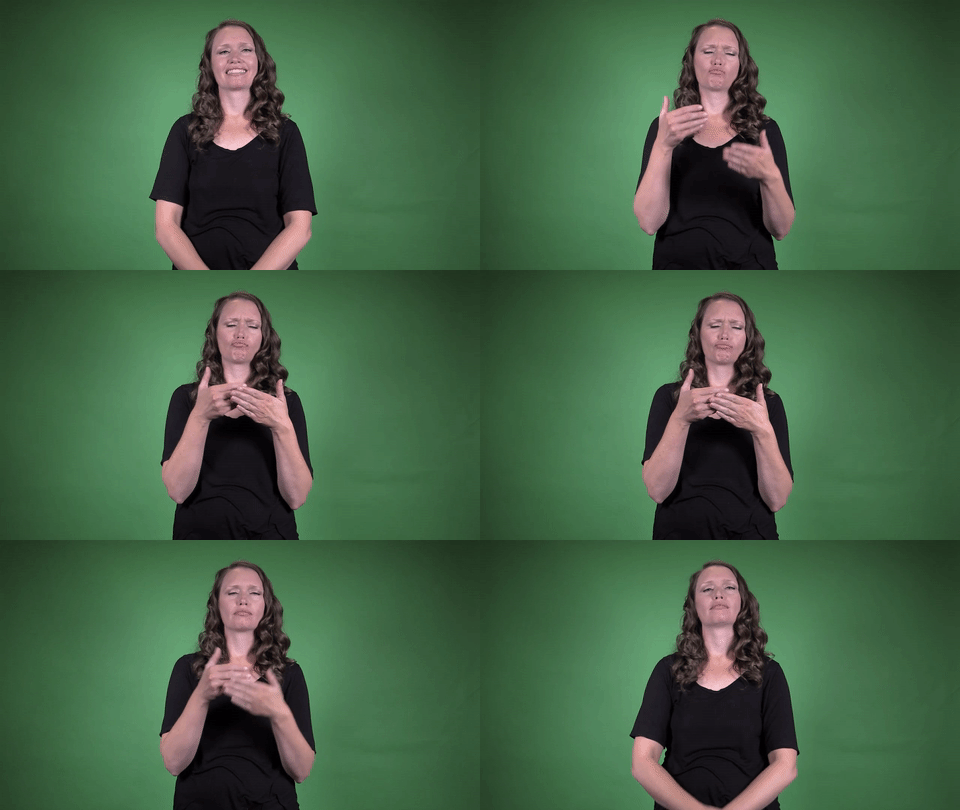
Definition: To move together.
Sign for CLOSE in ASL

Practice Activities:
To build confidence with the sign for CLOSE in ASL, start by practicing the sign in isolation. Stand in front of a mirror and repeat the movement several times, focusing on handshape, palm orientation, and fluid motion. Use a video recording to analyze your accuracy and make adjustments as needed.
Once you are comfortable, move on to using the sign in short phrases. Examples include “close the door,” “close the book,” or “close your eyes.” Practice chaining these phrases into longer sentences such as “Please close the door before you leave” or “She told me to close my eyes for a surprise.” This will help you understand how the sign for CLOSE in ASL functions grammatically in different contexts.
Try storytelling activities where you describe a daily routine or event that includes the concept of closing something. For instance, narrate your morning: “I wake up, close my alarm clock, close the window, then go make breakfast.” This helps you connect the vocabulary to real-life usage.
Work with a partner to practice comprehension and expressive skills. One person can sign a sentence using the sign for CLOSE in ASL, while the other identifies what object is being closed. You could also act out short skits like “a librarian closing the library” or “someone closing a suitcase for a trip,” then switch roles.
For vocabulary expansion, identify other words commonly used with “close,” such as “closet,” “close-knit,” or “close call,” and discuss whether these should be fingerspelled or signed differently in ASL. This helps clarify context-specific uses of the sign for CLOSE in ASL versus when to fingerspell similar-looking English terms.
Finish your session by reviewing all the different uses of the sign throughout your practice. Regular repetition through varied exercises will help reinforce memory while improving fluency.
Cultural Context:
In American Sign Language, understanding the cultural context of signs like the sign for CLOSE in ASL helps build clear and respectful communication within the Deaf community. This particular sign can carry different meanings depending on facial expressions, direction, and the situation in which it’s used. ASL is deeply rooted in visual and spatial expression, so the way a sign is shown can significantly change its meaning.
The sign for CLOSE in ASL is often used to indicate physical proximity, emotional closeness, or even the act of shutting something like a door or a book. However, tone and body language matter just as much as hand movements. If someone signs CLOSE with a warm smile, it might suggest a close personal connection. If it’s signed quickly and firmly, it could refer to closing something abruptly.
In Deaf culture, the context surrounding the sign for CLOSE in ASL is just as important as the sign itself. ASL is not a direct word-for-word translation of English. This means that using the sign for CLOSE in ASL requires knowledge of how proximity and relationships are conceptualized in Deaf spaces. Communication in ASL goes beyond individual signs and relies on a whole-body, expressive approach.
When used to talk about relationships, the sign for CLOSE in ASL can indicate a deep bond between friends or family members. Emotional closeness is often expressed with subtle changes in facial expression and posture. It’s more than just hands making a shape—it’s about evoking connection and trust.
For describing distance, the sign for CLOSE in ASL helps clarify spatial relationships. Whether giving directions or setting up a visual scene in storytelling, spatial awareness is a core part of ASL grammar. A signer may show how close one object is to another using this sign, helping paint a visual picture of a place or situation.
The sign for CLOSE in ASL is also frequently used in everyday routines. It commonly appears in school settings, home life, or job sites, where physical actions like closing a door or shutting a book are common. This shows how embedded the sign is in daily life for those who use ASL as their main language.
Because ASL relies heavily on visual cues, signing CLOSE can be personalized by how it’s signed and how the signer feels. This makes every use slightly unique and reflects the signer’s intention. Cultural nuances may shift based on region, age, or community traditions, making context important in how the sign for CLOSE in ASL is understood.
Understanding the sign for CLOSE in ASL means looking beyond
Extended Definition:
The sign for CLOSE in ASL can have different meanings depending on the context. It may refer to physical proximity, like something being near, or it might express emotional closeness or the act of closing something, such as a door or book. This flexibility makes the sign for CLOSE in ASL an important one to learn for everyday conversation.
When you’re talking about physical nearness, the sign for CLOSE in ASL typically uses flat hands to represent two objects coming near each other. In this case, the hands start apart and are brought together to show that two things are close. This version of the sign is often used to describe how near someone or something is in relation to another person or object.
If you’re describing emotional intimacy, such as having a close relationship with someone, the same sign may be used with a more personal or thoughtful expression. Facial expressions are a huge part of ASL, so when talking about emotional closeness, a caring or warm look will help convey the meaning more clearly. This emotional nuance makes ASL unique and rich.
Another common use of the sign for CLOSE in ASL relates to shutting or sealing something, like a door or window. In this case, the movement of the hands imitates the action of sliding or closing an object. Signs can vary slightly depending on the object being referenced, but the general visual of bringing things together stays true.
Regional differences and signing style may influence how the sign for CLOSE in ASL appears. Some signers might use alternative motions or handshapes based on their local dialect or level of fluency. Even though the meaning stays consistent, watching different versions can help learners expand their understanding.
In conversations, the sign for CLOSE in ASL is often paired with directional cues to show specific locations or objects. This can help clarify whether you mean something is located close by or that you want an object to be closed. Using spatial grammar effectively gives more accuracy to your signing.
Children and adults alike can benefit from learning the sign for CLOSE in ASL, as it appears often in daily interactions. Whether you’re saying your school is close by or asking someone to close the refrigerator, this sign comes in handy frequently. Practicing it in multiple contexts helps reinforce its use.
In learning environments, instructors often teach the sign for CLOSE in ASL early on because it’s so useful. It’s a foundational vocabulary word that appears in dialogues, narratives, and signed instructions. Knowing how to sign CLOSE can also help new learners understand other related signs and
Synonyms: near, nearby, adjacent, alongside, proximate
Educational resources: Find related learning materials in our course bank!
Want more? Check out some of our popular learning activities on the homepage!
Need to look up a sign? Use our highly rated dictionary: https://aslinteractive.com/best-asl-dictionary/
Follow us on tiktok: https://www.tiktok.com/@aslinteractive. More social media links at the bottom of this page!
Long-tail Keywords: what is the sign for close in asl, how do you sign close in american sign language, asl sign for the word close
Categories:
tags: Commands, Actions, Language Learning, Relationships, Proximity
Parameters
*Handshape*:
The handshape for the sign for CLOSE in ASL begins with both hands open, fingers extended and palms facing forward. The hands resemble the “B” handshape in ASL. They are positioned parallel to each other, about shoulder-width apart.
To complete the sign for CLOSE in ASL, the hands move toward each other until the fingertips nearly touch or overlap, forming a barrier-like motion. This change in handshape visually represents something being shut or coming together .
*Palm Orientation*:
For the sign for CLOSE in ASL, both hands typically have palms facing toward the body. The dominant hand and non-dominant hand start apart and move toward each other, closing in front of the body as if mimicking the motion of a door shutting.
This palm orientation helps reinforce the concept behind the sign for CLOSE in ASL, emphasizing an action that brings two surfaces together. The palms usually remain vertical throughout the movement.
*Location*:
The sign for CLOSE in ASL is typically produced in the space in front of the body, around chest or mid-torso level. This neutral signing space allows for clear visibility of both hands as they move together to indicate the concept of closing.
When demonstrating the sign for CLOSE in ASL, the movement occurs near the centerline of the body, not too high or low, making it easily observed. This central location helps convey the idea effectively in various conversational contexts.
*Movement*:
To perform the sign for CLOSE in ASL, start with both hands open, palms facing each other, held about shoulder-width apart. Move both hands toward each other smoothly until the fingertips of one hand meet the fingertips of the other hand, closing the space between them.
This movement represents something coming together or being shut. The sign for CLOSE in ASL is commonly used to show closing a door, window, or joining distance between objects.
*Non-Manual Signals*:
When using the sign for CLOSE in ASL, your facial expression should reflect the context—serious or neutral for literal meanings, like physically shutting an object, or more nuanced when referring to relationships. Slightly raised eyebrows can indicate emphasis or confirmation, while relaxed features match a neutral tone.
Eye gaze is directed at the object or person the sign refers to. The sign for CLOSE in ASL benefits from clear mouth morphemes such as “mm” or “pressed lips” for added meaning. ♂️
*Prosody, Dominant/Non-Dominant Hand*:
The sign for CLOSE in ASL typically uses both hands. The dominant hand, shaped like a flat B-hand, starts slightly away from the body with the palm facing inward. The non-dominant hand mirrors this shape and positioning. Both hands move toward each other, coming together as if “closing” a set of doors, with fingertips touching.
The movement is smooth and controlled, expressing the idea of bringing something to a close. Facial expression may reflect the context—neutral for physical closing, or more intense for emotional or abstract uses. The sign for CLOSE in ASL can vary slightly depending on the specific meaning, such as physical proximity or an action being finished.
Tips for Beginners:
When learning the sign for CLOSE in ASL, it’s important to pay attention to handshape and movement. The sign typically involves both hands held flat, facing each other with palms open, and then brought together in a swift, smooth motion, like closing a door. Practicing this movement slowly at first will help you build muscle memory and prevent awkward or unclear signing.
A common mistake is using uneven speed or not keeping the hands aligned properly. Be sure to move both hands in sync and keep your hands at the same level. Consistency in handshape and location is what makes the sign for CLOSE in ASL clear and easy to understand to fluent signers.
Facial expressions add context to the sign. In ASL, body language often adds emotional tone or specificity. A neutral or slight nod works well when using this sign in a general setting, but modifying your face to show urgency or emphasis can communicate more meaning.
Practice the sign for CLOSE in ASL in context by using it in common phrases like “close the door” or “close the book.” Repetitive use in real-life phrases helps reinforce usage while building your expressive skills. You’ll also better understand how it fits grammatically in full sentences.
Try practicing in a mirror or recording yourself to evaluate your motion and positioning. This is especially important for spotting subtle misalignments that others might notice. Make sure your handshapes are flat with fingers together for clarity.
If someone doesn’t understand you right away, don’t be discouraged. Pause, show the sign again with slower movement, and exaggerate slightly for clarity. This often helps beginners get their point across more effectively while improving over time.
Fingerspelling is rarely needed with this sign, so focus instead on mastering the proper motion. With consistent practice, your comfort with the sign for CLOSE in ASL will steadily improve.
sign for close in asl, how to sign close in american sign language, asl sign for close door, american sign language sign close, close sign in asl, learn sign for close in asl, what is the sign for close in asl, close in sign language meaning
Connections to Other topics:
The sign for CLOSE in ASL connects closely to directional and spatial concepts, such as NEAR, FAR, OPEN, and SHUT. Many of these signs are visually iconic, using hand movement and space orientation to represent physical proximity or barriers. Understanding these spatial relationships helps in building more complex sentence structure involving location and positioning.
Context plays a big role in how the sign for CLOSE in ASL is interpreted. It can indicate emotional closeness, physical proximity, or the act of shutting something like a door or window. This relates to the principle of classifier use in ASL, where handshape and movement represent categorical objects, allowing more nuanced meaning beyond a simple sign.
The sign for CLOSE in ASL can be a base in other compound signs such as CLOSE-TO or CLOSE-RELATIONSHIP. Both use modifications in facial expression and body movement to further define meaning. For example, CLOSED-DOOR combines the concepts of DOOR and CLOSE, often using a two-handed motion that mimics the shutting of a door, making it visually intuitive.
Learners will also find CLOSE in expressions related to time, such as CLOSE-DEADLINE or END-CLOSE, which borrow from the proximity meaning. These compounds help express urgency or upcoming events without needing elongated explanation, a key benefit of ASL’s visual and efficient nature.
Understanding the sign for CLOSE in ASL also enhances clarity in expressing opposites, such as OPEN versus CLOSE or FAR versus CLOSE. Oppositional signs often share structure and differ primarily in movement or palm orientation, which makes them ideal for comparison-based lessons for beginners and intermediate users alike.
Incorporating the sign for CLOSE in ASL across various conversational and narrative contexts strengthens fluency and demonstrates the flexibility of spatial and directional language in ASL. With consistent exposure, learners can intuitively recognize when to adapt the sign to show physical action, emotional connection, or even time sensitivity.
Summary:
The sign for CLOSE in ASL has several variations, depending heavily on context. It can refer to physical proximity, emotional connection, or the act of closing something like a door or book. This makes it a richly layered sign with dynamic uses in conversation and storytelling.
To sign CLOSE in the sense of physically shutting something, both flat hands start apart, palms facing each other, and then strike together as if closing a book or pair of doors. This movement creates a visual metaphor for a shutting action, making it easily understood across different contexts. It’s iconic in its representation.
There is also a version of the sign for CLOSE used for emotional or relational proximity. This form tends to mimic a gesture toward the heart or uses a more subtle movement to reflect intimacy or affinity. Its nuance is crucial in visually rich, culturally contextual ASL dialogue.
When CLOSE refers to physical closeness, the sign typically involves one hand moving near to the body or another stationary hand. The movement is deliberate and indicative of reducing space between two points. This sign conveys spatial relationships efficiently and viscerally.
ASL is spatial and gestural, allowing a single concept like CLOSE to take multiple shapes. This flexibility is not mere linguistic coincidence; it reflects how Deaf communities prioritize visual clarity and expressiveness. The sign for CLOSE in ASL reinforces this principle. ✨
In grammatical usage, the sign for CLOSE can be modified with facial expressions, speed, and body positioning to adjust meaning. A fast-opposing-hand motion with tight eyes might express frustration, while a softer, slower one might show sentimentality. These subtleties enrich conversations.
Understanding the sign for CLOSE in ASL requires cultural knowledge. In Deaf culture, concepts of space and proximity are often linked with communication norms—how people stand in groups or signal attention. The sign for CLOSE plays into this spatial awareness naturally.
The proximity meaning of the sign is often used in storytelling to show characters moving nearer to something. It sets scenes, builds tension, or introduces resolution. ASL narratives are layered and rely on visual cues like CLOSE to build immersive experiences.
Using the sign for CLOSE can also signal a change in topic or emotional tone. For example, closing a subject might be shown by the physical closure-style sign paired with a head nod or shift in posture. This shows how ASL uses visual grammar to indicate transitions.
Variations of the sign for CLOSE depend on regional dialects within ASL. In some areas, a more compact gesture is used for shutting actions, while others favor larger movements. These differences reflect ASL’s natural evolution and regional uniqueness.
Related signs include OPEN, NEAR, and SHUT. These all share spatial and gestural relationships. For instance, OPEN is often the reverse of the book-style CLOSE, further illustrating ASL’s symmetry and its tendency for movement pairs.
Applied linguistics studies of ASL point out how signs like CLOSE demonstrate ASL’s ability to convey both literal and abstract ideas. This goes beyond the physical and into metaphor like emotional closeness, a concept tied deeply to human connection.
Learners often struggle with the contextual choices for the sign for CLOSE in ASL. Learning which version to use requires both exposure and cultural insight. That’s why real-life practice with native signers is invaluable in achieving fluency. ✔️
For interpreters, choosing the appropriate version of CLOSE depends on understanding the source message deeply. An English speaker might say “close the deal” or “they’re very close” and the ASL interpretation dramatically changes from physical to emotional. Skilled interpretations rely on semantic analysis.
Culturally, the concept of being CLOSE in Deaf communities holds weight. Given the tight-knit nature and shared experiences within Deaf culture, relational closeness is highly significant. The sign’s use often reflects these communal values, especially in shared narratives or group settings.
In storytelling or poetry in ASL, the sign for CLOSE contributes to rhythm and visual metaphor. For example, a story may use a repeated handshape shrinking the space between hands to symbolize tension or union. The visual language here adds multiple layers of meaning.
ASL linguistics identifies the sign for CLOSE as a classifier-friendly structure. For example, it can accompany established classifiers to denote doors closing, eyes closing, or even a crowd forming closely. This makes the sign especially adaptable and expressive.
Facial expressions are an inseparable part of the sign for CLOSE in ASL. A furled brow or a ducked chin can turn the sign into warning, sorrow, or endearment. These layers of emotional intensity make the sign resonate on a human level.
In educational contexts, teaching the various forms of CLOSE helps demonstrate how signs are not limited to direct translations. These lessons introduce students to ASL’s rich descriptive nature and its preference for visual storytelling over linear grammar.
The sign for CLOSE also appears in idioms or metaphorical use in ASL, such as in discussions about relationships coming to an end or
Want more? Check out some of our popular learning activities!
ASL Interactive Resources
ASLInteractive YouTube Channel
Follow us on tiktok: @aslinteractive.com
Follow us on Instagram: aslinteractive
Facebook page: aslinteractive
Facebook group: aslinteractive
LInkedIn: ASL Interactive LLC
Twitter: @ASL_interactive
*Some information on this page is AI-generated. AI can make mistakes. Please check the information.


Responses