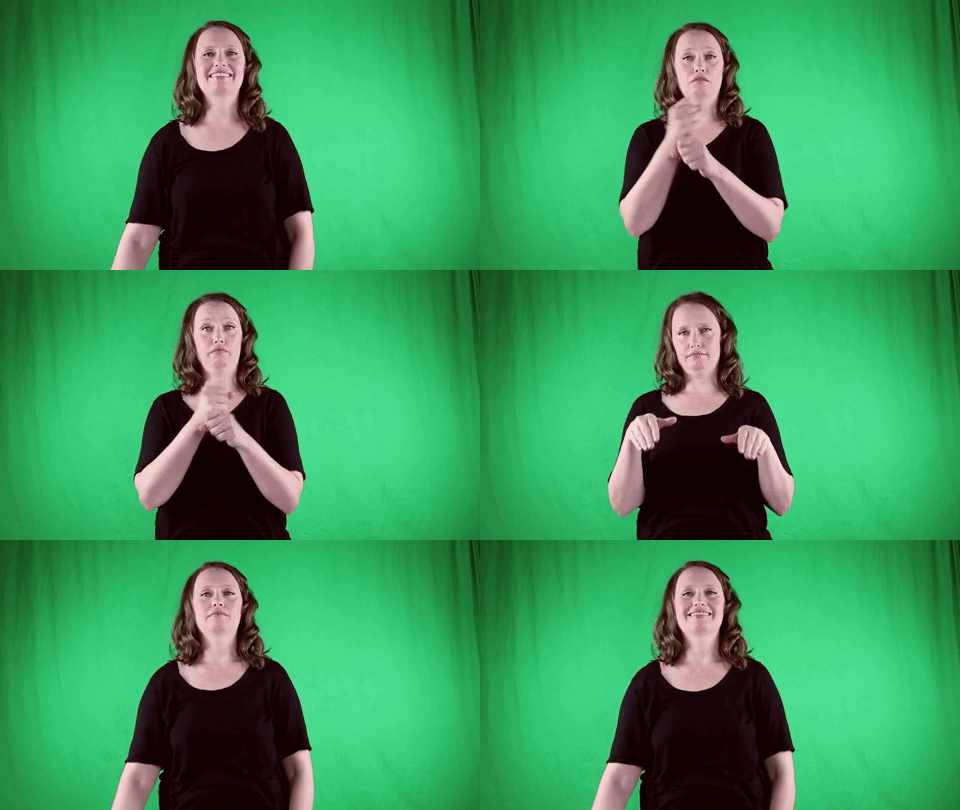
Definition: A place for coffee.
Sign for COFFEE HOUSE in ASL

Practice Activities:
To get comfortable with the sign for COFFEE HOUSE in ASL, start by practicing the sign in isolation. Use a mirror to watch your handshape and movements, ensuring smooth transitions between the sign for COFFEE and the sign for HOUSE. Repeat the sign slowly, then gradually increase speed while maintaining clarity.
Next, try including the sign for COFFEE HOUSE in ASL within simple sentences. Practice signs like “I go to the coffee house weekly,” or “My friend works at a coffee house.” Use these sentences to build fluency and reinforce understanding of vocabulary in context.
Create a daily routine video using ASL and include going to a coffee house as part of your day. For example, sign “Every morning, I stop at the coffee house before work.” This helps integrate the vocabulary naturally into your expressive skills.
Engage in partner practice sessions where one person signs a short dialogue involving a coffee house experience. The other person watches and responds appropriately. Example prompts include ordering a drink, meeting a friend at the coffee house, or studying there with classmates.
Storytelling exercises are particularly helpful. Create a narrative about an imaginary visit to a new coffee house in your neighborhood. Include signs for drinks, interactions with staff, seeing friends, and choosing a seat.
To make it fun, play a sign-and-guess game where one person signs a situation related to a coffee house and the other guesses what they are describing. Encourage use of classifiers to describe the layout and atmosphere of the place.
Finally, take a short field trip to an actual coffee house and record yourself signing what you see and do. Identify the name of the location, what you order, and who you’re with—all using signs, including the sign for COFFEE HOUSE in ASL.
Cultural Context:
In Deaf culture, the sign for COFFEE HOUSE in ASL reflects more than just a place to enjoy a drink. It represents a social hub where members of the Deaf community gather to communicate, connect, and share stories using American Sign Language. These spaces are often informal yet deeply meaningful to those who value Deaf identity.
Using the sign for COFFEE HOUSE in ASL helps show a shared understanding of a community-oriented place. Coffee houses are frequently chosen for Deaf meetups, interpreting events, and ASL poetry nights. The setting supports open communication in ASL and is often hearing-friendly as well, with minimal background noise and good lighting—perfect for visual language.
The ASL sign for COFFEE HOUSE combines two individual signs: coffee and house. The sign for coffee involves a motion that mimics the grinding of beans, while house is signed by outlining the shape of a house with your hands. When expressing the sign for COFFEE HOUSE in ASL, these signs may be either produced one after the other or smoothly blended together, depending on context.
Cultural significance plays a big role in how the sign for COFFEE HOUSE in ASL is used. Deaf individuals often choose coffee houses not just because of convenience, but because these places can easily transform into bilingual environments. This makes them popular venues for ASL learners and native users alike to interact in real-life situations.
Coffee houses linked to Deaf culture may also serve as event spaces for small performances or Deaf artist exhibitions. In these environments, using the sign for COFFEE HOUSE in ASL becomes an act of cultural affirmation. It tells others that the space is not only Deaf-friendly, but actively welcoming of Deaf culture and language.
ASL users often refer to specific coffee houses with local Deaf significance using the sign for COFFEE HOUSE in ASL as part of place-based storytelling. These locations might already have rich histories tied to the community, such as regularly scheduled silent suppers or Deaf group discussions. For some, the sign becomes a shorthand reference to a trusted meeting point.
Learning the sign for COFFEE HOUSE in ASL can help non-Deaf people gain better access to Deaf spaces. It also signals respect for ASL as a language and for the social experiences of its users. More than a functional term, the sign for COFFEE HOUSE in ASL holds community value and encourages more inclusive public interactions.
In many cities, references to the sign for COFFEE HOUSE in ASL are shared
Extended Definition:
The sign for coffee house in ASL combines two concepts: COFFEE and HOUSE. To express the full meaning clearly, signers typically use the sign for COFFEE first, followed by the sign for HOUSE. Each sign is done separately, but placing them together helps describe the specific type of place being talked about.
To sign COFFEE, place your dominant hand in an “S” shape and grind it over the fist of your non-dominant hand. This mimics the motion of grinding coffee beans, a common and easily recognized gesture in ASL. This sign is widely used across the Deaf community and is understood as referring to the drink or anything related to coffee.
The sign for HOUSE is created by outlining the shape of a house in the air. Place your open hands together in a triangle shape to show the roof, then move them downward and apart to represent the walls. This visual representation is simple and intuitive, used often in ASL when talking about buildings or dwellings.
When you put the two together, the sign for coffee house in ASL becomes both literal and functional. It tells the viewer that the place serves coffee and is a standalone building or enclosed space, like a café or coffee shop. It conveys not just what is being served, but also gives a clue about the environment.
In casual signing, some people might follow up with additional context depending on whether they’re referring to a local café, a large coffee chain, or a particular cultural space. If you’re talking about a specific place, you can fingerspell the name right after signing coffee house. This helps personalize the reference and make your meaning extra clear.
It’s worth noting that signing styles and preferences may vary slightly by region or community. However, the basic structure of signing COFFEE followed by HOUSE remains widely acceptable and understood. It’s a common phrase used in everyday ASL conversation, especially when making plans or sharing recommendations.
Learning the sign for coffee house in ASL adds a practical term to your vocabulary. It’s useful when discussing favorite spots, meeting friends, or recommending a place. The familiar imagery of grinding coffee and drawing a home’s shape makes the sign easy to remember
This compound sign also reflects how ASL often builds complex ideas from simpler ones. By learning how to combine basic signs like COFFEE and HOUSE, learners start to gain a better grasp of how the language works. It strengthens both comprehension and expressive skills in conversations.
For students of ASL and those
Synonyms: café, coffee shop, java house, espresso bar, coffee bar
Educational resources: Find related learning materials in our course bank!
Want more? Check out some of our popular learning activities on the homepage!
Need to look up a sign? Use our highly rated dictionary: https://aslinteractive.com/best-asl-dictionary/
Follow us on tiktok: https://www.tiktok.com/@aslinteractive. More social media links at the bottom of this page!
Long-tail Keywords: What is the sign for Coffee House in ASL, How do you sign Coffee House in ASL, ASL sign for Coffee House
Categories:
tags: Coffee, Activities, Facilities and other locations/needs, Language Learning, Everyday activities
Parameters
*Handshape*:
The handshape for the sign for COFFEE HOUSE in ASL combines two distinct signs. For COFFEE, both hands use the “S” handshape, with the dominant hand grinding on top of the non-dominant hand, mimicking a coffee grinder ☕. For HOUSE, both hands open flat with fingers together and form the shape of a house roof and walls by outlining a triangle and then moving downward.
In the sign for COFFEE HOUSE in ASL, the transition between the two signs is smooth, with a clear distinction between the circular grinding motion of the “S” hands and the structured straight lines formed by the “B” handshapes in the HOUSE portion. This sign is a compound, combining the two concepts into a fluid motion that accurately represents a coffee house.
*Palm Orientation*:
In the sign for COFFEE HOUSE in ASL, the dominant hand forms an “S” shape and circles on top of the non-dominant “S” hand, mimicking a grinding motion. The palms are oriented downward and slightly inward toward each other during this gesture.
When transitioning to the HOUSE sign portion, both hands form flat “B” shapes with palms facing each other and fingers pointing forward. The hands outline a roof and walls to indicate a house . Together, the palm orientation helps visually represent the sign for COFFEE HOUSE in ASL.
*Location*:
The sign for COFFEE HOUSE in ASL takes place primarily in front of the chest area. For the COFFEE portion, both fists are brought together at chest level, with the dominant hand circling on top of the non-dominant hand, as if grinding coffee beans. ☕
To complete the sign for COFFEE HOUSE in ASL, the HOUSE portion is signed by shaping the hands like flat palms and outlining a roof and walls in front of the torso. This compound sign stays in the neutral signing space near the center of the body.
*Movement*:
To make the sign for COFFEE HOUSE in ASL, start by forming both hands into the letter “S” handshapes. Rub the dominant “S” hand in a circular grinding motion on top of the non-dominant “S” hand, mimicking a coffee grinder. ☕
Next, immediately transition into the sign for HOUSE by bringing your open hands with fingers together in a peak formation, as if outlining the roof of a house, and then move straight down to show the sides. The sign for COFFEE HOUSE in ASL combines these motions smoothly to represent both concepts.
*Non-Manual Signals*:
When signing the sign for COFFEE HOUSE in ASL, maintain a neutral or slightly content facial expression, suggesting a relaxed or casual environment typically associated with a coffee house ☕. Slight eyebrow raises can convey interest or engagement, especially when referencing a specific location or inviting someone.
The non-manual signals help emphasize the casual tone and setting related to the sign for COFFEE HOUSE in ASL. Keep your eyes focused on your conversational partner or the signing space to support clarity and intention.
*Prosody, Dominant/Non-Dominant Hand*:
The sign for COFFEE HOUSE in ASL uses both hands. The dominant hand is in the “S” handshape, grinding in a small circular motion on top of the non-dominant hand, also in an “S” handshape, mimicking a coffee grinder ☕. Then, sign HOUSE by shaping both hands flat and together to form the roof and walls of a house .
When using the sign for COFFEE HOUSE in ASL, the dominant hand leads in both the COFFEE and HOUSE components. The non-dominant hand supports positioning and structure, especially for depicting the roof and foundation of a house. The flow remains consistent with right-hand dominance unless the user is left-handed.
Tips for Beginners:
When learning the sign for COFFEE HOUSE in ASL, it’s helpful to break it down into two separate signs: COFFEE and HOUSE. The sign for COFFEE uses both “S” handshapes, representing grinding coffee beans. Place the bottom “S” hand at chest level, then rotate the top “S” hand on top of it as though you’re grinding. Keep your movements steady and circular for clarity.
HOUSE is signed by using open “B” hands to trace the outline of a house. Start with your fingertips touching overhead, then move both hands downward and out to form the sides of the house. Make sure the movement is smooth and not rushed. When putting the signs together to form the sign for COFFEE HOUSE in ASL, sign COFFEE first, followed by HOUSE. This keeps the semantic order clear and mirrors English word order, which can be helpful for beginner learners.
One tip for mastering the sign for COFFEE HOUSE in ASL is to focus on the rhythm and spacing of each component. Don’t blend the signs into one movement. Clearly separate COFFEE from HOUSE so your meaning is easy to understand. Practice each sign individually before combining them.
A common pitfall is making the grinder movement in COFFEE too small or too big. Aim for a natural rotation, not exaggerated. For HOUSE, fingers that don’t meet at the top or uneven arm movement can make the shape unclear. Use a mirror to check your form and hand alignment.
Another practical way to use the sign for COFFEE HOUSE in ASL accurately is to watch native signers on videos or in real life. Observe their speed, clarity, and transitions. Repetition and consistency will help boost confidence and fluency, especially in everyday conversations ☕
Connections to Other topics:
The sign for COFFEE HOUSE in ASL connects directly to the concept of compound signs, where two individual signs—COFFEE and HOUSE—are combined to convey a single idea. These compounds help users communicate more efficiently, which is a common feature in many ASL phrases and locations. The sign draws from basic vocabulary often taught to beginners, making it useful for building more complex expressions.
The base sign COFFEE involves a mime-like gesture that resembles an old-fashioned coffee grinder, showing how ASL often draws from visual and experiential metaphors. HOUSE, on the other hand, uses outlining gestures to suggest the shape of a home. When combined, the sign for COFFEE HOUSE in ASL becomes both a cultural and linguistic expression, highlighting how location names often become compound constructions in ASL.
This compound sign shares similarities with others like BOOKSTORE, combining BOOK and STORE, or RESTAURANT + LOCATION, reinforcing location-specific vocabulary in ASL. Learners benefit from recognizing patterns in these compound forms, which enhances receptive skills and expressive fluency across a range of everyday topics. Understanding how signs like COFFEE HOUSE are constructed supports a deeper grasp of how ASL handles space and meaning.
Contextually, the sign for COFFEE HOUSE in ASL may be used in discussions about meeting places, work environments, or social settings. This placement also makes it valuable vocabulary for narratives or dialogues involving community, travel, and recreation. Since coffee houses often serve as informal centers for conversation, the sign may also appear in storytelling or theatrical ASL performances.
Additionally, this sign complements other topic areas like FOOD/DRINK, SOCIAL SPACES, and COMMUNITY. Pairing COFFEE HOUSE with signs for FRIEND, MEET, or CHAT further showcases how ASL captures nuanced interactions with limited vocabulary. Learning to sign COFFEE HOUSE fluently builds a foundation for broader understanding of signing about locations and daily routines.
Summary:
The sign for COFFEE HOUSE in ASL is a compound that combines two separate signs to express a single concept. It begins with the sign for COFFEE, followed by the sign for HOUSE. Each component carries its own meaning, but together, they communicate a culturally rich idea in Deaf communities.
To produce the sign for COFFEE, both hands are formed into the letter “S” handshapes. The dominant hand grinds over the top of the non-dominant hand in a circular, downward motion, replicating the action of turning a manual coffee grinder.
The sign for HOUSE follows by outlining the shape of a roof with both flat hands touching at the fingertips. The motion continues downward, outlining the walls of an imaginary house in front of the signer.
When the sign for COFFEE HOUSE is combined, the signer performs each sign in sequence without blending them into one single sign. This reflects how compound nouns often function in ASL—by preserving the integrity of each individual sign but maintaining a fluid transition between them.
The sign for COFFEE HOUSE in ASL refers to more than just a physical location where coffee is served. It encapsulates a communal space, often used within the Deaf community as a social hub. This cultural nuance adds layered meaning to an otherwise straightforward lexical concept.
Within Deaf culture, communal spaces like a coffee house serve as informal gathering spots where Deaf individuals can talk, socialize, attend events, or even participate in storytelling and poetry nights. The sign for COFFEE HOUSE in ASL evokes a place much more vibrant than just a drink-serving shop.
The fluidity of the compound mirrors the grammatical structure found in ASL where nouns can be formed by combining ideas. Using classifiers, location markers, and facial expressions, a signer can further enrich the context of a sign like COFFEE HOUSE depending on usage.
One of the challenges in learning the sign for COFFEE HOUSE in ASL lies in its spatial depiction. The hands mimic the physical shape of a house, and spatial cognition supports understanding linguistic input through visual movement.
Grammatically, this sign functions as a noun. Still, it can become part of larger sentence structures involving verbs like GO, MEET, LOVE, or STUDY, forming phrases like “I GO COFFEE HOUSE OFTEN” or “WE MEET COFFEE HOUSE WEEKLY.”
Pronunciation in ASL relies heavily on handshape, movement, palm orientation, location, and non-manual signals. For COFFEE HOUSE, precision in finger tension during the “grinding” motion and spatial accuracy in the house shape are essential for clarity.
The sign for COFFEE HOUSE in ASL shares lexical relationships with signs like CAFE, RESTAURANT, and BAR. Each has its own unique sign and carries different connotations, but the grammatical principles behind constructing compound signs remain consistent.
Culturally and linguistically, signing COFFEE HOUSE may carry implications about preferred gathering places in the Deaf community. The sign reflects sociological patterns where language and space intersect to create meaningful hubs of interaction.
From an applied linguistics perspective, COFFEE HOUSE in ASL highlights the embodied nature of sign languages. Language is not just auditory-verbal, but visual-gestural, rooted in handshapes and movement through space to convey meaning.
Learning to sign COFFEE HOUSE helps new ASL users understand how compound signs work and how cultural context influences meaning. It can also be a gateway into discovering Deaf community customs and using ASL appropriately in social settings.
In regional variations, some signers might fingerspell C-O-F-F-E-E H-O-U-S-E for emphasis or clarity, particularly when referencing a specific establishment name. Fingerspelling can be used to supplement or specify proper nouns within ASL syntax.
While the base of the sign remains relatively standard, experienced signers may adjust fluency, pacing, and even facial expressions based on conversational tone or narrative context. Thus, the sign for COFFEE HOUSE in ASL is rich in both gestural structure and emotional nuance.
Students of ASL might find practicing the sign in front of a mirror helpful for refining movement and handshapes. It is also important to seek feedback from native ASL users to develop precise and culturally appropriate signing for COFFEE HOUSE.
ASL literature, including plays and poetry, sometimes references communal spaces like coffee houses as settings for interaction, learning, and drama. The sign provides not only lexical value but also thematic resonance in storytelling.
Using the sign for COFFEE HOUSE in ASL can be a springboard to deeper conversations about Deaf spaces, accessibility, and linguistic identity. These locations symbolize autonomy and community for Deaf individuals.
In interpreting, the sign for COFFEE HOUSE must align with both the linguistic and cultural context of the conversation. Certified interpreters consider audience familiarity with Deaf culture when choosing between depicting the sign or fingerspelling it.
Deaf coffee house events, often advertised online
Want more? Check out some of our popular learning activities!
ASL Interactive Resources
ASLInteractive YouTube Channel
Follow us on tiktok: @aslinteractive.com
Follow us on Instagram: aslinteractive
Facebook page: aslinteractive
Facebook group: aslinteractive
LInkedIn: ASL Interactive LLC
Twitter: @ASL_interactive
*Some information on this page is AI-generated. AI can make mistakes. Please check the information.


Responses