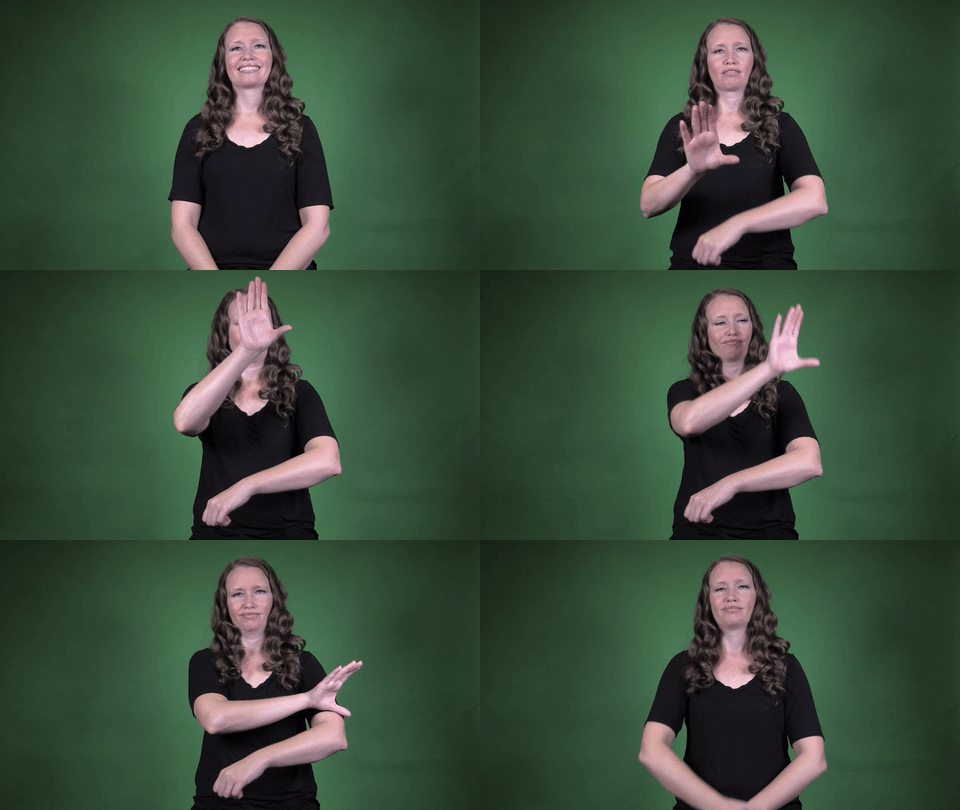
Sign for COLORADO in ASL | 🌄 ASL Dictionary

Definition: Colorado: A U.S. state known for the Rocky Mountains, outdoor activities, and vibrant cities like Denver and Boulder.

Sign for COLORADO in ASL

YouTube player

Practice Activities:

To build familiarity with the sign for COLORADO in ASL, begin by practicing it in isolation. Use a mirror or video recording to self-check the handshape, movement, and accuracy. Repeat the sign slowly at first, then gradually increase your speed to mimic natural signing. Practice alternating it with other state name signs to reinforce recognition and fluency.

Develop confidence by using the sign for COLORADO in ASL within short, everyday phrases. Examples include: “I visited COLORADO last summer,” “My friend lives in COLORADO,” or “Have you been to COLORADO?” Practice signing these slowly, then try signing them fluidly without pausing. Incorporating time signs and question words will help form complete sentences in ASL grammar.

Create a storytelling prompt where COLORADO plays a central role. For instance, tell a story about traveling to COLORADO, visiting the mountains, or going skiing. Include descriptive signs like MOUNTAIN, NATURE, SNOW, and CAMP. Practice telling the story to a partner or in a video to build expressive skills and narrative flow.

Join with a partner or learning group and take turns asking each other questions using the sign for COLORADO in ASL. Questions might include “Do you want to go to COLORADO?” or “What do you like about COLORADO?” This encourages spontaneous use of the sign within dialogue and supports receptive practice too.

Add regional or cultural vocabulary associated with COLORADO such as DENVER, ROCKY MOUNTAINS, and HIKING. Create a short weather report about COLORADO or a travel advertisement that includes multiple signs related to geography and activities.

End practice with a receptive drill by watching videos of others using the sign for COLORADO in ASL in context. Try to identify it accurately and interpret the full message. Recreate what you’ve seen to improve recall and muscle memory.

Cultural Context:

The sign for COLORADO in ASL is more than just a name; it reflects a unique place with a vibrant history and culture. In American Sign Language, signs for state names often carry cultural significance, and the sign for COLORADO in ASL is no different. It may connect to the state’s famous features like mountains, colors, or even historical aspects of the region.

Understanding the sign for COLORADO in ASL also means appreciating how Deaf communities across the United States mark geographic identity. Signs for each state evolve through community use, and the sign for COLORADO in ASL has developed in a way that reflects Colorado’s prominence and recognition among Deaf signers. Respecting these sign choices supports Deaf culture and language ownership.

COLORADO is famous for the Rocky Mountains, ski resorts, and national parks. These cultural and natural markers may influence how the sign for COLORADO in ASL has been shaped. Signs often represent something visually tied to the state, sometimes using the first letter or referencing key imagery known within the Deaf community.

The Deaf community in Colorado is active and strong, centered around schools, local organizations, and events such as Deaf expos or social meetups. Regional signs like the sign for COLORADO in ASL are widely known and used in these spaces. This usage reinforces a sense of belonging and pride among local signers.

Knowing how to sign COLORADO in ASL correctly is essential for cultural respect and effective communication. Whether you’re talking about travel, geography, or current events, using the appropriate sign for COLORADO in ASL helps ensure your meaning is clear and inclusive. For Deaf and hearing learners alike, accurate place-name signs show that you’re building awareness of ASL as a living language.

Some variations may exist for the sign for COLORADO in ASL, depending on the user’s location or community background. However, the most widely accepted version is usually taught in classrooms and used in media or interpreted events. Always observe how native ASL users sign COLORADO in conversation for the most culturally accurate version.

The visual nature of ASL means that many signs carry aesthetic connections to their meanings. In this way, the sign for COLORADO in ASL might echo the state’s association with color, landscape, or abbreviation. These layers make the sign both practical and artistically meaningful within ASL storytelling.

When interpreting or translating between English and ASL, consistently using signs like COLORADO in ASL maintains fluid communication. ASL users often include many place names in news updates,

Extended Definition:

The sign for COLORADO in ASL can vary depending on the region or context, but one commonly accepted version uses movements and handshapes that resemble the shape of the state or represent its cultural features. When learning the sign for COLORADO in ASL, it’s important to understand regional diversity and be open to local variations.

In one common version, the sign begins with the hand forming the letter “C” from the ASL alphabet and then making a small movement outward, mimicking the structure or outline of the state. Some people also incorporate elements similar to the sign for “color” or even signs that reference Colorado’s famous mountains. Depending on the signer’s background or where they learned ASL, the exact sign might differ slightly, so context and location matter greatly.

ASL often incorporates visual representations and classifiers to create meaning, and the sign for COLORADO in ASL is no different. It can take inspiration from well-known aspects of the state like the Rocky Mountains or the state’s diverse landscape. Sometimes, fingerspelling may be used, especially if the signer wants to be very specific or if the regional sign is not well known.

If someone uses fingerspelling for COLORADO in ASL, they will spell out each letter of the state’s name with clear, deliberate motions. This is a useful fallback if you’re unsure whether the other person is familiar with a particular regional sign. It helps maintain clarity, especially in formal or educational settings, or when communicating with new learners.

When searching for the sign for COLORADO in ASL, it’s helpful to view video demonstrations for better accuracy. Seeing a fluent signer perform the movement provides more detail on handshape, location, and direction. Although written descriptions help, ASL is a visual language, and the sign for COLORADO in ASL is best learned through visual practice.

Educators and students who use ASL in classroom settings might encounter different versions depending on their geographic location. In ASL classes, teachers often explain that the sign for a place like COLORADO might not be universally standardized. This is typical of place-name signs across the country, where regional identity and community norms influence what signs are commonly used.

When teaching or learning the sign for COLORADO in ASL, cultural awareness also plays a big part. ASL is deeply rooted in Deaf culture, and signs for locations often reflect shared cultural references known within regional Deaf communities. A sign may originate from how a place looks or what it’s known for, like snow, cliffs

Synonyms: Colorado, CO, Colo, Coloradans, Centennial State

Educational resources: Find related learning materials in our course bank!

Want more? Check out some of our popular learning activities on the homepage!

Need to look up a sign? Use our highly rated dictionary: https://aslinteractive.com/best-asl-dictionary/

Follow us on tiktok: https://www.tiktok.com/@aslinteractive. More social media links at the bottom of this page!

Long-tail Keywords: what is the sign for Colorado in ASL, how do you sign Colorado in ASL, Colorado ASL sign meaning

Categories:

tags: Colorado in American Sign Language, how to sign Colorado in ASL, ASL signs for Colorado, learning Colorado in ASL, Colorado state sign in ASL

Parameters

*Handshape*:

The handshape for the sign for COLORADO in ASL typically starts with the fingerspelled form of the state name, using the dominant hand to spell C-O-L-O. Each letter is produced using standard ASL fingerspelling handshapes, like the open “C” hand for C and an “O” hand for O.

Some variations of the sign for COLORADO in ASL transition from the fingerspelling into a sweeping motion of a modified “B” hand along the shoulder, mimicking a sash. This version uses a flat hand to indicate geographical or cultural symbolism. Both forms incorporate clear, distinct handshapes to ensure accuracy when signing.

*Palm Orientation*:

For the sign for COLORADO in ASL, the palm orientation begins with the dominant hand in a “C” handshape, touching the shoulder. The palm faces inward toward the body, specifically toward the shoulder when initiating the sign.

As the sign for COLORADO in ASL progresses, the hand moves down and away from the body while changing into an open “5” shape. During this motion, the palm also shifts orientation slightly to face forward or outward, depending on the signer’s style.

*Location*:

The location for the sign for COLORADO in ASL typically begins near the dominant side of the upper chest or shoulder area. This is where the movement starts if using the variation that combines the sign for COLOR plus the fingerspelled portion of “DO.”

When fingerspelling the word completely, the sign is produced in the neutral space in front of the torso, at chest height. The sign for COLORADO in ASL is clear and easily seen when presented in this central space, ensuring visibility and clarity.

*Movement*:

To produce the sign for COLORADO in ASL, start by fingerspelling the abbreviation “CO” using the dominant hand. Form the letter “C,” followed seamlessly by the letter “O,” in a small, smooth arc near the upper chest or slightly outward.

Sometimes, the full state name is fingerspelled for clarity, especially in formal or geographic contexts. The sign for COLORADO in ASL emphasizes accuracy in handshape and fluid movement, making it easily understood by native users. ️

*Non-Manual Signals*:

The non-manual signals for the sign for COLORADO in ASL are typically neutral, with a natural facial expression. There’s no exaggerated emotion unless additional context demands it, such as pride or enthusiasm about the state.

Your eyebrows stay relaxed, and your mouth remains closed or slightly open in a neutral shape. When using the fingerspelled version, keep eye contact and a steady head position to clearly support clarity. For accuracy, pair the non-manual cues correctly with the fingerspelling or regional variation of the sign for COLORADO in ASL.

*Prosody, Dominant/Non-Dominant Hand*:

The sign for COLORADO in ASL typically begins with the dominant hand forming the fingerspelled letters C-O-L-O. The hand moves in a slight arc from near the shoulder outward, showing clear finger transitions.

After the FS portion, some signers may follow with the sign for STATE, where the dominant flat hand brushes downward along the side of the non-dominant fist. This combination reflects both the abbreviation and geographic reference in the sign for COLORADO in ASL.

Tips for Beginners:

The sign for COLORADO in ASL is commonly done by fingerspelling the state’s abbreviation “CO” or spelling the full name depending on context. Beginners should start by practicing fingerspelling fluency, especially the smooth transition between “C” and “O.” These two letters involve very different handshapes, so it helps to isolate each letter and drill it slowly, then increase speed with accuracy.

When fingerspelling the full sign for COLORADO in ASL, it’s essential to maintain consistent palm orientation and clear hand placement. Beginners often shift the position of their hand or rotate their wrist when spelling rapidly, which can confuse the viewer. Keep your palm oriented slightly outward and your hand at shoulder level to maintain visibility and natural flow.

One common pitfall for beginners when using fingerspelling for the sign for COLORADO in ASL is running the letters together too quickly. This can distort the handshapes and make the word unreadable. Slowing down and enunciating each letter with proper form builds muscle memory and leads to better recognition and clarity. Practicing with a mirror or video feedback is a great way to self-correct.

Facial expressions are not heavily involved in the sign for COLORADO in ASL since it’s fingerspelled, but maintaining a calm and focused face helps with overall communication etiquette in ASL. Knowing when to fingerspell “CO” versus spelling out “COLORADO” depends on regional norms and audience familiarity. Use “CO” for quick references in signing with advanced audiences, but spell out the full state name when introducing or clarifying.

Consistent practice with fingerspelling drills will build confidence. Use online fingerspelling games or apps to increase speed while watching for clarity. The more often you practice the sign for COLORADO in ASL in everyday conversations, the easier it will become to produce naturally.

Connections to Other topics:

The sign for COLORADO in ASL often connects directly to the more general sign for STATE or utilizes a specific reference to local culture, such as depicting the abbreviation CO or referencing COLOR, then STATE. This layered structure demonstrates how signs for U.S. states frequently draw from geographical abbreviations or cultural identifiers, which also appears in signs like TEXAS and UTAH. Learners who understand this pattern can better anticipate or remember signs for less familiar regions.

In the context of place names, the sign for COLORADO in ASL may be informed by or related to signs for cities within the state, like DENVER or BOULDER. These are commonly fingerspelled but may also feature initialized signs in informal speech, especially within regional dialects. Understanding these geographic links helps signers contextualize locations and associate signs with visual and cultural elements specific to the state.

Compound signs using the sign for COLORADO in ASL can occur in phrases like COLORADO SPRINGS or COLORADO RIVER. In these cases, the signer may either fingerspell part of the name or pair the state sign with classifiers indicating geographic features like rivers, mountains, or springs. This lays a foundation for describing natural landscapes using directional and spatial classifiers in ASL.

The sign for COLORADO in ASL also links to vocabulary related to outdoor activities ⛷️, weather ❄️, or tourism ️, often associated with the state. For example, combining the sign for COLORADO with signs for SKI or MOUNTAIN creates context-specific meaning that enhances storytelling or casual conversation. Recognizing how regional signs integrate into broader vocabulary allows learners to build more fluid and expressive signing skills.

Because ASL reflects culture and environment, signs like COLORADO carry deeper meaning tied to how people conceptualize places. This connection strengthens narrative strategies in ASL and encourages learners to think holistically about how location-based signs enrich communication.

Summary:

One common way to show the sign for COLORADO in ASL is by fingerspelling the abbreviation “CO.” This version is most often used in geographical or formal contexts, such as writing addresses or referring to state names in legal settings. The letters C and O are signed clearly and with emphasis, ensuring the viewer recognizes the fingerspelled word.

There is also a more visual sign for COLORADO that draws from the word COLOR. In this variation, you sign the color sign by wiggling the fingers of your dominant hand in front of your chin, followed by a movement that mimics a mountainous terrain. This version visually associates the sign with the landscape that defines Colorado.

The visual reference to mountains in this version connects well with Colorado’s identity. The Rocky Mountains are one of the state’s defining features, and this physical landscape often shapes how native signers conceptualize and choose to represent the region. The visual component helps reinforce cultural identity through sign language.

When using the sign for COLORADO in ASL, context matters. In a casual setting, particularly among Deaf Coloradans or those familiar with the region, the iconic sign that blends COLOR and MOUNTAIN may be most appropriate. In contrast, formal or official mentions of the state may still rely on fingerspelling “CO.”

Linguistically, this dual representation provides a rich example of how ASL uses both initialized and iconic signs. The balance between abbreviation and visual representation reflects the flexibility of ASL to adapt to multiple communicative goals. This feature also connects to how regional signs evolve across communities.

The fingerspelled version is linguistically neutral and can be used across dialects. Fingerspelling holds an essential place in ASL, especially for proper nouns like place names. However, iconic versions like the COLOR + MOUNTAIN blend draw from shared visual experiences and foster stronger social and regional ties.

Sign language often integrates geography into its lexicon through depictions based on physical landmarks. The visual sign for COLORADO fits this pattern by connecting the name of the state to its prominent geography. This method exists in many regional signs across ASL and other signed languages.

ASL signs for U.S. states often combine fingerspelling with iconic forms. The sign for COLORADO in ASL exemplifies this hybrid approach, offering a direct way to refer to the state while also expressing meaning through movement and depiction. This allows deeper community associations with the concept.

From a grammatical standpoint, the sign for COLORADO typically functions as a proper noun. It is used in the same sentence locations and with the same syntactic rules as a name or location. For instance, you might use it after verbs such as “live,” “go,” or “visit.”

Facial expressions play a role when using location signs like COLORADO. For example, someone may raise their eyebrows for a yes/no question like “Do you live in Colorado?” The sign integrates naturally into these broader ASL expressions.

Exploring how COLORADO is signed in ASL also shows how regional culture can influence sign language lexicons. The iconic version evokes not just the state’s geography but also its cultural identity as a mountainous and colorful region. Such iconic representations enrich the language and build shared understanding.

Because ASL is a visual language, signs that reflect visual characteristics of real-world referents are often easier to remember and more meaningful. The sign for COLORADO in ASL reflects this through its referential imagery. This creates a memorable cue and reinforces understanding.

In Deaf culture, connecting signs to relevant landmarks is also a way to support Deaf-centric narratives. Instead of relying on print-centric or spoken references, visual stories emerge in ASL that echo the landscape and culture of places like Colorado. These signs become elements of shared storytelling.

The process of deciding between fingerspelling and iconic representation depends on factors like audience, formality, and local norms. Younger signers or newer users might default to “CO” due to its simplicity and recognition. Those more immersed in Deaf culture may feel a stronger draw to the iconic sign.

There’s an educational dimension to teaching the sign for COLORADO in ASL. Because it includes both a visual alternative and a fingerspelled form, language learners gain a deeper understanding of ASL structure. It offers an opportunity to talk about morphology, phonology, and socio-linguistic variation.

In applied linguistics, studies of place name signs like COLORADO reveal insights into language borrowing and code-mixing. Abbreviations mirror written English, while iconic forms borrow from the physical and cultural environment. The blending shows how ASL navigates English dominance while preserving its own identity.

Among native signers, the choice between abbreviations or visual signs often reflects community-level practices. For example, some regional communities may primarily use the mountain plus color sign, while others may have never seen it. These differences offer insights into language change and spread.

Deaf travelers often share signs for places that capture the essence of that location. For this reason,

Want more? Check out some of our popular learning activities!

ASL Interactive Resources

ASLInteractive YouTube Channel

Follow us on tiktok: @aslinteractive.com

Follow us on Instagram: aslinteractive

Facebook page: aslinteractive

Facebook group: aslinteractive

LInkedIn: ASL Interactive LLC

Twitter: @ASL_interactive

*Some information on this page is AI-generated. AI can make mistakes. Please check the information.

Sign for COLORADO in ASL

Responses