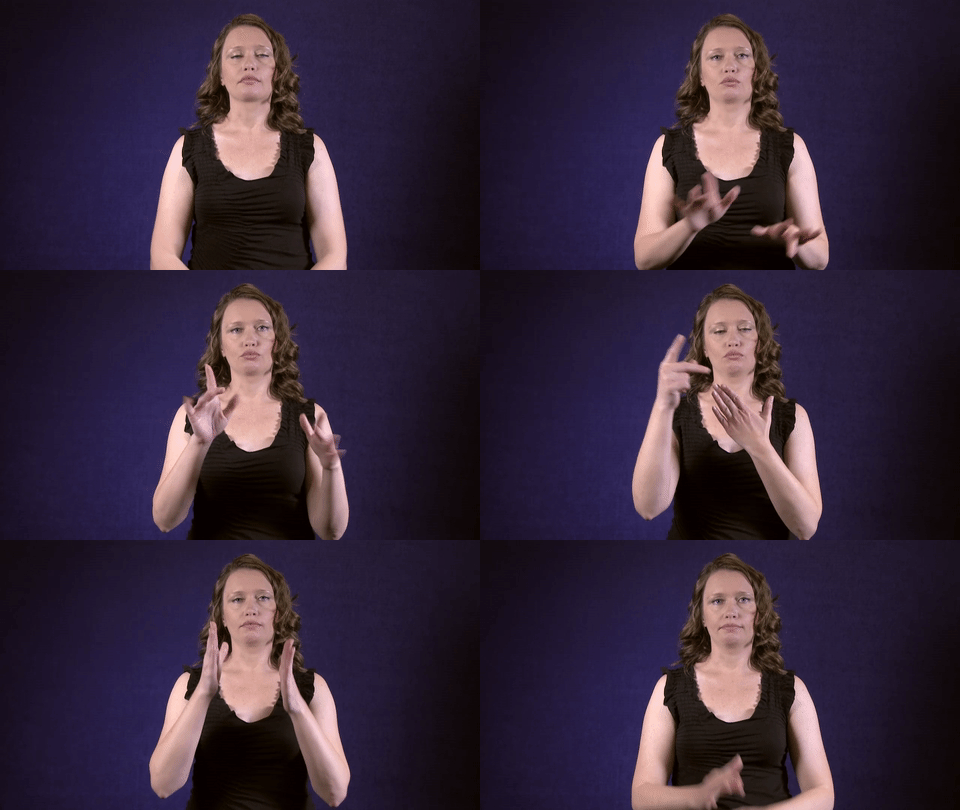
Definition: A computer programmer.
Sign for COMPUTER PROGRAMMER in ASL

Practice Activities:
Start by practicing the sign for COMPUTER in isolation. Use a flat dominant hand in a “C” shape and circle it near the forehead. Repeat several times while saying the word softly to connect sound with motion. Then practice the sign for PROGRAMMER by combining the sign for COMPUTER with the agent marker, made by sliding both flat hands downward in parallel. Do each part separately before putting them together to master the complete sign for COMPUTER PROGRAMMER in ASL.
Practice the full sign in a mirror to self-correct hand shape and movement. Once confident, say example sentences like “My sister is a COMPUTER PROGRAMMER” or “I want to become a COMPUTER PROGRAMMER” while signing. These sentences give helpful context and reinforce fluency when combining the sign with other vocabulary.
Try a storytelling practice by describing a day in the life of a COMPUTER PROGRAMMER. Use signs like WORK, TYPING, MEETING, and THINK to create a short story. This builds your confidence using the sign for COMPUTER PROGRAMMER in ASL and linking it with related signs used in conversation.
Engage in a partner activity by introducing yourself and then giving your job as a COMPUTER PROGRAMMER. Then take turns playing roles where one partner describes computer-related tasks while the other guesses the profession. This interactive practice strengthens comprehension and expressive skills.
Create flashcards with different professions and randomly pick one to sign. When you draw COMPUTER PROGRAMMER, sign it clearly and have your partner guess it. This exercise makes learning fun and aids in memorization. Add speed drills by timing how fast you can correctly sign COMPUTER PROGRAMMER after a prompt. Over time, increase sentence complexity to continue building your expressive language skills using the sign for COMPUTER PROGRAMMER in ASL.
Cultural Context:
The sign for computer programmer in ASL reflects both the evolving nature of technology and the rich linguistic creativity of the Deaf community. In American Sign Language, signs often combine ideas or functions to express complex concepts, and the term computer programmer is a perfect example of that. This sign blends elements related to computing with signs related to creating or constructing software.
Understanding the cultural significance behind the sign for computer programmer in ASL means exploring how Deaf professionals participate in today’s digital world. As more Deaf individuals pursue careers in software engineering and coding, the language adapts to include career-specific signs. The growth of the tech industry has created new opportunities and terms that the Deaf community has embraced, leading to more nuanced signs rooted in commonly used ASL structures.
ASL is a visual language driven by clarity and efficiency, so the sign for computer programmer in ASL naturally emphasizes function. When you sign computer programmer, the focus is not just on the technology itself but also on the person’s skill in writing and developing code. Each part of the sign highlights core ideas: the digital tools used and the programmer’s creative input.
For many Deaf tech professionals, using the sign for computer programmer in ASL creates a strong sense of identity within both the Deaf and tech communities. It allows people to communicate their profession clearly in ASL without relying on fingerspelling long English terms. This sign has become more common in educational, professional, and training settings, where visual language and technical concepts intersect.
As the number of Deaf students entering STEM grows, so does the demand for standardized signs like the sign for computer programmer in ASL. Teachers and interpreters frequently use this sign during lessons focused on coding, web development, and IT principles. Having a consistent, culturally appropriate sign helps support accessibility in technical fields and ensures that Deaf students can fully engage with the content.
Deaf programmers and coders often share videos and tutorials using the sign for computer programmer in ASL, allowing others to see how it functions in context. These peer-created materials contribute to the richness of ASL and support the development of specialized vocabulary that reflects real-life usage. Many of these signs emerge organically from the community and are later adopted widely.
The evolution of the sign for computer programmer in ASL also shows how language and culture are deeply connected. It demonstrates that ASL grows naturally as the community’s interests and professional fields grow. This adaptability ensures that ASL remains relevant and fully expressive in modern society.
In professional environments, using the sign for computer programmer in
Extended Definition:
The sign for computer programmer in ASL combines two key ideas: computer and programmer. In American Sign Language, complex professions like this often use a combination of conceptual and occupational signs to communicate the full meaning. Understanding this sign gives insight into both technology-related vocabulary and job titles in ASL.
To sign computer in ASL, you generally use a sign that involves one hand moving in a circular motion near the side of the head or signing the letter “C” while tapping it near the forehead. This mimics the idea of computing or thinking, which connects well with the function of a computer. There are a few regional variations, but this version is widely understood across the ASL community.
The sign for programmer builds on the technology concept by combining the sign for code or coding with the person marker. The sign for code often uses scanning or writing handshapes that show data input or output. Then, to indicate that it’s a person, you add the person classifier. When combined, the full sign for computer programmer in ASL is both descriptive and easy to understand through context.
Facial expressions and body language help clarify the intention behind the sign for computer programmer in ASL. Because this profession involves specific skills and tools, showing seriousness or attention while signing adds more meaning. ASL is a visual language, so details like expression and motion really matter.
In practice, signing computer programmer may also be accompanied by finger spelling, especially in formal or educational settings. Deaf professionals in tech commonly use this full sign when describing their job role. Since the field of technology is always evolving, ASL communities often adapt and update their signs for new roles and concepts.
It’s useful to be familiar with the sign for computer programmer in ASL whether you’re interpreting, learning ASL for professional communication, or building vocabulary for everyday use. Knowing how to express different jobs expands your ability to describe people and roles in settings like schools, workplaces, and social events.
At tech conferences and in the workplace, being able to quickly sign computer programmer in ASL supports clearer interaction with Deaf individuals. This sign is also useful for ASL students aiming to learn vocabulary related to STEM careers. Adding tech job signs to your learning limits helps create a more inclusive environment.
Understanding the sign for computer programmer in ASL is also helpful when teaching or learning coding in Deaf education programs. It connects language learning with career preparation and helps students visualize their potential future careers. The combination of specific concept signs with occupational endings in ASL offers a
Synonyms: coder, software developer, software engineer, programmer, application developer
Educational resources: Find related learning materials in our course bank!
Want more? Check out some of our popular learning activities on the homepage!
Need to look up a sign? Use our highly rated dictionary: https://aslinteractive.com/best-asl-dictionary/
Follow us on tiktok: https://www.tiktok.com/@aslinteractive. More social media links at the bottom of this page!
Long-tail Keywords: what is the sign for computer programmer in ASL, how do you sign computer programmer in ASL, computer programmer sign language interpretation
Categories:
tags: Computer Programmer, Language Learning, Activities, Employment Status, Technology
Parameters
*Handshape*:
The handshape for the sign for COMPUTER PROGRAMMER in ASL begins with both hands using the letter C handshape to represent “computer.” The dominant hand, in a C shape, moves downward along the forearm of the non-dominant arm, which is held horizontally.
Next, the sign transitions to the agent marker to show “programmer.” For this part, both hands change to open flat hands (B handshapes) and move downward in parallel, indicating a person. The sign for COMPUTER PROGRAMMER in ASL clearly combines the concepts of technology and professional role.
*Palm Orientation*:
For the sign for COMPUTER PROGRAMMER in ASL, the palm orientation changes between the two components of the compound sign. During the sign for COMPUTER, the dominant hand typically faces inward or downward depending on the regional variation, with the movement occurring near the forearm. When transitioning to PROGRAMMER, which incorporates the sign for PROGRAM followed by a person classifier, the hands generally face inward, with both palms parallel to the body as they move downward to indicate the agent. This maintains clarity and consistency throughout the sign for COMPUTER PROGRAMMER in ASL.
*Location*:
The sign for COMPUTER PROGRAMMER in ASL begins at the side of the head or slightly in front of it, near the temple, where the sign for COMPUTER typically starts. This area symbolizes the mental aspect of computing, reflecting the intellectual process behind programming.
After the initial movement, the hands move downward near the torso to complete the sign for PROGRAMMER using flat hands or modified “P”-hand shapes, near the upper chest or mid-torso. The sign remains in the neutral space in front of the body throughout.
*Movement*:
Begin by forming the sign for COMPUTER: use both hands in a C handshape, dominant hand makes small circular motions across the non-dominant forearm. This mimics the motion often associated with classic computer features.
Next, transition into the sign for PROGRAMMER by taking both hands in a P handshape. The dominant P hand slides downward along the back of the non-dominant flat hand, followed by changing both hands into flat open hands to show the agentive suffix—indicating a person. The Sign for COMPUTER PROGRAMMER in ASL combines these elements smoothly to represent the profession accurately. ️
*Non-Manual Signals*:
When signing the sign for computer programmer in ASL, a focused facial expression shows concentration, reflecting the technical and detail-oriented nature of the profession. Slight eyebrow furrowing and attentive eyes emphasize clarity, especially when transitioning between the signs for “computer” and “programmer.”
A neutral or mildly inquisitive expression can enhance communication and ensure the sign for computer programmer in ASL is understood clearly during conversation . Nods may occur to affirm understanding or context, depending on sentence structure and tone.
*Prosody, Dominant/Non-Dominant Hand*:
The sign for COMPUTER PROGRAMMER in ASL uses both hands. The dominant hand makes the sign for COMPUTER, usually by tapping the middle finger of the bent “C” handshape on the back of the non-dominant hand, mimicking typing or computer interaction. Then, both hands shift into flat “P” handshapes, facing down, and move downward parallel to indicate the “person” or “-er” suffix.
In the sign for COMPUTER PROGRAMMER in ASL, the dominant hand is primarily responsible for initiating movement and forming the base signs. The non-dominant hand serves as a stable platform during the COMPUTER sign and works symmetrically during the PERSON-marker movement. Both hands function together to give a complete and clear representation of the concept.
Tips for Beginners:
When learning the sign for COMPUTER PROGRAMMER in ASL, it’s important to remember that this is a compound sign made up of COMPUTER and the agentive suffix, often translated as PERSON or -ER. The sign for COMPUTER is typically made by using a dominant hand in the “C” handshape tapping at or near the forehead, indicating the location of the brain and connecting to the idea of computing or processing. Then, to form the sign for PROGRAMMER, you fingerspell P-R-O-G-R-A-M and follow it with the agent marker by holding both hands flat and downward-facing, sliding downward to indicate a person who performs an action. Some signers will also indicate PROGRAM with a directional motion to show code being written or transferred.
For beginners, accurately fingerspelling PROGRAM is essential. Maintain steady pace and clarity while fingerspelling—don’t rush it. Practicing with a mirror or slow-motion video recording can help refine each individual letter. When adding the agentive suffix, ensure your hands are symmetrical and the downward motion is clear and controlled. This helps emphasize the idea of the person doing the job related to the base word.
A common pitfall in signing the sign for COMPUTER PROGRAMMER in ASL is blending the fingerspelling with the agent sign too quickly. There needs to be a slight pause to clearly separate the concept of programming from identifying someone as the programmer. Also, ensure that the sign for COMPUTER is placed correctly near the head and not too low or close to the chest, which can confuse it with other signs.
Repetition and context are your best tools. Use the sign for COMPUTER PROGRAMMER in ASL within sentences to become more fluid and natural with transitions. Practicing in front of others or a mentor can provide valuable feedback. Consistency in handshapes and transitions makes a big difference in clarity and fluency.
Connections to Other topics:
The sign for COMPUTER PROGRAMMER in ASL connects closely with other tech-related signs, especially COMPUTER and PROGRAM. Understanding these individual signs enhances comprehension when they are combined into a compound sign. The sign typically starts with COMPUTER, often represented by a “C” handshape tapping the side of the head or using a motion linked to typing, and transitions into the sign for PROGRAMMER, which is derived from the sign for PROGRAM followed by the AGENT marker.
The sign for PROGRAM is often shown by demonstrating movement through a space, representing coding or instruction flow. When this is followed by the AGENT marker—created by placing both flat hands down the sides of the torso like a person standing—the resulting sign identifies someone who writes or develops software. This structure relates to many occupation-based signs in ASL, such as TEACHER, STUDENT, or ENGINEER, where the occupation is created using a root concept and then the AGENT marker.
In learning the sign for COMPUTER PROGRAMMER in ASL, it’s useful to explore related vocabulary like DEVELOPER, SOFTWARE, and CODE. These abstract, technical terms might not have standardized signs and may be fingerspelled, but they often help reinforce the broader context of computing. Exposure to these enriched terms improves fluency when navigating conversations about careers or technology.
The sign for COMPUTER PROGRAMMER in ASL is also a great way to introduce students to the use of compound signs. It teaches how complex ideas are commonly built from more basic signs in ASL. By observing how signs like COMPUTER and PROGRAM combine into a profession-specific term, learners grasp foundational principles of ASL morphology and syntax.
This sign also sets useful groundwork for discussions involving workplace roles, education in STEM, or tasks in a digital environment, making it relevant for both social and academic conversations within the Deaf community.
Summary:
The sign for COMPUTER PROGRAMMER in ASL is a compound sign composed of two parts: the sign for COMPUTER followed by the sign for PROGRAMMER. This layout mirrors how many occupational signs are constructed in ASL by combining an action or role with the agentive suffix.
The sign for COMPUTER typically involves using the dominant hand in a bent “C”-shape to tap the back of the non-dominant flat hand, or alternately, circulating the “C”-hand near the side of the head or temple. These variations reflect regional and generational differences in ASL.
For the PROGRAMMER part, the base sign is PROGRAM, which involves both hands in index fashion, with the dominant finger weaving around the non-dominant index to indicate the idea of structured code or sequence. Adding the AGENT marker, which involves both hands in flat parallel shapes moving downward (similar to other profession signs), converts PROGRAM into PROGRAMMER.
Thus, the full sign for COMPUTER PROGRAMMER in ASL combines visual cues representing technology and structured thinking, followed by an indication of a professional role. This layered approach showcases the descriptive nature of ASL, where concepts are built in sequence.
In addition to its compositional beauty, the sign integrates well into ASL grammar. It allows for clarity in sentence structures, such as identifying what someone does, or using classifiers to describe computer programming tasks or environments.
From a cultural perspective, computer programmers have played a pivotal role in Deaf communities, creating technologies that enhance accessibility, such as closed captioning software, video relay platforms, or sign language recognition technologies. The visibility of this occupation in ASL reflects the evolving nature of Deaf professional identity.
The sign is also rich in linguistic value. It provides a visual-spatial model that mirrors the hierarchical and modular nature of coding—the manipulation of pathways and elements, similar to how fingers trace structured movement.
There are similar signs, like SOFTWARE ENGINEER or DEVELOPER, which use a modified sign for SOFTWARE or PROGRAM with the agent marker. These related terms often involve more technical connotations, but they share structural roots with the sign for COMPUTER PROGRAMMER in ASL.
The process of forming compound signs like this offers insight into how ASL vocabulary grows. When new professions emerge, especially in tech, they can be built upon existing modalities in the language, reinforcing the dynamic and adaptive structure of ASL.
The sign is generally understood across regional variations. However, in some parts of the country or certain educational institutions, fingerspelling may still be preferred for terms such as PROGRAMMER, particularly in highly technical settings.
Understanding the sign for COMPUTER PROGRAMMER in ASL can help bridge communication gaps between Deaf and hearing professionals in tech environments. More inclusive communication leads to more equitable contributions in collaborative spaces like software development and IT engineering.
The sign reflects ASL’s capacity to encapsulate modern ideas using the language’s inherent physiology and visual-space-based grammar. This mirrors broader linguistic adaptations, wherein new professions are integrated through contextual meaning built on existing signs.
Linguistically, the blending and sequencing in this compound sign align with the verb+noun structure often seen in classifier systems in ASL. It shows how morphology in ASL tends to rely on clear, discrete units that can be recombined to express new meanings.
In applied linguistics, signs like this help researchers understand how sign languages create terminology for rapidly evolving fields. It offers a unique view into community-driven lexical innovation, mirroring similar processes in spoken languages.
The sign underscores the viability of ASL as a full language capable of adapting to modern discourse. The sign for COMPUTER PROGRAMMER in ASL is a prime example of how visual language meets conceptual precision.
It also embodies ASL’s spatial affordances. The parts of the sign can be animated larger when emphasizing professional status or commitment, or more subtle when used casually in conversation.
The agentive suffix, sometimes referred to as the “person marker”, is a component used extensively in occupational signs. It adds a layer of specificity that converts conceptual work into a person who performs or embodies that role.
In some contexts, the sign might be supplemented with fingerspelling for clarity or when dealing with proper titles, like a specific programming role or firm. But in everyday usage, the compound sign alone typically suffices.
Historical usage of occupation signs reflects societal tech shifts. As technology roles expanded, ASL incorporated signs like COMPUTER and PROGRAMMER well before much of the general workforce even recognized the jobs.
The sign also contributes to language normalization. As more Deaf individuals enter STEM fields, signs like this promote identity and agency within technical cultures.
Interestingly, some tech forums in the Deaf community may fluidly switch between fingerspelling and the compound sign, depending on pace and familiarity. This bilingual interplay showcases ASL’s fluency in managing environments with specialized jargon.
The sign lends itself to expressive storytelling in ASL. By emphasizing motion or intensity, users can add layers of meaning—such as storytelling about coding long nights or overcoming debugging challenges.
Even in
Want more? Check out some of our popular learning activities!
ASL Interactive Resources
ASLInteractive YouTube Channel
Follow us on tiktok: @aslinteractive.com
Follow us on Instagram: aslinteractive
Facebook page: aslinteractive
Facebook group: aslinteractive
LInkedIn: ASL Interactive LLC
Twitter: @ASL_interactive
*Some information on this page is AI-generated. AI can make mistakes. Please check the information.


Responses