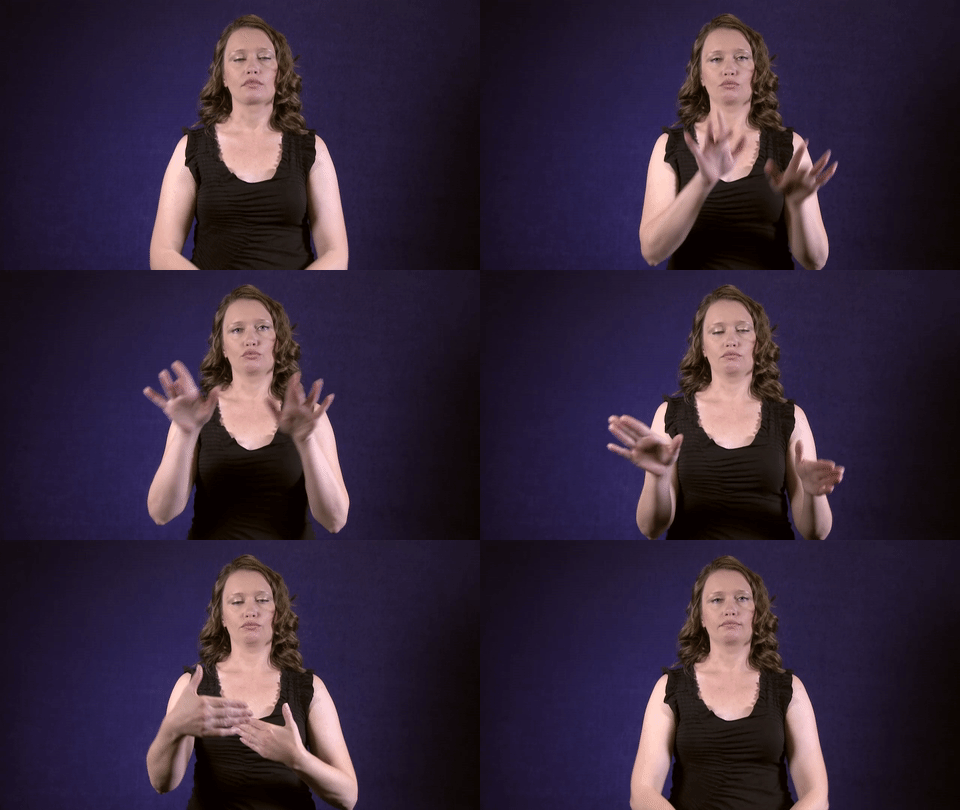
Definition: A computer room.
Sign for COMPUTER ROOM in ASL

Practice Activities:
Start by practicing each individual part of the sign for COMPUTER ROOM in ASL. Practice signing COMPUTER, which involves the dominant “C” hand making a small downward arc on your nondominant forearm. Then sign ROOM by forming both hands into “flat B” shapes and outlining an imaginary box in front of you. Repeat these signs slowly and clearly in front of a mirror to monitor your handshape and movement.
Once you feel confident with the individual components, practice putting the signs together smoothly. Use a rhythm to help you transition between COMPUTER and ROOM without pausing too long in between. Say the English words under your breath as you sign to solidify their meaning. Try alternating between fast and slow speeds to build fluency.
Incorporate the sign for COMPUTER ROOM in ASL into short sentences. For example: I STUDY IN COMPUTER ROOM, or COMPUTER ROOM CLOSED TODAY. Sign each sentence and then fingerspell the word COMPUTER to reinforce recognition. You can also try listing who uses the space the most, like STUDENTS GO COMPUTER ROOM or TEACHER WORK COMPUTER ROOM.
Set up a storytelling prompt. Imagine a day at school that begins in the computer room. Sign a short story using relevant vocabulary such as CLASS, LEARN, TYPE, and HOMEWORK. Include the sign for COMPUTER ROOM in ASL to introduce and revisit the location throughout your narration.
Pair up with a partner and take turns giving each other directions to different rooms, including the computer room. You might sign: FROM OFFICE, GO RIGHT, COMPUTER ROOM THERE. Practice answering questions like WHERE COMPUTER ROOM? or WHO IN COMPUTER ROOM?
Try labeling different rooms in your home or classroom using ASL. Make a pretend floor plan and sign where everything is, using COMPUTER ROOM in ASL multiple times within your layout explanations. This gives real-life context for spatial use.
Cultural Context:
The sign for computer room in ASL reflects both language and cultural adaptation in the Deaf community. In American Sign Language, spaces like classrooms, cafeterias, and computer rooms have specific signs that combine key concepts meaningfully. The sign for computer room in ASL typically blends the sign for computer with the sign for room or space, showing an intuitive, visual way to communicate location.
In Deaf culture, physical space plays an important role in communication. Classrooms, including specialized rooms like a computer room, are often referred to during storytelling, instruction, or giving directions. The sign for computer room in ASL helps set the scene in conversations, especially in educational or technological contexts.
When discussing schools, tech centers, or libraries, the sign for computer room in ASL offers clarity and precision. It is essential for both children and adults learning ASL to understand how locations are represented in sign language. Knowing the correct sign allows Deaf individuals and interpreters to describe environments accurately, supporting effective communication.
The American Deaf community has adapted to the digital age just like hearing communities. With the growing importance of technology in education, access, and jobs, spaces like computer rooms hold cultural value. Using the sign for computer room in ASL enables users to express modern environments without needing fingerspelling or complicated explanations.
In many Deaf schools, the computer room is a place of learning, interaction, and exposure to new skills. This makes the sign for computer room in ASL not just practical but also symbolic of access to information and empowerment. The sign helps highlight how integral technology is within Deaf culture today.
Teachers and support staff working with Deaf students frequently use the sign for computer room in ASL during daily routines. It becomes part of the language children grow up with, helping them navigate their surroundings confidently. This makes the sign both culturally and educationally significant in ASL.
The sign for computer room in ASL also reflects broader conversations about accessibility. Conversations around inclusive education often include references to resources like computer rooms. Being able to refer to these spaces efficiently in ASL is part of equal access and equity.
ASL is continually evolving, and the sign for computer room in ASL evolves along with it. As technology changes, so do the signs associated with it, but core location-based signs like this one keep serving a practical purpose in daily conversation. This ongoing development mirrors how the Deaf community integrates new concepts into the language.
In community centers or Deaf events, when a computer room is mentioned or used, the sign
Extended Definition:
The sign for computer room in ASL combines two concepts: the sign for computer and the sign for room. In American Sign Language, complex ideas or compound nouns are often expressed by pairing related signs together in a logical sequence. This is true for signs like computer room, where each part contributes to the full meaning.
To sign computer, common variations involve the dominant hand using a “C” handshape in circular motions at the side of the head or tapping the wrist or upper arm, depending on the regional preference. Some variations may mimic the act of typing or reflect interaction with technology. The variation you use might depend on your location or the preference of your signing community.
The word room is typically signed by forming both hands into flat palms and outlining the shape of a small rectangular space in the air. This mimics the shape and confines of a physical room. When added after the sign for computer, it creates the idea of a physical space designated for using computers.
When you put the two signs together—first signing computer, then room—it clearly conveys the concept of a computer room. This room could be in a school, office, library, or home. By combining the two signs fluidly, you ensure that the phrase is understood efficiently and accurately in ASL.
It’s important to note that facial expressions and non-manual markers add clarity when signing phrases like computer room. For example, depending on the context, you might need to show whether it’s a classroom, lab, or public access room. ASL integrates physical space and facial expression to convey these nuances.
The sign for computer room in ASL may also include contextual signs when explained during a conversation. For example, someone might clarify by adding signs like school, library, or work to specify what kind of computer room is being discussed. This helps avoid confusion and gives the viewer more information.
Because language evolves, and ASL is a vibrant, living language, newer or more stylized versions of the sign for computer room in ASL may appear. This is especially true as technology continues to influence communication. Signing communities might update their signs to better reflect digital spaces or virtual environments.
If you’re teaching or learning ASL, it’s recommended to practice these compound signs in real conversations. Signing computer room in ASL is not just about memorizing handshapes but also understanding how signs flow together naturally. Look up videos, practice with native signers, or use ASL dictionaries to ensure accuracy.
Whether you’re a student learning vocabulary
Synonyms: computer lab, technology room, IT room, coding room, tech lab
Educational resources: Find related learning materials in our course bank!
Want more? Check out some of our popular learning activities on the homepage!
Need to look up a sign? Use our highly rated dictionary: https://aslinteractive.com/best-asl-dictionary/
Follow us on tiktok: https://www.tiktok.com/@aslinteractive. More social media links at the bottom of this page!
Long-tail Keywords: what is the sign for computer room in ASL, how do you sign computer room in ASL, learn how to sign computer room in American Sign Language
Categories:
tags: Objects in the Classroom, Facilities and other locations/needs, Activities, Language Learning, Colleges/Universities/schools
Parameters
*Handshape*:
The handshape for the sign for COMPUTER ROOM in ASL typically combines the handshapes for both “computer” and “room.” For “computer,” use the dominant hand in a C-handshape, tapping the wrist or forearm of the non-dominant hand. This represents the concept of technology or computing.
For “room,” both hands form flat B-handshapes and move to outline a square shape in the air, symbolizing an enclosed space. This combined sign clearly conveys the meaning of the sign for COMPUTER ROOM in ASL .
*Palm Orientation*:
For the sign for COMPUTER ROOM in ASL, the palm orientation begins with the sign for COMPUTER. Typically, both hands are in a C-handshape, with the dominant hand moving in small circles near the non-dominant forearm. Palms generally face downward or slightly inward, depending on style.
When transitioning to the sign for ROOM, both hands shift into flat B-handshapes with palms facing each other, moving from wide to narrow space to indicate four walls. The palm orientation stays inward during this part of the sign. The sign for COMPUTER ROOM in ASL combines both movements fluidly, maintaining consistent palm alignment for clarity.
*Location*:
The sign for COMPUTER ROOM in ASL is composed of two separate signs: COMPUTER and ROOM. The sign for COMPUTER typically takes place in the neutral space in front of the body, using dominant hand motion around the head or wrist depending on the variation used. The ROOM portion of the sign is usually formed near the torso area, indicating the shape of a room using both hands.
When signing the phrase together, the location moves from the head area for COMPUTER to the chest or torso region for ROOM, maintaining smooth spatial transitions. The sign for COMPUTER ROOM in ASL should be fluid, with clear hand movements that reflect each part of the compound word in its respective space.
*Movement*:
The sign for COMPUTER ROOM in ASL combines the sign for COMPUTER followed by the sign for ROOM. For COMPUTER, form the dominant C handshape and circle it inward toward the side of the forehead in small repeated motions. This mimics a computer function or tech-related interaction.
Next, sign ROOM by creating flat B hands with both hands, palms facing each other. Move them forward and then around in a rectangular shape to show the outline of a room ️ . The sign for COMPUTER ROOM in ASL is produced as a compound, with each part signed sequentially and smoothly.
*Non-Manual Signals*:
When signing the sign for COMPUTER ROOM in ASL, maintain a neutral expression with clear focus. Slight eyebrow raise can indicate the topical subject, especially if you’re transitioning into talking about that specific location.
For clarity, use slight head tilts or eye gaze shifts between the two parts of the compound sign — COMPUTER and ROOM — to show their relationship. Facial engagement helps emphasize the sign for COMPUTER ROOM in ASL, reinforcing it as a specific place within conversation.
*Prosody, Dominant/Non-Dominant Hand*:
The sign for COMPUTER ROOM in ASL uses both hands in sequential signs. For COMPUTER, the dominant hand forms a “C” shape and circles near the forehead or taps the wrist, depending on the variant. The non-dominant hand typically supports or remains neutral during this portion.
Then, ROOM is signed by forming both hands into flat “B” shapes, palms facing each other, and moving them outward like you’re outlining the walls of a square. The sign for COMPUTER ROOM in ASL combines these two concepts smoothly, often done in a compound motion by fluent signers.
Tips for Beginners:
When learning the sign for COMPUTER ROOM in ASL, it’s important to know that you are combining two signs: COMPUTER and ROOM. Start by practicing each sign separately so you’re confident in their individual meaning and form. Then, combine them smoothly while maintaining clear transitions between signs.
The sign for COMPUTER typically involves forming a dominant C-handshape and moving it in a small circular motion near the forehead or on the forearm, depending on the variation you’re learning. Be consistent with the version you adopt, especially if you’re practicing with a particular teacher, class, or online video source. The sign for ROOM requires making the outlines of a small square box to represent a physical room or enclosed space. Be sure both hands are at the same height and move parallel to each other to maintain accuracy.
One beginner mistake is rushing through the phrase, leading to slurred or dropped movements that make the meaning unclear. Take your time with the sign for COMPUTER ROOM in ASL—you should aim for understanding and fluency rather than speed at first. Muscle memory will develop over time with consistent practice.
Use a mirror or record yourself while signing to detect any unclear hand movements or awkward transitions. This feedback helps refine your motor control and visual accuracy. Don’t be discouraged if it doesn’t look right at first. Every learner goes through this stage.
Be sure your facial expressions remain neutral or appropriate. Because COMPUTER ROOM is a noun phrase, heavy emotional facial expressions aren’t typically required. Just focus on clean, accurate motions.
Repetition and contextual use are key. Practice in daily activities by telling someone in sign that you’re heading to the computer room. That real-life usage will make the sign for COMPUTER ROOM in ASL more natural over time. Keep practicing and stay patient with yourself!
Connections to Other topics:
The sign for COMPUTER ROOM in ASL combines two distinct concepts: the sign for COMPUTER, often using a movement near the side of the head or on the forearm depending on regional variation, and the sign for ROOM, signed using a handshape that mimics the four walls of a space. This compound construction reflects the spatial nature of ASL, where combining two distinct ideas can represent a specific location, just like in English compound nouns.
The sign for COMPUTER ROOM in ASL connects naturally to other location-based vocabulary like CLASSROOM, BEDROOM, or BATHROOM, which also pair a function or object with the generic ROOM sign. Understanding how ROOM acts as a meaningful base sign enables learners to recognize patterns in ASL morphology. This helps in conceptualizing how the language visually categorizes spaces by usage.
Signs like COMPUTER LAB or COMPUTER CLASS might also derive from similar concepts, sharing the COMPUTER sign and modifying the location part depending on context. For example, switching ROOM to CLASS changes the location type but maintains the core idea. This shows how ASL utilizes modular components to build meaning, a critical concept for language learners to master.
Additionally, the sign for COMPUTER ROOM in ASL may interact with directional and locative signs, such as GO-TO, IN, or WHERE, to construct full sentences describing movement or inquiry about space. For example, combining GO and the sign for COMPUTER ROOM can represent “go to the computer room,” reinforcing how signs build on one another in context.
As technology grows more integrated in everyday life, knowing the sign for COMPUTER ROOM in ASL becomes increasingly useful in educational and workplace dialogues. It ties into broader signs such as OFFICE, TECHNOLOGY, and SCHOOL, expanding vocabulary around common environments. This interconnection deepens understanding of how ASL structures meaning visually and spatially. ️
Summary:
The sign for COMPUTER ROOM in ASL is a compound sign, pulling from two separate concepts: COMPUTER and ROOM. Generally, in ASL, compound signs are formed by signing two separate words in sequence and blending their meanings for clarity. The individual signs are modified slightly to flow smoothly into one another.
To begin, the sign for COMPUTER typically involves a dominant hand in a “C” handshape circling or brushing against the forehead or temple area. Another variation involves using both hands in “C” handshapes that rotate forward, mimicking the spinning of computer tape reels—echoing older computer technology. It may also be signed by using the middle finger and tapping it against the wrist, mimicking old machine logic types.
The sign for ROOM is formed by both hands in “B” handshapes, held opposite each other, then moved in a square shape to depict the outline of a room or enclosed space. This is a spatial visual representation that maps the concept of a confined area clearly for a visual language like ASL. The shape suggests physical space and location, important elements in ASL grammar.
When combining these two signs into the sign for COMPUTER ROOM in ASL, it follows standard ASL syntax by placing the subject noun (COMPUTER) before the location indicator (ROOM). This order mirrors many other compound or compound-like sequences in American Sign Language, reinforcing linguistic patterns and helping learners absorb predictable sentence structures.
The sign for COMPUTER ROOM in ASL is functionally descriptive: it identifies a specific space designated for computer use. It may appear in school settings, office environments, or public institutions, such as libraries. The context of this sign often implies technology, digital access, and work or study environments.
ASL is a visually spatial language where classifiers and physical depictions of objects or locations help shape meaning. Although COMPUTER ROOM in ASL may seem straightforward, it can be nuanced with directional cues, emotional expressions, or even classifiers indicating the size or layout of the room. For example, if describing a large computer laboratory, facial expressions and hand movement distance might be amplified.
Understanding the sign for COMPUTER ROOM in ASL helps illuminate the interplay between modern lexicon and visual representation. As culture evolves, so does language—ASL has adapted computer vocabulary as technology has advanced. What was once a sign for large computing machinery now represents sleek laptops and even abstract systems.
This sign also reflects how ASL continues to integrate conceptual blending in depicting modern society. Using older motion-based signs (like rotating reels) for COMPUTER in the compound doesn’t necessarily isolate the sign to historical uses. Many ASL users still employ this visual metaphor due to cultural retention and language tradition.
In educational linguistics, signs like COMPUTER ROOM illustrate how ASL incorporates new terms through compounding, borrowing, and fingerspelling. The sign avoids fingerspelling the phrase each time, which would be inefficient and less fluid in rapid conversation. This shows the natural language economy in ASL and its evolution toward efficiency.
Notably, in classrooms or schools for the Deaf, the sign for COMPUTER ROOM may be standardized for clarity among younger learners. Teachers might emphasize the complete compound sign or break it down for pedagogical purposes. Over time, learners begin to use the compact form as habits form and language maturity increases.
In Deaf culture, a COMPUTER ROOM isn’t just about machines—it can represent connection, digital literacy, or even community. With the rise of video phones, texting, and internet access, computer rooms often hold special significance in expanding Deaf autonomy. These spaces symbolize access to broader communication, inclusion, and even empowerment.
Some users may modify the sign for COMPUTER slightly when used in the context of COMPUTER ROOM. For instance, if the dominant variant is the temple-wipe method, they may choose a simpler form for smoother transitions. This kind of adaptation is common in fluent signers who prioritize speed and flow.
Computer-related vocabulary in ASL continues to grow, and signs like COMPUTER ROOM serve as anchor points for newer terminology. Users may build from this base by chaining concepts like COMPUTER LAB, COMPUTER CLASS, or COMPUTER HELP. Hence, basic compound signs are building blocks for more complex ideas.
Linguistically, the sign showcases the AGENT + LOCATION structure, with the agent (the object) placed before the location. This order is a signature of ASL grammatical structure and contrasts with English’s determiners and suffix usage. In ASL, concepts unfold visually and spatially, rather than phonetically or temporally.
From a cultural lens, knowing how to sign COMPUTER ROOM in ASL bridges understanding between hearing and Deaf learners in bilingual environments. This fosters inclusion and also promotes digital equity in Deaf education spaces. Technology is closely tied to access for Deaf individuals, and naming these spaces with precision is key.
In broader terms, understanding the sign for COMPUTER ROOM in ASL also reinforces how multi-modal and dynamic sign languages are. Rather than being a one-to-one translation from English, ASL conveys meaning through movement,
Want more? Check out some of our popular learning activities!
ASL Interactive Resources
ASLInteractive YouTube Channel
Follow us on tiktok: @aslinteractive.com
Follow us on Instagram: aslinteractive
Facebook page: aslinteractive
Facebook group: aslinteractive
LInkedIn: ASL Interactive LLC
Twitter: @ASL_interactive
*Some information on this page is AI-generated. AI can make mistakes. Please check the information.


Responses