Definition: A conclusion 2.
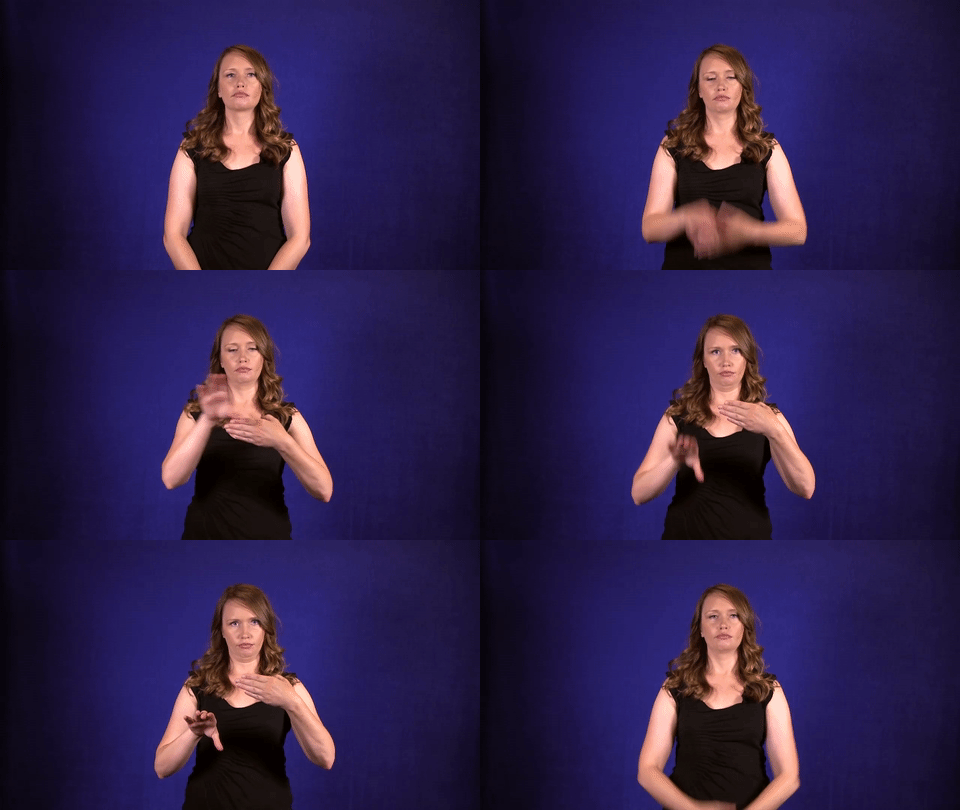
Sign for CONCLUSION 2 in ASL

Practice Activities:
Start by practicing the sign for CONCLUSION 2 in ASL in front of a mirror. Focus on the clarity of your handshape, movement, and facial expression. Repeat the sign slowly, then increase your speed while maintaining accuracy.
Once you feel confident signing it on its own, begin incorporating it into simple phrases like “the conclusion was clear” or “that’s the conclusion.” Signing short phrases builds fluency and helps you transition from isolation to context more smoothly. Use a video recorder to play back your signing and check precision.
Next, try building simple sentences around the sign for CONCLUSION 2 in ASL. For instance: “My conclusion is different,” or “We reached a conclusion after the debate.” Practice signing these sentences fluidly while emphasizing facial grammar to match the tone of each message.
Storytelling is a great way to practice the sign in longer narratives. Create a short story about a mystery or debate and use the sign for CONCLUSION 2 in ASL to show how the storyline wraps up—for example, someone finds the missing item and reaches a conclusion about who took it. Retell your story to a partner or in front of a classmate to build expressive language skills.
Partner practice helps reinforce the sign with real-time feedback. Have one person describe a situation that requires a conclusion, and ask the other to summarize it using the sign appropriately. Switch roles to increase exposure and understanding of various contexts.
For receptive skill building, watch videos where others use the sign for CONCLUSION 2 in ASL and identify when and why it’s used. This improves your comprehension and helps you mirror natural usage. Practicing both expressive and receptive skills ensures your use of the sign becomes second nature in everyday ASL communication. ✋
Cultural Context:
In American Sign Language (ASL), signs can have multiple variations depending on the region, community, or specific context. The sign for CONCLUSION 2 in ASL represents one such variation and is typically used in both formal and informal conversations. While it carries the same general meaning, its presentation may differ slightly in handshape or movement compared to other signs for conclusion.
The sign for CONCLUSION 2 in ASL is often used in academic settings, storytelling, and presentations. It helps indicate the final point or the wrapping up of thoughts, aligning with how the term “conclusion” is applied in English. Whether someone is summarizing an idea, ending a discussion, or finishing a paper, this version brings clarity and structure to communication.
Cultural understanding is essential in using ASL effectively. The sign for CONCLUSION 2 in ASL reflects the Deaf community’s value of visual clarity. Ending a conversation or a narrative neatly with a clear sign like CONCLUSION 2 points to the community’s emphasis on complete and coherent signing.
Different Deaf communities sometimes favor unique signs or variations, especially when it comes to abstract or academic terms like “conclusion.” The sign for CONCLUSION 2 in ASL might be preferred by some signers because of its fluid motion or strong visual component. These preferences evolve through social use in classrooms, interpreters’ choices, and native signer influence.
Using CONCLUSION 2 in ASL also shows how ASL incorporates gestures and expressions that match the emotion or tone of a conversation. When people sign a conclusion, they might adjust their facial expressions to match the finality or importance of the message. These visual cues are just as important as the hand movements.
The sign for CONCLUSION 2 in ASL may also appear more often in interpreted environments, such as religious services, business meetings, or televised interpreting. In these contexts, signers choose clear and concise signs to match spoken content without losing meaning. CONCLUSION 2 fits well for summing up points or marking an end explicitly.
Language variation in ASL helps keep it rich and responsive to communication needs. Signs like CONCLUSION 2 play a key role in making ASL versatile and adaptive. Whether a Deaf student is writing a school report or a teacher is ending a lecture, signs like CONCLUSION 2 deepen the expressive potential of ASL.
Using the sign for CONCLUSION 2 in ASL also helps learners expand their sign vocabulary. Seeing multiple ways to express one English word strengthens awareness
Extended Definition:
The sign for conclusion 2 in ASL expresses the idea of something finishing, ending, or being finalized. This version of the sign is used in both casual and formal ASL conversations, especially in academic or professional contexts. It’s useful when discussing papers, talks, problems, or even stories where a final point is being made.
To sign conclusion 2 in ASL, the dominant hand often moves in a motion that represents wrapping up or closing. This specific variation focuses on the abstract concept of wrapping something up intellectually or logically. It can be used when referring to the final result or determination after a process of reasoning or analysis.
People commonly use the sign for conclusion 2 in ASL during presentations or when summarizing ideas. You might see it in situations involving debates, lectures, or reports when someone summarizes their final thoughts. It may also be used in storytelling when things are coming to a close, and the moral or outcome is presented.
The sign for conclusion 2 in ASL differs slightly from sign for conclusion 1 in ASL, which may involve a different handshape or motion. Understanding both can help users express themselves more clearly depending on the context. This version generally leans more toward academic or logical discussions.
In written or spoken English, the word conclusion might appear in essays, scientific studies, or speeches. When translating this into ASL, it’s helpful to consider which version of the sign fits more appropriately. The sign for conclusion 2 in ASL targets the logical end to a process.
Learners should practice this sign as part of upper-intermediate or advanced ASL vocabulary. It’s especially helpful for students, researchers, or professionals who regularly engage in formal communication. Becoming familiar with when and how to use this particular sign improves fluency and understanding.
Facial expressions play a key role when using the sign for conclusion 2 in ASL. A serious or thoughtful expression helps convey the sense that a final decision or abstract summary is being made. This non-manual marker adds depth and emotion to the concept being shown.
In everyday use, you might sign conclusion 2 when wrapping up thoughts at a meeting, ending a complex idea, or clarifying a point after a discussion. It helps reinforce that a topic has reached its final step. This visual cue supports the clarity of your message, especially in group settings.
While learning ASL, clear repetition of both the motion and role of this variant helps internalize meaning. Watching native users sign conclusion
Synonyms: end, wrap-up, final decision, resolution, finishing statement
Educational resources: Find related learning materials in our course bank!
Want more? Check out some of our popular learning activities on the homepage!
Need to look up a sign? Use our highly rated dictionary: https://aslinteractive.com/best-asl-dictionary/
Follow us on tiktok: https://www.tiktok.com/@aslinteractive. More social media links at the bottom of this page!
Long-tail Keywords: what is the sign for conclusion in ASL, how do you sign conclusion in ASL, ASL sign for conclusion
Categories:
tags: Conclusion, Language Learning, Commands, Activities, Major Decisions
Parameters
*Handshape*:
The handshape for the sign for CONCLUSION 2 in ASL begins with both hands in flat “O” handshapes. The fingertips of each hand touch lightly and face each other, positioned near the chest.
To sign effectively, the hands pull apart slightly and then come together again, giving a subtle closing movement. This sign visually suggests finality or a wrap-up, aligning with the meaning of the sign for CONCLUSION 2 in ASL ✨.
*Palm Orientation*:
For the sign for CONCLUSION 2 in ASL, the palm orientation typically begins with both hands open and facing each other, palms slightly angled inward. As the motion progresses, the dominant hand moves forward and closes into a flat hand, palm down, while the non-dominant hand remains in place or supports the motion.
This palm orientation helps emphasize the finality and closure represented in the sign for CONCLUSION 2 in ASL. The closing motion toward a flat, downward-facing palm visually conveys the idea of reaching an end or summing up. ➡️✋
*Location*:
The sign for CONCLUSION 2 in ASL is produced in the neutral space directly in front of the torso, about mid-chest height. The location remains centered to allow clear movement and visibility without obstruction from the body or face.
This consistent placement keeps the sign easily readable while allowing other facial expressions or grammatical markers in ASL to remain distinct. Using the neutral space also helps differentiate the sign for CONCLUSION 2 in ASL from similar conceptual signs.
*Movement*:
To perform the sign for CONCLUSION 2 in ASL, bring both open hands in front of you, palms facing inward. Move the dominant hand in a quick, downward and inward motion until it firmly lands flat on the non-dominant palm, as if symbolizing a final decision or end.
This gesture visually represents finality, tying directly into the meaning of the sign for CONCLUSION 2 in ASL . The motion is deliberate and controlled, emphasizing a clear, decisive point.
*Non-Manual Signals*:
The non-manual signals used in the sign for CONCLUSION 2 in ASL typically include a neutral to slightly serious facial expression, showing finality or resolution. Slight nodding may accompany the sign to emphasize that something has come to an end or been determined.
Eye contact is usually maintained to affirm the decision or outcome represented. These subtle cues help reinforce the definitive nature of the sign for CONCLUSION 2 in ASL .
*Prosody, Dominant/Non-Dominant Hand*:
The sign for CONCLUSION 2 in ASL uses a dominant flat hand and a non-dominant closed hand. The dominant hand sweeps downward and comes to rest on the back of the non-dominant hand, symbolizing a final point or ending.
This motion suggests a wrapping up or finishing of an idea, making the sign for CONCLUSION 2 in ASL useful in academic or formal contexts . The non-dominant hand stays steady while the dominant moves with intention.
Tips for Beginners:
When learning the sign for CONCLUSION 2 in ASL, it’s essential to first understand the motion and handshape involved. This version of the sign generally involves an open flat hand that closes into a flattened “O” handshape, symbolizing the idea of wrapping something up. Make sure your hand movement is intentional and smooth, rather than rushed or jerky, to maintain clarity.
A common issue beginners face with the sign for CONCLUSION 2 in ASL is not keeping their movements confined and precise. Avoid overextending your arms or exaggerating the motion, as this can confuse the meaning or distract from the point of communication. Practicing in front of a mirror can help you monitor your motions and make sure they are consistent with the standard ASL expression.
Focus on maintaining eye contact with your conversation partner during signing. In ASL, facial expressions carry a significant part of the grammatical structure and emphasis. When using the sign for CONCLUSION 2 in ASL, a nod or a slight raising of the eyebrows can enhance the finality of what you’re trying to say.
Repetition and muscle memory are your best allies. Incorporate the sign into short sentences to build context and fluency. For example, try saying sign phrases like “that’s my conclusion” or “in conclusion” so you get used to using the sign in real-life conversations.
Lastly, don’t be afraid to ask for feedback. Whether it’s from a teacher, a Deaf friend, or in a community class, feedback will help you refine your expression. The more you use the sign for CONCLUSION 2 in ASL naturally and in context, the more confident and accurate you will become.
Connections to Other topics:
The sign for CONCLUSION 2 in ASL shares conceptual space with signs meaning “end,” “final,” and “result,” offering a way to express the termination or summation of events or ideas. It is often used in both academic and conversational settings where a final thought or wrap-up is needed. This sign supports narrative structure in ASL, guiding a story or argument to its resolution.
The sign for CONCLUSION 2 in ASL also relates to the broader category of signs used in logic, reasoning, and debate such as “therefore,” “because,” and “summary.” These are commonly grouped into the domain of transition markers, which help signers structure arguments cohesively. When learners understand these transitions, they can better navigate opinion essays or storytelling in ASL.
This sign often appears in compound or sequential sign phrases such as “in conclusion” or “the final result,” which might incorporate accompanying facial expressions or body shifts to emphasize closure. Sometimes, it appears alongside signs like “decision,” “analysis,” or “point” as part of academic or formal presentations. Mastering these sequences enhances clarity in public speaking contexts.
The sign for CONCLUSION 2 in ASL frequently overlaps with the visual concept of shutting or closing down. This visual metaphor helps link it to other signs such as “close,” “shut,” or even the metaphorical “close chapter,” a common gesture among fluent signers expressing endings. Context is crucial in distinguishing these subtle shifts in meaning.
In legal, educational, or scientific settings, the sign for CONCLUSION 2 in ASL becomes especially relevant. Final statements, hypotheses, or research findings often rely on this sign to communicate the wrap-up of intellectual effort. This shows how integral it is for signers to grasp not just vocabulary but functional positioning within overall communication strategies.
Summary:
The sign for CONCLUSION 2 in ASL features a movement that embodies the idea of something reaching a final point or coming together. This version differs slightly from other signs for “conclusion,” offering a specific variation with subtle distinctions in motion or handshape. Such variations are common in ASL as regional, contextual, or stylistic preferences shape how signs are understood and used.
To form the sign for CONCLUSION 2 in ASL, both hands generally start in an open “5” shape, palms facing either each other or slightly downward. The hands then move toward one another, closing into flat “O” handshapes or bent hands that come together like closing a thought or completing a statement. The fluid motion echoes the wrapping up of a narrative or argument in a clear and meaningful gesture.
This sign effectively communicates the end of an explanation, the result after analysis, or the last stage of a process. It can be applied in both academic and conversational contexts, making it a flexible element in ASL communication. The tactile rhythm of the movement reflects a psychological or emotional completion, resonating across both linguistic and symbolic dimensions.
In academic contexts, the sign for CONCLUSION 2 in ASL is especially effective when summarizing ideas, recapping points, or identifying a key takeaway. It offers a visual cue that something has reached its end or that understanding has been achieved. The gesture helps reinforce the structure of formal presentations in Deaf discourse.
Grammatically, the sign aligns with ASL’s Subject-Verb-Object (SVO) structure but is often placed toward the end of a signed sentence or argument. It cues viewers or participants that something is finalized or that attention can shift to another topic. Its timing within syntax supports the language’s temporal and spatial nature.
Linguistically, the sign represents a metaphorical conceptualization: abstract thought being “collected” or “drawn to a close.” This mental image is a hallmark of visual-spatial languages like ASL, where physical motion becomes a mirror to mental constructs. As a result, hands are not just tools of expression—they become expressions themselves.
Understanding the sign for CONCLUSION 2 in ASL reveals how the language captures nuance and variation within shared meaning. While there may be a primary conventional sign for “conclusion,” variations like this one show how expressive options broaden communication. This sign reflects ASL’s growth and its ability to personalize fixed concepts.
The cultural significance of this variant lies in its connection to ASL storytelling and discourse formats. In ASL narratives, signs like CONCLUSION 2 hold power not just to indicate an end, but to mark emotional or thematic resolution. It connects signed storytelling to the natural arc expected in visual literature.
Because of ASL’s visual modality, signs must often carry both literal and metaphorical meaning. The sign for CONCLUSION 2 in ASL does this effectively, combining the semantics of “ending” with motion that suggests synthesis or gathering ideas. Such dual functions are typical of rich, expressive signs.
From a sociolinguistic angle, this variation may indicate a signer’s regional background or educational exposure. Different schools, families, or regions often create and propagate their own slight sign differences, creating a rich mosaic. This reflects one of ASL’s most dynamic qualities—it is always living and adapting.
In relation to similar signs, the sign for FINISH might seem comparable, but it serves a different purpose. FINISH typically indicates temporal completion or is used to mark tense in ASL grammar. While CONCLUSION 2 signals a more conceptual wrap-up, FINISH concerns the act being done.
Other related signs include DECIDE, RESULT, and SUMMARY. These share conceptual relationships with CONCLUSION 2 but individually express different steps or levels of processing. While DECIDE involves choice, SUMMARY extracts key points, and RESULT focuses on outcomes—CONCLUSION 2 suggests holistic closure.
Applied linguistics perspectives might examine how learners of ASL use or distinguish between sign variants like this one. Understanding and choosing the correct variant depends on exposure, cognitive mapping, and immersion. Nuance in sign selection reflects deeper fluency and comprehension of visual grammar.
Facial expressions often accompany this sign and can modify its intensity or emotional tone. A serious or thoughtful expression might underscore importance, while a satisfied face may emphasize a sense of resolution. Non-manual signals are crucial in expressing subtleties inherent in conceptual signs like this.
In Deaf rhetoric or education settings, this sign often appears in ensemble with signs like EXPLAIN, THINK, and UNDERSTAND. These build up to a CONCLUSION—a shared visual crescendo of logic or insight. The synergy among those signs builds coherence in presentations meant to persuade or inform.
This sign is also part of ASL’s broader system of visual punctuation. Much like a period or exclamation point in written English, signs like CONCLUSION 2 punctuate the visual stream of discourse. It allows the audience to follow shifts in topics or frameworks more clearly.
Want more? Check out some of our popular learning activities!
ASL Interactive Resources
ASLInteractive YouTube Channel
Follow us on tiktok: @aslinteractive.com
Follow us on Instagram: aslinteractive
Facebook page: aslinteractive
Facebook group: aslinteractive
LInkedIn: ASL Interactive LLC
Twitter: @ASL_interactive
*Some information on this page is AI-generated. AI can make mistakes. Please check the information.
Responses