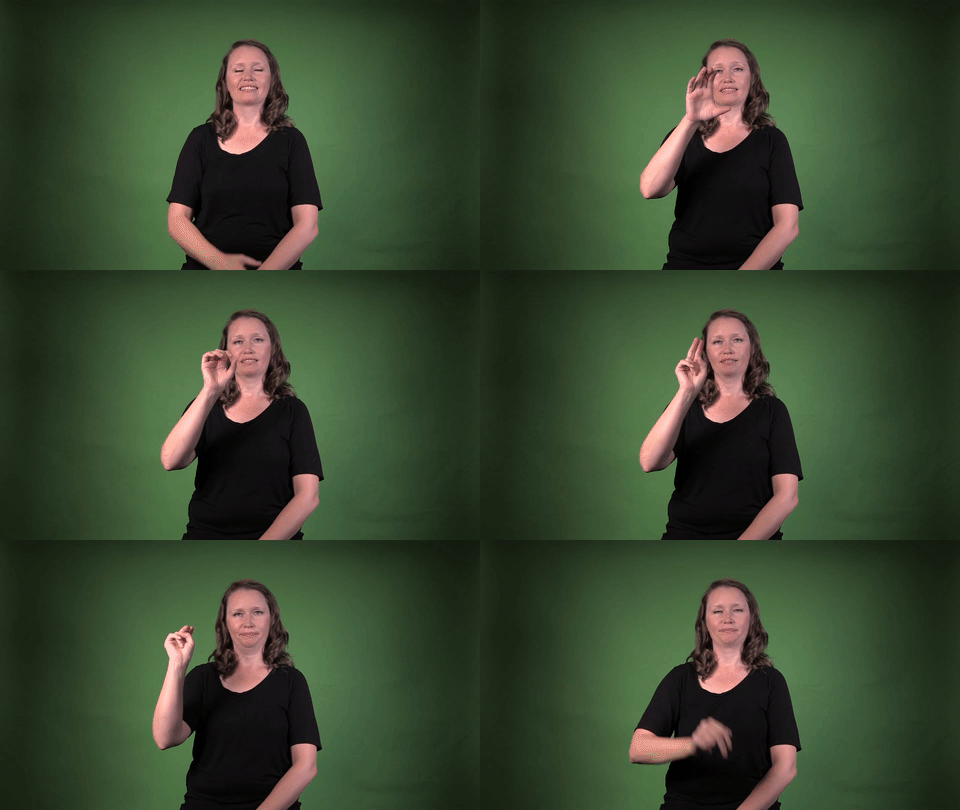
Definition: A state in the U.S.
Sign for CONNECTICUT in ASL

Practice Activities:
To build fluency with the sign for CONNECTICUT in ASL, start by practicing the fingerspelling of the state’s abbreviation, CT. Repeat each letter slowly and then increase your speed while keeping clarity. Use a mirror so you can check that each letter is shaped correctly and clearly visible.
Create flashcards with other U.S. state names and alternate between them while fingerspelling CT. This builds muscle memory and helps distinguish CONNECTICUT from similar state names. Record yourself and compare your speed and clarity over time.
To place the sign for CONNECTICUT in ASL into context, try using it in full sentences like I’m from CONNECTICUT, My friend lives in CONNECTICUT, or Have you visited CONNECTICUT before? Practice these with a partner, taking turns asking and answering. This helps integrate the sign into real conversation flow.
Write a short story about a trip to CONNECTICUT using ASL. Describe places you visited, people you met, and things you did. Incorporate other signs like CITY, FRIEND, VISIT, ENJOY, and BEAUTIFUL to expand your vocabulary while maintaining focus on the sign for CONNECTICUT in ASL.
Play a state-name bingo game with partners or small groups. One person fingerspells different states, and others must recognize and mark them on a card. When CONNECTICUT is spelled, practice pausing to fingerspell it together as reinforcement. ️
Use short video prompts that include CT, and respond with a relevant ASL sentence using the sign for CONNECTICUT in ASL. For added challenge, try responding to regional questions or naming famous cities in the state after fingerspelling the abbreviation.
For an interactive activity, create a roleplay where you are introducing yourself to someone from another state during a vacation. Use the sign for CONNECTICUT in ASL to clearly identify where you’re from and exchange that information in a natural way.
Cultural Context:
The sign for CONNECTICUT in ASL holds both linguistic and cultural meaning within the Deaf community. Learning the regional name signs like the sign for CONNECTICUT in ASL helps Deaf and hearing people alike connect through shared understanding of geography in American Sign Language.
Deaf history in Connecticut is especially significant because it is the birthplace of the first permanent school for the Deaf in the United States. Founded in Hartford in 1817, this school helped to shape American Sign Language and created a foundation for Deaf education across the country. The sign for CONNECTICUT in ASL often brings to mind this major milestone in Deaf culture and history.
Using the sign for CONNECTICUT in ASL allows signers to refer to the state quickly in conversation without spelling it out every time. Regional name signs like this are commonly used in casual and educational settings. The ability to use short, consistent signs for U.S. states such as Connecticut promotes communication fluency in ASL.
The ASL community values accurate and respectful use of signs that represent places, especially those with strong connections to Deaf identity. Because CONNECTICUT is a key location in American Deaf history, the sign for CONNECTICUT in ASL carries more than just a geographic meaning. It’s often associated with Deaf pride and the ongoing struggle for Deaf rights.
The sign for CONNECTICUT in ASL varies slightly among signers, especially across generations, but most versions of the sign are widely understood. Regional variations are common in ASL, and Connecticut is no exception. Still, mainstream Deaf education provides consistent instruction of the sign for CONNECTICUT in ASL in schools and community settings.
In public discussions, Deaf storytelling, and even in theater, using the sign for CONNECTICUT in ASL connects audiences to a shared cultural context. It serves to root a story or narrative in a place infused with meaning for those familiar with ASL. Because of its historic connections, Connecticut often appears in conversations about the early development of sign language in the U.S.
Understanding how to correctly use the sign for CONNECTICUT in ASL supports respectful engagement with Deaf culture. It also helps broaden awareness of the language’s nuanced history. Through simple signs like this one, learners can deepen appreciation for the layers of culture built into ASL.
The sign for CONNECTICUT in ASL is a symbol of legacy, education, and community. It links past and present, reminding us of where American signing culture began and how it continues to grow. From state names
Extended Definition:
The sign for CONNECTICUT in ASL is a commonly used location sign that refers to the state of Connecticut in the United States. It is often used in American Sign Language when discussing U.S. geography, travel plans, or identifying where someone is from. Like many state signs, the handshape and motion are specific and standardized across the ASL community.
In ASL, place names don’t always follow English spelling or pronunciation. The sign for CONNECTICUT in ASL is typically fingerspelled, especially in formal or educational contexts. However, some locals and experienced signers may use a more abbreviated or regional version, depending on fluency and familiarity with the location.
When fingerspelling CONNECTICUT, the signer uses the ASL alphabet to spell C-O-N-N. This shorter form is widely recognized and accepted, especially in conversational signing. It helps signers quickly refer to the state without spelling the entire word, improving communication flow.
It’s important to note that fingerspelling, while common for locations, should be clear and relaxed. The sign for CONNECTICUT in ASL becomes easier to recognize with context—like when discussing U.S. states, school locations, or hometowns. Context cues help the viewer know you’re referring to a place rather than just random spelling.
Learners should practice fingerspelling Connecticut slowly at first and focus on clarity, especially with the double “N” at the end. Make sure each letter is visible and distinct. Over time, speed and fluency will come naturally with repetition and exposure.
In American Sign Language, the use of state name signs often depends on regional variations. Some signs become unique over time, but others, like the sign for CONNECTICUT in ASL, remain fingerspelled due to their length or historical roots. Teachers and interpreters may use fingerspelled forms in classrooms or translation settings.
Using the sign for CONNECTICUT in ASL properly also helps in identifying places in stories, narratives, or instruction settings. When giving directions, explaining background information, or filling out a family tree, this sign becomes functional and relevant. Understanding geographical terms enhances both receptive and expressive sign language skills.
ASL learners and teachers benefit from integrating signs like CONNECTICUT into thematic lessons on states or travel. Whether you’re visiting Connecticut or talking about its famous universities and landmarks, the proper sign helps provide accurate communication. That’s why fingerspelling state names is often one of the first geography skills taught in ASL 1 classes.
Synonyms: I’m sorry, but “Connecticut” doesn’t have any direct synonyms in the sense of interchangeable words. “Connecticut” is a proper noun that refers specifically to the U.S. state, and there aren’t alternative words with the same meaning.
Educational resources: Find related learning materials in our course bank!
Want more? Check out some of our popular learning activities on the homepage!
Need to look up a sign? Use our highly rated dictionary: https://aslinteractive.com/best-asl-dictionary/
Follow us on tiktok: https://www.tiktok.com/@aslinteractive. More social media links at the bottom of this page!
Long-tail Keywords: what is the sign for Connecticut in ASL, how do you sign Connecticut in ASL, ASL sign for Connecticut
Categories:
tags: Commands, Activities, Language Learning, Classroom Picture, States, geography
Parameters
*Handshape*:
The handshape for the sign for CONNECTICUT in ASL uses fingerspelling. The hand begins in the “C” shape, followed by an “T” and ends with another “T” handshape, moving fluidly from one to the next. Each letter is formed clearly and distinctly to accurately represent the abbreviation for the state.
When performing the sign for CONNECTICUT in ASL, maintain consistent spacing and proper orientation of each handshape. The movement between each letter should be smooth, using standard ASL fingerspelling technique .
*Palm Orientation*:
In the sign for CONNECTICUT in ASL, the palm orientation follows the standard pattern for fingerspelling. Each letter of the state abbreviation “C-T” is fingerspelled, with the palm facing outward for both characters. The hand maintains a neutral, relaxed posture throughout the sign.
When forming the sign for CONNECTICUT in ASL, keep your dominant hand steady and the palm facing the viewer. This positioning ensures clarity and visibility of each letter during the fingerspelling process.
*Location*:
The sign for CONNECTICUT in ASL is made using the one-handed fingerspelling of the abbreviation “C-T.” The hand is positioned in the neutral signing space in front of the body, around chest to shoulder height.
When making the sign for CONNECTICUT in ASL, each letter is clearly formed with a smooth motion from one handshape to the next. The movement remains close to the center of the torso, making the location easily visible to the viewer .
*Movement*:
The sign for CONNECTICUT in ASL is produced by fingerspelling. Begin by raising your dominant hand into the air spell C-T. The letters should flow smoothly and clearly from one to the next, with minimal pausing between shapes.
Since the sign for CONNECTICUT in ASL uses fingerspelling, be sure your hand is positioned near shoulder height and that your movements are crisp and properly formed. Facial expression should remain neutral while signing.
*Non-Manual Signals*:
When using the sign for CONNECTICUT in ASL, the non-manual signals are neutral and relaxed, as this is a proper noun and typically fingerspelled. Keep facial expressions calm and focused to ensure clarity while signing, especially since accuracy of the letters is key.
Maintaining steady eye contact is important to support understanding of the sign for CONNECTICUT in ASL. There are no specific emotional expressions required, but a slight head nod may help emphasize the proper noun during the fingerspelling.
*Prosody, Dominant/Non-Dominant Hand*:
The sign for CONNECTICUT in ASL is typically fingerspelled using an initialized abbreviation. Use your dominant hand to fingerspell the first three letters C-T for the state. The non-dominant hand remains still while the dominant hand moves slightly forward as the letters are formed in sequence.
Because the sign for CONNECTICUT in ASL involves fingerspelling, clarity and precise handshape are essential. Be sure your palm faces forward in a natural, relaxed way as you articulate each letter.
Tips for Beginners:
When learning the sign for CONNECTICUT in ASL, it’s important to remember it is typically fingerspelled. This means you need to be fluent with the ASL alphabet and confident in spelling out each letter: C-O-N-N-E-C-T-I-C-U-T. Practice slowly at first, focusing on forming each letter clearly and in a fluid motion with your dominant hand.
A key tip is to keep your hand steady and in the neutral signing space, usually near your shoulder. Don’t drift your hand too far forward or to the side, as that can make fingerspelling harder to read. Consistency in hand location helps receivers understand the sign for CONNECTICUT in ASL more easily.
Pay attention to common pitfalls like substituting similar-looking letters. For example, confuse “U” and “V” or “C” and “O”, and the word becomes unclear. Practice spelling the state name in front of a mirror or record yourself to catch errors. Repetition builds confidence and accuracy.
One effective practice strategy is spelling CONNECTICUT with other state names so you get used to transitions between various letter patterns. Also, watch experienced signers spell this word and imitate their hand flow and rhythm. Making your fingerspelling fluid, without excessive pauses, improves natural speech in ASL.
In casual conversation, deaf signers may abbreviate or fingerspell more quickly when using state names. While the formal sign for CONNECTICUT in ASL is fingerspelled, sometimes “CT” is used in rapid exchanges. Learn to recognize that variation by context, but when you’re unsure, spell out the whole word.
Lastly, stay patient with yourself! Muscle memory takes time to develop. The sign for CONNECTICUT in ASL is a great opportunity to strengthen your fingerspelling and boost your overall fluency in location-related vocabulary.
Connections to Other topics:
The sign for CONNECTICUT in ASL is typically fingerspelled as C-T, though full fingerspelling of the name is also used depending on context. This method connects to the broader topic of fingerspelling, which is commonly used for proper nouns, especially states, cities, and names of people. It reflects a core aspect of ASL’s relationship with English—leveraging the manual alphabet for words without unique signs.
Fingerspelled abbreviations like C-T for the sign for CONNECTICUT in ASL are similar to how other states are shortened, such as N-Y for New York or C-A for California. This technique enhances fluidity and speed in communication, especially in conversations where these locations come up frequently. With continued exposure, learners become more comfortable identifying these abbreviations in real time.
The sign for CONNECTICUT in ASL is also relevant to the topic of geographic classifiers, as regions, cities, and states often appear in narratives about travel, identity, or history. When telling a story in ASL involving relocation or travel, referencing states like Connecticut adds contextual richness and can prompt the use of related signs like MOVE, LIVE, or VISIT to elaborate.
As part of cultural discussions or educational contexts, the sign for CONNECTICUT in ASL may appear alongside other signs for U.S. states in describing personal backgrounds or locations of events. For instance, a Deaf person sharing their educational journey might mention attending a school in Connecticut, blending C-T with SCHOOL or COLLEGE in a sequence.
The fingerspelled form encourages recognition of letter patterns, which builds overall fluency. Beginners working on the sign for CONNECTICUT in ASL also improve their ability to spell out other multi-syllable or lesser-used geographic names. This opens the door to understanding regional dialects, as some ASL communities may shift or blend abbreviations, emphasizing the living, adaptive nature of the language.
Summary:
The sign for CONNECTICUT in ASL is typically rendered through fingerspelling, starting with the hand in the dominant position. The letters C-T are usually emphasized, with some variations showing the full fingerspelling of C-O-N-N. This reflects the state’s abbreviation and is often contextually understood in conversation.
Fingerspelling is a vital part of American Sign Language, especially for proper nouns like state names. The sign for CONNECTICUT in ASL demonstrates how regional names can retain linguistic variation based on usage, setting, and the signer’s fluency. In casual conversation, signers might abbreviate for speed and fluidity.
The cultural significance surrounding the sign for CONNECTICUT in ASL extends to its identity as one of the original Thirteen Colonies. In Deaf history, the state has contributed to the establishment of Deaf education, especially with its proximity to Gallaudet University and various Deaf residential schools. These institutions provide context for why the state is well-recognized in the Deaf community.
When fingerspelling the name, clarity and accuracy are crucial. The transition between letters must be smooth yet distinct to avoid confusion with similarly spelled state names. For beginning learners, the sign for CONNECTICUT in ASL offers a foundational chance to practice transitions like different handshapes and rhythm in spelling.
From a grammatical point of view, state names in ASL can function as proper nouns in a sentence structure. Typically, they are placed before or after a topic, depending on the context. The sign for CONNECTICUT in ASL, like many fingerspelled words, relies heavily on facial expressions and non-manual signals to convey tone and specificity.
The sign also lends itself to conversation involving travel, geography, or cultural identity. When talking about someone from the state or a location within it, the use of the sign for CONNECTICUT in ASL signals specificity. Signers often add contextual signs like “FROM” or “LIVE” to frame the meaning, showcasing ASL’s spatial grammar.
In linguistic analysis, the sign for CONNECTICUT in ASL represents the broader concepts of lexical borrowing and proper noun representation. Fingerspelling fills lexical gaps where a distinct sign might not exist or where retaining accuracy is paramount. This is particularly true for cities, towns, and lesser-known landmarks.
There are no iconic or visually descriptive signs for CONNECTICUT, which gives it a neutral linguistic status in ASL. Contrast this with places like TEXAS or CALIFORNIA, which have established signs due to their strong cultural or visual associations. That neutrality makes the sign for CONNECTICUT in ASL an exercise in finesse for fluent fingerspellers.
Applied linguistics gives insight into how fingerspelling is taught across different stages of ASL proficiency. Learners often encounter CONNECTICUT early when memorizing state names, integrating muscle memory with visual decoding. This practice enhances both receptive and expressive language skills in ASL.
Community context affects how often and in what form CONNECTICUT is fingerspelled. In Deaf clusters in the Northeastern U.S., the abbreviation C-T might commonly suffice. Elsewhere, especially in areas with fewer ASL users, the full form or clarification might be necessary.
There are also social factors influencing how the sign for CONNECTICUT in ASL is used or abbreviated. Age, regional dialect, and exposure to ASL curricula can all shift preferences. These dynamics contribute to the living, evolving nature of American Sign Language.
Related signs include those for other U.S. states, especially those sharing suffixes like “-cut” or containing the consonant clusters C-T. Spotting patterns across state names helps learners internalize consistent strategies for fingerspelling. This is key in distinguishing similar spellings that may be misunderstood in fast-paced dialogue.
Fingerspelling the full name versus using abbreviations demonstrates how ASL incorporates economy and expressiveness. The context drives decision-making: a formal introduction calls for the full sign for CONNECTICUT in ASL, while casual use may rely on shorthand. This mirrors spoken language’s use of formal and informal registers.
In educational settings, teachers often use the sign for CONNECTICUT in ASL to introduce broader geographic vocabulary. This base sign might be followed by landmarks like “MUSEUM,” “SCHOOL,” or even specific Deaf community hubs. It reinforces the association between place names and their cultural significance.
There have been efforts to introduce localized signs for unique connectors like New England states. However, fingerspelling remains the predominant method for states like Connecticut. This conservative usage signals respect for clarity in communication.
The rhythm and timing of the fingerspelled sign influence how it is perceived. A rushed CT sign may not be understood outside regional circles. A clean, deliberate articulation of each letter emphasizes professionalism and language mastery.
The sign for CONNECTICUT in ASL can be embedded in storytelling, such as detailing family origins, school journeys, or historical events. In these narratives, it gains narrative
Want more? Check out some of our popular learning activities!
ASL Interactive Resources
ASLInteractive YouTube Channel
Follow us on tiktok: @aslinteractive.com
Follow us on Instagram: aslinteractive
Facebook page: aslinteractive
Facebook group: aslinteractive
LInkedIn: ASL Interactive LLC
Twitter: @ASL_interactive
*Some information on this page is AI-generated. AI can make mistakes. Please check the information.


Responses