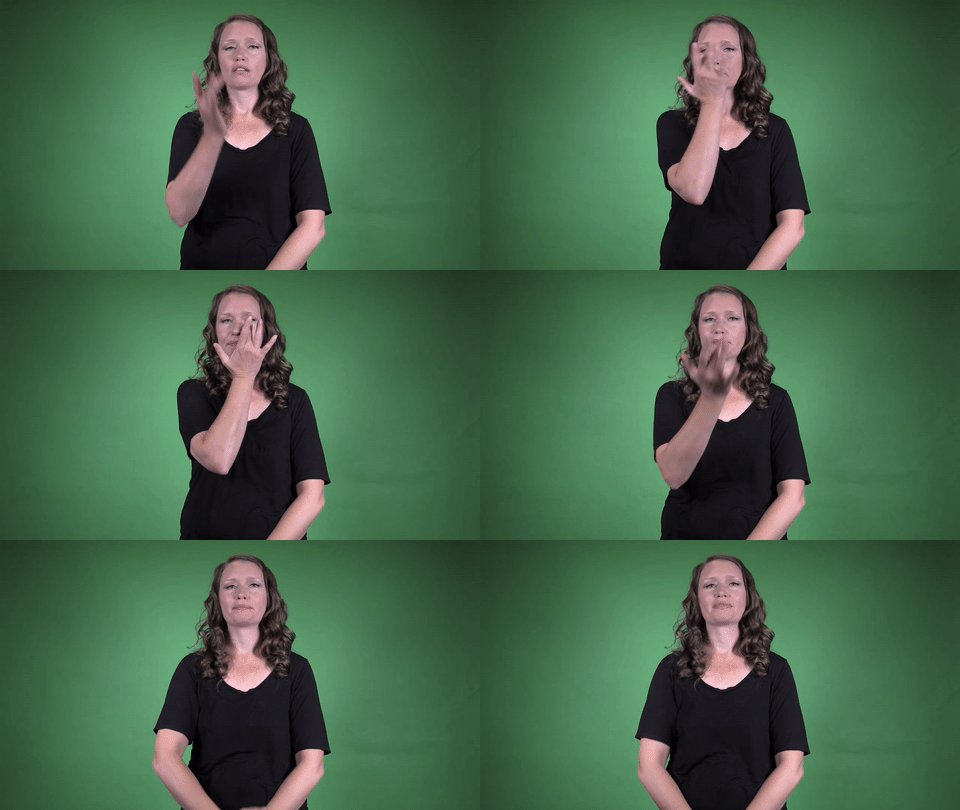
Sign for CONTACT LENSES in ASL | 👁️ ASL Dictionary

Definition: a thin, curved lens placed on the film of tears that covers the surface of your eye

Sign for CONTACT LENSES in ASL

YouTube player

Practice Activities:

To build confidence using the sign for contact lenses in ASL, begin by practicing it in isolation in front of a mirror. Alternate between your left and right eyes to mimic placing each lens. Repeat the motion slowly and clearly to develop precision and consistency.

Incorporate the sign for contact lenses in ASL into daily vocabulary drills. Combine it with signs like CLEAN, DRY, EYE, GLASSES, or SEE to create short phrases. For example, sign “I CLEAN CONTACT LENSES” or “NO GLASSES, USE CONTACT LENSES.” This helps reinforce sentence structure and content relevance.

Practice storytelling by signing a short narrative about your morning routine, including putting on contact lenses. Talk about waking up, going to the bathroom, and inserting your lenses before heading out. Use expression to convey how it feels—comfortable, irritating, or easier than wearing glasses.

Pair up with a practice partner and ask questions using the sign for contact lenses in ASL. For example, ask “YOU USE CONTACT LENSES?” or “CONTACT LENSES HARD PUT-IN?” Take turns answering and elaborating on your experiences to develop conversational flow.

Play a matching game where flashcards with different eye-related vocabulary are paired with their correct ASL translations. Include the sign for contact lenses in ASL in the mix. This reinforces recognition and categorization of related signs.

Watch ASL vlogs or YouTube videos that discuss eye care and see how native signers incorporate the term into fluid signing. Imitate their use of the sign within context. Try pausing the video and signing along to improve your rhythm and clarity.

Create a short skit that involves a trip to the eye doctor. Use role-play to describe the exam, prescription, and choice between glasses or contact lenses. This engages both expressive and receptive ASL skills in a realistic scenario. ‍⚕️ ️

Cultural Context:

Understanding the sign for contact lenses in ASL offers more than just vocabulary; it reflects an inclusive perspective on how personal care and medical tools are expressed in Deaf culture. The sign for contact lenses in ASL is especially relevant in contexts like visiting an eye doctor, talking about vision needs, or even discussing makeup routines in casual conversation.

In American Sign Language, concepts like contact lenses are typically signed through a combination of signs or modified classifiers. This reflects how ASL adapts to incorporate modern technological items and shifts in style or personal health. When learning the sign for contact lenses in ASL, it’s helpful to understand that the concept goes beyond the object—it ties directly into experiences such as maintaining eye health or choosing vision correction methods.

For Deaf and hard-of-hearing individuals, using the correct sign for contact lenses in ASL ensures clear communication with others about specific needs and preferences. Talking about whether one wears glasses or contact lenses can come up in everyday conversations, so being confident with this sign is practical and empowering. The sign is often seen in conversations with friends, educators, or medical professionals.

The growing use of contact lenses across all communities has made this sign more relevant than ever. Whether discussing new types of lenses, difficulties inserting them, or the cost comparison with glasses, the sign for contact lenses in ASL allows for seamless and accessible communication. Using ASL for health and wellness topics helps strengthen autonomy and equal access in healthcare settings.

Deaf representation in health-related media and resources benefits from accurate vocabulary, including the sign for contact lenses in ASL. The more this term is used and understood, the easier it becomes to advocate for services tailored to the Deaf community. Representation matters, especially in scenarios where proper communication can impact patient care or personal health decisions.

It’s also important to note the social and cultural dimensions of wearing contact lenses in the Deaf community. Much like in the hearing world, contact lenses are often chosen for convenience or style. Discussing these choices in ASL, including mentioning the sign for contact lenses in ASL, promotes greater self-expression and connection in peer conversations or educational content.

ASL is a visual language that evolves with technology and culture. Adapting signs for new products or medical innovations helps keep ASL current and expressive. The sign for contact lenses in ASL reflects this dynamic nature, showing how visual language continues to grow with its users’ needs.

Parents, teachers, and interpreters often introduce the sign for contact lenses in ASL early to prepare students for communicating

Extended Definition:

The sign for contact lenses in ASL is a visual representation of both the concept of contact lenses and the action of putting them into the eyes. When using this sign in American Sign Language, it’s important to mimic the placement of a small object into or near the eye. The handshape and motion clearly convey the delicate action typically associated with wearing contact lenses.

This ASL sign helps describe an everyday activity for many people who use contact lenses instead of glasses. It is often signed with a subtle movement near the eye area, typically using the index finger to tap or move toward the eye, indicating the insertion of a contact lens. Depending on context, facial expression and slight variations in handshape may accompany this sign to add clarity.

Knowing the sign for contact lenses in ASL is useful in medical, personal care, or optometry-related conversations. It allows Deaf and hard of hearing individuals to discuss eye care needs, contact lens preferences, or even visit an optometrist with full confidence in clear, visual communication. It becomes essential vocabulary for ASL users who wear contacts or who work in environments where eye health is discussed.

This sign can also be helpful in educational settings where students may need to describe their vision correction methods. For children using ASL in school, expressing the difference between wearing glasses and contact lenses becomes easier when they know the appropriate signs for each.

The sign for contact lenses in ASL may appear different depending on regional dialects or personal signing styles. However, the basic concept remains the same—pointing or gesturing near the eye while referencing something small, like a lens. It is commonly combined with signs for eye, glasses, or vision to provide more context when needed.

When learning ASL vocabulary related to health and body care, this sign is often taught alongside terms like glasses, vision test, and optometrist. These signs create a complete set of phrases and interactions for those learning American Sign Language as a second language or who are teaching it to young learners. Seeing the sign for contact lenses in ASL used in real-life conversation reinforces understanding and builds confidence in usage.

In medical interpreting, knowing the sign for contact lenses in ASL ensures clients get accurate information during appointments. Skilled interpreters use this sign when translating between patients and healthcare providers, making sure nothing gets lost in communication. It helps foster independence and clear communication in healthcare discussions.

For ASL video blogs, tutorials, or Deaf community content, the sign for contact lenses in ASL is a great topic to

Synonyms: Contact lenses, corrective lenses, vision lenses, eye lenses, optical lenses

Educational resources: Find related learning materials in our course bank!

Want more? Check out some of our popular learning activities on the homepage!

Need to look up a sign? Use our highly rated dictionary: https://aslinteractive.com/best-asl-dictionary/

Follow us on tiktok: https://www.tiktok.com/@aslinteractive. More social media links at the bottom of this page!

Long-tail Keywords: what is the sign for contact lenses in asl, how do you sign contact lenses in american sign language, contact lenses asl sign

Categories:

tags: contact lenses ASL sign, how to sign contact lenses in ASL, ASL dictionary contact lenses, learn contact lenses in ASL, contact lenses American Sign Language

Parameters

*Handshape*:

The handshape for the sign for CONTACT LENSES in ASL typically uses the dominant hand in a modified G-handshape , resembling how one might hold a small object like a contact lens. The movement mimics placing a contact lens on the eye, using gentle precision near the face.

This handshape captures the delicate act tied to the sign for CONTACT LENSES in ASL, helping to visually convey the specific task associated with wearing lenses ️. It’s essential to maintain a relaxed but precise grip to reflect the correct meaning.

*Palm Orientation*:

For the sign for CONTACT LENSES in ASL, both hands typically form a flat “O” handshape, mimicking the shape of contact lenses. The palms face toward the signer, with fingers and thumbs forming a circular shape as if holding an invisible lens close to the eye area.

This palm orientation supports the natural motion of bringing contact lenses toward the eyes. The sign for CONTACT LENSES in ASL visually represents the act of placing lenses on the eyes, with palms angled inward for accuracy. ️ ️

*Location*:

The sign for CONTACT LENSES in ASL is typically performed near the face, specifically close to the eyes. The dominant hand moves toward the area just below or at the lower eyelid, mimicking the action of inserting a contact lens.

This location helps visually represent the concept behind the sign for CONTACT LENSES in ASL, making it more intuitive. Because the eyes are the focal point, maintaining correct positioning near them is key for clarity and accuracy.

*Movement*:

Using both hands in a modified “G” handshape (thumb and index finger slightly apart), bring the tips of each hand close to the eyes, mimicking the action of placing lenses on the eyeballs. The movement may involve a gentle inward motion toward each eye, as if delicately inserting contact lenses.

The Sign for CONTACT LENSES in ASL clearly reflects the action commonly associated with putting on lenses. This sign may be followed or preceded by the sign for EYE, depending on context.

*Non-Manual Signals*:

When using the sign for CONTACT LENSES in ASL, the facial expression should be neutral yet slightly focused, as though handling something delicate. Eyebrows may remain relaxed, and the eyes should look toward the finger as it approaches the eye area, mimicking lens placement.

Maintaining soft eye contact and a gentle demeanor helps reinforce the careful gesture used in the sign for CONTACT LENSES in ASL. Avoid exaggerated expressions, as the movement itself is precise and calm.

*Prosody, Dominant/Non-Dominant Hand*:

The sign for CONTACT LENSES in ASL uses both hands, typically with the dominant hand mimicking the motion of placing a lens in the eye. The dominant hand is usually in a modified “G” handshape, approaching the eye gently as if inserting a contact. The non-dominant hand is generally not involved unless emphasizing the location of the lens.

Facial expressions and eye focus play a big role in clearly conveying the sign for CONTACT LENSES in ASL ️. Because this sign mimics a real-world action, prosody is often natural and fluid, highlighting the precision required in placing lenses.

Tips for Beginners:

When learning the sign for contact lenses in ASL, it’s essential to remember that this concept often uses the sign for “contact” combined with a gesture toward the eye to indicate the lens component. One common approach is to make a small pinching motion between your thumb and index finger (like holding a tiny object) and bring that motion close to your eye, mimicking the way people actually place contact lenses. Start slowly so your hand movement is smooth and controlled, keeping it visually clear.

Practice the sign in front of a mirror to ensure your handshape is accurate and the motion is not exaggerated. Overdoing the gesture toward the eye can look unnatural or lead to confusion with other signs. Be mindful of facial expressions—they can support the meaning but shouldn’t be overdone. A slight squint or focus of the eyes can help clarify the meaning when paired with the correct sign for contact lenses in ASL.

One common issue beginners face is not differentiating clearly between the sign for glasses and the sign for contact lenses. Glasses involve outlining frames on your face, while contact lenses include a more delicate placement near the eye. Think of how tiny a contact lens is and let that guide how gentle and precise your hand motion should be.

Another helpful tip is to fingerspell the word “contacts” or “lenses” if unsure how to convey the idea clearly or if signing in a more formal context. The sign for contact lenses in ASL may vary slightly depending on region or individual preference, so exposure to different signers will also help expand your understanding.

Use repetition and context-rich practice—such as explaining your morning routine or describing assistance putting in lenses—to build confidence. ️ Repetition in real-life scenarios deepens retention and helps make the sign for contact lenses in ASL second nature.

Connections to Other topics:

The sign for CONTACT LENSES in ASL connects closely to signs related to eye care and vision, such as GLASSES, EYE, and EYE DOCTOR. Learners will find that understanding how to sign parts of the face and items that relate to personal care enhances comprehension, especially in medical or daily routine contexts. It’s beneficial to become familiar with signs that reference the face, as directional movements near the eyes are a common feature of signs related to vision.

There is a natural contextual link between the sign for CONTACT LENSES in ASL and signs like VISION, BLURRY, or CLEAR due to how people describe eye conditions. In conversation, signers can compound signs for example EYE + DOCTOR + CHECK to convey an eye appointment, or incorporate fingerspelling for brand names like FS:ACUVUE or FS:DAILIES when talking about specific products. These compound or combined signs allow for efficient and clear expression.

This sign also ties well into the broader category of hygiene and grooming. Signs such as WASH FACE, BRUSH TEETH, or PUT ON can be used together with the sign for CONTACT LENSES in ASL to describe a morning routine. Learners benefit from understanding these sequences to talk about daily habits or health-related tasks.

Comparing the sign for CONTACT LENSES in ASL with the sign for GLASSES can help clarify similarities and differences in how assistive devices for vision are portrayed. GLASSES is more visible and uses a broader handshape, while contact lenses require smaller, more specific movements, often near the eye, reflecting the delicacy of the item. Developing spatial and movement awareness near the face supports clarity in overall signing.

Using the sign for CONTACT LENSES in ASL opens up opportunities to discuss aesthetics, comfort, and maintenance. Signs like DRY, HURT-EYES, or CLEAN are commonly used in these discussions, enhancing vocabulary development around health and object use. These connections help learners talk about personal experiences more fluently in ASL.

Summary:

The sign for CONTACT LENSES in ASL combines gestures referring to the eye and to the act of touching or applying something small. Typically, it involves using the index finger to mimic a placement motion near the eye, resembling how one would insert contact lenses. Some signers also use a double-location format, pointing first at one eye and then at the other.

This sign is generally contextual. If it’s unclear in conversation, fingerspelling the word “CONTACT” followed by “LENSES” can clarify the meaning. Many ASL users fingerspell “CONTACT” and then use a gesture indicating the lens being placed in the eye.

The sign for CONTACT LENSES in ASL often includes non-manual markers such as a focused expression or slight squint to emphasize the precision and care this action requires. Because using contact lenses is a careful, deliberate process, the sign often mirrors this attention to detail. Facial expressions help distinguish this from similar motions used in different contexts.

In ASL grammar, the sign for CONTACT LENSES in ASL functions as a noun. It can be modified by classifiers or spatial references for pluralization or ownership. For example, one could indicate “my contact lenses” vs. “her contact lenses” by showing directionality or possessive indexing.

The sign is rooted in conceptual accuracy rather than sound-based translation from English. Unlike spoken languages, ASL uses visual cues and mimetic gestures. The gesture made during the sign invokes the common experience of touching one’s eye to add or adjust lenses.

Because contact lenses are a recent invention, the sign incorporates modern adaptations rather than deriving from older ASL traditions. This is common for technological or medical objects. Over time, more standardized signs have emerged among younger or urban signers to make communication quicker and more clear.

In Deaf culture, the sign for CONTACT LENSES in ASL may carry broader meanings. Some may associate it with accessibility, appearance, or vision correction. It carries no stigma and is often used in conversations about healthcare or personal grooming.

There is also a subtle visual distinction between this sign and the sign for GLASSES. The latter usually involves mimicking the frame with both hands near the temples or over the nose. In contrast, CONTACT LENSES is more intimate and eye-focused.

Grammatical placement is important. A sentence might read: I WEAR CONTACT LENSES or I NEED TO CLEAN CONTACT LENSES. The sign is generally introduced early in phrases if it is the subject matter, especially in topic-comment structures.

The sign supports classifiers in rich narrative discourse. A signer discussing losing a lens might use location markers near the eye and illustrative classifiers to show the lens falling. This visual storytelling is a hallmark of ASL’s descriptive power.

In linguistics, this sign shows how ASL incorporates spatial metaphors and embodied cognition. The hand’s position directly correlates to an action on the human body. This physical mapping is often seen in signs for body-related items or tasks.

There is a minor variation depending on region or individual preference. Some prefer fingerspelling the plural form LENSES while others use a singular contact-lens motion duplicated twice. Still, the essential components remain recognizable across dialects.

The sign for CONTACT LENSES in ASL aligns with the community’s value of visual clarity. Vision aids like glasses and contacts often play a role in accessibility, even within Deaf culture, since visual cues are critical for navigation and communication.

Users often integrate this sign into hygiene routines or morning conversations. For example, a person might say: MORNING WAKE-UP, SHOWER, CONTACT LENSES, indicating a sequence of activities. This context-driven use of signs is common in ASL’s everyday flow.

Representation matters in sign usage. As contact lenses became more popular in society, the Deaf community adapted an efficient sign to reflect this modern need. It shows how ASL continually evolves without sacrificing its visual depth.

This sign rarely includes mouthing unless clarification is necessary. While mouthing English equivalents is optional in ASL, some may mouth parts of “contacts” for emphasis or with hearing audiences. Still, the primary communication is through handshape and motion.

Language learners benefit from understanding how this sign is built. By analyzing the eye-point and contact gesture, students gain insight into how ASL encodes physical interaction and locational parameters. It provides a valuable real-world illustration of spatial grammar.

Parents teaching their Deaf children about hygiene will often introduce this sign early. It’s functional and practical. Used alongside other signs for bathroom items or self-care, it forms part of a child’s early conceptual lexicon.

The sign also ties into health-related discussions. Optometrists or healthcare professionals using interpreting services must be fluent with the sign for CONTACT LENSES in ASL. This ensures accurate and empathetic communication in clinical settings.

Over time, signers may develop personalized versions. If someone has disposable lenses, they may sign THROW-AWAY before or after using the

Want more? Check out some of our popular learning activities!

ASL Interactive Resources

ASLInteractive YouTube Channel

Follow us on tiktok: @aslinteractive.com

Follow us on Instagram: aslinteractive

Facebook page: aslinteractive

Facebook group: aslinteractive

LInkedIn: ASL Interactive LLC

Twitter: @ASL_interactive

*Some information on this page is AI-generated. AI can make mistakes. Please check the information.

Sign for CONTACT LENSES in ASL

Responses