Sign for COOKIE in ASL | 🍪 ASL Dictionary

Definition: A small baked treat.

Sign for COOKIE in ASL

YouTube player

Practice Activities:

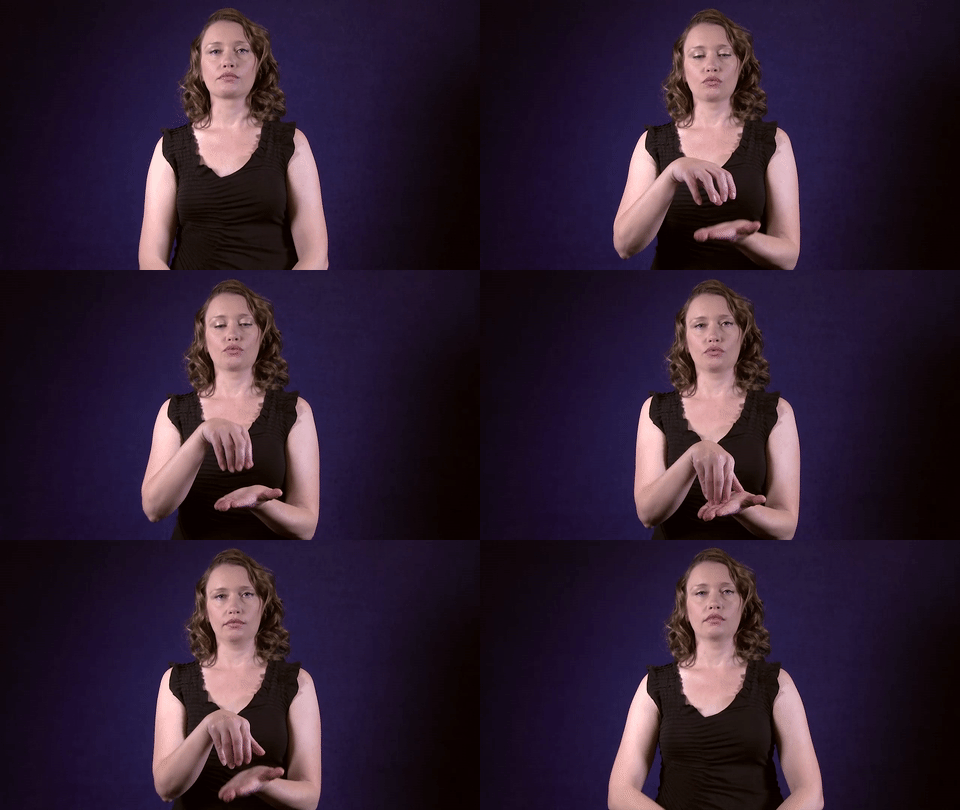
To practice the sign for COOKIE in ASL, start by isolating the movement and handshape. Form your dominant hand into a bent “claw” shape and mimic the motion of cutting a round cookie out on your non-dominant palm, which is held flat. Repeat the movement several times in front of a mirror to check for fluency and clarity.

Once comfortable, practice using the sign in short sentences. For example: I like cookie. She baked cookie. He ate a big cookie. Say or sign each sentence slowly at first, then try to speed up while keeping the sign clear. Record yourself signing to track your progress.

Work with a partner if possible. One person can act out different cookie-related scenarios, such as eating a cookie, offering a cookie, or baking cookies. The other person can try to describe what is happening using the sign for COOKIE in ASL along with other relevant signs. Switch roles to challenge each other.

Try storytelling practice by creating a short narrative. For example, a story about a child who sneaks a cookie from the kitchen or a grandma who makes chocolate chip cookies every weekend. Sign the whole story, incorporating the sign for COOKIE in ASL every time it appears in the plot.

You can also categorize cookie types while practicing. Sign names of cookies and use classifiers to describe their shape, size, or texture. Pair this with real or imagined cookie visuals to connect signs to real-world concepts. Use the COOKIE sign with matching adjectives like delicious, big, soft, round, or sweet.

Flashcard drills are another fun solo activity—mix in signs for food items and identify COOKIE when it appears. These varied approaches will help learners build confidence with the sign for COOKIE in ASL, both in isolation and conversational use.

Cultural Context:

Cookies are a beloved treat across many cultures, and the sign for COOKIE in ASL brings this sense of comfort and familiarity into the Deaf and signing community. When using the sign for COOKIE in ASL, you’re incorporating not just a snack but an emotional connection to family kitchens, celebrations, and shared moments.

The sign for COOKIE in ASL mimics the act of cutting out cookie shapes with a cookie cutter, giving it a visually iconic meaning. This sign is used in a variety of settings, from casual home conversations to classroom discussions about food. It’s especially popular with young learners and during holiday seasons when cookies play a big role.

Food signs are a key part of ASL vocabulary because food is such a universal subject. The sign for COOKIE in ASL appears early in language development for many signing children, often alongside other favorites like milk, apple, and candy. This perfectly reflects how language and culture are intertwined, even from a young age.

In Deaf culture, food often features in social gatherings, and the sign for COOKIE in ASL is common at events, potlucks, and family get-togethers. Whether someone is asking if cookies are available or expressing their love for baking, the sign helps convey excitement and warmth.

ASL is rich with signs that have cultural and visual roots, and the sign for COOKIE in ASL is an example of how classifiers and visual concept mapping work in the language. The circular motion that mimics shaping a cookie gives deeper meaning to the sign, making it more than just a translation — it’s a cultural expression.

Children often learn the sign for COOKIE in ASL while playing, role-playing, or preparing food in educational settings. It’s frequently used in early childhood education and plays a role in helping young signers connect to everyday routines. Teachers and parents introduce the sign in fun, engaging contexts.

In ASL storytelling, the sign for COOKIE in ASL is often used in narratives involving baking, surprises, or rewards. Because signing is so expressive, signs like COOKIE bring stories to life in an unmistakable way. These cultural narratives help preserve language and create shared experiences within the Deaf community.

The sign for COOKIE in ASL also shows up in signed music and videos designed for kids and families. ASL performers often use food signs to keep their audience interested and visually engaged, and COOKIE is one of the more animated and fun signs to include.

Signing about food brings more than words to life; it also brings sensory experiences. The sign

Extended Definition:

The sign for cookie in ASL is a fun and engaging sign typically taught to young children as they learn both American Sign Language and everyday vocabulary. It combines a simple hand movement with a visual representation of shape and action, making it easy to remember and use. The sign is commonly used in educational settings, storytelling, and daily communication, especially during snack time or when talking about baking.

To produce the sign for cookie in ASL, start by forming your non-dominant hand into a flat surface, like a plate. Then, make a claw shape with your dominant hand and pretend you are pressing down and giving a little twist as if you’re cutting out a cookie from dough. This twisting motion mimics using a cookie cutter, which helps reinforce the concept of a cookie.

The sign for cookie in ASL is often used by parents, teachers, and caregivers during interactions with children. It can also help encourage communication in deaf or hard-of-hearing children who are beginning to express their preferences. Using signs like cookie allows kids to make requests and engage more deeply in social situations involving food or treats.

In Deaf culture, sharing food is a meaningful act, and using the sign for cookie in ASL adds to this communication experience. It provides an opportunity to connect language with everyday experiences, helping bridge the gap between seeing and understanding. Whether it’s about asking for a chocolate chip cookie or baking together, this sign becomes a key tool in inclusive interaction.

Learning the sign for cookie in ASL also gives language learners imagery that connects with their senses. Because cookies are a popular and beloved food, students often find this sign to be one of the most enjoyable to learn. It’s especially helpful in ASL classes where food-related vocabulary is introduced.

You might see variations in how people use the sign for cookie in ASL depending on their region or personal signing style. However, the core motion involving the circular twisting action remains consistent. Understanding these subtle differences can help learners better navigate sign language communication in diverse settings.

The sign for cookie in ASL plays an important role in both instructional and recreational settings. It’s a favorite in classrooms, libraries, and homes during storytelling sessions or themed lessons around cooking and food. Incorporating the sign into regular lessons also strengthens vocabulary recall and supports multisensory learning.

Digital tools and online ASL dictionaries have made it even easier to learn the sign for cookie in ASL. Animated gifs, videos, and step-by-step visual guides offer learners clear demonstrations of hand shapes and movement

Synonyms: biscuit, sweet treat, baked good, confection, snack

Educational resources: Find related learning materials in our course bank!

Want more? Check out some of our popular learning activities on the homepage!

Need to look up a sign? Use our highly rated dictionary: https://aslinteractive.com/best-asl-dictionary/

Follow us on tiktok: https://www.tiktok.com/@aslinteractive. More social media links at the bottom of this page!

Long-tail Keywords: what is the sign for cookie in ASL, how do you sign cookie in American Sign Language, ASL sign for cookie

Categories:

tags: Cookies, Food, Dessert, Snacks, Sweet Treats

Parameters

*Handshape*:

The dominant hand in the sign for COOKIE in ASL forms a curved claw handshape, similar to a loose “C” shape. The non-dominant hand stays flat, palm up, representing a cookie sheet or surface.

To create the sign for COOKIE in ASL, the curved dominant hand moves in a twisting motion and taps the palm of the non-dominant hand, as if cutting out a cookie. The shifting of the clawed hand mimics the action of stamping a cookie cutter.

*Palm Orientation*:

The palm orientation for the sign for COOKIE in ASL involves the dominant hand in a claw shape with palm facing down. The non-dominant hand remains flat, palm up, acting like a plate. The claw-shaped dominant hand twists slightly back and forth on the palm of the non-dominant hand, mimicking the motion of cutting out a cookie shape. This natural movement supports clarity in the sign for COOKIE in ASL .

*Location*:

The sign for COOKIE in ASL is made in front of the body at about chest level, slightly in front of the torso. The dominant hand, shaped like a claw, mimics a cookie cutter motion onto the palm of the non-dominant hand, which stays flat and horizontal. This location is central enough to be clearly visible and allows for the curved motion that represents cutting a cookie.

When using the sign for COOKIE in ASL, ensure that your hands remain within the signing space comfortably in front of you. Positioning it at chest level helps maintain clarity and fluidity, making the sign easy to identify and understand during conversations.

*Movement*:

To make the sign for COOKIE in ASL, form your non-dominant hand into a flat palm facing up. Curve your dominant hand into a claw shape and place it on the center of your palm. Twist the claw slightly as if mimicking the motion of cutting cookie dough with a cutter .

Then lift your dominant hand, slightly reposition it, and repeat the twisting motion again in a different spot. The motion helps visually reinforce the concept, making the sign for COOKIE in ASL easy to remember and recognize.

*Non-Manual Signals*:

When demonstrating the sign for cookie in ASL, the facial expression should remain relaxed and neutral. A soft, friendly smile often matches the context, especially if referring to a sweet treat.

Eyebrows generally stay in a natural position since the sign for cookie in ASL is commonly used in everyday conversation. If asking a question about cookies, you may raise your eyebrows slightly to match the inquisitive tone.

*Prosody, Dominant/Non-Dominant Hand*:

The sign for COOKIE in ASL uses the dominant hand in a claw shape to represent a cookie cutter. The non-dominant hand is flat, palm facing up, acting as a surface or tray. The dominant claw hand taps the non-dominant palm, then twists slightly and taps again, mimicking the motion of cutting cookies from dough.

When performing the sign for COOKIE in ASL, keep hands at chest level and movements small but clear. This sign vividly captures the act of shaping cookies and is a cheerful, visual representation. Remember to maintain relaxed but accurate finger placement.

Tips for Beginners:

When learning the sign for COOKIE in ASL, focus on the motion and shape of the dominant hand. This sign involves pressing a curved hand (representing a cookie cutter) into the palm of your non-dominant flat hand. Beginners often forget to maintain a slight curve in their fingers, which is essential for the movement to resemble placing and cutting a cookie shape into dough.

Practice the up-and-down motion to make it resemble the action of cutting out a cookie with a cutter. One common mistake is turning the wrist or moving the hand in strange directions—keep the motion clean and deliberate. The more consistent your motion, the more easily others can recognize the sign for COOKIE in ASL.

Be mindful of hand positioning. Your non-dominant hand should stay flat and face up, serving as the “tray” or “dough.” Try using a mirror to make sure you are placing the curved hand squarely into the palm and not to the side. Angle and clarity matter a lot in sign language, especially with object-based signs like this.

Slow down your movement when practicing the sign for COOKIE in ASL. Rushing leads to sloppy signs, which can confuse viewers. It’s better to sign slowly and accurately than quickly and incorrectly. Repetition is key—try practicing this sign five times a day for a week to build hand memory.

If possible, watch Deaf signers or signing videos from trusted ASL resources to compare your technique. Seeing the sign used in real ASL conversations can help you refine the size, speed, and emotion behind it. Eventually, you’ll not only master the sign for COOKIE in ASL, but become more confident in your ability to interpret and convey everyday words with greater fluency.

sign for COOKIE in ASL, how to sign COOKIE in ASL, ASL sign COOKIE, sign language COOKIE sign, American Sign Language COOKIE

Connections to Other topics:

The sign for COOKIE in ASL connects closely to signs involving food and kitchen-related vocabulary. It often appears in daily conversations such as discussing snacks, desserts, or meal preparation. Knowing this sign enhances your ability to describe specific foods during mealtime discussions or while teaching children about food choices .

This sign also relates to signs like CAKE, BREAD, and DESSERT, all of which use variations of handshapes and movements that depict the preparation or form of the food. For example, the circular motion in the sign for COOKIE mimics a cookie cutter, which is a visual theme echoed in signs like CUT or SLICE. These movement patterns help reinforce the link between similar culinary categories.

In expressive ASL, the sign for COOKIE in ASL can be compounded with other signs to describe flavors or traits, such as CHOCOLATE COOKIE, where the sign for CHOCOLATE is made first followed by COOKIE. You might also see it combined with FAVORITE to describe preferences, like FAVORITE COOKIE, or in phrases such as WANT COOKIE, which is common in teaching environments.

Contextually, this sign can also be used metaphorically or humorously. In storytelling or playful exchanges, COOKIE may appear in idiomatic or symbolic roles, like calling someone a “smart cookie,” which would be adapted using signs like SMART and COOKIE with expressive facial grammar to convey tone.

The sign for COOKIE in ASL is an ideal anchor when teaching thematic units on food, holidays, or baking. It supports vocabulary expansion into nouns like OVEN or INGREDIENT and verbs like BAKE or EAT. In group settings, this sign can be used in classroom games or signed recipes, offering learners both practical and playful ways to engage with ASL.

Summary:

The sign for COOKIE in ASL reflects both a specific motion and a culturally relatable concept. To sign it, the dominant hand, shaped in a claw or slightly curved “C” handshape, taps and slightly twists on the upturned palm of the non-dominant hand. This conveys the action of pressing a cookie cutter into dough—a clear visual metaphor.

The sign is iconic in nature, directly mimicking the physical process associated with making cookies. This iconicity helps beginners and children remember it easily. It’s highly visual and represents a common experience for many people, which adds to its accessibility and learning potential.

The sign for COOKIE in ASL captures not only the idea of the baked treat but also conveys a sense of warmth, home, and celebration. Culturally, cookies are often tied to holidays, hospitality, and childhood. This vitality is part of what makes the sign engaging for both signers and viewers.

Grammatically, COOKIE is a noun in ASL and is typically used in declarative statements, questions, or commands. It can also appear in its plural forms contextually, depending on sentence structure and nonmanual markers. Tone and emotion in the face can adjust the meaning from basic to enthusiastic, like showing desire or excitement over cookies.

Modifiers such as “chocolate chip” or “oatmeal” are usually fingerspelled before the sign for COOKIE in ASL. For example, CHOCOLATE comes before COOKIE to clarify the type. Descriptions using classifiers or additional contextual signs may also follow for elaboration.

Facial expressions go a long way in signing COOKIE expressively. Raised eyebrows might indicate a question like “Do you want a cookie?” while exaggerated facial joy might imply love or craving. ASL relies not only on hands but on the upper body and face to create full linguistic expression.

The sign for COOKIE in ASL can be incorporated into educational settings, especially with young learners, to teach both language and concepts of food or nutrition. It’s often used in pre-schools and early sign language curricula. The tangible connection to real-life experiences strengthens comprehension.

In both home and school settings, signing COOKIE can encourage communication about wants, needs, and turn-taking. It serves a functional role in communication development for both hearing and Deaf children. The real-world association with the item helps reinforce its sign’s retention.

From a linguistic standpoint, COOKIE demonstrates iconicity and spatial referencing. The movement mimics the object’s interaction, and placement in space shows grammatical structure. This helps both signed language learners and linguists study language acquisition and cognitive development.

Applied linguistics explores how signs like COOKIE support second language acquisition, especially as learners engage in kinesthetic and visual pathways. Using iconic signs improves memory and concept formation. This has been particularly useful in hearing learners of ASL.

In Deaf culture, the sign for COOKIE in ASL may come up in social, familial, or festive contexts, making it a socially rich term. Baking cookies together or sharing them can be tied to traditions, and the sign reflects both domestic and communal moments. This cements its place in everyday ASL use.

ASL storytelling often features everyday objects like cookies to engage children and promote literacy. Visual descriptions involving COOKIE might help build vocabulary while encouraging narrative skills. It teaches concept development and sequential thinking during stories or signed books.

Sometimes signs related to sweetness like CAKE, CANDY, or ICE CREAM appear near the mention of COOKIE, showing how food-related signs cluster semantically. This lexical grouping aids in vocabulary expansion. It also enhances cultural understanding of preferences and celebration-related foods.

The sign for COOKIE in ASL highlights the importance of shared sensory experiences in sign formation. Creating a sign to visualize the act of stamping out a cookie helps deepen experiential learning. This embodies the hands-on nature of ASL as a complete language system.

Visually, COOKIE offers a great example of how classifiers in ASL can be used afterward. After signing COOKIE, one might use a classifier to describe it being eaten, passed, or crumbled. These extensions allow flexibility and add expressive richness.

In casual Deaf discourse, COOKIE might be used humorously or metaphorically, especially in family settings. For instance, “He got too many cookies!” could suggest overindulgence or sweetness used figuratively. This showcases ASL’s capability for abstract and playful use.

Related signs like MILK, CAKE, or BREAD often coexist in themed discussions, like cooking or eating. This thematic cohesion helps language learners create mental categories. In ASL classes, such signs are often taught together for maximal engagement.

During holidays, COOKIE in ASL becomes particularly common, especially around Christmas or Hanukkah where baking traditions flourish. Social ASL interactions often include these familiar signs to convey celebration and activities. It invites cultural conversations and depth.

Emergent bilingual Deaf students benefit from signs like COOKIE in ASL being taught alongside their English counterparts. The cueing of physical motion and visual metaphor eases cross-linguistic

Want more? Check out some of our popular learning activities!

ASL Interactive Resources

ASLInteractive YouTube Channel

Follow us on tiktok: @aslinteractive.com

Follow us on Instagram: aslinteractive

Facebook page: aslinteractive

Facebook group: aslinteractive

LInkedIn: ASL Interactive LLC

Twitter: @ASL_interactive

*Some information on this page is AI-generated. AI can make mistakes. Please check the information.

Sign for COOKIE in ASL

Responses