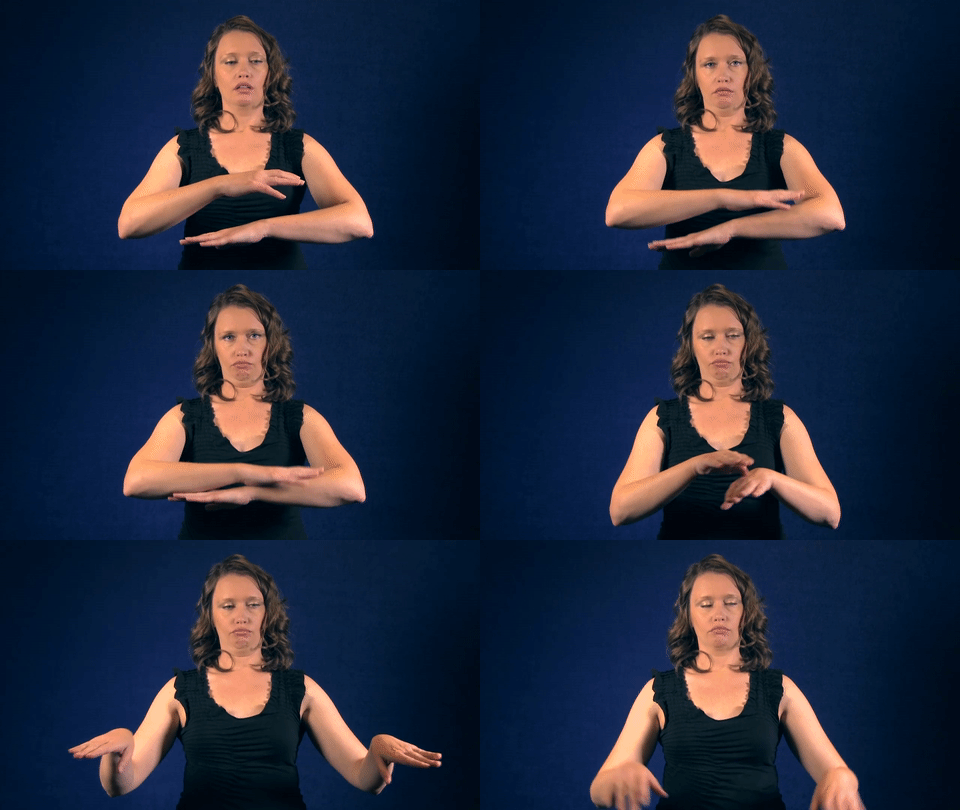
Definition: A flat surface on which goods are sold or served.
Sign for COUNTER in ASL

Practice Activities:
To master the sign for COUNTER in ASL, begin by practicing it in isolation in front of a mirror. Watch your handshape and movement carefully. Try alternating between fast and slow repetitions to build muscle memory and precision.
Use flashcards to match the sign for COUNTER in ASL with images of various types of counters, such as kitchen counters, check-out counters, or ticket counters. Label different surfaces in your home and walk around signing COUNTER when you see them to create context-based practice.
Practice forming simple sentences like “I cleaned the counter” or “She leaned on the counter.” Signing short phrases repeatedly helps reinforce both the vocabulary and sentence flow. Say the sentence out loud, then sign it to connect spoken language with ASL.
Create storytelling prompts such as describing a day working behind a counter or cooking on a kitchen counter. Include the sign naturally as you tell the story in ASL. Record your signing and review it to check accuracy and expressiveness.
Try partner activities where one person describes a scene involving a counter, and the other signs what is being described. Use objects or create skits such as checking out at a store, making sure to include the sign for COUNTER in ASL each time it comes up.
Using a digital or physical journal, draw or take pictures of different types of counters you see in your daily life. Describe each situation using ASL and include the sign in full sentences. Reflect daily to see consistent progress.
In classroom or group settings, play charades where others guess what kind of counter you’re referring to based on your signs and body language. This introduces variety and improves receptive understanding of the sign for COUNTER in ASL through playful repetition.
Cultural Context:
In American Sign Language, the sign for COUNTER in ASL can carry multiple meanings depending on context. It is important to consider the situation and cultural background when using this sign, as it can refer to a surface like a kitchen counter, keeping track of numbers, or going against something or someone.
The cultural context of the sign for COUNTER in ASL is rooted in visual and spatial language. Deaf culture emphasizes clarity and accuracy, so the use of the sign for COUNTER in ASL must fit clearly into the conversation. Whether describing a physical object like a work counter or a conceptual idea like countering an argument, context is key.
When used to describe a kitchen or store counter, signers often incorporate real-world spatial referencing. For instance, pointing to an actual surface while signing helps provide clarity. The sign for COUNTER in ASL in this setting may be paired with classifiers to label the flat surface or the activity on it, such as food preparation or exchanging money at a business.
In numerical contexts, the sign for COUNTER in ASL may be used in descriptions involving tracking, counting, or maintaining tallies. This is especially common in educational or sports settings, where keeping score or counting attendance is essential. Deaf individuals rely on precise signs like COUNTER to navigate these settings with clear communication.
The sign can also be used in situations where someone is resisting or opposing an idea or argument. Culturally, debate and expressive discourse are common in the Deaf community, particularly in social and academic spaces. Using the sign for COUNTER in ASL to oppose a viewpoint is not aggressive; rather, it is a valued part of interactive discussions.
Understanding the tone of the conversation is crucial when using the sign. A physical surface COUNTER can be shown with a classifier that holds shape and location, while a conceptual use may involve direction toward the speaker or subject being opposed. These subtle differences in use convey important cultural and linguistic cues.
Students learning the sign for COUNTER in ASL benefit from exposure to real-life interactions within the Deaf community. Observing people signing in shops, at school, or during debates helps illustrate how flexible and meaningful this sign is. ASL is not just a translation of English but a unique language, and signs like COUNTER shift dynamically depending on meaning.
The sign for COUNTER in ASL reflects not only the situation but also the signer’s intent. It is common within the Deaf world to pair facial expressions and body movements with the sign to reinforce clarity.
Extended Definition:
The sign for COUNTER in ASL can vary depending on the context. In American Sign Language, COUNTER might refer to a kitchen countertop, a customer service counter, or even the act of counting, depending on the sentence. This is why understanding the full context of the conversation is essential when interpreting or using this sign.
When referring to a physical counter, such as a kitchen or store counter, the sign for COUNTER in ASL typically uses a flat handshape. This hand movement is usually done in front of the body, demonstrating the spatial concept of a flat horizontal surface. The movement and space give clues about the nature and size of the counter being described.
If someone is referring to a service counter, like the kind found in a bank, post office, or airport, the sign might incorporate a different facial expression or be paired with other signs that make the setting clearer. Adding signs like BANK, HELP, or SERVICE alongside the sign for COUNTER in ASL improves clarity. Facial expressions and body positioning also provide more visual cues in these cases.
It’s important not to confuse COUNTER with COUNT, as they have different meanings and signs in ASL. Even though they sound the same in English, these concepts are shown differently in American Sign Language. The sign for COUNT involves finger movements that represent the act of tallying or numbering items rather than a physical structure.
The sign for COUNTER in ASL is often taught in beginner and intermediate ASL classes because it’s commonly used in everyday conversation. Whether you’re talking about placing something on a kitchen counter or discussing customer service experiences, this sign proves useful. Learning its correct context strengthens your ASL vocabulary and signing fluency.
Regional variations may affect how the sign for COUNTER in ASL is expressed. Just like spoken languages, sign languages can have slight differences depending on where you are or who you’re speaking with. Engaging with Deaf communities and watching multiple signers will help you recognize these subtle differences.
When signing COUNTER, keep your sign placement accurate within the signing space. Using directional concepts and space appropriately helps convey the full meaning of your message. Practice with other signs about room settings, furniture, and structures can enhance comprehension.
Video resources and sentence examples are helpful to reinforce understanding of the sign for COUNTER in ASL. Watching fluent signers demonstrate the sign in action can make it easier to distinguish between its different uses. It’s beneficial to study in context, rather than trying to memorize isolated signs.
Whether you are learning ASL
Synonyms: oppose, resist, dispute, rebut, contradict
Educational resources: Find related learning materials in our course bank!
Want more? Check out some of our popular learning activities on the homepage!
Need to look up a sign? Use our highly rated dictionary: https://aslinteractive.com/best-asl-dictionary/
Follow us on tiktok: https://www.tiktok.com/@aslinteractive. More social media links at the bottom of this page!
Long-tail Keywords: What is the sign for counter in ASL?, How do you sign counter in American Sign Language?, ASL sign for counter
Categories:
tags: Numbers, Counting, Mathematics, Language Learning, Everyday Activities
Parameters
*Handshape*:
The handshape in the sign for COUNTER in ASL typically involves both hands using flat B-handshapes, palm-down. The hands are moved outward, as if outlining the shape or top of a physical surface like a countertop or table.
This sign uses clear hand positioning to visually represent a horizontal surface. When using the sign for COUNTER in ASL, make sure the fingers are extended and together, and the thumbs are tucked alongside the palms for proper structure.
*Palm Orientation*:
The palm orientation for the sign for COUNTER in ASL depends on the intended meaning—whether referring to a surface or an act of counting. For a kitchen counter, the dominant hand usually mimics a flat surface, with the palm facing down, moving sideways across an invisible plane.
If using the sign for COUNTER in ASL to suggest tallying or counting, fingers may flick outward from the thumb, with the palm facing in toward the signer. Proper orientation enhances meaning and clarity in context.
*Location*:
The sign for COUNTER in ASL is typically performed in the neutral space in front of the torso, slightly below chest level. Depending on the version used, hands may move outward from the center of the body, emphasizing surface dimensions.
Some variations of the sign for COUNTER in ASL may incorporate contact with the flat palm to indicate a countertop surface. Always ensure an appropriate signing space that matches the visual shape or function of a counter.
*Movement*:
To produce the sign for COUNTER in ASL, form both hands into flat B-handshapes with palms facing down, about shoulder-width apart. Move both hands forward together in a slight arc, as if outlining a flat surface like a kitchen counter .
The movement should be smooth and parallel, resembling the top of a counter. The sign for COUNTER in ASL may also include a slight pause at the end to indicate the boundary of the surface.
*Non-Manual Signals*:
When expressing the sign for COUNTER in ASL, the facial expression should remain neutral or slightly thoughtful, depending on the meaning—such as a kitchen counter or when used to describe counting or opposing something. Raised eyebrows and a slight head tilt may accompany questioning or differentiating contexts for clarity.
For spatial reference, subtle eye gaze shifts may occur when illustrating a physical countertop or contrasting elements in a conversation. The non-manual signals help reinforce the intended meaning of the sign for COUNTER in ASL ♂️.
*Prosody, Dominant/Non-Dominant Hand*:
The sign for COUNTER in ASL typically uses a flat B handshape on the dominant hand to mimic a surface, moving slightly forward or tapping lightly on the other hand or in space to indicate a surface or structure like a countertop. The non-dominant hand may stay neutral or form a base, depending on the context.
When describing a physical structure, both hands might be used with space to show dimensions. The sign for COUNTER in ASL may vary slightly based on whether you mean a kitchen counter, a cashier counter, or a telling device. ️
Tips for Beginners:
When learning the sign for COUNTER in ASL, it’s important to first understand the context in which the word is being used. ASL has different signs for COUNTER depending on whether you’re referring to a kitchen counter, a person who counts, or the act of counting. For a flat surface like a counter in the kitchen, the dominant hand mimics the outline of a surface. This sign incorporates spatial awareness, so use your non-dominant hand to anchor the reference point if needed.
One of the most common beginner mistakes is mixing up the sign for counter the surface with the verb “count.” Remember, ASL is concept-driven—always think about the function or idea of the word when choosing the right sign. If you’re unsure which sign to use, fingerspelling COUNTER is also an acceptable fallback while you’re still learning.
Consistent handshape and clear motion are key to producing the sign for COUNTER in ASL correctly. Practicing in a mirror can help you monitor your hand position and angle. Also, don’t forget to use appropriate facial expressions to support your sign’s meaning. For example, for a counter as a location, a neutral expression works best. For counting actions, your focus should follow your hand motion to show you’re counting something.
Try to practice the sign for COUNTER in ASL in different locations and with real-life scenarios to reinforce your memory. Signing while in the kitchen or at a retail store can help build automatic recall. Watch videos by native ASL users to see how they vary the sign depending on context. Use repetition and real-world context to keep it fresh in your mind. Practice makes permanent—keep signing every day!
Connections to Other topics:
The sign for COUNTER in ASL can link to multiple concepts depending on context. It may refer to a flat surface, such as a kitchen counter, or relate to counting numbers. This duality builds a bridge to signs like TABLE, SURFACE, or COUNT, highlighting how spatial understanding and classifiers play an integral role in expressing nuanced meaning.
In many cases, the sign for COUNTER in ASL uses classifiers to represent objects on a horizontal surface. CL:3 and CL:B can be used to depict counters with items on them or people standing behind them, such as in a restaurant or customer service setting. This connects to topics like spatial referencing and describing locations, which are critical in ASL for painting clear visual scenes.
Learners using the sign for COUNTER in ASL might also explore the variation corresponding to its verb meaning, as in to counter an argument. In such cases, counter is often fingerspelled or translated depending on context using directional verbs such as OPPOSE or FIGHT-BACK. This broadens understanding into abstract concepts and moves beyond the physical representation of a counter.
This sign also often appears within compound phrases. For example, in the phrase cashier counter, one might sign CASHIER followed by the appropriate classifier or surface sign to represent the physical counter. Similarly, when referring to a kitchen counter, a user might describe the layout of the room using HOUSE structure vocabulary and depict the countertop with a flat handshape.
The sign for COUNTER in ASL ties into topics like location description, directional verbs, and classifiers. It strengthens understanding of how signs can shift form and meaning depending on use. Exploring how COUNTER connects to both concrete surfaces and abstract counters promotes a fuller grasp of ASL’s visual and conceptual flexibility .
Summary:
The sign for COUNTER in ASL depends on the meaning and context in which the word is used. COUNTER can refer to a surface like a kitchen counter, the act of opposing an idea, or counting in numerical terms. Each of these meanings has distinct signs or expressions in ASL.
When referring to a surface such as a kitchen counter or countertop, the sign usually mimics the horizontal plane. It may involve a flat B-hand that moves across the surface space. The dominant hand sweeps in a slight arc over an imaginary surface in front of the signer.
This sign captures the physicality and flatness of a typical counter. It emphasizes spatial mapping, which is a fundamental feature of ASL. The signer’s body and hands illustrate space in a way that spoken language cannot represent.
When COUNTER is used in the sense of opposing, a very different sign appears. ASL employs a movement or concept similar to contradict, challenge, or resist. The dominant index finger may jab or push back against another index finger or space representing an argument or harmful action.
This expressive form represents conceptual opposition. It embodies people or forces pushing in opposite directions. It’s commonly used in debates, political discussions, or interpersonal conflict narratives.
Grammatically, the sign for COUNTER in ASL shifts based on syntax and topicalization. A signer might sign the type of counter being discussed first, then describe its location or material features. In contrast, for opposition meanings, the subject and object of disagreement affect hand orientation and eye gaze.
As with many signs in ASL, classifiers help fine-tune the meaning of the sign for COUNTER. A flat surface might be shown with the B-handshape sweeping across space. A longer or raised counter might be shown with two hands at different heights illustrating structure.
Context is crucial when interpreting the sign for COUNTER in ASL. A signer discussing food might demonstrate where the counter sits in a kitchen, inviting spatial setup. Someone in a legal setting might, instead, use oppositional signs based on dispute or rebuttal.
The overlapping homonyms of COUNTER in English do not exist in ASL in the same way. Each meaning is lexically separated and visually distinct in ASL. This highlights the visual-based language’s ability to avoid spoken-language ambiguity.
ASL’s rich visual-spatial modality allows signs like COUNTER to change dynamically with referential content. Additional signs like TABLE, DESK, or SHELF may support or replace the surface-oriented version of COUNTER depending on the signer’s intent. Descriptive adjectives often follow.
When describing a kitchen renovation, the sign for COUNTER in ASL may be followed by color, height, or texture signs. These may include signs for MARBLE, METAL, or WOOD using mouth morphemes to intensify description. The visual nature of this enhances storytelling.
In opposition usage, the sign may be part of broader legal or political discourse. For instance, the sign for COUNTER in ASL meaning “to contest” may appear with other protest or policy-related signs. These thematic clusters often occur in academic or activist settings.
Linguistically, the distinction in meaning requires that learners of ASL become adept at recognizing non-manual markers. Tilted brows, lip movement, and eye gaze change meaning drastically. This is especially important because a sign like COUNTER can appear similar in handshape under different intents.
Applied linguistics in ASL emphasizes how visual proximity and metaphor shape meaning. A surface-level counter is shown physically, while an argument is represented abstractly. This correlation is seen in gesture studies, where space is metaphor for power dynamics.
Many Deaf ASL users will fingerspell COUNTER in specific contexts, especially if discussing a brand or a very specific concept in architecture. Fingerspelling carries a sense of formal terminology, avoiding translation into generalized signs.
When borrowing terms from English, Deaf communities selectively adopt the most efficient or expressive versions. In the case of the sign for COUNTER in ASL, native signers often prefer context-specific signs to preserve core meaning. Borrowing is done with careful linguistic logic.
Culturally, the act of countering in the sense of resistance is embedded within Deaf history. Advocacy, social justice, and resistance to audism all reflect the metaphorical usage of COUNTER. This aligns the oppositional version of the sign with cultural values.
The surface-oriented COUNTER reflects home life, workplace interactions, and shared environments. In narratives, Deaf signers often set up the kitchen or café environment using such spatial indicators. The sign helps ground interactions in shared space.
Broader themes in ASL cultural studies discuss how shared environments give rise to visual metaphors. A countertop becomes a platform for exchange, much like argument counters serve to create tension or balance. These connections offer rich material for academic analysis.
The sign for COUNTER in ASL also encourages detailed classifiers among advanced signers. Particularly in ASL storytelling, classifiers denote the length, height, curvature
Want more? Check out some of our popular learning activities!
ASL Interactive Resources
ASLInteractive YouTube Channel
Follow us on tiktok: @aslinteractive.com
Follow us on Instagram: aslinteractive
Facebook page: aslinteractive
Facebook group: aslinteractive
LInkedIn: ASL Interactive LLC
Twitter: @ASL_interactive
*Some information on this page is AI-generated. AI can make mistakes. Please check the information.


Responses