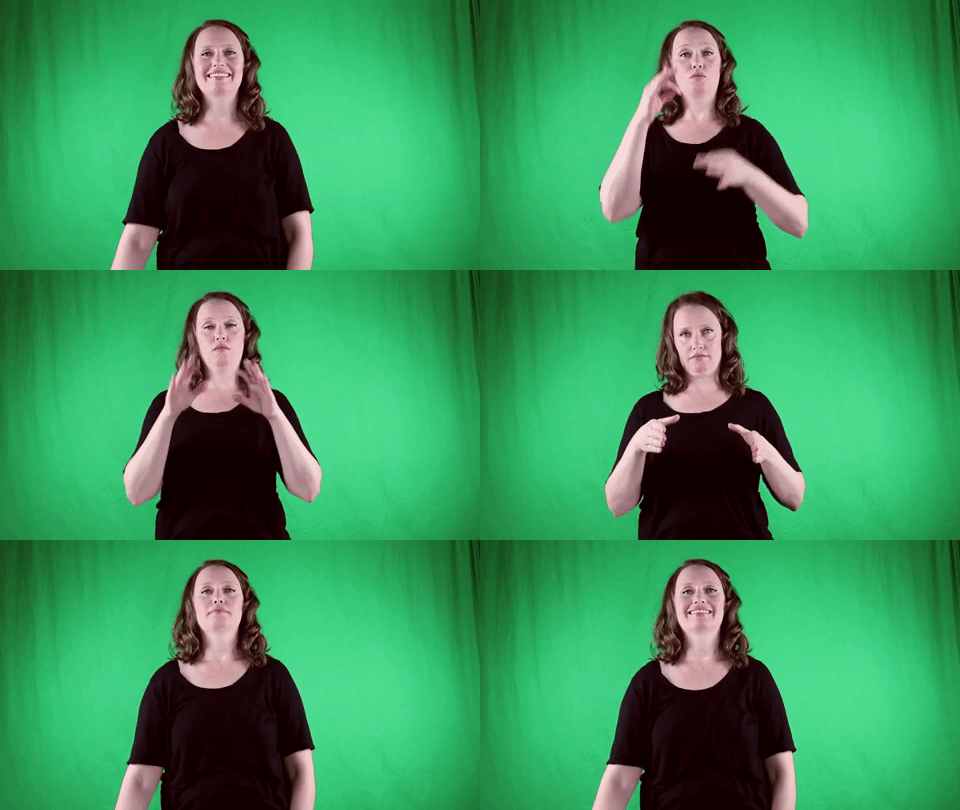
Definition: A building where legal cases are heard.
Sign for COURT HOUSE in ASL

Practice Activities:
To effectively learn the sign for COURT HOUSE in ASL, begin by practicing each part of the compound sign separately. The sign for “court” often mimics the scales of justice with a balance motion, and “house” is typically made by outlining the shape of a house with both hands. Once comfortable with each sign individually, combine them smoothly to form the complete concept.
Use mirrors or record yourself to observe hand shapes, facial expressions, and transitions between signs. Repetition is key—sign court house ten times in a row for fluency. Add variations in speed and emphasis to enhance expressiveness. Practice signing it both slowly and naturally, as you would in a real conversation.
Build comfort by placing the sign for COURT HOUSE in ASL into full sentences. For example, “I went to the court house today” or “The court house is downtown near the library.” Sign these slowly, paying attention to grammar and facial expressions. Then, try answering questions like “Where do judges work?” or “Where do legal cases happen?” using the sign in your answer.
Write simple stories or scenarios involving locations, especially public buildings. Have a story that includes characters going to the court house for a hearing or meeting a lawyer. Sign out the story while incorporating other related vocabulary like “judge,” “lawyer,” and “case.”
When working with a partner, play a location-guessing game. One person signs clues including gestures for places like hospital, school, and court house while the other guesses the location. This reinforces not only the sign for COURT HOUSE in ASL but also vocabulary for community settings.
To further reinforce the sign, watch videos or ASL stories that include government buildings or legal settings. Pause and mirror each usage of the sign when court house is mentioned. Consistency and context-rich practice will help reinforce long-term memory and usage.
Cultural Context:
In Deaf culture and the broader Deaf community, understanding the sign for court house in ASL plays a vital role in discussions about access to justice and civil rights. Legal settings are important in every society, and for Deaf individuals, knowing how to navigate those spaces using American Sign Language is essential. The sign for court house in ASL is more than just vocabulary; it reflects how language bridges communication between the Deaf community and the legal system.
Interpreters often accompany Deaf individuals in courtrooms, but being able to express concepts like court house independently in ASL helps promote autonomy and confidence. This sign may be used when discussing legal appointments, family court situations, or issues related to civil, criminal, or traffic cases. Having clear, consistent ASL signs like the sign for court house in ASL supports better understanding and participation in legal processes.
It’s also common to see this sign used during educational lessons about government and legal systems. Teachers working in Deaf education or bilingual classrooms explain institutions such as the court house using ASL. The sign for court house in ASL connects abstract civic concepts to visual language, making them more accessible for students.
In storytelling or life experiences shared within Deaf spaces, references to legal matters may involve the sign for court house in ASL. Whether someone is sharing a story about jury duty, a lawsuit, or child custody, the sign becomes a key linguistic and cultural marker. Understanding how to use the sign properly in context supports culturally respectful and accurate communication.
Community events or advocacy campaigns, especially those championing equal access, may use the sign for court house in ASL when making videos or hosting informational sessions. These efforts highlight the importance of inclusive language and accessible justice. Having the correct sign helps advocate for rights while staying grounded in the cultural practices of ASL users.
Deaf legal professionals, advocates, and interpreters must know the sign for court house in ASL in order to engage effectively in their work. For a Deaf lawyer or a Deaf client, fluency in legal signs contributes to meaningful participation in court cases. This is why it’s important for learners and fluent signers alike to be familiar with this and other related signs.
The use of the sign for court house in ASL also illustrates how ASL evolves to meet societal needs. As legal awareness rises within the Deaf community, so does the need to communicate about legal matters with precision. ASL serves as a visual, spatial language capable of expressing complex concepts like justice, law, and civic institutions clearly.
Whether for
Extended Definition:
The sign for court house in ASL combines legal and building concepts to convey the idea of a judicial location. This sign typically uses the handshape for “court” followed by the sign for “building” or “house,” depending on the regional variation.
In American Sign Language, compound signs like the sign for court house in ASL are common when discussing legal or government-related topics. This helps make conversations more efficient and contextually accurate. The use of this sign is essential when talking about places where legal proceedings happen, including trials and hearings.
Court houses are central locations in the legal system where judges, lawyers, and others work to resolve legal matters. To sign this concept in ASL, users often begin with the sign for “court,” which suggests judgment, followed by a sign that identifies a location. This sequence delivers a clear visual idea of a court location.
The sign for court house in ASL can vary slightly depending on the local Deaf community and their preferred expressions. Some might use a sign that resembles the shape or structure of a house after showing the court sign, while others may emphasize the function more than the structure. Communicating the concept effectively often depends on clarity and context.
It’s helpful for students or interpreters learning ASL to understand that the sign for court house in ASL combines abstract and concrete ideas. The “court” part refers to the legal concept, and the “house” or “building” part refers to the physical place where it occurs. This layering of meanings is a unique and powerful feature of ASL grammar.
When fingerspelling is necessary, especially in more formal education or legal contexts, spelling out c-o-u-r-t h-o-u-s-e can clarify meanings. However, experienced users often rely on the set sign for court house in ASL for smoother communication. This highlights the importance of mastering both the sign and fingerspelling for complete fluency.
If you’re discussing where a trial took place, or asking someone about visiting such a site, knowing this specific sign in ASL is important. For example, in a story about civic duty or crime, the sign for court house in ASL would likely appear several times. It becomes an anchor in conversations about the legal process.
The visual nature of the sign supports understanding even if someone is new to the language, making it more accessible. ASL’s structure allows this type of concept to be illustrated clearly through movement and handshape. The sign for court house in ASL benefits from this express
Synonyms: courthouse, judicial building, courthouse facility, legal court building, court of law
Educational resources: Find related learning materials in our course bank!
Want more? Check out some of our popular learning activities on the homepage!
Need to look up a sign? Use our highly rated dictionary: https://aslinteractive.com/best-asl-dictionary/
Follow us on tiktok: https://www.tiktok.com/@aslinteractive. More social media links at the bottom of this page!
Long-tail Keywords: what is the sign for courthouse in ASL, how do you sign courthouse in American Sign Language, ASL sign for courthouse
Categories:
tags: Facilities and other locations/needs, Legal system, Buildings, Government, Community places
Parameters
*Handshape*:
The handshape for the sign for COURT HOUSE in ASL uses the “F” handshape for the initial part representing “court.” Both hands form an “F” shape—thumb and index finger touching to create a circle, with the remaining fingers extended. These hands move side to side in a weighing motion, as if balancing scales ⚖️.
To represent “house,” the hands switch to flat “B” handshapes. These flat hands mimic the outline of a roof and walls, starting from a peak shape then moving downward into a square. The sign for COURT HOUSE in ASL blends both concepts clearly with distinct handshapes.
*Palm Orientation*:
The palm orientation for the sign for COURT HOUSE in ASL depends on the two-part sign. For COURT, use both flat “F” hands with the palms facing each other, alternating up and down like balancing scales. Then transition to the HOUSE sign, where both flat hands touch at the fingertips and then move downward to form the shape of a roof and walls, with palms facing each other and slightly angled forward.
In the sign for COURT HOUSE in ASL, the hands shift from a vertical orientation (in COURT) to a more forward-facing angle (in HOUSE), illustrating the conceptual progression from justice to building structure. Palms remain open and directed outward or toward each other based on the specific part of the compound sign. ️
*Location*:
The sign for COURT HOUSE in ASL is typically performed in two parts. The first part uses the sign for “court,” which is placed at chest level, often moving slightly outward to indicate a formal setting. The second part uses the sign for “house,” created by shaping the rooftop and walls of a house in the space just in front of the body.
This sign usually stays within the neutral signing space in front of the torso, not too high or too low. The combination of signs for the sign for COURT HOUSE in ASL keeps the movements clear and centered for easy visibility. ️
*Movement*:
Begin the sign for court house in ASL by forming the dominant hand into the letter “F” and tapping the tips of the thumb and index finger on the base of the non-dominant palm, facing upward, to represent the concept of “court.” Then, transition into the sign for “house” by using both flat hands with fingers together, starting with fingertips touching to form a rooftop, and move downward to form the sides of a house. The sign for court house in ASL uses a compound movement to represent both the legal and physical meanings. This smooth, two-part motion clearly conveys the full concept. ️
*Non-Manual Signals*:
When signing the Sign for COURT HOUSE in ASL, maintain a neutral facial expression or a mildly formal look that matches the solemnity or seriousness associated with legal institutions. Slight eyebrow tension or a steady gaze can help convey the importance tied to a courthouse setting.
Avoid overly expressive or playful facial movements, as the Sign for COURT HOUSE in ASL typically conveys a formal concept. The overall demeanor should reflect respect and authority, aligning with the institutional nature of a courthouse ️.
*Prosody, Dominant/Non-Dominant Hand*:
The sign for COURT HOUSE in ASL typically involves a two-part sign combining the concept of “court” and “house.” For “court,” use the dominant hand in an open “F” handshape, palm down, moving side to side above the non-dominant hand to show a scale of justice. Then sign “house” by forming both hands as flat “B” shapes, fingertips touching at the top and then moving downward to outline the roof and sides.
When producing the sign for COURT HOUSE in ASL, the dominant hand leads the initial “court” portion while both hands are used equally during the “house” part to represent structure. The motion mirrors the symbolic connection between law and place. Maintain appropriate facial expressions to reinforce the meaning, especially if emphasizing the setting or role of a courthouse ️.
Tips for Beginners:
When learning the sign for COURT HOUSE in ASL, it’s helpful to understand that this is often a compound sign. Many signers combine the sign for COURT with the sign for HOUSE. This mirrors how compound nouns are built in ASL and helps preserve clarity and meaning. Focus on learning each component sign clearly before blending them together.
A common mistake beginners make with the sign for COURT HOUSE in ASL is rushing the transition between signs. Practice pausing slightly after signing COURT before moving into the HOUSE sign to help maintain fluid communication. As you get more fluent, this transition will become smoother, but clarity should always come first when you’re starting out.
Another useful tip involves handshape precision. The sign for COURT usually involves a modified “F” handshape, and a flat “B” handshape is used for HOUSE. Make sure your fingers are well-formed and held at the appropriate angles. Sloppy handshapes can lead to misunderstandings or make your sign look like a different word.
Facial expressions are key in making your signs more natural and communicative. When signing an official place like COURT HOUSE, maintain a neutral or slightly serious expression to match the formality of the concept. Avoid overly animated or casual expressions which may undercut the meaning.
Practice with a mirror or record yourself. Watching your own signing can help you catch handshape or movement errors that you may not notice while signing. This is particularly useful when working on complex or compound signs like the sign for COURT HOUSE in ASL.
Lastly, if you’re unsure about your sign’s accuracy, ask a fluent ASL user or teacher for feedback. Native signers often give tips that can’t be found in textbooks. With consistent practice and attention to detail, your confidence with the sign for COURT HOUSE in ASL will grow greatly over time. ✨
Connections to Other topics:
The sign for COURT HOUSE in ASL connects closely with legal and governmental concepts in sign language, such as LAW, JUSTICE, JUDGE, and GOVERNMENT. These associated signs often feature formal handshapes and movements that emphasize structure and authority. For example, the sign for LAW uses a flat hand with another hand striking it as a reference to written laws or rules, complementing how COURT HOUSE symbolizes the location where these laws are upheld.
This sign is a compound concept, combining the signs for COURT and HOUSE. The sign for COURT typically uses a palm-up flat hand bouncing side to side, representing decision-making or the scales of justice. HOUSE is depicted by outlining the shape of a peaked roof with both hands, symbolizing a building or structure. When used together, the sign for COURT HOUSE in ASL clearly refers to a specific building associated with legal proceedings, often appearing in context with other civic institutions like CITY HALL or POLICE STATION.
Learners often encounter this sign when discussing professions like LAWYER, LEGAL AID, or JUDGE, all of which are inherently connected to a courthouse setting. The sign LAWYER is formed by combining the sign for LAW with the PERSON marker, representing someone who practices law. These role-based signs naturally build vocabulary around the concept introduced in the sign for COURT HOUSE in ASL.
In practical conversation, the sign for COURT HOUSE in ASL may appear alongside time-based or location-specific signs, especially when describing events like court dates, legal appointments, or directions. For instance, combining TODAY or NEXT WEEK with COURT HOUSE builds temporal clarity in a sentence. Similarly, pairing it with directional signs helps to describe where the courthouse is located, reinforcing spatial grammar in ASL.
Summary:
The sign for COURT HOUSE in ASL is a compound sign that combines the concept of “court” with “house.” This compound reflects how American Sign Language often combines conceptual elements to make up words that don’t have a one-to-one.
To express this idea, signers typically use the sign for COURT first. This is done by using the dominant hand in the “F” handshape, alternating it from side to side as though weighing legal matters on a scale. This mimics the scales of justice associated with legal settings.
Following that sign, the sign for HOUSE is immediately made. This is done with both hands flat and facing one another, fingertips touching to form a roof shape before moving downward to outline walls of a house. This visual clearly conveys the idea of a building.
The sign for COURT HOUSE in ASL, when done in sequence, blends legal and architectural visual cues. The resulting sign provides an intuitive representation of a building used for law-related purposes.
The sign for COURT HOUSE in ASL is additive in nature, mirroring how compound nouns are formed across different languages. This points to ASL’s rich morphology, where two distinct signs can combine to create a new conceptual unit.
The sign may also include some variation depending on region or context. In formal discussions or legal contexts, some may fingerspell “C-O-U-R-T” and then sign “HOUSE” to emphasize the specific institution being discussed. This variation offers adaptability depending on audience and setting.
In informal contexts, signers may abbreviate or modify the sign slightly, depending on speed and familiarity. ASL, like all living languages, flexes depending on the communication situation.
The cultural significance of the sign for COURT HOUSE in ASL extends beyond its semantic meaning. It reflects how Deaf culture engages with elements of civic life, law, and rights. The concept of a court is deeply intertwined with advocacy, justice, and equal representation, all of which are key issues for the Deaf community.
Legal accessibility is a long-standing concern. The sign for COURT HOUSE in ASL doesn’t just mean a location—it often symbolizes either systems of inclusion or exclusion based on how Deaf individuals are supported—or not—in legal proceedings.
Historically, many Deaf individuals have faced barriers in court settings. The phrase itself can invoke stories of interpreters not being provided, or legal rights not fully understood because of gaps in communication access. This lends the sign a powerful cultural resonance.
The topic ties closely to applied linguistics, especially in legal interpreting and translation. Interpreter accuracy is vital in environments such as a court house, and the nuances of the sign for COURT HOUSE in ASL relate directly to discussions in interpreter ethics and practice.
Within the grammatical structure of ASL, compound words like COURT HOUSE demonstrate how ASL handles classifying locations or institutions. These compound signs emphasize the time-space efficiency of signed languages, as well as the syntactic flexibility to apply other classifiers or referents.
For example, a signer may refer to “the court house downtown” by signing COURT HOUSE and then pointing or describing its physical location. The classifier structure in ASL supports spatial reasoning, and such use makes full use of the visual modality.
Semantically, the sign for COURT HOUSE in ASL brings together two domains: abstract (law) and concrete (building). This dual coding offers richness and redundancy, helping ensure clarity even when encountering background noise or disruptive visual environments.
From a linguistic perspective, the combination of COURT and HOUSE also highlights the productive nature of the language. Rather than creating arbitrary signs for new ideas, ASL leverages existing lexicon to compose new meanings efficiently.
Signed discourse on legal topics frequently uses this sign. In ASL debates, classrooms, or legal seminars, this sign may be part of a larger cluster of law-related vocabulary—like JUDGE, LAWYER, or VERDICT—each built up in a similar conceptual fashion.
Classifiers may be introduced after the primary compound to discuss events that happened inside the building, such as a trial. A signer might introduce COURT HOUSE and then use a classifier for people to describe a group entering the building.
Spatial mapping is often employed with this sign as well. A signer may set up the COURT HOUSE in a location in signing space and refer back to it during the conversation, reinforcing its significance using topographic reference.
Many regional dialects within ASL offer subtle differences in how the components of the sign are performed. Some regions emphasize the balance motion for COURT while others minimize it, based on local norms or community preferences.
The influence of English is apparent in signs like COURT HOUSE. Given the term’s origins in English, its conceptual components are drawn from English semantic structures, but signed forms evolve to meet the grammar of ASL.
The role of Deaf jurors or lawyers in the U.S. has also increased visibility and use of signs like COURT HOUSE. As more Deaf professionals work in the legal field,
Want more? Check out some of our popular learning activities!
ASL Interactive Resources
ASLInteractive YouTube Channel
Follow us on tiktok: @aslinteractive.com
Follow us on Instagram: aslinteractive
Facebook page: aslinteractive
Facebook group: aslinteractive
LInkedIn: ASL Interactive LLC
Twitter: @ASL_interactive
*Some information on this page is AI-generated. AI can make mistakes. Please check the information.


Responses