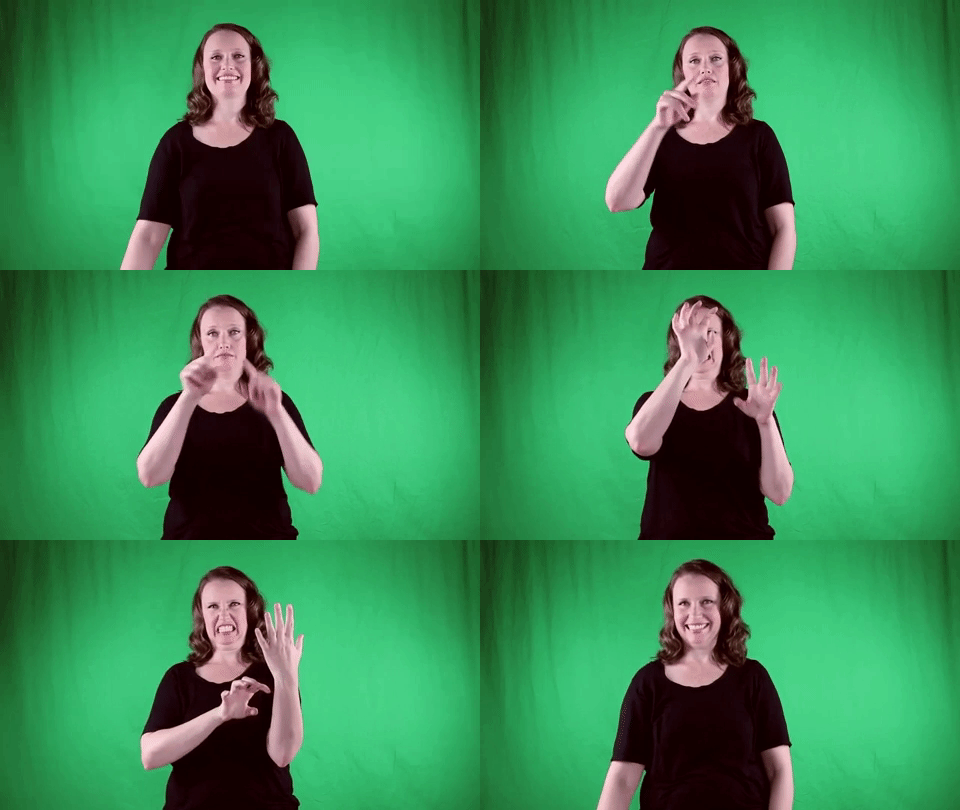
Definition: Having a crack on an iPad.
Sign for CRACKED ON IPAD in ASL

Practice Activities:
To build fluency with the sign for CRACKED ON IPAD in ASL, start by isolating the key concepts. Practice the sign for CRACKED several times using both hands. Mimic the visual appearance of a break or damage across a surface, such as a screen. Use a flat, neutral expression at first, and gradually include more emotion like surprise or frustration to show realistic reactions.
Hold up a real or imaginary iPad and practice placing the CRACKED sign over it. Use spatial referencing to indicate the iPad’s screen. Pretend to drop the iPad, then immediately produce the sign for CRACKED OVER IPAD. Sign slowly, then speed up with fluency. Pair with a mirror or video recording to check for clarity.
Create short example sentences like “MY IPAD CRACKED” or “TODAY DROP IPAD, NOW CRACKED.” Add facial expressions that match how upset or annoyed you’d be. Transition into longer descriptions: “YESTERDAY I CARRY IPAD, SLIP, FALL—SCREEN CRACKED BAD.” Encourage variations using different tenses or adding emotions.
For partner activities, act out short skits where a person accidentally drops their iPad. One signer acts; the other responds. Have conversations like one asking “WHAT HAPPEN YOUR IPAD?” and the other replying with signing the CRACKED ON IPAD phrase. Switch roles to keep the practice varied and interactive.
Write a visual story using the sign for CRACKED ON IPAD in ASL as the theme. Include steps leading up to the situation and the reaction afterward, like calling for repair or explaining it to a parent or boss. Use different locations and scenarios, such as libraries, classrooms, or travel.
Use flashcards with images or written scenarios that cue the learner to produce the sign for CRACKED ON IPAD in ASL. Add storytelling challenges where learners describe how the iPad got cracked, who was involved, and what happened next.
Cultural Context:
In Deaf culture, clear communication through American Sign Language is essential, especially when discussing technology. The sign for cracked on iPad in ASL is a helpful expression used when sharing information about broken screens, damaged devices, or malfunctioning apps. Whether through daily conversations or in classroom settings, knowing this sign bridges communication gaps between Deaf individuals and the tech world they interact with.
The phrase cracked on iPad often comes up when describing tech mishaps. The sign for cracked on iPad in ASL allows users to express the concept quickly and clearly without needing to finger-spell long phrases. This is especially useful in fast-paced environments or when troubleshooting tech issues with friends or classmates .
ASL signs for modern technology evolve constantly in Deaf communities. Devices like iPads are common tools in both personal and educational settings. When an iPad screen breaks or malfunctions, the sign for cracked on iPad in ASL gives Deaf individuals a straightforward way to discuss what happened without confusion.
In day-to-day life, mentioning that a screen is cracked lets others know why a device may not be usable. The visual nature of this sign reflects the physical state of the screen, making it easier for others to understand the problem instantly. Sharing the sign for cracked on iPad in ASL is also helpful for interpreting mishaps in storytelling or everyday updates.
This sign can come up while describing a drop accident, a hardware issue, or a glitch after downloading an app. Many students in Deaf schools use iPads for notes, online classes, and homework. If their device breaks, using the sign for cracked on iPad in ASL helps them report the problem effectively to teachers or peers .
Parents, educators, and tech support staff familiar with ASL can better assist Deaf users when they recognize this phrase. It promotes digital accessibility and reduces frustration when devices fail. The sign for cracked on iPad in ASL becomes a tool for advocacy and communication in a tech-driven world.
Social media usage has even boosted the relevance of this sign as people post stories and updates about broken devices. Deaf vloggers, influencers, and tech reviewers also use this sign when sharing their experiences online . It’s a widely understood part of the modern ASL vocabulary.
Cultural understanding comes from learning how language adapts to new technologies. The sign for cracked on iPad in ASL is a great example of how the Deaf community continues to innovate language in visual and practical ways. It helps ensure that current tech issues are shared
Extended Definition:
The sign for cracked on iPad in ASL is a useful term when describing a damaged or broken screen on an Apple device. This specific sign combines elements representing an electronic device, like the iPad, with descriptors that indicate cracking or breaking. Context is important in ASL, so you’ll want to show on your face and in your movements that the iPad itself is cracked and not just malfunctioning.
When signing cracked on iPad in ASL, most users first indicate the concept of “iPad” through a flat rectangular shape, suggesting a tablet screen. Then, to show “cracked,” they typically use a movement that mimics something breaking or splintering apart. This is often a directional movement using both hands to show a jagged line or split across the space in front of you. It visually mimics a cracked screen that is familiar to most people.
The sign for cracked on iPad in ASL is highly visual and may include classifiers that depict the object (iPad) and the damaged condition. You might use a flat hand to represent the screen and a bent or clawed handshape moving across it to show spider-web-like cracks. Using facial expressions to show surprise, frustration, or disappointment can reinforce the meaning and make your message clearer.
This sign is commonly used when talking about tech-related problems in daily life. Whether the iPad was dropped, sat on, or just fell off a surface, it’s helpful to know how to explain the situation visually in ASL. Describing damage accurately helps in conversations with friends, tech support, or classmates in a deaf learning environment.
When you’re learning the sign for cracked on iPad in ASL, watching native signers and practicing in front of a mirror can really help. ASL is a visual language, and this sign depends on both hand movement and space use. Because each sign reflects real-life events, the movement should be natural and easy to understand by experienced or new signers.
This type of sign falls into the category of descriptive or illustrative ASL signs. Rather than spelling out words or using standard lexical signs, cracked on iPad in ASL is a phrase that is built using a combination of classifiers and meaningful gestures. It demonstrates how versatile and expressive American Sign Language can be, especially when describing modern technology.
In signed conversations, especially when something goes wrong with electronics, being able to show the sign for cracked on iPad in ASL makes storytelling more detailed. It lets you share
Synonyms: Broken Screen, Shattered Display, Fractured Glass, Damaged iPad Screen, Smashed Screen
Educational resources: Find related learning materials in our course bank!
Want more? Check out some of our popular learning activities on the homepage!
Need to look up a sign? Use our highly rated dictionary: https://aslinteractive.com/best-asl-dictionary/
Follow us on tiktok: https://www.tiktok.com/@aslinteractive. More social media links at the bottom of this page!
Long-tail Keywords: what is the sign for cracked on ipad in ASL, how do you sign cracked on ipad in ASL, ASL sign for cracked on ipad
Categories:
tags: Objects, Technology, Actions, Damage, Language Learning
Parameters
*Handshape*:
The handshape for the sign for CRACKED ON IPAD in ASL uses both hands. Typically, the dominant hand is in a claw or bent-5 handshape, symbolizing the disruption or splintering effect of a crack. The non-dominant hand may remain flat to represent the surface of the iPad .
To express the sign for CRACKED ON IPAD in ASL, the clawed dominant hand moves across the flat nondominant hand while flexing slightly, mimicking a jagged or fractured line. This visual metaphor reflects the look of a cracked screen.
*Palm Orientation*:
For the sign for CRACKED ON IPAD in ASL, the palm orientation starts with both hands facing each other, palms inward. The dominant hand may simulate a breaking motion or a jagged line moving down the non-dominant hand, imitating a screen crack effect.
When signing “iPad,” the palm typically faces the signer, depending on whether you’re fingerspelling or miming touching a screen. In total, the sign for CRACKED ON IPAD in ASL uses palms that shift to emphasize the concept of a broken device screen .
*Location*:
The sign for CRACKED ON IPAD in ASL is generally located in the neutral space in front of the torso, slightly angled toward the dominant side. The hands are centered near chest level where the cracking motion can be clearly seen. For the iPad portion, a flat-palm shape may be used to represent the device, held in non-dominant hand space to simulate a screen.
When explaining the sign for CRACKED ON IPAD in ASL, the dominant hand often mimics a visual break or splintering line over the other hand that represents the iPad. The motion stays within a comfortable and visible range in front of the signer’s body to clearly depict the idea of damage on a screen. Keep everything at chest to mid-torso height for clarity .
*Movement*:
To show the sign for CRACKED ON IPAD in ASL, begin by holding the non-dominant hand flat, palm facing up, to represent the iPad. With the dominant hand in a claw or bent five shape, move it downward toward the center of the flat hand, then quickly split the fingers apart as if mimicking a crack forming.
Facial expression, like a sudden look of shock or concern , helps emphasize the idea of something being unexpectedly damaged. The gesture clearly shows a break or fracture occurring on a surface, capturing the meaning behind the sign for CRACKED ON IPAD in ASL.
*Non-Manual Signals*:
To express the Sign for CRACKED ON IPAD in ASL, incorporate a facial expression that shows concern or surprise , typically with widened eyes and slightly raised eyebrows. You might also show a wince or grimace when depicting the moment of the “crack,” especially if illustrating screen damage.
The Sign for CRACKED ON IPAD in ASL benefits from leaned-forward posture, emphasizing focus on the screen area. Paired with a subtle head tilt and pursed lips, these non-manual signals help express the seriousness or disappointment about the crack.
*Prosody, Dominant/Non-Dominant Hand*:
The sign for CRACKED ON IPAD in ASL uses both hands to depict the idea of a fracture or break on a screen. The dominant hand forms a clawed 5-hand and moves downward diagonally across the flat, non-dominant palm, mimicking the image of a screen crack. The non-dominant hand stays steady, representing the iPad’s surface.
To express the sign for CRACKED ON IPAD in ASL clearly, you may also fingerspell IPAD before or after signing CRACKED. Facial expressions add meaning—show concern or surprise to emphasize damage. This visual representation helps convey the keyword phrase naturally in ASL.
Tips for Beginners:
When learning the sign for CRACKED ON IPAD in ASL, it’s important to focus on the visual and contextual aspects of the sign. To express “cracked,” use a dominant hand with a bent 5-handshape that splits downward across a flat non-dominant palm to represent a break or fracture. Make sure your split movement is clean and slightly jagged to mimic the look of a true crack. For “iPad,” fingerspell I-P-A-D clearly and at a reasonable pace so it’s understood without confusion.
Begin with slow, exaggerated motions when practicing the crack sign. Gradually speed up as you become more confident, but don’t rush the fingerspelling part—clarity is key. Try recording yourself to ensure the crack movement mimics the irregularity of shattered glass. Beginners commonly make the mistake of doing a smooth, soft motion. In reality, a more sudden and sharp break better communicates the idea of a crack.
Facial expressions are also critical in the sign for CRACKED ON IPAD in ASL. Show surprise, concern, or frustration to convey the gravity of a broken screen. This emotional nuance helps the meaning come through, especially in casual conversation where context might not be clear.
Practicing in front of a mirror will help in maintaining the correct handshapes and angles. Also, if you’re describing a specific type of crack—across the screen or in the corner—you can point or trace where the crack would appear. This adds a spatial component that enhances understanding.
Another tip is to watch native signers demonstrate the phrase. You’ll notice small variations in tone, intensity, and speed, which you can adapt into your own use of the sign for CRACKED ON IPAD in ASL. Practicing regularly in situations where you describe broken items will deepen your comfort level.
Connections to Other topics:
The sign for CRACKED ON IPAD in ASL connects with a range of technology-related vocabulary, including words like BROKEN, SCREEN, DEVICE, and IPAD itself. Learners often adapt general signs for electronics in specific contexts, and this encourages flexibility in communication. For example, the sign for IPAD uses a flat hand miming the rectangular shape of the device, and incorporating a cracking motion on top of that shows damage or malfunction.
This sign also links directly to the broader concept of damage or destruction. Signs like BREAK, CRACK, and SHATTER share similar handshapes and motions, often resembling a split or separation gesture. These signs can be modified visually depending on the object being damaged, which makes classifiers an important tool when expressing what’s cracked—whether it’s glass, a device, or something else.
Compound signs provide deeper connection to real-world scenarios. For example, one might sign something like IPAD BROKE BY ACCIDENT to provide additional context. Another variation might integrate facial expressions and classifiers to emphasize how severely the screen was cracked. This kind of nuanced expression demonstrates the multi-layered nature of ASL storytelling and description.
The sign for CRACKED ON IPAD in ASL also overlaps with expressions used when discussing accidents or repairs. Terms like NEED FIX, SCREEN REPLACE, or TO REPAIR are often paired with the cracked screen idea, which allows for more complete conversational structures. These signs appear frequently when discussing customer service or tech problems.
In educational or home settings, the sign for CRACKED ON IPAD in ASL is also useful when describing mishaps—like a child dropping the device. The sign helps bridge daily technology experiences with ASL learning while promoting use of visual classifiers and space usage in describing real-world events. Repetition of such signs supports vocabulary retention through relevant and frequent use.
Summary:
The sign for CRACKED ON IPAD in ASL typically begins with the sign for CRACKED, which is a classifier-based sign to represent something broken or split. A common approach uses both index fingers tracing a jagged or irregular line across the surface to mimic the look of a crack. This representation visually aligns with a fracture on a screen, like those found on iPads or other tablets.
To indicate that the crack is specifically on an iPad, users generally establish the concept of the iPad through a classifier or fingerspelling. The noun-IPAD can be represented using FS(IPAD) or by showing a rectangle shape with both hands to depict the size and shape of the device. Once the location is established, the CRACKED sign is applied over the classifier for the object, indicating it has sustained damage.
In conversational ASL, it is important to spatially align signs like CRACKED with their referents. This means positioning the CRACKED sign directly above or on the established location of the iPad in the signer’s spatial structure. This spatial grammar allows for clear and effective communication, and it enhances the visual impact of the message.
CRACKED itself is often used metaphorically in ASL, indicating breakage not only of surfaces but also of situations or relationships. This flexibility makes it a highly visual and semantically rich sign. When applied to a physical object like an iPad, however, it takes on a very concrete, literal meaning.
The sign for CRACKED ON IPAD in ASL demonstrates a synthesis of lexical signs and classifiers. Classifier handshapes are integral in ASL for representing object types and describing physical characteristics like cracks or breaks. This usage showcases how ASL leverages handshape morphology to convey nuanced meaning beyond static vocabulary.
Classifier usage highlights a deeper level of linguistic structure in ASL, where form and function coincide. The hands don’t just stand in symbolically for objects—they describe them dynamically. Especially in the case of something like an iPad with a jagged screen, ASL visually mirrors the damage through motion.
The FS(IPAD) component of the sign for CRACKED ON IPAD in ASL places emphasis on the specific technology involved. This fingerspelling ensures clarity in identifying the device, especially when no default sign exists or is ambiguous.
In more advanced usage, signers may interchangeably use a gestural representation of a tablet to avoid fingerspelling, depending on the audience and context. A box-shaped classifier made with both B-hands can effectively reference a tablet. This flexibility is useful for adaptive communication across varying levels of ASL proficiency.
There’s a rising trend among younger signers and digital native users in ASL to develop unique signs for modern technology. This includes devices like tablets, smartphones, and apps, sometimes creating a need for frequent clarification. The sign for CRACKED ON IPAD in ASL is one area where evolving tech vocabulary intersects with traditional ASL grammar.
Learners of ASL may find it helpful to focus first on signs like CRACKED in isolation before applying them in context-dependent phrases like CRACKED ON IPAD in ASL. Understanding the structure and usage in steps helps build grammar comprehension more effectively. It’s equally essential to work on expressive and receptive skills when learning to describe tech damage.
The demand for specific damage reporting in Deaf tech support or repair situations adds relevance to signs like CRACKED. In this context, the sign for CRACKED ON IPAD in ASL carries functional communicative importance. This allows Deaf persons to interface with repair professionals, consumers, and colleagues with precision.
The sign carries both practical and emotional weight. When an iPad is cracked, whether through accident or malfunction, signers may pair CRACKED with NMMs (non-manual markers) expressing frustration, concern, or surprise. These facial expressions elevate the sign, adding emotional resonance to what might otherwise be a simple report.
While spoken English relies heavily on description via adjectives and prepositions, ASL conveys this meaning through location, classifiers, and facial expression. The grammar of the sign for CRACKED ON IPAD in ASL centers on these components. This creates a more holistic and visual strategy for depicting an event or damage type.
Another layer is the cultural understanding that technology is deeply embedded in modern Deaf culture. iPads often serve as communication portals via FaceTime, messaging, and apps translated into ASL. Describing a cracked iPad is not just reporting damage—it may denote a barrier to communication, which elevates the urgency of the situation.
This usage scenario places the sign for CRACKED ON IPAD in ASL within the broader discourse about accessibility. A cracked screen impedes tactile and visual access, which holds unique consequences for Deaf users. Therefore, being able to sign such damage clearly is especially critical.
Interpreters may encounter the sign for CRACKED ON IPAD in ASL in medical settings, educational environments,
Want more? Check out some of our popular learning activities!
ASL Interactive Resources
ASLInteractive YouTube Channel
Follow us on tiktok: @aslinteractive.com
Follow us on Instagram: aslinteractive
Facebook page: aslinteractive
Facebook group: aslinteractive
LInkedIn: ASL Interactive LLC
Twitter: @ASL_interactive
*Some information on this page is AI-generated. AI can make mistakes. Please check the information.


Responses