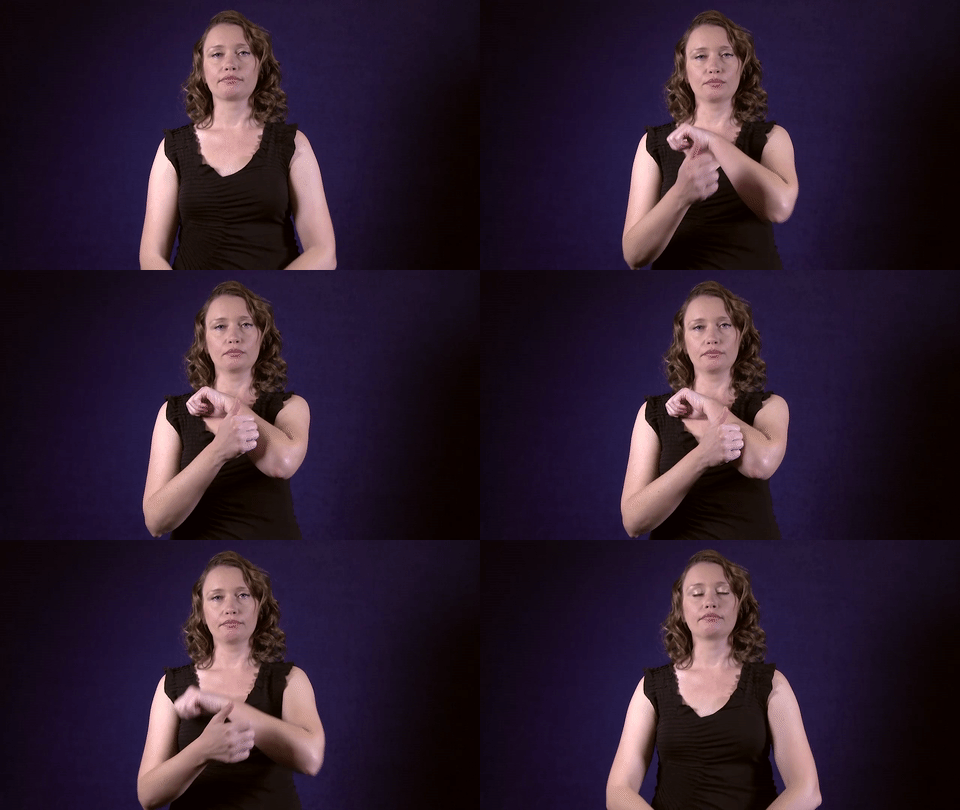
Sign for CRACKER in ASL | 🍪 ASL Dictionary

Definition: A thin crisp wafer or biscuit.

Sign for CRACKER in ASL

YouTube player

Practice Activities:

To practice the sign for CRACKER in ASL, start by standing in front of a mirror and performing the sign slowly and clearly. This helps you check proper hand placement and motion. Repeat the sign in isolation ten times while maintaining the correct form to build muscle memory.

Next, use the sign for CRACKER in ASL within short sentences like “I want a cracker,” “She eats crackers,” or “No more crackers, please.” Signing these full sentences will help solidify the context and smooth transitions between signs. Try signing these sentences at a slow pace at first, then gradually increase your speed for fluency.

Work with a partner and take turns miming a snack time scene where one person requests a specific food and the other responds using various food signs, including the sign for CRACKER in ASL. Create simple dialogues such as “Do you want chips or crackers?” and respond appropriately with the sign. This kind of back-and-forth practice supports both expressive and receptive skills.

As a storytelling activity, describe a picnic scene using ASL, including what was eaten, how it tasted, and any fun moments. Be sure to include the sign for CRACKER in ASL several times throughout the narrative to reinforce context. Record yourself to review clarity and accuracy later.

Try a matching game where you or a friend hold up flashcards with snack items, and you sign each item as quickly as possible. Include a mix of foods, ensuring the sign for CRACKER in ASL shows up repeatedly. This rapid recall game helps improve sign retrieval and confidence under time pressure.

Lastly, pretend to shop in a grocery store and walk around your home or class looking for snacks. Sign what you find, including the sign for CRACKER in ASL, and express whether you like or dislike each item.

Cultural Context:

The sign for cracker in ASL can have different meanings depending on the context, and cultural understanding plays an important role in interpreting it correctly. In American Sign Language, the sign often refers to a type of food, like a snack cracker or saltine, and should be used carefully to match that context. When learning the sign for cracker in ASL, it’s important to recognize nuances in meaning and avoid confusion with other signs.

In Deaf culture, making accurate signs that reflect appropriate intent shows respect and fluency. Since signs can resemble each other in motion, handshape, or location, it’s vital to clearly use the correct movement while signing cracker, especially in group settings or educational environments. Understanding the cultural significance behind proper signing helps bridge communication and prevents misunderstandings.

The sign for cracker in ASL is frequently taught in classrooms, particularly in early education and beginner ASL courses. Children learn this sign as part of their vocabulary when discussing snacks or mealtimes. It’s a functional and commonly used word that appears in daily conversations, especially when discussing food preferences or dietary needs.

It’s also necessary to remember that ASL is a living language, and the sign for cracker in ASL might vary slightly between regions or families. Just as spoken English has regional accents or slang, ASL has variations across the United States and even within individual Deaf communities. Exposure to different signing styles enhances one’s ability to improve and adjust to real-life ASL use.

When introducing this word to learners, instructors usually include it with food-related vocabulary. Learning the sign for cracker in ASL opens the door to further explore similar signs like cheese, bread, or soup. This builds more complete communication skills around everyday conversations involving food, nutrition, and social experiences like meals or snacks.

Visual communication within Deaf culture often reflects shared experiences. Using signs like the sign for cracker in ASL during communal mealtimes supports conversational flow and gives Deaf individuals more independence. In events where snacks are available, knowing this sign allows for smoother interactions and self-expression.

Politeness and etiquette in ASL extend to signing food terms correctly, especially in mixed hearing and Deaf settings. Misuse of a food sign may lead to unintentional humor or even offense, depending on the situation. For this reason, mastering the accurate way to express cracker is an important detail that contributes to strong and respectful ASL communication.

In formal and academic Deaf environments, teaching food signs like cracker often includes visual aides and live demonstrations. This ensures clarity and retention as part

Extended Definition:

The sign for cracker in ASL is often associated with the motion of cracking a small item, like a saltine cracker, near the elbow. This motion mimics the idea of cracking or tapping something, which helps visually convey the meaning of the word. The specific sign is typically made by placing the dominant fist near the elbow of the non-dominant arm and tapping down lightly.

In American Sign Language, context matters greatly. The sign for cracker in ASL is used to refer to the food item, not slang usage or alternative meanings. This is important for clear communication, especially in conversations about snacks, meals, or shopping.

Crackers are a common part of many diets, so understanding the sign for cracker in ASL is useful in both casual and educational conversations. If someone is discussing ingredients, recipes, or snacks, this sign can help Deaf and hard of hearing individuals fully participate in the discussion. It’s also handy in classroom settings where food vocabulary is being taught.

When teaching or learning the sign for cracker in ASL, it’s helpful to connect the motion with the object. Making the motion more vivid in your mind can help with memory and fluency. Since it uses the elbow as a point of reference, it’s unique compared to signs that take place near the face or chest.

Like many signs in ASL, the motion for cracker represents a visual metaphor. It helps paint a picture for the meaning of the word. This makes it easier to grasp even for younger learners or those new to signing.

If you’re learning ASL with the goal of communicating effectively about food or mealtime, mastering signs like the sign for cracker in ASL is essential. It supports vocabulary building and increases accessibility during shared meals or grocery shopping. Parents often use this sign when introducing snacks to their children, making mealtime communication smoother.

Cracker is a basic yet important word in ASL, especially because it’s a common snack often given to children. Its frequency in everyday life makes it a valuable addition to one’s sign language vocabulary. Having easy-to-recognize signs for such frequent items helps reinforce confidence in both learners and fluent signers.

Variations of the sign for cracker in ASL may exist depending on regional use or the age of the signer, but the basic concept remains consistent. Always consider context and regional influences when interpreting signs. Watching fluent ASL users is a helpful way to learn subtle variations.

Whether you’re teaching ASL, learning it yourself, or interpreting for others, the sign for

Synonyms: cracker, biscuit, wafer, flatbread, crisp

Educational resources: Find related learning materials in our course bank!

Want more? Check out some of our popular learning activities on the homepage!

Need to look up a sign? Use our highly rated dictionary: https://aslinteractive.com/best-asl-dictionary/

Follow us on tiktok: https://www.tiktok.com/@aslinteractive. More social media links at the bottom of this page!

Long-tail Keywords: what is the sign for cracker in ASL, how do you sign cracker in American Sign Language, ASL sign for cracker

Categories:

tags: objects, snacks, food, language learning, classroom objects

Parameters

*Handshape*:

The handshape used in the sign for CRACKER in ASL involves forming an “A” handshape with the dominant hand. This means the fingers are curled into a fist with the thumb resting alongside the fingers, similar to holding a small object.

During the sign for CRACKER in ASL, the knuckles of the dominant hand tap or strike the area just below the chin on the non-dominant side, imitating the motion of cracking something. This handshape is crucial for conveying the correct meaning and avoiding confusion with similar signs. ️

*Palm Orientation*:

For the sign for CRACKER in ASL, the dominant hand is in the shape of a fist with the palm facing down. The palm is parallel to the floor and located just under the chin. This orientation allows the knuckles to gently tap the underside of the chin, mimicking the action associated with the sign for CRACKER in ASL .

Maintaining the downward palm orientation helps clarify the movement specific to the sign for CRACKER in ASL. The non-dominant hand is not typically involved, keeping the focus on the movement and palm positioning of the dominant hand.

*Location*:

The sign for CRACKER in ASL is produced near the elbow area of the opposite arm. The dominant hand typically forms an “S” handshape and taps the bent elbow of the non-dominant arm, which is held across the body. This location is specific to the gesture and helps differentiate the sign from others using a similar movement or handshape.

To accurately perform the sign for CRACKER in ASL, keep the motion clearly at the elbow and avoid shifting too far up the arm. Proper location ensures clear and respectful communication, especially since context and formality often matter in everyday use.

*Movement*:

The sign for CRACKER in ASL begins with the dominant hand forming an “S” handshape. Place the knuckles of this hand against the opposite elbow or lower arm. Tap the “S” handshape once or twice on the elbow in a short, firm motion, resembling the gesture of cracking something like a whip or nut.

This movement mimics the idea of impact or cracking, which ties into the meaning of the sign for CRACKER in ASL. Keep your facial expression neutral to slightly engaged to match the context.

*Non-Manual Signals*:

When producing the sign for CRACKER in ASL , maintain a neutral or mildly engaged facial expression. There’s no strong emotional emphasis needed, but a slight nod can help reinforce the meaning depending on context. Keep your eyes focused on the location near the elbow where the signing hand contacts the arm.

Non-manual signals for the sign for CRACKER in ASL should remain natural and composed, as this is a common food-related term. Overexaggerated facial gestures aren’t necessary, but syncing subtle facial expressions with the hand movement improves clarity.

*Prosody, Dominant/Non-Dominant Hand*:

The sign for CRACKER in ASL is made using the dominant hand in an “S” handshape. Place it near the elbow of the non-dominant arm, which remains relaxed at your side. Then tap the dominant hand downward against the elbow area a couple of times, resembling the action of cracking something.

When signing the sign for CRACKER in ASL, your dominant hand does all the motion while your non-dominant arm remains still. This sign visually mimics cracking a whip or a nut, helping convey the meaning clearly in context.

Tips for Beginners:

When learning the sign for CRACKER in ASL, it’s important to start by practicing the correct handshape and movement slowly. The sign is made by taking a dominant S-handshape and tapping it a couple of times on your non-dominant elbow. Make sure your movements are firm but not forceful to keep the sign clearly identifiable.

Beginners often forget to maintain proper posture when signing. For the sign for CRACKER in ASL, keep your elbows relaxed but stable so the tapping action isn’t awkward or exaggerated. Avoid tapping too high on the upper arm or too low on the forearm — staying near the elbow gives the most accurate form of the sign.

A common mistake is overusing facial expressions or adding unnecessary motion. Stay focused on the precision of the handshape and location of the tapping. Like with many ASL signs, less is often more. Overemphasizing can confuse your intent or make the sign harder to understand.

One tip is to practice in front of a mirror. Being able to see both your handshape and the point of contact on your arm will help catch small, hard-to-see mistakes. Repetition is key. Try signing “cracker” in short practice sentences such as “I want a cracker” or “Do you like that cracker?” to build muscle memory.

Native signers often use fluid motion, which takes time to develop. Don’t rush yourself—accuracy comes before speed. Watching videos of native signers can also help you mimic natural flow and pacing of the sign for CRACKER in ASL. Pausing the video and trying to replicate it frame by frame can be a powerful learning strategy.

Finally, remember that regional variations may exist. If you’re in a Deaf community or taking a class, ask if there’s a preferred or more commonly used version of the sign for CRACKER in ASL. Staying open to feedback and correction will make you a more effective communicator.

Connections to Other topics:

The sign for CRACKER in ASL is a good example of how cultural context influences sign development. This sign uses a motion that refers to the traditional way of tapping a cracker or biscuit against one’s elbow, suggesting old-fashioned or folk associations. It is important for ASL learners to understand that signs can retain historical meanings that might not be immediately clear from the modern English word.

In learning the sign for CRACKER in ASL, users can connect it to food-related signs such as BREAD, CHEESE, or SANDWICH. These links help build vocabulary in food categories and can aid in creating smooth sentence structures around meal planning or describing foods. For example, in describing a snack using multiple signs, a person may use the sign for CRACKER in ASL followed by CHEESE to indicate cheese and crackers.

This sign also opens doors to discussions about regional and cultural variation in ASL. Some signs are used differently across the country depending on community norms or exposure to Deaf culture. Understanding the sign for CRACKER in ASL can act as a way into broader themes of regional dialect differences in ASL and the importance of recognizing acceptable signs within different contexts.

There are no commonly used compound signs involving CRACKER, but it fits naturally into phrases and descriptions for routines or food preferences. For example, a user could comment, I EAT CRACKER WITH SOUP, combining basic signs to share a familiar activity. This encourages learners to practice constructing grammatically correct ASL sentences using learned vocabulary efficiently.

Finally, this sign may be confused with similar signs involving the elbow area, which helps beginners develop better visual discrimination and receptive skill. Practicing the sign for CRACKER in ASL alongside signs like APPLE and COOKIE helps users refine those skills and increase their fluency .

Summary:

The sign for CRACKER in ASL involves a gesture at the elbow, where the dominant hand—a loose fist or the “S” handshape—taps the back of the non-dominant elbow once or twice. This motion mimics the idea of cracking something, often linked to food items like crackers or crunchy snacks, and is visually intuitive. The motion reflects the cultural association of “cracker” as something crisp or brittle.

This sign is commonly used in conversations about food, particularly when discussing snacks or meal components. It functions grammatically as a noun and often appears with classifiers or descriptors such as CHEESE or SOUP to describe a meal or type of cracker.

Linguistically, the sign for CRACKER in ASL is an example of an iconic sign, where the form of the sign mimics the meaning. The tapping motion resembles a cracking motion, which offers a visual metaphor that bridges comprehension between sign and concept.

When discussing food textures in ASL, CRACKER is essential in painting a sensory picture. Texture is a strong component in the language, and signs for crunchy, soft, or chewy inform a signer’s narrative. CRACKER adds to that texture lexicon and situates itself as a reference point.

The sign also has interesting sociolinguistic implications. In English, “cracker” has both benign and derogatory meanings depending on context. However, in ASL, this food-specific sign is distinctly separate from any pejorative usage, which would instead be fingerspelled or use different contextual discourse.

Therefore, it’s important to distinguish signs for CRACKER in ASL strictly within food-related discourse. Any alternative meanings in English are not conveyed through this sign and require proper fingerspelling or additional context to avoid miscommunication.

This separation emphasizes the importance of context and modality in signed languages. ASL doesn’t rely on the same auditory ambiguity of homophones found in English. It uses visual space, classifiers, and nonmanual signals to differentiate meanings.

The sign aligns with a broader theme in ASL where signs for food tend to imitate hand-to-mouth motions or actions of preparation. Like the sign for CANDY placed on the cheek or COOKIE formed with a twisting motion on the palm, CRACKER follows that gestural theme reflecting interaction with food.

In educational ASL settings, signs like CRACKER illustrate how the language draws on familiar motions. Children and learners remember food signs more easily when they mirror real-life movements, reinforcing both linguistic memory and functional vocabulary.

Grammatically, the sign can be modified to show plurality or emphasis. A repeated tap can suggest multiple crackers or emphasize a large quantity, particularly in emphatic or animated storytelling.

The use of the sign often occurs during meal preparation discourse, picnic planning, or snack time in educational settings. Its function therefore is not just lexical but interactive, supporting discourse and social narration around food rituals.

In Deaf culture, discussions around shared meals and social gatherings include references to typical American snacks, with CRACKER being a common example. The sign features in conversations along with signs for DIP, CHEESE, and MEAT, painting full descriptions of meal types or events.

The sign also fits into larger ASL food lexicons used in Deaf cooking shows, recipe vlogs, and social media commentary. These virtual spaces emphasize food culture within the Deaf community, and signs like CRACKER help complete visual menus.

Within signed narratives, storytellers might use the sign for CRACKER in ASL to describe textures, characters who eat crackers, or even sound effects. The act of chewing or crunching can be supplemented by this sign, paired with expressive facial grammar.

Cognitively, food-related signs, particularly those that are iconic like CRACKER, stand out as more readily acquired by new learners. Their concrete nature supports conceptual mapping and retention in ASL fluency training.

Applied linguistics recognizes this sign as an example of visually-motivated lexical construction. Language learners see a clear connection between motion and meaning, which supports acquisition and cross-modal understanding.

When comparing to other signed languages like British Sign Language (BSL), the sign for cracker differs significantly. This highlights the variance in signed vocabulary across language boundaries, even when spoken terms align.

ASL instructors often teach the sign for CRACKER alongside related signs like BREAD, SOUP, SANDWICH, and CHIPS. This grouping helps learners build a category of food signs that can be used in flexible and meaningful statements.

If discussing health or dietary needs, the sign may pair with GLUTEN-FREE, SALT, or HEALTHY to introduce commentary on nutritional value or food preferences. This capacity for descriptive extension shows how ASL can build categories around core nouns.

There is also a regional variation where some signers may use a slightly different handshape or location on the elbow. These variations usually remain understood within the Deaf community due to shared context cues and visual clarity.

Cultural sensitivity is

Want more? Check out some of our popular learning activities!

ASL Interactive Resources

ASLInteractive YouTube Channel

Follow us on tiktok: @aslinteractive.com

Follow us on Instagram: aslinteractive

Facebook page: aslinteractive

Facebook group: aslinteractive

LInkedIn: ASL Interactive LLC

Twitter: @ASL_interactive

*Some information on this page is AI-generated. AI can make mistakes. Please check the information.

Sign for CRACKER in ASL

Responses