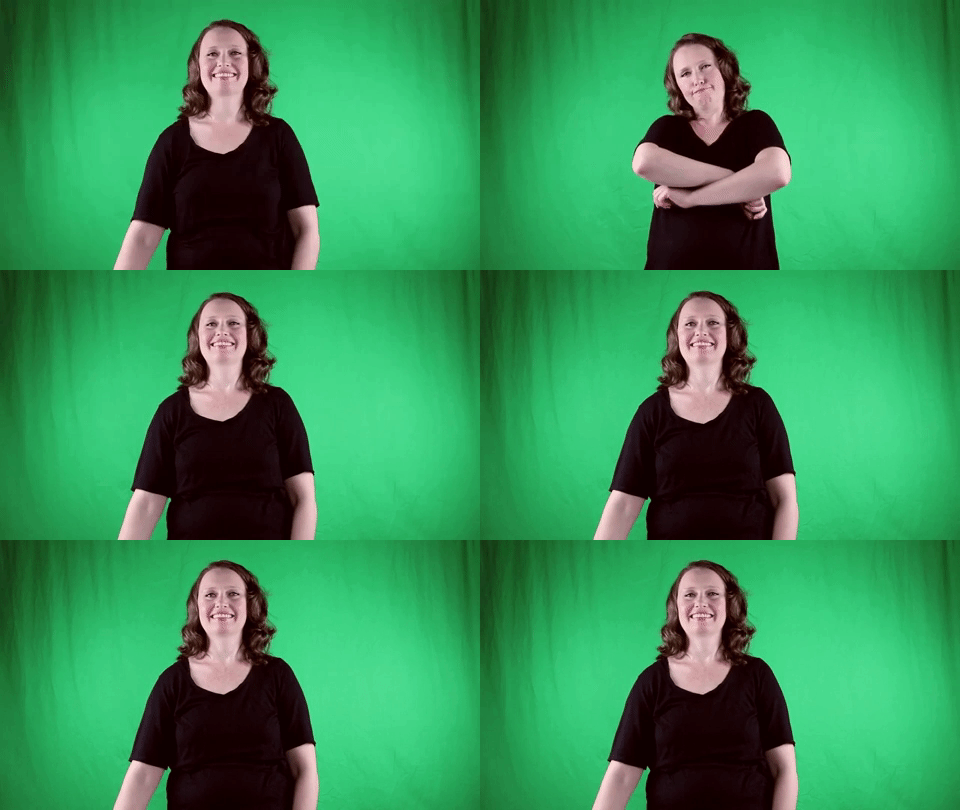
Sign for CROSSEDARMS in ASL | ‍🙅‍♂️ ASL Dictionary

Definition: Arms that are crossed.

Sign for CROSSEDARMS in ASL

YouTube player

Practice Activities:

To practice the sign for CROSSEDARMS in ASL, start by standing in front of a mirror and signing it in isolation. Repeat the movement ten times, checking form and fluidity. Then, shift from a relaxed stance into the sign and back again to develop muscle memory.

Next, integrate the sign into short phrases. Practice sentences such as “She sat with her arms crossed” or “He looked angry, arms crossed.” This helps learners familiarize themselves with how the sign for CROSSEDARMS in ASL connects to emotions or character descriptions.

Try storytelling prompts that involve physical posture or body language. For example, create a short story about someone waiting for a friend at a park bench, include the moment where they’re feeling impatient or bored, and use the sign for CROSSEDARMS in ASL to show that body language. Practicing expressive signing in this way improves fluency.

Use role play with a partner to explore different meanings of the crossed-arms gesture. One partner can act out a scene where they’re upset or frustrated, using the appropriate facial expressions and the sign. The other partner can narrate what they’re seeing or ask how the person feels—this encourages real-time conversational skills.

Watch short ASL videos or vlogs that feature descriptive storytelling. Pause at moments when someone uses posture-based signs and try to analyze whether the sign for CROSSEDARMS in ASL is relevant or used. Then mimic the sign and insert it into a similar scenario you’ve created.

Use emoji prompts to make it fun! For example, show a or emoji and prompt yourself or your study partner to act out matching body language, including the correct ASL sign. This not only strengthens recall but also hones non-manual markers associated with the sign.

Cultural Context:

The sign for CROSSEDARMS in ASL carries more meaning than just a physical stance. Within Deaf culture and American Sign Language, body language plays a key role in communication. This means that the position of arms, hands, and facial expressions can completely change the intent of a sign.

When someone uses the sign for CROSSEDARMS in ASL, it can show emotions like frustration, defensiveness, or being closed off. In different social contexts, it might also be used humorously or to mimic how hearing individuals show a similar stance in silence. This sign is one of many that reflect how ASL incorporates full-body communication into everyday conversation.

Unlike in spoken English, where a crossed-arm posture is purely visual, the sign for CROSSEDARMS in ASL becomes part of the grammar and emotional tone. This is a great reminder of the visual richness of signed languages. The use of such a sign shows how ASL integrates natural, culturally familiar gestures into a fluid and expressive language.

In Deaf culture, it’s common to use expressive body movements to replace spoken tone of voice. The sign for CROSSEDARMS in ASL often carries a tone based on the signer’s expression and posture. It may convey serious intent in one context, while in another it can express teasing or sarcasm.

Understanding the cultural background of the sign for CROSSEDARMS in ASL helps learners avoid miscommunication. A neutral or smiling face can completely shift the meaning of this sign, as can the pace and strength of the movements. It’s important to observe how fluent signers use this expression in real-life settings, such as during storytelling or heated debates.

Storytelling is a powerful part of Deaf culture. When characters in ASL stories use the sign for CROSSEDARMS, they are immediately recognized as thoughtful, annoyed, or stubborn. These traits are visually communicated in a way that’s deeply embedded in the language structure of ASL.

In educational settings, teachers may teach the sign for CROSSEDARMS in ASL to help students understand body positioning in fluency training. Since it’s a familiar gesture for many, it provides a relatable entry point into more complex body-language-based signs. Learning when and how to use this sign appropriately builds cultural and conversational confidence.

The sign for CROSSEDARMS in ASL also appears in theater and performance art within the Deaf community. Actors use it to capture emotion and attitude in a way that’s instantly recognizable to Deaf audiences

Extended Definition:

The sign for CROSSEDARMS in ASL represents a physical gesture that conveys more than just a position of the arms. When someone crosses their arms in American Sign Language, it often expresses an emotion, attitude, or context depending on the conversation. This gesture goes beyond the literal and frequently communicates feelings such as resistance, defiance, or emotional closure.

To sign CROSSEDARMS in ASL, the signer generally brings both arms across their chest, placing each hand on the opposite bicep or elbow. This is a natural and commonly understood body posture, and while not a formal ASL word, it functions as an expressive body language form within ASL communication. Deaf culture strongly incorporates facial expressions and body postures to add meaning and depth to a sign, and the sign for CROSSEDARMS is no exception.

This gesture can appear in everyday conversation when someone is upset, uninterested, or asserting a boundary. For example, if a person signs while standing or sitting with their arms crossed, it may convey that they are annoyed or withholding agreement. Context always plays a major role. The meaning of the sign for CROSSEDARMS in ASL can change based on facial cues, tone, and signing speed.

In storytelling or dramatic ASL performances, the sign for CROSSEDARMS can help establish a character’s mood or attitude. The signer might pause with arms crossed and include an intense facial expression to show defiance, disappointment, or strength. This adds emotion and immediacy to the message, creating a vivid visual for the audience.

It’s important to note that the sign for CROSSEDARMS in ASL is a descriptive gesture and not a coded dictionary sign with its own handshape or movement structure. Instead, it’s a role-shifted use of body language that mirrors how people cross their arms in real life. As a result, it is more tied to visual storytelling than to standardized vocabulary.

Because American Sign Language relies heavily on spatial awareness, body posture plays a key role in communication. A simple pose like arms crossed can function as a grammatical or narrative device. When the sign for CROSSEDARMS in ASL is used in dialogue, it often signals inner conflict, resistance, or negotiation without a single word needing to be expressed.

In learning environments, instructors might demonstrate the sign for CROSSEDARMS in ASL to show students how emotion is portrayed through physical stance. When paired with appropriate expression and

Synonyms: folded arms, arms crossed, arms folded, crossing arms, folded across

Educational resources: Find related learning materials in our course bank!

Want more? Check out some of our popular learning activities on the homepage!

Need to look up a sign? Use our highly rated dictionary: https://aslinteractive.com/best-asl-dictionary/

Follow us on tiktok: https://www.tiktok.com/@aslinteractive. More social media links at the bottom of this page!

Long-tail Keywords: what is the sign for crossed arms in ASL, how do you sign crossed arms in ASL, ASL sign for crossed arms

Categories:

tags: body language, nonverbal communication, emotions, gestures, attitudes

Parameters

*Handshape*:

The handshape for the sign for CROSSEDARMS in ASL generally uses relaxed, open hands or fists, depending on the context or attitude expressed. Both arms are crossed over the chest in a natural, neutral position. This body-based sign doesn’t rely on intricate hand configurations but rather on the crossing motion and arm placement.

The sign for CROSSEDARMS in ASL can reflect mood or posture. When using fists, it may portray defiance or confidence ‍♂️, while open hands suggest relaxation .

*Palm Orientation*:

For the sign for CROSSEDARMS in ASL, the palm orientation faces inward toward the body. Both hands are placed across the chest in an X-shape, typically with fists closed and the knuckles of each hand resting near the bicep of the opposite arm. This posture mimics the natural stance of arms being crossed.

When demonstrating the sign for CROSSEDARMS in ASL, be sure that the palms remain facing yourself rather than outward. This helps accurately convey the physical position associated with a crossed-arms posture .

*Location*:

The sign for CROSSEDARMS in ASL typically takes place in front of the upper torso or chest area. Both arms are crossed over one another, with each hand resting on the opposite upper arm or shoulder, depending on the context or emphasis.

This positioning centers the sign around the chest, maintaining visibility and replicating the natural gesture. The sign for CROSSEDARMS in ASL keeps movements close to the body to represent folded or closed-off stances accurately.

*Movement*:

To show the sign for CROSSEDARMS in ASL, begin by placing both arms in front of your chest with the forearms crossing each other like an “X”. Your hands should be flat or slightly curved and rest gently on your upper arms or shoulders depending on how tight the gesture is.

The movement is static, emphasizing the body language of arms folded rather than a dynamic motion. The sign for CROSSEDARMS in ASL communicates a posture common in emotions like frustration, defiance, or deep thinking.

*Non-Manual Signals*:

The sign for CROSSEDARMS in ASL is typically accompanied by a firm, neutral facial expression or a slightly closed-off demeanor. Eyebrows may lower slightly, and lips are usually pressed together without a smile to emphasize the non-verbal cue of being defensive or unapproachable.

When using the sign for CROSSEDARMS in ASL, the signer may lean back slightly or tighten their posture to reinforce the meaning. This non-manual signal strengthens the idea of emotional or physical closure .

*Prosody, Dominant/Non-Dominant Hand*:

The sign for CROSSEDARMS in ASL uses both arms in a neutral resting position to visually mimic crossing them over the torso. Both the dominant and non-dominant hands are involved equally, starting by bringing each arm across the body so that the forearms overlap at the chest level.

This symmetrical sign conveys body language directly, often accompanying emotions like defiance or contemplation. Since both arms play a mirrored role in the sign for CROSSEDARMS in ASL, there is no dominant hand action, emphasizing posture over handshape .

Tips for Beginners:

When practicing the sign for CROSSEDARMS in ASL, it’s important to be mindful of your body language and facial expressions. This sign involves physically crossing your arms over your chest, with each hand tucked under the opposite bicep, palms facing in or slightly downward. It’s often used to convey emotions such as defiance, defensiveness, or simply being at rest, depending on the context and facial expression.

One of the best tips for mastering the sign for CROSSEDARMS in ASL is to focus on the subtleties of your posture and overall stance. Unlike many ASL signs that rely primarily on handshapes and motion, this gesture-based sign is highly dependent on your physical position. Practicing in front of a mirror can help ensure your arms are evenly crossed and your posture is intentional and confident.

Avoid common pitfalls such as letting your hands dangle or not fully crossing the arms. This can confuse the meaning or make the sign look unclear. Keep your motions smooth and deliberate, and hold the position for a moment when signing to allow others to clearly see your intent.

Another useful tip is to pair the sign for CROSSEDARMS in ASL with appropriate non-manual markers, such as a serious or skeptical facial expression if you’re trying to express emotional weight. ASL is a visual language, and your face contributes heavily to the grammar and meaning of your sign.

If you’re using the sign to describe someone else in a storytelling or descriptive context, make sure to establish the person’s physical position first and then mimic the posture accurately. The sign for CROSSEDARMS in ASL can also serve as a classifier in some cases to represent someone standing silently or standoffishly. Practicing consistency will help polish your use of this sign across settings.

Connections to Other topics:

The sign for CROSSEDARMS in ASL connects directly to nonverbal communication elements in ASL culture. Signers often draw from natural, body-based gestures to express emotion, stance, or engagement, and crossed arms can symbolize defensiveness, attitude, or being closed off. While it may not always be lexicalized as a standard ASL vocabulary word, representing it with classifier usage or role-shifting supports the language’s visual-spatial modality.

This sign concept relates to classifiers, particularly body classifiers or whole-body expressions, which depict physical states or postures. For instance, you might see this sign integrated into storytelling contexts where a character is upset, confrontational, or uninterested. The use of classifiers alongside facial expressions ensures a full, clear message, making the sign for CROSSEDARMS in ASL a good bridge to mastering ASL storytelling techniques.

There are also compound contexts where this concept pairs with emotion-driven signs like MAD, DISAGREE, or ATTITUDE to reinforce the message. For example, incorporating the sign for CROSSEDARMS before signing MAD can visually emphasize someone’s defensive anger. This blending of sign choices demonstrates how body language underpins meaning in ASL beyond handshapes alone.

The sign for CROSSEDARMS in ASL can also appear in discussions about cultural behaviors or interpersonal dynamics within Deaf culture. Expressive body posture is crucial to communication, and depicting someone with their arms crossed may add layers to a conversation about emotional states or relational boundaries. This highlights how deeply connected physical positioning is with meaning in the broader ASL lexicon.

In theatrical or narrative use, a signer may use role shift and space mapping to show a character repeatedly crossing their arms to indicate stubbornness or retreating into themselves. The sign for CROSSEDARMS in ASL, then, becomes not just an emblem of body language but a storytelling and expressive tool.

Summary:

The sign for CROSSEDARMS in ASL involves a gesture where both arms are crossed over the chest or stomach area. This is a highly visual and iconic sign that draws directly from real-world body language. It mimics the natural pose of arms resting one over the other across the torso.

This posture is commonly recognized as a gesture of defensiveness, stubbornness, or simply being cold or closed off. In American Sign Language, gesture plays an important role in signs that depict emotional or behavioral states. The sign for CROSSEDARMS in ASL uses this gestural principle effectively.

The sign itself may differ slightly in execution depending on the region or person, but the fundamental concept remains the same: crossing the arms across the front of the body. This action conveys a combination of attitude and barrier. Unlike some ASL signs that rely on handshape configurations, this one relies on full-arm positioning and nonmanual signals.

Facial expression significantly enhances the meaning of the sign for CROSSEDARMS in ASL. Depending on context, a stern, angry, or dismissive look might accompany the movement, conveying different emotional tones. These facial cues are part of ASL’s nonmanual markers, just as integral to meaning as the hands themselves.

Grammatically, the sign for CROSSEDARMS in ASL can function as a verb or a descriptor, depending on the sentence context. For example, it may be used to show how someone is standing in a narrative, or to describe a person’s mood. The signer may use role-shifting or eye gaze to emphasize who is crossing their arms in the story.

Signers might choose the sign for CROSSEDARMS in ASL to emphasize resistance or withdrawal in storytelling or explanation. It embodies a metaphor — creating a literal ‘barrier’ between the person and others — which links to how a person might behave in an emotional sense. It is often used in visual storytelling or dramatic narratives.

This is a mimicry-based sign, categorized linguistically under iconic signs. Iconic signs carry clues to their meaning through their form, and this contributes to easier comprehension for visual learners or ASL beginners. The gesture resembles real-world body language, strengthening its intuitive grasp.

Interestingly, the sign for CROSSEDARMS in ASL isn’t always a standardized lexical sign like DOG or HOUSE. Depending on the context and fluency of the signer, it may be more of a classifier or even a fully gestural representation. This makes it flexible but also reliant on shared understanding and contextual cues.

In broader Deaf culture, body language plays a significant role in daily expression. Deaf individuals often have heightened sensitivity to body movement and face cues due to the visual nature of their language. Therefore, signs like the one for CROSSEDARMS stand out as powerful communicative tools.

The sign can easily be paired with other signs to describe people or emotions. For example, CROSSEDARMS followed by MAD or ANGRY enhances the depiction of someone upset. The sign reinforces mood physically as you sign topically-driven descriptors.

Culturally, the sign for CROSSEDARMS in ASL may be used in narratives and jokes as a way of showing resistance or sass. It becomes a powerful reference to someone’s personality or emotional stance. It can also depict indignation or a character who is closed off to communication.

The sign intersects with many related signs, such as STUBBORN, GRUMPY, or even WAITING, depending on accompanying facial expressions and context. In storytelling, subtle variations in posture, along with the crossing motion, can express a wide array of emotions and traits. These combinations add color and detail in Deaf performances or everyday conversations.

In classifiers or depictions, someone might set up a signer using role-shift and simply cross their arms while shifting their torso to embody a person standing that way. This semi-gestural depiction conveys a lot efficiently. ASL is rich in this kind of embodied narrative technique.

The dialectic variation of the sign for CROSSEDARMS in ASL may include additional gestures, such as shrugging the shoulders or tapping the upper arms, depending upon regional or generational use. These embellishments reflect how ASL evolves. Such variations demonstrate the creativity and regional flavors across Deaf communities.

If used with mouth morphemes or eyebrow expressions, the sign for CROSSEDARMS in ASL can gain additional nuance. A signer may puff the cheeks out to indicate annoyance or disappointment when crossing the arms, or they might raise the brows in exaggeration or sarcasm. These added pieces are crucial parts of natural ASL expression.

Linguistically, signs like CROSSEDARMS contribute to our understanding of ASL as a visual-spatial language. They emphasize that some concepts are best conveyed through physical embodiment. Rather than abstract hand configurations, signs that integrate full-body expression tell us about ASL’s unique modality.

In the study of applied linguistics,

Want more? Check out some of our popular learning activities!

ASL Interactive Resources

ASLInteractive YouTube Channel

Follow us on tiktok: @aslinteractive.com

Follow us on Instagram: aslinteractive

Facebook page: aslinteractive

Facebook group: aslinteractive

LInkedIn: ASL Interactive LLC

Twitter: @ASL_interactive

*Some information on this page is AI-generated. AI can make mistakes. Please check the information.

Sign for CROSSEDARMS in ASL

Responses