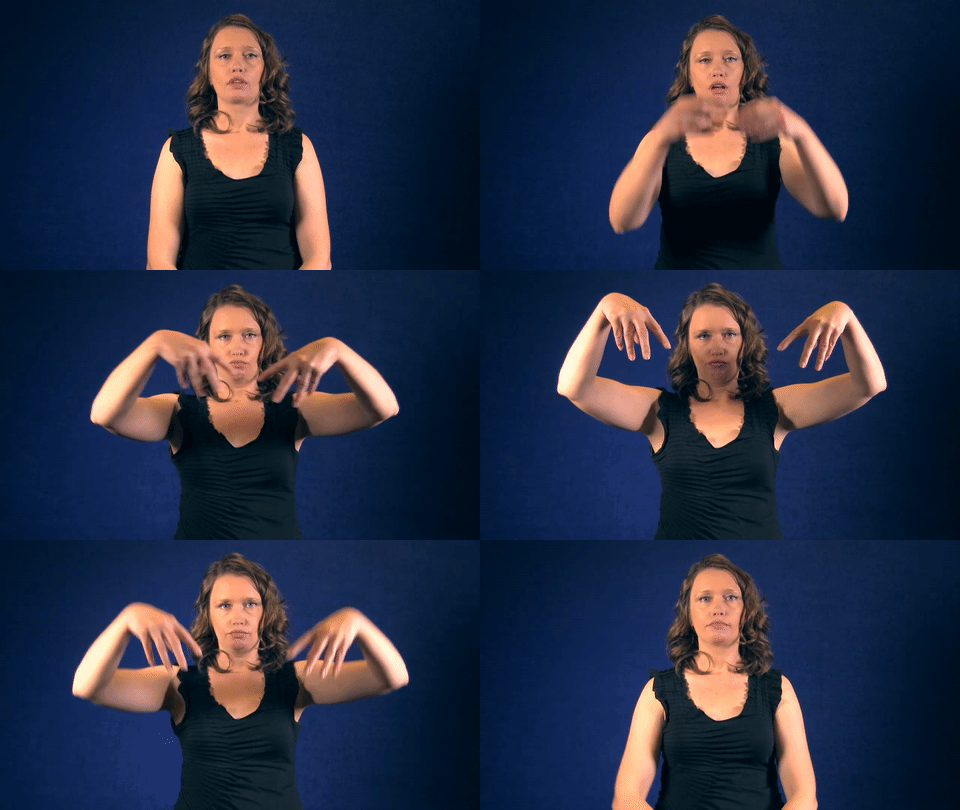
Definition: Pieces of fabric hanging over a window.
Sign for CURTAINS in ASL

Practice Activities:
To effectively practice the sign for CURTAINS in ASL, begin by signing it in isolation multiple times while facing a mirror. Focus on your handshape, palm orientation, and the motion to ensure accuracy and clarity. Repetition will help develop muscle memory and help you recognize the sign more quickly when others use it.
Next, connect the sign to everyday objects for reinforcement. Look around your home and identify different types of curtains, then sign about them. For example, stand near a window, then sign “window” followed by the sign for CURTAINS in ASL. Labeling real-world items supports long-term retention and comprehension.
Practice forming simple sentences. Try “I open curtains every morning” or “The curtains are long and white.” Signing these phrases slowly, then at a conversational pace, lets you become comfortable using the sign in descriptive context. You can also combine it with time indicators like “morning” or “night” to describe when the action takes place.
Create short storytelling prompts that include domestic scenes involving this household item. For instance, sign a story about someone waking up, walking to the window, and opening the curtains to see the sun. Adding emotional expressions, like surprise or happiness, helps you communicate the full meaning of your story.
Partner practice is beneficial to enhance receptive skills. One partner can describe different rooms using the sign for CURTAINS in ASL while the other identifies which room they’re referring to. You can also take turns signing household routines and include signs like “open,” “close,” or “draw” along with CURTAINS to simulate real-life actions.
Use flashcards or images of different curtain styles and challenge yourself to describe them using ASL signs. This adds variety while strengthening your vocabulary. With consistent practice, you’ll be confident using the sign for CURTAINS in ASL in everyday conversation.
Cultural Context:
In Deaf culture and the broader signing community, home-related signs like the sign for CURTAINS in ASL carry more than just their basic meanings. They reflect everyday life, personal environments, and sensory interactions that are deeply visual and tactile. Signing about household items such as curtains helps create vivid mental imagery for communication.
The sign for CURTAINS in ASL is often used in stories or conversations about preparing a room, adjusting lighting, or even setting a mood for a space. Since sign language thrives on visual components, detailing the appearance and motion of curtains adds richness and clarity. Describing colors, patterns, or actions like opening and closing the curtains can add emotional or narrative depth.
Understanding the cultural significance of space and visibility plays an important role in how the sign for CURTAINS in ASL is used. In Deaf households, visibility within a room can be crucial for communication. Open or closed curtains may directly impact how well one can see and interact with others visually, especially in natural light.
Curtains also represent privacy, which is a key value in many cultures. In Deaf culture, privacy and visual boundaries are sometimes discussed through the use of descriptive signs. The sign for CURTAINS in ASL allows users to indicate personal space or set a scene within visual storytelling.
This sign becomes especially meaningful in children’s signing narratives, teaching them how to describe their environment and share experiences. Teachers often use the sign for CURTAINS in ASL as part of thematic lessons about home, rooms, and decoration. It connects language to the practical reality of categorizing the world around us.
In storytelling traditions within the signing community, people describe scenes down to small details like the presence of curtains. Creating a visual setting helps maintain engagement and builds a stronger sensory picture. The sign for CURTAINS in ASL might be part of a larger narrative involving morning routines, changes in weather, or emotional shifts represented by how the curtains are used.
The sign for CURTAINS in ASL may also appear in casual social conversations, especially during discussions about home improvements or aesthetic preferences. It allows for expressive dialogue about one’s living space, emphasizing the highly visual nature of decorations, lighting, and fabric textures. Signing about such details fosters connection and shared experiences.
In community events or Deaf theater, the concept of curtains also appears symbolically. The opening and closing of stage curtains serve as metaphors for transitions, timing, and dramatic structure. The sign for CURTAINS in ASL can be adapted metaphorically
Extended Definition:
The sign for curtains in ASL is a visual representation of how curtains move across a window or space. American Sign Language often mirrors how objects are used or appear in the real world, and the sign for curtains is no exception. It’s a natural, iconic sign that most learners find easy to remember once they understand its context.
To perform the sign for curtains in ASL, both hands are used to mimic the movement of drawing curtains open or closed. With your hands positioned near the top of an imaginary window, you move them in a way that shows the curtains being pulled apart or drawn together. This sign is usually made with a relaxed handshape, mimicking how curtains are handled in everyday life.
This sign can be modified slightly depending on whether you’re discussing horizontal curtains, vertical blinds, or theatrical drapes. For example, if referring to stage curtains, you might make a more dramatic, sweeping motion to indicate size and grandeur. ASL users often adapt signs to better match the situation, and the sign for curtains is flexible in this way.
In everyday conversations about home, interior decorating, or cleaning, the sign for curtains in ASL appears frequently. It’s also commonly used in storytelling or retail settings, especially when discussing home goods or window treatments. Because curtains are a familiar part of most people’s environment, this sign is practical and relevant for daily communication.
Understanding the sign for curtains in ASL also helps learners develop spatial awareness, a key component of American Sign Language grammar. Because ASL is rooted in space and movement, visualizing the size and placement of objects like curtains contributes to fluency. This is especially useful when describing a setting, like a living room or a bedroom, where curtains may be a prominent visual element.
The sign for curtains in ASL is important for both expressive and receptive skills. When watching someone sign, recognizing this specific motion is crucial for understanding the context of a conversation. For students and interpreters alike, memorizing common household vocabulary like curtains builds a strong foundation.
You might also see classifiers used alongside the basic sign for curtains. Classifiers can indicate fabric type, length, or the motion of the curtains swaying in a breeze. Layering the sign for curtains with such classifiers adds richness to the communication, painting a complete picture for the viewer.
Whether you’re learning ASL for personal use, for interpreting, or for academic studies, becoming comfortable with vocabulary like the sign for curtains in ASL is essential. It bridges the gap between abstract language and
Synonyms: drapes, blinds, window coverings, shades, draperies
Educational resources: Find related learning materials in our course bank!
Want more? Check out some of our popular learning activities on the homepage!
Need to look up a sign? Use our highly rated dictionary: https://aslinteractive.com/best-asl-dictionary/
Follow us on tiktok: https://www.tiktok.com/@aslinteractive. More social media links at the bottom of this page!
Long-tail Keywords: what is the sign for curtains in ASL, how do you sign curtains in ASL, ASL sign for curtains
Categories:
tags: Objects, Housing, Describing Residence, Language Learning, Everyday Activities
Parameters
*Handshape*:
The handshape for the sign for CURTAINS in ASL uses both hands in an open B-handshape, with fingers straight and together, thumbs extended and relaxed. The palms face toward you, mimicking the position of hands pulling back fabric.
To sign CURTAINS in ASL, start near the top of your shoulders and move both hands outward to the sides, as if drawing curtains open. This iconic movement, combined with the open B-handshape, clearly indicates the object being referenced.
*Palm Orientation*:
The palm orientation for the sign for CURTAINS in ASL typically involves both hands positioned in front of the body, starting near the shoulders. The palms face each other, oriented slightly forward and toward the centerline of the body, as if grasping imaginary curtain panels.
In the sign for CURTAINS in ASL, the hands then move outward like drawing back real curtains. Palms continue facing inward throughout the motion, mimicking the opening gesture.
*Location*:
The sign for curtains in ASL is typically produced in the neutral space in front of the upper torso or near shoulder height. Both hands start near the center of the chest and move outward to the sides, mimicking the action of pulling open a pair of curtains.
This use of space clearly demonstrates the concept behind the sign for curtains in ASL, making it both visually iconic and easy to remember.
*Movement*:
To sign curtains in ASL, start with both hands open and spread, palms facing each other in front of the body at about shoulder level. Move the hands apart horizontally toward the sides, mimicking the motion of drawing open a pair of curtains.
This motion illustrates the act of pulling back fabric, which makes the sign for curtains in ASL visually iconic . Keep the movement smooth and controlled to clearly represent the concept.
*Non-Manual Signals*:
When demonstrating the sign for CURTAINS in ASL, the non-manual signals can include a neutral or mildly expressive facial expression to reflect description or location placement, often used when describing household items. Eyebrows may raise slightly if asking a question about curtains, or remain relaxed when simply stating or identifying them.
Proper directional gaze, such as looking toward an imaginary window space, helps anchor the sign for CURTAINS in ASL in context. Including slight head tilts can also emphasize spatial arrangement or the size of the curtain being referenced.
*Prosody, Dominant/Non-Dominant Hand*:
Both hands are used for the sign for curtains in ASL, typically mirroring each other. Start with both open B-hands held upright and palm-in near the sides of the head, then pull the hands outward and slightly downward, mimicking the motion of drawing curtains open.
The dominant and non-dominant hands work in tandem for this symmetrical movement. The sign for curtains in ASL visually represents the action of parting drapes, making the concept easily understood.
Tips for Beginners:
When learning the sign for CURTAINS in ASL, it’s helpful to visualize the motion of drawing open or closing a window curtain. This sign is typically made using both hands to mimic the action of opening curtains from the center outward. Be sure to position your hands at about shoulder height and keep your fingers slightly curved to represent grabbing fabric.
One important tip for beginners is to use smooth, deliberate movements, not rushed hand motions. Don’t focus on speed—focus on expressing the meaning clearly. The sign for CURTAINS in ASL depends heavily on visual accuracy, so practicing in front of a mirror can help you adjust spacing and hand shape more precisely.
A common mistake is performing the sign too low on the body or too far to the sides. Keep your movements at the proper height to match where curtains would normally hang around a window. Staying within your signing space and maintaining a comfortable range of motion can make your signing clearer and easier to understand.
If you wear long sleeves or bracelets, be aware that your clothing might obscure the motion, especially if your hand movements are subtle. Good visibility is key in the sign for CURTAINS in ASL, so it’s recommended to practice in short sleeves or snug sleeves until the movement becomes natural.
Make sure your face is expressive while signing. Although facial expressions may seem secondary, they add important context to the sign. If you’re describing high curtains or heavy drapes, a facial expression can reinforce the mood or tone you’re trying to convey.
Lastly, commit time to watching native signers demonstrate this sign. Noticing details like fluidity, rhythm, and body posture can accelerate your progress. Regular repetition combined with observation will help you internalize the proper look and execution of the sign for CURTAINS in ASL.
Connections to Other topics:
The sign for CURTAINS in ASL connects closely with other signs related to home and environment. It shares visual and conceptual similarities with signs like WINDOW and BLINDS due to the context of home décor and the motion of pulling or opening. These associated signs often include directional or spatial elements that help express how objects in a room interact with each other, offering a deeper understanding of space in ASL.
In context, combining the sign for CURTAINS in ASL with HOME, ROOM, or WINDOW can clearly describe where the curtains are and their purpose. For example, a signer might use ROOM followed by WINDOW and then CURTAINS to describe what is in a particular room. This shows how compound expressions are naturally formed in ASL based on conceptual groupings rather than rigid grammatical rules.
The sign for CURTAINS can also be adapted slightly depending on whether you’re referring to stage curtains or household curtains. This overlap introduces learners to the idea of classifier usage and slight modifications in sign execution to express related but distinct meanings. Classifiers used to describe wide, heavy drapes versus light sheer curtains help learners expand their visual vocabulary and sign choices.
There’s also a useful link between the sign for CURTAINS in ASL and signs for LIGHT or DARK, as one can describe a room getting darker when the curtains are drawn. This real-world application helps learners not only remember the sign for CURTAINS visually, but also understand how it interacts with other signs naturally in conversation.
Exploring the sign for CURTAINS in ASL opens a path to learning other spatial and environmental descriptors, including FURNITURE, FLOOR, and WALL. These help a signer construct imaginative scenes, enhancing both narrative storytelling and everyday communication. As learners build their ASL fluency, signs like CURTAINS serve as functional connectors to a broader visual language system.
Summary:
The sign for CURTAINS in ASL is deeply rooted in visual-spatial representation, mimicking the physical act of opening or drawing a curtain aside. This iconic sign captures the vertical motion of pulling drapes apart with both hands, starting from the center and moving outward. It reflects ASL’s use of classifiers and visual metaphors to express tangible concepts.
This sign commonly uses both open or curved hands, palms facing each other, beginning near the center of the chest and pulling outward horizontally. The motion suggests separating two panels of fabric, as with standard domestic curtains. The placement and motion provide intuitive connections with the physical world.
The sign for CURTAINS in ASL can be modified to express different types of curtains depending on context, such as theater curtains or shower curtains. These expansions are often clarified through classifiers or descriptive signing before or after the core sign itself. For example, adding a sign indicating a shower environment contextualizes a shower curtain.
In homes, the sign carries cultural resonance, representing privacy, decor, and control over space. The act of drawing a curtain signals transitions between inner and outer environments. In the Deaf community, this can also symbolize the need for visual privacy in homes with open visual layouts.
The sign for CURTAINS in ASL is typically used as a noun, but in context-rich conversations, it can function within verb phrases. For instance, saying “I opened the curtains” can include the classifier sign for CURTAINS alongside the verb OPEN. ASL’s flexibility with sign sequencing allows meaning to emerge from the flow of iconic gestures.
Structurally, ASL preserves a subject-verb-object order but often shifts depending on emphasis. The sign for CURTAINS in ASL tends to appear in object position when describing actions involving curtains. For example, “C-U-R-T-A-I-N-S CLOSE” would follow the ASL structure when describing an action involving closing curtains.
Classifier usage enhances the expressive potential of the sign for CURTAINS in ASL. A classifier may show fabric falling, waving, fluttering, or being drawn—as in theatrical performances. Movement, handshape, orientation and non-manual markers all contribute to layered meaning.
In drama and live performances, curtains symbolize transitions and endings. Theatrical settings may involve more exaggerated movements to create the image of heavy stage curtains being pulled shut. This reflects cultural connotations of completion, drawing a metaphorical curtain on events.
Grammatically, the sign fits into a rich domain of spatial referencing, common in ASL’s structure. Speakers may index the curtain’s location using pointing or visual bracketing, anchoring the curtain in spatial memory for future reference in discourse. This spatial consistency improves understanding in longer narratives.
The sign for CURTAINS in ASL connects to broader household vocabulary like WINDOW, BLINDS, SHADES, or DOOR. These signs often appear together in conversations about interior design, household planning, or preferences for light and privacy. This grouping enables fluent thematic discussions in home-related conversations.
Related signs utilize similar motion or orientation—like the sign for DOOR, which also reflects a physical motion. Understanding the differences between these similar signs sharpens one’s ability to distinguish spatial and functional aspects of ASL. Such comparisons enrich signers’ visual-cognitive mapping.
The sign for CURTAINS in ASL shares visual logic with other garment or fabric-related vocabulary. For instance, signs for DRESS or CLOTHES involve sweeping movements suggestive of fabric. This reflects ASL’s systemic use of gesture to root abstract words in bodily experience.
In applied linguistics, analyzing the sign for CURTAINS in ASL provides insight into how ASL users engage with the physical environment through sign. The bodily enactment of real-world movements offers examples of enactive cognition. This presents rich research avenues for understanding embodied language.
Semantic extensions of curtains in metaphor also appear in Deaf storytelling and visual literature. Metaphors signified by CURTAINS can involve separation, unveiling, or concealment. The sign plays a role in visual poetry or conceptual narratives that use the concrete to anchor the abstract.
In expressive signing, facial expressions often accompany the verb-action associated with curtains. A signer may widen their eyes as they depict curtains being drawn open to reveal something surprising. These non-manual signals animate the meaning and connect emotion to the act.
Some signers may emphasize curtain types through describing length, texture or movement. For instance, adding a visual cue for lace or thickness builds meaning around standard CURTAIN signs. These descriptive strategies help specify without needing fingerspelling or excessive elaboration.
The sign for CURTAINS in ASL is generally learned at novice or intermediate levels of ASL curriculum, as it is relevant to daily living. It frequently appears in ASL storytelling, household vocabulary units, and practical scene descriptions. Learners must understand its visual-spatial properties early on.
Technology has influenced how the sign for CURTAINS in ASL is taught. Through online
Want more? Check out some of our popular learning activities!
ASL Interactive Resources
ASLInteractive YouTube Channel
Follow us on tiktok: @aslinteractive.com
Follow us on Instagram: aslinteractive
Facebook page: aslinteractive
Facebook group: aslinteractive
LInkedIn: ASL Interactive LLC
Twitter: @ASL_interactive
*Some information on this page is AI-generated. AI can make mistakes. Please check the information.


Responses