Sign for CURVES in ASL | ➰ ASL Dictionary

Definition: Curved lines or shapes.

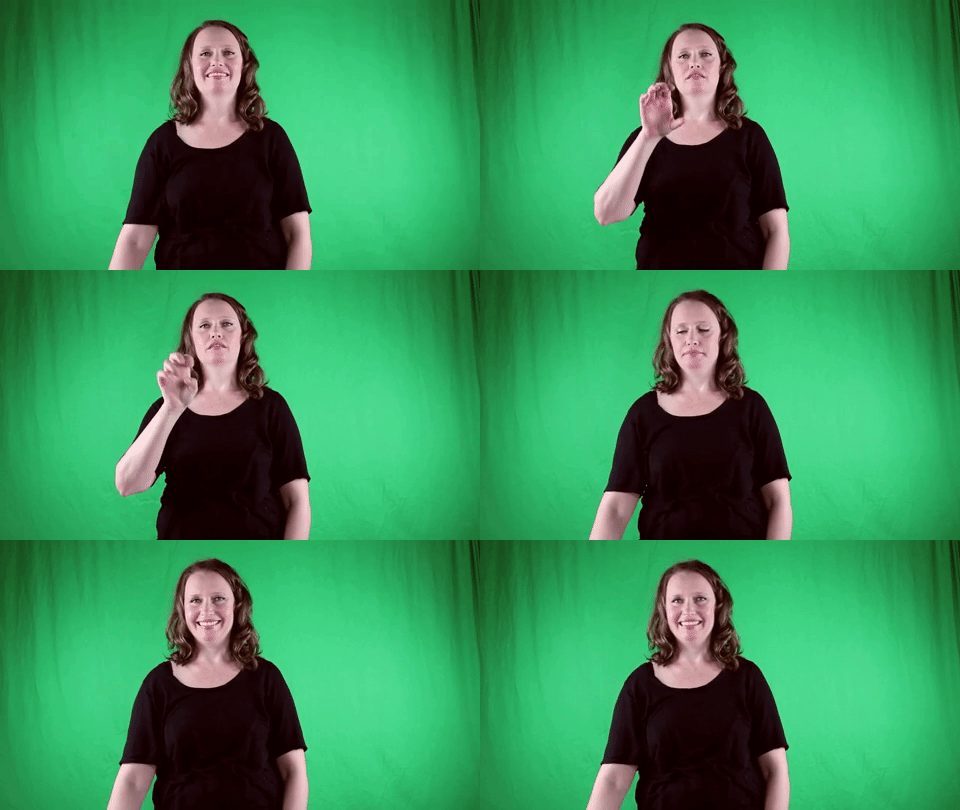
Sign for CURVES in ASL

YouTube player

Practice Activities:

To practice the sign for CURVES in ASL, begin by isolating the motion. Repeatedly practice the fluid movement of the dominant hand forming a curved shape through the air. Stand in front of a mirror to ensure your motion is smooth and clearly represents a curved line. You can use the sign to mimic the shape of a road, a hill, or other natural curves to reinforce the concept visually.

Next, create short phrases that include the sign. Try signing “curves in the road,” “the river curves here,” or “her body has curves.” Get comfortable forming these phrases smoothly. Practicing in front of a camera can help you review and correct your handshape and pacing.

For storytelling, create a short narrative using the sign for CURVES in ASL to describe a winding path or an adventure involving twisty roads. Use other signs to describe the experience, such as WALK, TRAVEL, or ROAD. This helps you put the sign in context while using expressive facial grammar.

In a partner activity, take turns describing images that contain curves—like bridges, winding rivers, spiral staircases, or roller coasters. The other person guesses what’s being described. This builds both vocabulary and receptive skills with the sign for CURVES in ASL.

Label objects around the house that have curved features. Practice describing them to yourself or someone else: “This chair has curves,” “the spoon curves up,” or “look at the curved design.” Reinforcing the visual aspect with actual items helps strengthen your understanding and recall.

Record yourself using the sign in sentences and get feedback from instructors or fluent signers. Repetition, variation, and contextual use are key to mastering the sign for CURVES in ASL and becoming comfortable using it naturally in conversation.

Cultural Context:

In American Sign Language, visual concepts are fundamental to communication. The sign for CURVES in ASL reflects the visual and spatial nature of the language, as it captures shapes and forms that bend or arc. This sign is typically used to describe wavy lines, rounded roads, curvy designs, or any naturally curved shape in the physical world.

Within the Deaf community, the sign for CURVES in ASL can be applied in a wide variety of settings. Whether talking about roads that bend through mountains, hairstyles with waves, or curvy furniture designs, this sign offers a straightforward way to express roundness. The shape of the sign matches the shape it represents, making it intuitive for visual learners.

ASL is deeply connected to physical space and visual imagery. When a signer uses the sign for CURVES in ASL, they often use directional or spatial movements to show the type and size of the curve. This flexibility allows for expressions ranging from gentle slopes to sharp twists, depending on the context.

The meaning behind curves also carries cultural connotations. In conversations about art or dance within the Deaf community, the term CURVES can describe flowing motion and rhythm. The sign for CURVES in ASL allows users to talk about beauty, grace, and movement, all through a visually rich and expressive gesture.

In Deaf education and early childhood learning, basic shape descriptions are important vocabulary. Children learning ASL often start with signs like straight, round, or curve. So, the sign for CURVES in ASL becomes an early building block for more complex visual-spatial conversations in school or play settings.

Signers use facial expressions and body language to reinforce the meaning of signs. When using the sign for CURVES in ASL, slight head tilts or hand shape variations can show whether the curve is soft, tight, or exaggerated. These non-manual signals are crucial for conveying the full meaning.

In fashion and body image discussions, the sign for CURVES in ASL can refer to body shape in a positive way. It allows signers to discuss curves in a respectful and body-positive tone, adding value to inclusive conversations about size and self-image in the Deaf community

In architectural or design conversations, when discussing a building with curving features or a sculpture with rounded edges, the sign for CURVES in ASL offers an accessible way to share visual inspiration. Curved lines often suggest softness and ease, something that can be effectively communicated through signed descriptions.

Storytelling in ASL is

Extended Definition:

The sign for CURVES in ASL can refer to a range of visual and physical shapes that bend or arch without sharp angles. It is often used to describe the outlines of objects, roadways, body figures, or abstract movements. The sign typically mimics the smooth, flowing shape being referenced.

In American Sign Language, visual descriptors are essential for conveying the meaning of words like “curves.” The sign for CURVES in ASL often involves a hand movement that spirals, bends, or arcs in the air. Depending on what is being described, the handshape and motion can change to better represent the specific type of curve.

You might use the sign for CURVES in ASL to describe the curvature of a road, the rounded edges of someone’s handwriting, or the design of a decorative object. It’s an expressive sign that relies on spatial imagining and sometimes facial expressions to add detail. The more emphasis placed on the movement, the more dramatic the curve.

In contexts where curves relate to physical fitness or body image, the sign can be used to describe curvy figures. The way the sign is presented might differ slightly to reflect a more personal or body-focused context. This use of the sign for CURVES in ASL is popular in social media, especially when emphasizing body positivity and natural forms.

The sign can also be used mathematically or scientifically, describing waveforms, data trends, or planetary orbits. In such cases, the sign is more technical and precise, often involving clear directional motion. Educators and students may use the sign for CURVES in ASL during discussions in STEM-related fields.

When talking about clothing or fashion, you can use the sign to describe how certain fabrics or designs follow the body’s natural curves. This visual indexing adds depth to the conversation, helping both deaf and hearing signers visualize what’s being explained. It’s commonly used in fashion blogs and vlogs that include sign language.

Storytelling in ASL also makes rich use of the sign for CURVES in ASL. It can help describe scenic backgrounds, winding paths, or the visual characteristics of characters and objects. This flexibility makes it a valuable tool for expressive storytelling and visual poetry.

In artistic settings, the sign might be combined with signs like “shape” or “design” to build more complex ideas. Artists and creative signers often draw attention to how curves influence visual composition or emotional flow. This further demonstrates the versatility of the sign for CURVES in ASL.

Learning the correct way to

Synonyms: Turns, bends, arcs, contours, twists

Educational resources: Find related learning materials in our course bank!

Want more? Check out some of our popular learning activities on the homepage!

Need to look up a sign? Use our highly rated dictionary: https://aslinteractive.com/best-asl-dictionary/

Follow us on tiktok: https://www.tiktok.com/@aslinteractive. More social media links at the bottom of this page!

Long-tail Keywords: what is the sign for curves in ASL, how do you sign curves in ASL, ASL sign for curves

Categories:

tags: Curvy, Shapes, Describing Objects, Geometry, Drawing

Parameters

*Handshape*:

The handshape used in the sign for CURVES in ASL typically involves a modified “C” handshape or relaxed open hand. The dominant hand moves in a flowing, curved motion to represent the idea of a bend or a contour.

In the sign for CURVES in ASL, the fingers remain extended and gently curved, showing the variation or flex of a line or object. This movement combined with the handshape helps convey shape, form, or a winding path.

*Palm Orientation*:

The palm orientation for the sign for CURVES in ASL typically involves one or both hands with the palms facing sideways or slightly downward, depending on the shape of the curve being indicated. The dominant hand may trace an arc or wave-like motion in the air, simulating the contour of a curve.

When demonstrating the sign for CURVES in ASL, the fingers remain extended and slightly curved, following the direction of the arc. The fluid motion helps clarify that the subject has a rounded or flowing shape rather than sharp angles.

*Location*:

The sign for CURVES in ASL is typically produced in the neutral space in front of the torso, allowing room for a fluid, continuous motion. Hands start near the center of the body and trace a curved or wavy path outward, depending on the context or shape being described.

This location in front of the torso provides visibility and flexibility, allowing the sign for CURVES in ASL to clearly represent undulating or rounded forms using a visual-spatial approach.

*Movement*:

To show the sign for CURVES in ASL, start with your dominant hand open and palm facing down. Move your hand in a smooth, wave-like motion through the air, mimicking the shape of a winding curve. The wrist stays relaxed while the hand moves in gentle, fluid arcs.

This flowing motion helps visually represent the meaning behind the sign for CURVES in ASL. Keep the movement continuous and steady, avoiding sharp angles or stiff motions.

*Non-Manual Signals*:

When using the sign for CURVES in ASL, the facial expression often includes slightly raised eyebrows and a soft, inquisitive gaze to show the graceful or gentle nature of the curves. A relaxed mouth posture or a subtle, closed-mouth smile may also be appropriate, especially when describing something visually flowing or elegant.

The non-manual signals help convey the visual smoothness and shape changes referenced by the sign for CURVES in ASL. You may also tilt your head slightly or follow the motion with your eyes to emphasize the directional flow of a curve.

*Prosody, Dominant/Non-Dominant Hand*:

The dominant hand takes the form of the index finger extended, drawing a loose, wavy line in the air to show the shape of curves. The movement is fluid and horizontal, mimicking the outline of a curved object or path. The non-dominant hand remains still or is not used.

The sign for curves in ASL visually represents physical or metaphorical curves, such as body curves or winding roads. This expressive sign relies on clear hand movement and space usage to convey its meaning naturally.

Tips for Beginners:

When learning the sign for CURVES in ASL, it’s important to first understand the concept you want to convey. The sign typically mimics the shape or motion of a curve with your dominant hand, often using a flat-B or index finger depending on the context. Practicing in front of a mirror helps ensure that your motion is smooth and controlled, resembling the natural arc you’re trying to communicate.

One of the main challenges for beginners is illustrating the type of curve you mean. For example, drawing a vertical curve versus a horizontal one can slightly change your hand movements. When practicing the sign for CURVES in ASL, remember to exaggerate the motion slightly to keep the meaning clear.

Handshape consistency is key. If you’re using an index finger to trace a curve, keep your fingers tight and your motion fluid. Jerky or uneven movements can make the sign confusing or ambiguous to the viewer. The goal is to make your sign visually descriptive without being overly complicated.

Another helpful technique is associating this sign with real-life objects that have curves, such as roads or hills, and practicing how you’d indicate those shapes. This will build muscle memory and improve your ability to adapt the sign for different settings. Not every curve is the same, so flexibility in your depiction is helpful.

Body orientation can also impact how the sign is received. Always keep your signing space clear and your movements within a comfortable range. When using the sign for CURVES in ASL in conversations, check for understanding, especially if you’re indicating a complex or specific curve. Use facial expressions and head movements to add clarity when necessary.

Practice slowly at first, maintaining control and precision. Over time, speed and fluency will come naturally. Remember, clarity always trumps speed.

Connections to Other topics:

The sign for CURVES in ASL connects closely to spatial awareness and movement-based signs, which are foundational in the language. Because curves often represent visual or tactile shapes, this sign ties into topics like geometry, design, and body descriptions. It is frequently used when describing roads, shapes, and even the human body, especially when indicating curved or rounded forms.

This sign also relates to directional and classifier-based communication. Classifier handshapes are often used to show the outline or path of something curved. For example, the sign for “curvy road” might combine the sign for CURVES with a classifier that shows the winding motion of a street. In such contexts, the sign becomes a building block for more complex spatial representations, helping learners build compound concepts.

The sign for CURVES in ASL also shows up in contexts involving fashion and physical descriptions. Signs like BODY, SHAPE, or STYLE are often combined with it to convey meanings such as “curvy figure” or “stylish with curves.” These compounded signs are often used in narratives or compliments, tying physical appearance to more expressive ASL storytelling.

In academic and educational settings, the sign for CURVES may appear in discussions around math, especially with concepts like graph curves or geometric figures. It can also be applied metaphorically in discussions around paths in life or non-linear progress, much like the sign for JOURNEY or PATH when describing experiences that aren’t straightforward.

Understanding how the sign for CURVES in ASL relates to other signs also helps with discussing art, sculpture, and architecture. When describing objects or elements that feature rounded or flowing designs, this sign pairs well with classifiers or directional gestures, allowing for a more nuanced visual explanation. This reinforces the importance of spatial grammar and visual representation in fluent ASL use .

Summary:

The sign for CURVES in ASL typically involves representing a flowing or bending shape with the dominant hand. This is done by moving the hand through the air in a serpentine motion to mimic the contour of a curve. It’s a highly visual sign and often adapts depending on the context it’s used in.

In ASL, iconicity plays a major role in conveying meaning. The sign for CURVES in ASL is iconic because it visually matches the concept it represents. This allows for intuitive comprehension, especially among beginning signers or in expressive contexts.

When expressing CURVES in ASL, context is key. Whether referring to the curves of a road, a body, or a design, the signer may slightly alter the flow or shape of the motion. These nuanced differences enrich the language and allow specific meaning to be conveyed without additional words.

The handshape used is typically the B or open B, allowing the hand to glide lightly. The motion is fluid, often stretched across space, suggesting elongation or a series of undulations. This helps communicate whether there’s a single curve or multiple ones.

The non-manual signals like facial expressions often intensify the curves’ context. A raised eyebrow or a mouth morpheme mimicking “oooo” can enhance the richness, showing pleasure, surprise, or admiration depending on the curve’s subject. These features form the emotive backdrop to the sign.

The sign for CURVES in ASL can also bridge physical and metaphorical meanings. For example, discussing curving trends over time, paths, or even storytelling arcs, signers can adapt the shape to signify abstract curves. This fluidity of meaning makes ASL a deeply expressive tool.

In Deaf culture, visual orientation is central to communication. The sign for CURVES in ASL resonates deeply because it mirrors this priority. The flowing shape aligns with a visual learning style and spatial cognition frequently seen among native signers.

This sign intersects with other signs like ROAD, BEND, BODY, SHAPE, and FLEXIBLE. When used together, they form a lexicon that helps describe environments, movement, and form. It’s common to see CURVES embedded in compound signs or spatial classifiers.

In ASL grammar, the shape of a curve may be built into classifiers. Classifiers give precision to CURVES by indicating the direction, scale, and interaction with other objects. A small, tight curve in a path is different from a wide, sweeping arc, and classifiers help communicate that.

Variations exist for the sign depending on region or cultural input. For instance, some may show double curves using two hands or emphasize symmetrical curves using alternating hand movements. This kind of variation makes the sign highly adaptive to context and dialect.

From a linguistic standpoint, the sign for CURVES in ASL shows how ASL incorporates visual-spatial mapping into grammar. Syntax is not just about sequence but orientation and movement. The curve becomes not just a noun but an event described in space.

In tactile ASL used by DeafBlind individuals, the curve is traced directly onto the partner’s hand or body to illustrate its shape. This form of communication requires referencing kinesthetic memory and spatial imagination in a more physical way. Curves are felt as much as they are seen.

In educational settings, teaching the sign for CURVES in ASL expands students’ ability to describe geometry, art, and anatomy. It becomes a point where math and language intersect. Learners can express sine waves, design elements, and even grammatical nuances through this one motion.

Culturally, the sign finds its place in discussions of dance, fashion, and body image within the Deaf community. The sign for CURVES in ASL may be used to celebrate body positivity or highlight aesthetic appreciation. It becomes a gesture of empowerment or admiration.

In artistic ASL storytelling, curves are often illustrated with dramatic flair. Poets and performers will elongate the sign or match it with body sways to imitate movement. This dramatization turns language into living art.

The sign can also be involved in constructing metaphoric language. For instance, a twisting path through life, a “curved” future, or emotional ups and downs can all be represented creatively. This relies on established knowledge and shared meaning within the ASL community.

When interpreting for someone talking about physical curves—like a winding staircase or curved furniture—the interpreter must clearly replicate these using space and movement. This role as a visual translator places high precision on using the right variant of the sign for CURVES in ASL.

Technological contexts are also seeing new uses of the sign. With CAD software, 3D printing, or virtual design in classrooms, there’s a growing demand for accurate ASL equivalents. As the concept of curvature expands in engineering and art, ASL users need flexible tools for expressing it.

In ASL linguistics, the sign for CURVES exemplifies ASL’s non-linear morphology. A whole set of meanings can be packed into the shape, size, and movement of

Want more? Check out some of our popular learning activities!

ASL Interactive Resources

ASLInteractive YouTube Channel

Follow us on tiktok: @aslinteractive.com

Follow us on Instagram: aslinteractive

Facebook page: aslinteractive

Facebook group: aslinteractive

LInkedIn: ASL Interactive LLC

Twitter: @ASL_interactive

*Some information on this page is AI-generated. AI can make mistakes. Please check the information.

Sign for CURVES in ASL

Responses