Sign for DATE in ASL | 📅 ASL Dictionary

Definition: An appointment to meet or go out with someone you are, or may soon be, romantically involved with.

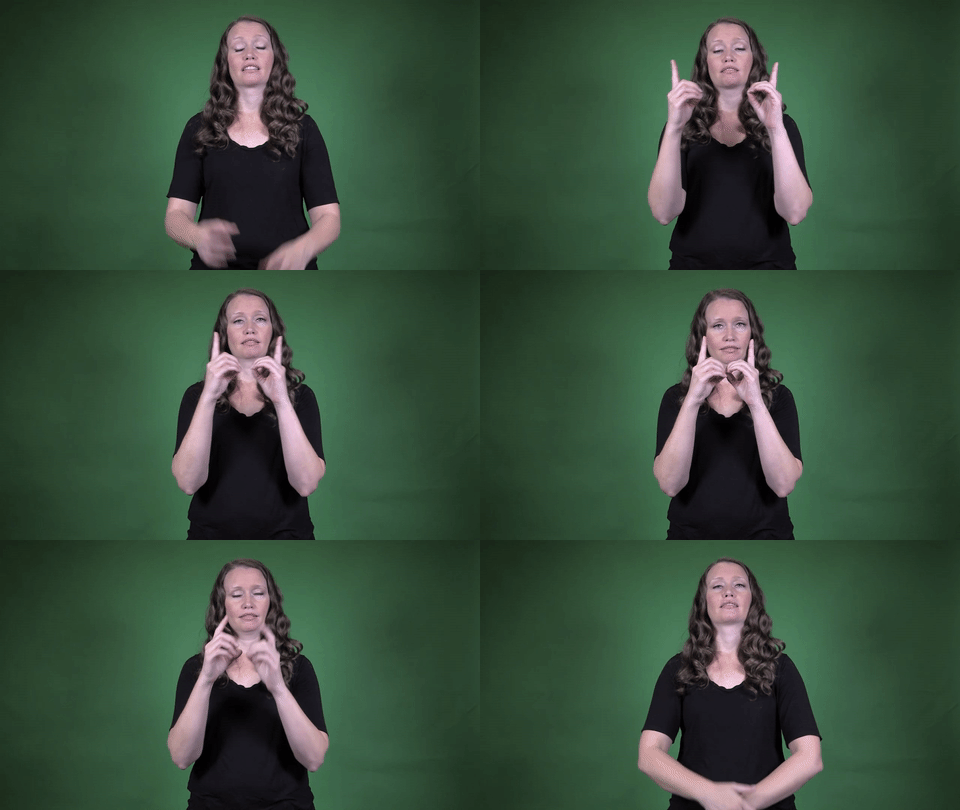
Sign for DATE in ASL

YouTube player

Practice Activities:

Practice recognizing and producing the sign for DATE in ASL by starting with a mirror. Watch your handshape and movement closely to ensure you’re using the correct D-handshapes with fingertips tapping together. Repeat the sign multiple times in front of a mirror, first slowly and then at conversational speed to improve muscle memory.

Now, move into context-based exercises. Create five simple sentences using the sign for DATE in ASL. For example: “I have a date tonight.” or “What’s the date today?” Sign each sentence slowly and clearly, then increase your speed for a more natural flow. Video yourself and review to check clarity and fluency.

Practice fingerspelling the names of days and months to build fluency, then combine them with the sign for DATE in ASL. For example, practice saying: “Today’s date is June 15.” Fingerspell “June” and the number after signing DATE. This is a great way to reinforce the structure used in date-related expressions.

Try storytelling as a solo activity. Tell a short story about a memorable date or event—real or fictional—and include the sign for DATE in ASL throughout. Mention past or upcoming dates to practice using the sign in multiple contexts.

With a partner, take turns asking and answering questions about dates. Try prompts like “When is your birthday?” or “Do you remember our first date?” Incorporate the sign naturally in your responses. Use props, such as a calendar, to make this more interactive.

For a more advanced challenge, describe a week’s schedule and emphasize signing each DATE clearly. Practice pairing it with holiday or appointment vocabulary to reinforce real-world usage. These varied exercises will help you become more confident using the sign for DATE in ASL in everyday conversations.

Cultural Context:

In American Sign Language, understanding the cultural context of the sign for DATE in ASL helps learners grasp more than just how to form the sign. The sign for DATE in ASL can refer to both the calendar date and a romantic appointment, so understanding the context is key to interpreting its meaning correctly.

When someone uses the sign for DATE in ASL during a conversation, the environment and topic usually make the meaning clear. If you’re talking about schedules or events, it likely refers to the calendar. But if the conversation is about relationships or social plans, the sign for DATE in ASL might refer to a romantic outing or meeting.

In Deaf culture, clarity and context are essential in signed communication. The sign for DATE in ASL may be accompanied by facial expressions or additional signs to provide more detail. For instance, when talking about a school event, a calendar date might be signed before or after DATE to give it meaning.

ASL is not a word-for-word translation of English, so many signs are used based on shared cultural understanding. The sign for DATE in ASL requires more than just copying the hand movements. It involves interpreting what the person means and how they’re using non-manual signals like facial expression and body movement.

Discussing social events is common in the Deaf community, making the sign for DATE in ASL useful in group conversations. Whether planning a movie night or discussing a partner, this sign often comes up in everyday chats. It’s also popular among teens and young adults, especially in school settings.

In educational environments, students regularly use the sign for DATE in ASL to ask about assignment due dates or to schedule study sessions. Teachers in Deaf programs often include this sign in daily classroom routines to help reinforce calendar skills. This shows how the sign is integrated across both academic and personal interactions.

The sign for DATE in ASL also appears in discussions around holidays and family gatherings. When Deaf families plan events like birthdays, graduations, or trips, the sign is a practical tool for coordination. It demonstrates how the sign blends into the day-to-day flow of life within the Deaf community.

The use of the sign for DATE in ASL also reflects shared values within Deaf culture, such as maintaining strong social connections. Social interaction is a central part of community life, and scheduling get-togethers is a regular topic. Using the sign for DATE in ASL helps people stay connected and make plans visually.

Getting comfortable with the sign for DATE in ASL is important for both native sign

Extended Definition:

The sign for DATE in ASL refers to the concept of a romantic or scheduled appointment between two people. It’s commonly used in everyday conversations to ask someone if they are going on a date, have a date set, or are discussing past or future plans with someone special.

To sign DATE in American Sign Language, bring both hands into the “D” handshape (made by forming the letter D with your fingers). Touch the tips of the fingers together twice in front of your chest. This motion symbolizes two people coming together, representing the idea of a date.

The sign for DATE in ASL can also be used in broader contexts to refer to appointments or scheduled meetings, especially if the context is clear. However, it’s most often understood as referring to romantic meetings. If you’re talking about a calendar date or a fruit (like a date), those would use entirely different signs.

When used in conversation, the sign for DATE often pairs with other signs to provide more context. For example, you might sign DATE along with WHERE or WHO to form basic questions like “Where is your date?” or “Who is your date?” This makes the sign versatile and easy to incorporate into both informal and casual ASL dialogues.

Cultural awareness is also important when using signs like this. In Deaf culture, discussions about relationships and personal interactions are common and welcomed. Using the sign for DATE in ASL shows that you are capable of navigating both language and culture with respect and fluency.

Facial expressions are essential when using DATE in ASL. Raising your eyebrows for a yes/no question or looking inquisitive when asking about a date helps to convey your message clearly. ASL relies on both hand movements and non-manual markers, such as facial cues and body positioning, to fully express meaning.

The sign for DATE in ASL is typically learned early on by ASL students because it’s part of everyday vocabulary. Talking about plans or social interactions is a typical topic of conversation, especially among friends or in school settings. As people develop more language skills, they also learn to distinguish signs based on situational clues.

Some ASL users may adapt the speed or intensity of the sign to show emotion or urgency. For example, signing DATE more energetically may show excitement, while signing it slower could indicate hesitation or concern. This flexibility adds emotional depth to the sign in natural conversation.

For those learning ASL, remembering the visual metaphor of two “D” hands coming together can help retain the meaning of the sign for

Synonyms: appointment, meeting, rendezvous, engagement, encounter

Educational resources: Find related learning materials in our course bank!

Want more? Check out some of our popular learning activities on the homepage!

Need to look up a sign? Use our highly rated dictionary: https://aslinteractive.com/best-asl-dictionary/

Follow us on tiktok: https://www.tiktok.com/@aslinteractive. More social media links at the bottom of this page!

Long-tail Keywords: what is the sign for date in ASL, how do you sign date in ASL, date in American Sign Language

Categories:

tags: dates, time, calendar, events, occasions

Parameters

*Handshape*:

The handshape for the sign for DATE in ASL involves using both hands in the D handshape, with the index finger extended while the other fingers remain curled. Each hand forms the ASL letter D . These hands are brought together so that the tips of the middle fingers touch lightly in front of the body.

This positioning is key in the sign for DATE in ASL because it visually suggests two people or events coming together. It captures the concept of an appointment or romantic meeting through symbolic hand interaction.

*Palm Orientation*:

In the sign for DATE in ASL, both hands are in the “D” handshape. The dominant and non-dominant hands face each other with palms oriented inward, toward each other. The fingertips touch gently in front of the body.

This palm orientation helps signify the concept of two people coming together, which aligns with the meaning of the sign for DATE in ASL. The inward direction emphasizes connection and interaction between the two points.

*Location*:

The location for the sign for DATE in ASL is in the neutral space directly in front of the torso, at about chest height. Both hands move toward the center of the body, with fingers coming into contact in the middle area.

This placement makes the sign for DATE in ASL clearly visible and easy to distinguish from other nearby signs. The sign stays close to the body without touching the torso, emphasizing clarity and facial expression .

*Movement*:

To perform the sign for DATE in ASL, form both hands into the “D” handshape. Bring the tips of the “D” hands together in front of your body, making a small tapping motion where they lightly touch each other once or twice. The movement should be quick and concise, suggesting a setting or appointment.

The sign for DATE in ASL uses symmetrical movement and is generally centered in front of the chest. Make sure both hands are at equal height and the motion is clear to emphasize the concept of a meeting or romantic outing.

*Non-Manual Signals*:

When performing the sign for DATE in ASL, facial expression should reflect the context, such as curiosity or interest if asking about a romantic date. Eyebrows are often lowered slightly when forming a question involving the sign for DATE in ASL, indicating inquiry.

A neutral or slightly raised brow might be used when discussing general calendar dates. Mouth posture stays relaxed but attentive, aligning with the topic and maintaining clear visual engagement.

*Prosody, Dominant/Non-Dominant Hand*:

The sign for DATE in ASL uses both hands in the “D” handshape. The dominant hand makes contact with the non-dominant hand, bringing the fingertips of each “D” together twice in front of the body. This sign often mimics the idea of two people coming together, as in dating or setting a time. The sign for DATE in ASL is directional and can vary slightly depending on context.

Tips for Beginners:

When learning the sign for DATE in ASL, one helpful tip is to focus on the specific handshape and placement. It uses both hands in the “D” handshape (from the ASL alphabet), touching together at the fingertips in front of your chest. Practicing this handshape consistently will help solidify proper form, especially if you’re still learning the ASL alphabet.

Another key detail is the motion involved. The fingers of both “D” hands tap together gently, usually a couple of times. It’s important to keep the motion small and clean—an exaggerated or unclear movement could confuse the meaning. A clear sign makes conversations smoother and avoids the need to repeat yourself.

Consistency in hand position is also critical. Make sure your hands meet at an even level rather than one being too high or too low. A mirror or video recording can help you check your own accuracy and consistency as you practice the sign for DATE in ASL.

One common beginner mistake is using the wrong handshape, such as mistaking the “D” for a plain index finger or not fully forming the circle part of the “D”. Take time to review your fingerspelling, particularly the letter “D”, to strengthen your foundation and avoid confusion in your signing.

Begin by incorporating the sign into casual practice conversations about scheduling, social plans, or the calendar. Contextual usage can help reinforce recognition and recall of the sign for DATE in ASL. Try pairing it with signs for days of the week or time expressions for more natural fluency.

Lastly, don’t rush. Slower, conscious practice is better than trying to sign too fast and missing accuracy. Confidence will come with repetition and correction over time. Be patient and celebrate your progress as you continue learning.

sign for date in asl, date sign asl, how to sign date in asl, american sign language date sign, asl sign for go on a date, date in asl

Connections to Other topics:

The sign for DATE in ASL connects closely with concepts tied to time, planning, and relationships. Because “date” can have multiple meanings—such as a romantic outing or a point in time—the sign is often understood in context or slightly adjusted using facial expressions or surrounding signs. This makes it a versatile sign and highlights the importance of non-manual markers in conveying intent.

When used in a romantic context, the sign for DATE in ASL is sometimes combined with signs like BOYFRIEND, GIRLFRIEND, or LOVE to specify the nature of the meeting. For instance, you might see DATE paired with GO-OUT or MEET, forming compound ideas like “date night” or “romantic meet-up.” These combinations help learners understand how ASL builds ideas from simpler signs.

The sign is also conceptually linked to time-based signs such as TIME, DAY, WEEK, MONTH, and CALENDAR. This connection makes it easier for learners to remember the sign for DATE in ASL when discussing schedules, appointments, or historical events. For example, combining DATE with BIRTHDAY or WEDDING creates clear and meaningful expressions for special occasions.

In educational or professional contexts, the sign often appears alongside important temporal markers such as DEADLINE, EVENT, or DUE, allowing signers to construct full, informative sentences. For example, when saying “due date,” both signs for DATE and DUE are combined to create a precise meaning. This further demonstrates how foundational the sign for DATE in ASL is for conveying well-timed information.

Learners often benefit from exploring how this sign is used across formal and informal settings. Its flexible use and contextual dependence reinforce the importance of visual grammar and contextual cues in ASL, showing that one sign can adapt to a range of social and conversational environments.

Summary:

The sign for DATE in ASL captures more than just romance—it references scheduled appointments, calendar events, and personal connections. It plays a practical and emotional role in everyday communication.

To produce the sign for DATE in ASL, form both hands into the letter D handshape. Bring the fingertips of the D hands together in front of the body and tap them lightly once or twice.

This motion conveys the bringing together of two elements, often interpreted as two people meeting or an event being marked on a calendar. Depending on context, it might refer to a romantic interaction or any type of scheduled meeting.

Culturally, the sign for DATE in ASL goes beyond the literal meaning. In Deaf culture, dates and shared experiences are essential forms of bonding and community-building. Social interaction often centers around in-person meetings and events.

The sign for DATE in ASL is used for both meanings—romantic date and calendar date. Context is key in understanding which meaning the signer is intending.

For romantic purposes, it might appear alongside signs like LOVE, RELATIONSHIP, or BOYFRIEND. In scheduling contexts, it often surfaces with signs like MEET, PLAN, or TIME.

A grammatical feature of ASL is its reliance on non-manual signals and classifiers, and these often accompany signs like DATE to specify nuances. For instance, raised eyebrows and leaning forward can show enthusiasm or curiosity when asking someone about a romantic date.

Related signs may change based on the topic. If you’re discussing history, the sign for DATE might transition to or be followed by YEAR, MONTH, or EVENT. This adds richness to the visual language.

In linguistics, the sign for DATE in ASL illustrates how handshape and movement combine to create visual metaphors. The D hands meeting in the center create a visual representation of two entities connecting—like people or timelines.

Applied linguistics explores how this sign is taught in educational settings. Students often learn both interpretations early in curriculum to support both social engagement and academic scheduling.

The fact that a single sign can convey multiple meanings exemplifies ASL’s polysemous nature. Instead of needing multiple signs to indicate a romantic date, a scheduled event, or a calendar reference, ASL uses one form and relies on surrounding context.

This dual usage also aligns with spoken English’s semantic range for the word “date.” But in signed conversation, visual cues like facial expressions and preceding signs do the work of clarifying meaning.

The sign for DATE in ASL can also be adapted or altered slightly in different regional dialects. Some Deaf communities might use alternative handshapes or dynamics, though the D handshape is central.

It’s important to note that fingerspelling D-A-T-E is occasionally used if clarity is deeply needed, especially in names of events or when emphasizing precision in formal contexts.

In storytelling or narrative ASL, the sign for DATE might be expanded with classifiers or space-setting strategies. A signer can set up two people in separate spaces and then indicate their meeting with the DATE sign.

Teaching the sign for DATE in ASL often includes drills on interpreting usage by tone and context. This relies on high exposure to real ASL dialogue, either through video or live interaction.

Technology and social media have given Deaf individuals new platforms for “dating.” The sign for DATE in ASL thus also becomes common in virtual interactions, vlogs, and video chats.

The versatility of the sign supports vivid communication in both formal and informal spaces. Whether discussing a doctor’s date, a romantic evening, or a deadline, the sign fits seamlessly into varying topics.

When taught to non-native users, instructors emphasize how the frequency and inflection of the sign can impact meaning. A gentle, single tap might be romantic, while a firm double-tap might suggest an important calendar scheduling.

For young ASL learners, the sign often appears in beginner lessons discussing daily routines or personal milestones. Educators tie it to the calendar and relationships to create strong memory associations.

Chronological markers in ASL often work in tandem with DATE. Signs like DAY, MONTH, and YEAR are integrated into larger temporal narratives, reinforcing how time is portrayed visually.

DeafBlind communicators using tactile ASL also produce the sign for DATE through contact adaptations. The handshape and directional gesture may be adjusted for touch-based clarity.

The sign’s efficiency shows how ASL compresses meaning into clean visual elements. This characteristic is valuable not only in day-to-day conversation but also in poetic ASL and performance art.

Poets and performers in the Deaf community have used DATE as a metaphor for fate, destiny, or important turning points. The visual symmetry of the D hands encourages layered interpretation.

Some linguists suggest that the choice of the D handshape connects not only with the word’s letter but also offers consistent mental mapping for users learning temporal signs.

Children acquiring ASL natively are often able to manipulate contextual clues with the sign for DATE early on. They notice subtle facial or body cues that accompany a romantic

Want more? Check out some of our popular learning activities!

ASL Interactive Resources

ASLInteractive YouTube Channel

Follow us on tiktok: @aslinteractive.com

Follow us on Instagram: aslinteractive

Facebook page: aslinteractive

Facebook group: aslinteractive

LInkedIn: ASL Interactive LLC

Twitter: @ASL_interactive

*Some information on this page is AI-generated. AI can make mistakes. Please check the information.

Sign for DATE in ASL

Responses