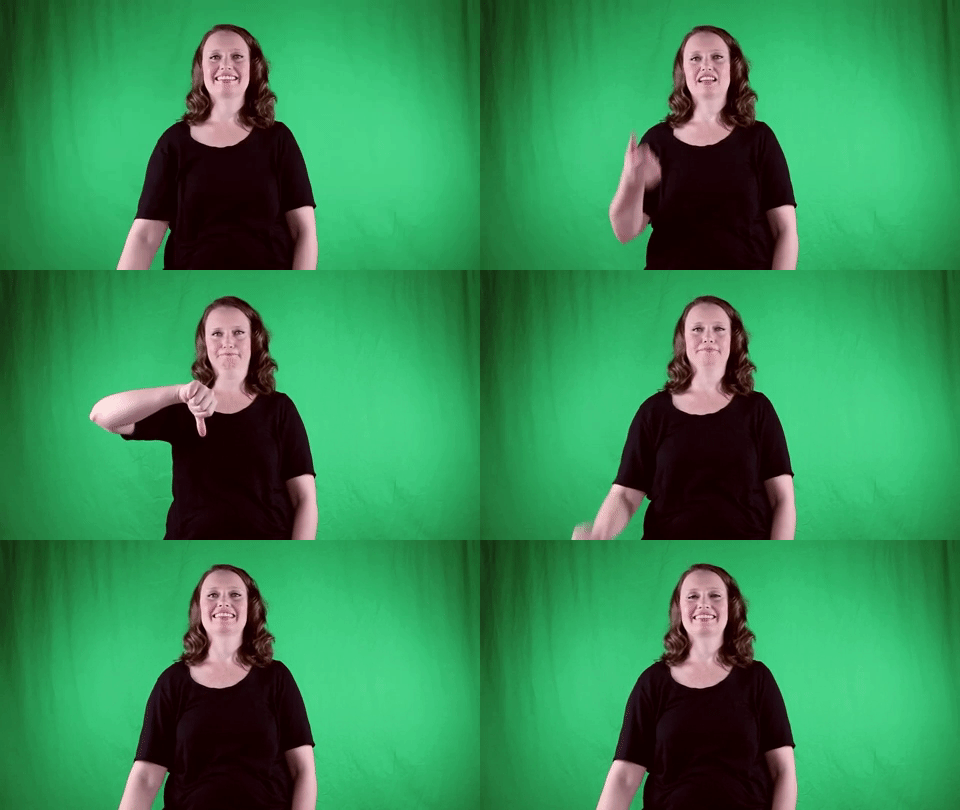
Definition: To decline or refuse.
Sign for DECLINE in ASL

Practice Activities:
To practice the sign for DECLINE in ASL, begin by isolating the movement and repetition. Use a mirror to ensure your handshape and motion are consistent. Start by signing DECLINE five times slowly, then increase your speed while maintaining accuracy. Say the English word softly as you sign to reinforce the connection between the concept and the sign.
Next, place the sign for DECLINE in simple sentences. Some practice examples include: “Sales decline every year,” “I saw her decline the invitation,” or “Grades might decline without study.” Sign each of these sentences slowly, focusing on fluid transitions between signs. Try recording yourself to observe your expression and fluency.
In storytelling, use a short scenario to incorporate the word. For example, create a story about a student who struggled with their classes and saw a decline in performance. Another prompt could be someone trying to save money, but their bank account continues to decline. Signing these events in narrative form helps solidify vocabulary retention.
For a partner activity, take turns acting out short situations involving decision-making or changes over time. One person can give a brief scenario in English, like a person declining a job offer, while the other signs it fully in ASL. Switch roles and offer feedback on clarity and non-manual markers.
Use flashcards with various situations, and have learners decide which ones require the sign for DECLINE in ASL. This will help with contextual awareness and deepen understanding. Visualize contrasts using positive and negative outcomes, signing both the increase and decline of events or numbers.
Finally, work on expressive ASL by creating vlogs or short dialogues to share with others for feedback. Include the sign for DECLINE in ASL within topics like business trends, emotional responses, or refusals to practice using it in diverse and relevant contexts.
Cultural Context:
In American Sign Language (ASL), the sign for decline is used not only to express a literal decrease, but also to convey complex social and emotional meanings. Understanding the sign for decline in ASL requires an appreciation of its use in various cultural and conversational contexts. Deaf culture, which centers around visual language and expression, often uses this sign during discussions of academic performance, financial trends, or even shifts in relationships.
The sign for decline in ASL may appear in conversations about economic issues, such as when jobs are lost or a company’s profits drop. It’s common in news reports and community discussions involving social justice, education, or access to resources. Because nuance plays a big role in ASL, facial expressions and body language are essential when using the sign for decline in ASL, especially to show seriousness or disappointment.
In daily interactions, Deaf individuals use the sign for decline in ASL to deliver both factual and opinion-based information. If someone declines an invitation or opportunity, this sign helps to clearly communicate that decision. Cultural norms in the Deaf community value direct communication, so the gesture is often accompanied by an explanation or context.
The sign for decline in ASL is also frequently used in academic settings. Teachers and students in Deaf schools or mainstream schools with interpreters may use it when talking about a fall in grades or performance. The visual nature of ASL allows people to instantly grasp the concept of decline, even when it’s abstract, such as mental or emotional well-being.
In healthcare situations, the sign for decline in ASL may be used to explain a patient’s worsening health condition. Deaf patients and professionals rely on accurate and expressive communication. This makes ASL essential in hospitals, clinics, and counseling offices where discussing physical or mental decline is common.
Media from within the Deaf community, including vlogs, social media posts, and educational videos, often incorporate the sign for decline in ASL. These platforms help spread awareness on important issues, such as declining access to interpreting services or drops in policy funding. Such usage keeps the language current and reflective of today’s challenges.
Culturally, Deaf individuals value shared experiences and connections. The sign for decline in ASL often comes up in group conversations to talk about trends that affect the community, including legal rights, employment opportunities, and education access. By using ASL to express these shifts, the Deaf community maintains a strong sense of identity and advocacy.
Learning the sign for decline in ASL is not just about memorizing a handshape. It involves
Extended Definition:
The sign for decline in ASL can be used in a variety of contexts to express the idea of rejecting, reducing, or refusing something. Depending on the situation, it might refer to a decrease in value, turning down an offer, or showing disinterest.
To sign decline in ASL, the most common version involves a hand gesture that symbolizes a downward or rejecting motion. Typically, the dominant hand moves from a neutral or forward-facing position down and away from the body. The facial expression that accompanies this sign is just as important and usually includes a slight head shake or a dismissive look, which signals rejection or refusal.
When discussing a decline in health, the sign for decline in ASL complements signs like sick, worse, or deteriorate. This usage helps clarify that something is getting worse over time, especially in conversations about physical or mental well-being. For example, someone might use this sign when talking about the condition of a grandparent or the progression of certain illnesses.
In economic or financial contexts, this sign is useful for describing a drop in prices, profits, or market value. A person fluent in ASL might pair the sign for decline in ASL with other signs like money, stock, or value to convey a more complete meaning. This is especially useful in classroom discussions, business presentations, or news reports conveyed in American Sign Language.
The sign can also be used in social situations to politely turn down an invitation or request. It expresses refusal in a clear and respectful way, suitable for interactions among friends, colleagues, or strangers. Using the sign for decline in ASL in this context often includes a gentle shake of the head and soft facial expressions to maintain politeness.
While regional variations may exist, most ASL users understand the standard version of this sign, making it widely accepted across different age groups and communities. Some regions might use modified handshapes or slightly different motions, but the underlying concept remains the same.
Context is key in making sure the meaning of the sign for decline in ASL is clear to the person watching. Adding related signs or providing more surrounding signs in a sentence helps prevent misunderstandings. As with many ASL signs, combining facial expressions, body movement, and handshape enhances the accuracy of the message.
The sign is practical in both casual and formal settings. From daily conversations to academic lectures or professional meetings, the sign for decline in ASL helps convey a wide range of ideas connected to reduction or refusal. Its flexibility makes it a foundational sign that
Synonyms: decrease, diminish, reduce, wane, downturn
Educational resources: Find related learning materials in our course bank!
Want more? Check out some of our popular learning activities on the homepage!
Need to look up a sign? Use our highly rated dictionary: https://aslinteractive.com/best-asl-dictionary/
Follow us on tiktok: https://www.tiktok.com/@aslinteractive. More social media links at the bottom of this page!
Long-tail Keywords: what is the sign for decline in asl, how do you sign decline in american sign language, decline sign language
Categories:
tags: Negation, Commands, Language Learning, Verbs, Responses
Parameters
*Handshape*:
The handshape for the sign for DECLINE in ASL typically begins with the dominant hand in a flat “B” handshape, palm facing downward. The fingers stay together and extended while the hand moves downward at a diagonal angle, symbolizing a drop or refusal.
This motion visually represents a reduction or rejection, which matches the concept behind the sign for DECLINE in ASL . The non-dominant hand may remain neutral or may be used for added emphasis, depending on context or variation.
*Palm Orientation*:
The palm orientation for the sign for DECLINE in ASL typically starts with the dominant hand open and fingers spread, palm facing slightly upward and outward. As the motion progresses, the hand moves downward while maintaining or slightly rotating to a palm-down orientation.
This downward motion mimics the concept of a dip or reduction, reinforcing the meaning behind the sign for DECLINE in ASL. The palm orientation remains consistent and clear to convey the intended message effectively.
*Location*:
The sign for DECLINE in ASL is typically produced in the neutral space in front of the torso, slightly below chest level. Hands begin near the center of the body and move downward and away, symbolizing a drop or decrease.
This specific location helps visually support the concept of something falling, fading, or being rejected. Proper placement in this area ensures clarity when expressing the sign for DECLINE in ASL during conversation or instruction.
*Movement*:
To perform the sign for decline in ASL, start with your dominant hand in a flat “B” handshape held in front of you, palm facing sideways or slightly downward. Move the hand down diagonally toward your body in a smooth, controlled motion, as if something is being lowered or turned down.
The non-dominant hand may remain at your side or serve as a resting platform. Facial expression often includes a slight shake of the head or a neutral to negative expression to reflect refusal or decrease. The sign for decline in ASL clearly conveys reduction or rejection depending on context.
*Non-Manual Signals*:
Facial expression plays a crucial role in showing the meaning behind the sign for decline in ASL. The eyebrows are typically lowered, sometimes with a slight head shake or tilt back to show refusal or a downward trend.
A subtle frown or pursed lips can emphasize rejection or a negative shift. These non-manual signals enhance the effectiveness of the sign for decline in ASL, making the meaning clear through both gesture and expression.
*Prosody, Dominant/Non-Dominant Hand*:
The sign for DECLINE in ASL typically uses the dominant hand in a B-handshape to represent a downward movement, symbolizing rejection or decrease. The non-dominant hand may remain stationary or be lightly involved for context, depending on the interpretation.
To perform the sign for DECLINE in ASL, start with your dominant hand palm down and slide it diagonally downward from shoulder height. Facial expression such as a slight frown often complements the message to emphasize refusal or reduction.
Tips for Beginners:
When learning the sign for DECLINE in ASL, it’s helpful to clearly understand the context in which you’re using it. This sign can relate to a decrease in numbers, turning down an offer, or even a physical slope, so make sure your facial expression and body language match the intended meaning. Practicing the sign in context will help with long-term retention.
Beginners sometimes confuse the motion of this sign with other directional or negative-response signs. Pay close attention to the movement: the dominant hand often makes a downward, sloping gesture away from the body, symbolizing a drop or rejection. To avoid confusion, be deliberate with your handshape and speed.
For the best results when practicing the sign for DECLINE in ASL, use a mirror to check hand placement, angle, and movement. Practicing in front of a friend or teacher can provide immediate feedback and help reinforce correct form. Using videos or ASL apps can also help you compare your version to native signers.
A common mistake is not incorporating facial expressions that reflect rejection or reduction. ASL is deeply reliant on non-manual markers like your eyebrows, head tilt, or mouth movements. If you’re signing a decline in performance or numbers, an appropriately concerned or serious face helps convey the message clearly.
Another important tip is to pay attention to the palm orientation. The direction the palm faces and the trajectory of your movement can change the meaning. Over time, muscle memory will develop, but early on, intentional repetition helps solidify accuracy.
Lastly, incorporate real-world scenarios to practice the sign for DECLINE in ASL—such as pretending to turn down a job offer or showing a decline in sales. Contextual use makes learning more practical and engaging. Don’t be afraid to ask fluent signers for corrections—they’re often happy to help!
Connections to Other topics:
The sign for DECLINE in ASL often connects with a broader set of signs involving reduction, refusal, or deterioration. It shares visual similarities with other signs such as REJECT, FALL, and FAIL, reflecting a downward or negative directional motion. These conceptual similarities can help learners more quickly identify patterns in ASL related to negative changes or outcomes.
This sign also ties into economic or statistical topics, where signs like INCREASE, DECREASE, LEVEL, and GROWTH are used. When paired in contexts like stock market trends or company performance, the sign for DECLINE in ASL can be used in compound expressions such as DECLINE-IN-STOCK or DECLINE-IN-SALES. These compounds are commonly understood in Deaf professional environments and educational discussions .
Grammatically, the sign for DECLINE in ASL may be indexed directionally depending on the subject. For instance, if a person is declining help, the movement of the sign is more personal or may include a facial expression of refusal . When describing the decline of an object or abstract concept, like a country’s economy, the sign’s movement focuses more on spatial representation.
Facial expressions and classifiers can further clarify the type of decline. A steep drop in something like temperature might use a downward classifier movement with furrowed brows, emphasizing severity. Comparatively, a gentle decline may use a slower, downward sweep, making it more nuanced in meaning.
Understanding the sign for DECLINE in ASL also supports the learning of other signs in the refusal or reduction family. Phrases like DECLINE-INVITE, DECLINE-OFFER, and DECLINE-INTEREST show how the core meaning can be extended across social, emotional, and practical uses. This flexibility makes it a core part of fluent ASL communication.
Summary:
The sign for DECLINE in ASL can vary slightly depending on context and intent. In a common version, the dominant hand in a flat “B” handshape moves downward from shoulder level toward the front of the body, palm facing down, while the head may shake slightly. This motion reflects a metaphorical or literal downturn or refusal.
Context affects which sign is chosen. If referring to refusing an invitation, a gesture similar to rejecting or pushing away might be used. When talking about economic or performance decline, a downward sliding palm movement is more appropriate, showing a dip or drop.
The directionality of the movement is key. A downward motion often signals negative change or refusal. Paired with appropriate facial expressions—like raised eyebrows for a question or a slight frown for emphasis—the sign for DECLINE in ASL becomes more grammatically rich.
In ASL grammar, non-manual markers help convey intensity or attitude. A small shake of the head or pursed lips can shift the sign from neutral to firm rejection. ASL relies on this blend of manual and non-manual communication to express subtleties beyond spoken equivalents.
The sign for DECLINE in ASL carries both practical and conceptual meanings. When used in financial or health contexts, it mirrors the idea of diminishing ability or worsening conditions. This aligns with the visual-gestural nature of the language, where conceptual precision is often grounded in imagery.
Related signs include FALL, DECREASE, REJECT, and REFUSE. Each has a distinct handshape and motion, but they sometimes overlap depending on sentence framing and subject matter. Understanding nuance in these related signs encourages clearer communication among ASL users.
The semantic range of decline covers many areas, from economy and behavior to physical health. Consequently, the sign for DECLINE in ASL takes on specialized meanings depending on whether the speaker is discussing social trends or personal capability. This adaptability reflects ASL’s linguistic depth.
Cultural use of the sign is shaped by the situation. In Deaf culture, transparent communication is highly valued. Expressing decline clearly—whether in terms of refusal, fall-off in performance, or deterioration—is expected and appreciated for its directness.
In academic settings, instructors use the sign for DECLINE in ASL to explain downward trends in graphs, sociological data, or student performance. The sign’s visual nature aids learners by reinforcing the conceptual message with physical motion. This embodies ASL’s pedagogical strengths.
In healthcare discussions, the sign is used to express declines in condition or ability. Whether talking about cognitive decline in aging or functional decline after injury, the sign gives visual form to abstract medical concepts. Paired with timeline gestures, it creates full narratives.
The morphology of the sign can vary based on syntactic order. When used to negate an offer, the sign is performed crisply and near the chest. When indicating a general drop—such as market decline—it’s done more broadly, showing a directional metaphor.
Linguistically, the sign for DECLINE in ASL is a great example of how spatial grammar is used. The space in front of the signer acts as a visual timeline or metaphor space. The sign’s downward arc visually reinforces the idea of descent or lesser positioning.
Applied linguists study such signs to better understand conceptual mapping in ASL. The metaphor of height equating to value or positivity is prevalent even in spoken languages. ASL’s use of motion and gravity-based symbolism showcases this cross-linguistic commonality.
The sign is also poignant in sociopolitical contexts—discussions of a society’s moral decline or environmental degradation, for instance. The physicality of the sign in these contexts adds emotional resonance. It’s not just a word; it’s an embodied statement.
Facial grammar is vital when using the sign for DECLINE in ASL. A slight sneer or downward pull of the mouth can turn a neutral description into a commentary. These subtle markers enrich the language and align with the expressive tradition of visual culture.
Interpreters must consider tone and register when selecting how to render decline during live translations. For example, a business presentation’s referential use differs from a personal statement of emotional descent. Each context demands its own calibration.
ASL’s iconicity is clear in the form of the sign for DECLINE in ASL. It visually matches its meaning in many cases, though not all signs are iconic. Still, this correlation between form and meaning helps build intuitive understanding, especially for beginners.
When talking about refusing something—like declining an invitation—a different sign often takes precedence. This version uses a flicking motion from the lips outward or a firm push-away gesture. The same English word links to multiple ASL representations.
Temporal and aspectual markers can be added to the base sign. A repetitive downward motion might indicate ongoing decline. Conversely, an exaggerated drop may signal a sudden or sharp decrease, demonstrating the capacity for expressive layering.
In the educational sphere, the sign is introduced when covering topics like percentages, stock
Want more? Check out some of our popular learning activities!
ASL Interactive Resources
ASLInteractive YouTube Channel
Follow us on tiktok: @aslinteractive.com
Follow us on Instagram: aslinteractive
Facebook page: aslinteractive
Facebook group: aslinteractive
LInkedIn: ASL Interactive LLC
Twitter: @ASL_interactive
*Some information on this page is AI-generated. AI can make mistakes. Please check the information.


Responses