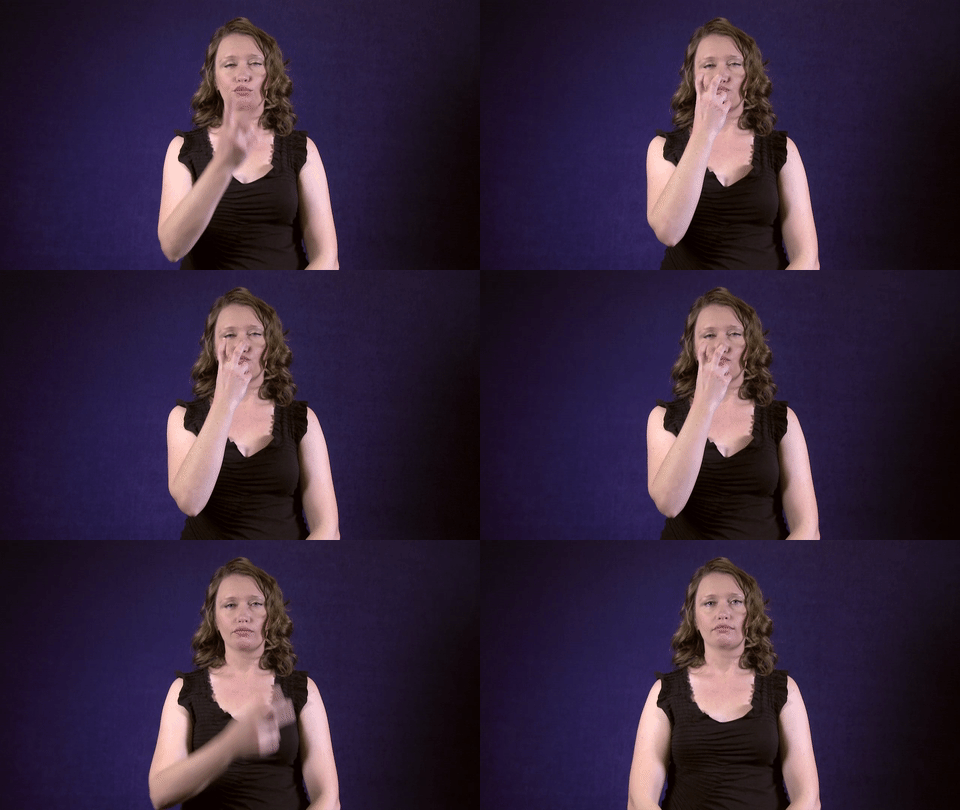
Definition: A feeling of uncertainty.
Sign for DOUBT in ASL

Practice Activities:
To build fluency with the sign for DOUBT in ASL, start by practicing it in front of a mirror. Watch your facial expression as well as your handshape and movement. This sign typically involves one hand in a bent “V” shape facing your eyes, lightly tapping under your eye or shifting slightly forward to show hesitation or uncertainty.
Repeat the sign for DOUBT in ASL slowly and then increase your speed as you gain confidence. Use flashcards with words like “uncertain,” “maybe,” or “question” and sign DOUBT in response. Try practicing in short phrases like “I DOUBT her,” “You DOUBT me,” and “They DOUBT what?” to reinforce sentence construction.
Create a list of situations that involve uncertain feelings. For example, “DOUBT I pass the test,” “DOUBT he comes today,” or “DOUBT it’s true.” Sign each sentence out loud in ASL, focusing on matching facial expressions with the emotion of doubt. Use exaggerated facial cues when first practicing to develop expressive range.
Storytelling activities are highly effective. Develop a short personal narrative that includes a moment of hesitation, like being unsure which road to take or second-guessing a decision. Include the sign for DOUBT in ASL naturally within the story. Record yourself and review your expression and sign fluency.
Work with a partner to role-play conversations that include DOUBT. One person can express a confident plan, and the other introduces doubt. For example, “I will win the race.” The partner could reply with “DOUBT,” adding a clear non-manual signal. Switch roles for each new topic.
Use emojis in text storytelling for fun prompts: “ ➡️DOUBT,” “ DOUBT truth,” or “✈️ ️ DOUBT flight today.” Try translating these prompts into full ASL sentences. Repeating the sign for DOUBT in ASL with different scenarios helps improve both fluency and natural usage.
Cultural Context:
In American Sign Language (ASL), the sign for DOUBT conveys more than just uncertainty—it reveals subtle emotion and tone through facial expression and hand movement. The sign for DOUBT in ASL often includes raised eyebrows or a slight head tilt, which visually emphasizes the feeling of hesitation or disbelief. This cultural nuance helps differentiate DOUBT from other similar feelings like confusion or curiosity.
The Deaf community uses the sign for DOUBT in ASL not just to express uncertainty, but also to signal skepticism or second-guessing. It’s often used in storytelling, casual discussions, and debates where trust and belief are being questioned. Facial expression plays a key role, and the context determines how strong or mild the DOUBT feels.
ASL is a visual language, and the sign for DOUBT in ASL taps into shared cultural experiences that go beyond individual words. Whether someone is questioning a decision, expressing disbelief in a story, or reconsidering an opinion, the sign for DOUBT adds emotional depth. In Deaf culture, gestures and expressions work together to strengthen communication.
When signing the word DOUBT, users may adjust the speed and intensity based on their relationship with the person they’re talking to. A parent might use the sign gently when talking to a child, while a friend might use a more exaggerated version during a debate. The flexibility of the sign for DOUBT in ASL shows how emotion and trust are embedded in ASL dialogue.
The sign for DOUBT in ASL is often introduced early in ASL education because it supports important conversational skills. Students learn how it’s used in questions, opinions, and critical thinking. In schools and community groups, this sign often appears when participants talk about assumptions and facts, playing a key part in learning discussions.
Through media, such as Deaf vlogs or performances, the sign for DOUBT in ASL adds dramatic tension or humor. It breaks the fourth wall at times, involving the audience in the speaker’s uncertainty. This makes it a valuable storytelling and performance tool in the Deaf arts.
For Deaf children growing up, learning the sign for DOUBT in ASL helps them express feelings of hesitation or suspicion in a safe, expressive way. Parents and educators use it to open dialog about emotions, helping kids build confidence and communication skills. It offers a nonverbal way to say I’m not sure, which is critical in emotional development.
Among adults, the sign for DOUBT in ASL
Extended Definition:
The sign for doubt in ASL is a common expression used to show uncertainty, hesitation, or lack of belief. This sign can be both conceptual and visual, often relying on the signer’s facial expressions in addition to hand movements to convey the intended meaning effectively.
To sign doubt in ASL, the typical movement mimics a finger wiggling near the side of the face or involves a transformation from a strong idea to a weaker, more uncertain one. Variations of this sign can also depend on regional differences or the level of skepticism the signer is trying to express. Like many ASL signs, context and facial grammar are essential parts of the meaning.
The facial expression for the sign for doubt in ASL often includes furrowed eyebrows or a slight head tilt. These non-manual signals are crucial in emphasizing disbelief or confusion. In a signed conversation, if you show a flat facial expression, the meaning of doubt might not come across clearly.
Sometimes, the ASL sign for doubt is linked to concepts like suspicion, disbelief, or being unsure. By using this sign, someone can politely question what has been said without interrupting the flow of communication. It serves as an essential bridge in expressing inner thoughts during conversation in the Deaf community.
Negative space and movement in ASL grammar play an important role in this sign. The transition from certainty to doubt is often performed using a downward or reducing motion with one hand. Depending on how it’s used, it can soften a statement or indicate strong disbelief by amplifying the wiggle or changing facial expression.
ASL relies heavily on the combination of hand shapes, movement, and expressions. When making the sign for doubt in ASL, the overall body posture can also help emphasize skepticism. Shrugging shoulders or a raised eyebrow can transform the meaning subtly, helping the viewer understand whether mild confusion or deep disbelief is being communicated.
In some cases, people pair the sign for doubt in ASL with signs for think, believe, or maybe to clarify their level of uncertainty. This can help reinforce context, especially when discussing emotional or complex topics. The layering of multiple signs is a common strategy in ASL to add detailed meaning.
Beginners learning ASL often overlook how important facial cues and non-manual markers can be to the clarity of a message. The sign for doubt in ASL is an excellent example of how physical expression supports signed vocabulary. Becoming more comfortable with expressions and gestures will make this sign feel more natural over time.
Sometimes, the sign for
Synonyms: uncertainty, skepticism, hesitation, mistrust, indecision
Educational resources: Find related learning materials in our course bank!
Want more? Check out some of our popular learning activities on the homepage!
Need to look up a sign? Use our highly rated dictionary: https://aslinteractive.com/best-asl-dictionary/
Follow us on tiktok: https://www.tiktok.com/@aslinteractive. More social media links at the bottom of this page!
Long-tail Keywords: what is the ASL sign for doubt, how to sign doubt in American Sign Language, what is the correct ASL sign for doubt
Categories:
tags: Emotions, Wh-words, Language Learning, Negation, Major decisions
Tips for Beginners:
When learning the sign for DOUBT in ASL, one of the most helpful things you can do is practice the facial expression and body language alongside the hand movements. ASL is a visual language, and the right expression reinforces your message. For this sign, a furrowed brow or a slightly skeptical look can emphasize the meaning of “doubt.”
The handshape and movement are also essential. The sign for DOUBT in ASL typically involves flexing the index and middle fingers while holding the other fingers down, with the hand moving slightly downward in front of the face, as if something is questionable or uncertain. Beginners should keep the movement smooth and avoid over-exaggerating the flexing, as that can distort the meaning.
Many learners unintentionally confuse the sign for DOUBT with other abstract signs like THINK or QUESTION. To prevent this, make it a point to learn DOUBT in context. Practice signing questions or sentences like, “I doubt that” or “Do you have doubt?” to reinforce muscle memory and proper use.
Another helpful tip is to sign slowly at first. Clarity matters more than speed, especially when you’re still building confidence. Watching native signers use the sign for DOUBT in ASL in conversation can also help you understand nuances in movement and expression .
Practice in front of a mirror or record yourself using the sign so you can evaluate your movement and expression objectively. Often, practicing with a peer or tutor can make a big difference as well. It’s important not to get discouraged—abstract signs like DOUBT can be tricky at first, but with repetition and attention to detail, you’ll improve over time. Stay persistent and remember that progress in ASL is all about daily use and exposure .
long-tail keyword: sign for DOUBT in ASL, doubt in American Sign Language, ASL signs for uncertainty, how to sign doubt in ASL, American Sign Language DOUBT sign
Connections to Other topics:
The sign for DOUBT in ASL connects closely to concepts like uncertainty, confusion, hesitation, and skepticism. These emotional and cognitive states are commonly expressed together in ASL storytelling or everyday dialogue, especially when someone is unsure or second-guessing a decision. Learners will notice that this sign is often paired with appropriate facial expressions, particularly raised eyebrows or a tilting head, which are crucial for conveying the full meaning in context.
In ASL, many abstract concepts such as BELIEVE, THINK, and GUESS share overlapping elements with the sign for DOUBT in ASL. For example, DOUBT can be integrated into compound phrases like “DOUBT-ABOUT-DECISION” or “DOUBT-IN-TRUST” to show more complex ideas. This layering of concepts is commonly used in ASL to condense meaning into a single flowing phrase while still maintaining clarity.
The motion and handshape used in the sign for DOUBT in ASL may resemble signs for words like WORRY or CONCERN, which also communicate mental states. However, DOUBT tends to include a downward or flicking movement paired with a questioning expression, reflecting uncertainty or disbelief. Understanding how this differs highlights subtleties in meaning that are important for fluency.
The sign for DOUBT in ASL also connects well with grammatical constructs like rhetorical questions or conditional statements. In ASL, someone might sign something like “YOU THINK TRUE? DOUBT,” using non-manual signals and sign order to create meaning. This shows the way DOUBT is not just a standalone vocabulary word but functions within sentence structure to convey tone and intention.
Culturally, expressing doubt in ASL often includes a combination of body language and pacing that reflects the emotional tone of the signer. It’s a good opportunity for learners to practice incorporating rhythm and facial grammar into their signing to make it more natural and effective. Mastering the sign for DOUBT in ASL can greatly enhance expressive range in both casual and interpretive communication.
Summary:
The sign for DOUBT in ASL conveys a nuanced emotional and cognitive state. Using a single or both index fingers, the movement emulates flicking downward at or in front of the eyes, symbolizing uncertainty or disbelief. It’s a visually evocative sign, drawing a connection to how doubt clouds perception.
In many cases, the dominant hand acts alone with the index finger bending slightly near the eye area to represent an internal questioning. Alternatively, a two-handed version may incorporate shifting or flicking motions of both index fingers, adding emphasis or intensity to the emotion being expressed. Facial expression plays an essential role in completing the message.
The facial grammar associated with the sign for DOUBT in ASL is critical. Eyes squinted, brows furrowed, and a subtle head shake may accompany the sign to enhance its skepticism. ASL conveys a rich blend of facial expressions and body language that elevates the core meaning well beyond the manual gesture itself.
The sign’s underlying metaphor reflects how doubt is perceived in the mind and interpreted physically. By implying something foggy or unclear in front of the eyes, the signer communicates a conceptual uncertainty. This use of visual metaphor is common in ASL, where abstract thoughts are reimagined through space and movement.
Grammatically, the sign for DOUBT in ASL is often used as a predicate adjective or as part of a facially-marked rhetorical question. For example, paired with WHO or WHY, it can serve as a broader questioning mechanism about someone’s honesty or a given situation’s clarity. Sentence order in ASL is flexible but must be paired with proper facial grammar.
The sign connects deeply with related signs such as SUSPICION, CONFUSION, and THINK. Each of these taps into cognition but with distinct emotional filters. While DOUBT is about unsettled belief, CONFUSION tilts toward disorientation, and SUSPICION implies mistrust.
A related sign with subtle difference is DON’T BELIEVE. This sign shares conceptual territory with doubt, but it implies a stronger disbelief or rejection than a wavering uncertainty. Understanding the degrees of doubt through various signs is a core element of ASL fluency.
Culturally, the sign for DOUBT in ASL reflects the Deaf community’s value of clear and honest communication. Doubt often introduces potential for clarification and further explanation. In many Deaf conversations, doubt functions as a cue for repetition, elaboration, or introspective check-ins.
Deaf storytelling frequently utilizes the sign for DOUBT in ASL to build emotional tension or illustrate internal character development. Characters may repeatedly sign doubt while showing conflicted expressions to enhance narrative depth. The layering of gesture with emotion creates a more immersive story experience.
From a linguistic perspective, this sign fits into the cognitive domain of belief, one of the abstract categories explored by signed languages globally. Cross-linguistic comparison shows similar metaphors used in other signed languages, illustrating common ways humans visualize disbelief.
Applied linguistics looks at how deaf learners of ASL adopt signs like DOUBT to express complex thinking. It’s often introduced in later stages of learning due to its emotional subtlety. Its proper use requires mastery of both handshape and affective non-manual signals.
In interpreting, the sign for DOUBT in ASL often appears in legal, medical, or interpersonal contexts where uncertainty plays a key role. Interpreters must modulate their signing to accurately reflect the speaker’s tone and degree of doubt. Misinterpretation can skew entire conversations.
The psychological weight of doubt, especially in identity development or decision-making, is captured well through the spatial and gestural capacities of ASL. Abstract signs like this allow Deaf individuals to reflect introspectively just as richly as spoken language permits.
The sign can also function idiomatically. For instance, in dramatic contexts or sarcastic statements, DOUBT may be paired with a skeptical head tilt or exaggerated motion. These contextual modifications make the sign adaptable across different signing registers.
Socially, discussions of doubt and trust are frequent in Deaf culture. Experiences navigating medical systems, educational settings, and interpreters often produce dialogues rich with the sign for DOUBT in ASL. Its presence expresses vulnerability and the need for transparency.
The sign integrates well into comparative grammar lessons when studying modality and epistemics in ASL. Linguists pay attention to how DOUBT reveals the signer’s perspective on knowledge, belief, and possibility. This makes it fertile ground for deep language analysis.
Within ASL poetry, DOUBT is a commonly used concept. Poets use the sign’s brevity and emotional resonance to explore themes of identity, betrayal, and personal struggle. The expressive potential of the sign gives it lasting appeal in visual literary traditions.
Linguistic anthropology explores how the sign for DOUBT in ASL functions as a social cue. It not only expresses internal hesitation but also questions interpersonal reliability. Much like tone in spoken language, DOUBT soft
Want more? Check out some of our popular learning activities!
ASL Interactive Resources
ASLInteractive YouTube Channel
Follow us on tiktok: @aslinteractive.com
Follow us on Instagram: aslinteractive
Facebook page: aslinteractive
Facebook group: aslinteractive
LInkedIn: ASL Interactive LLC
Twitter: @ASL_interactive
*Some information on this page is AI-generated. AI can make mistakes. Please check the information.

Responses