Sign for ENGINEER in ASL | ️ ASL Dictionary

Definition: A person who designs, builds, or maintains engines.

Sign for ENGINEER in ASL

YouTube player

Practice Activities:

To practice the sign for ENGINEER in ASL, start by focusing on the handshape and movement. Use a mirror to check that you are consistently using the correct dominant and non-dominant handforms, and that the movement remains smooth and steady. Repeating the sign 10 times slowly will help reinforce muscle memory.

After mastering the sign in isolation, begin using it in simple sentences. Try saying, “My brother is an engineer,” or “She wants to be an engineer.” Sign these sentences out loud while mouthing the English words to support language retention. Record yourself signing and review the video to identify areas for improvement.

Set up short storytelling sessions using the sign for ENGINEER in ASL. Describe a day in the life of an engineer, using signs for related words like BUILD, WORK, COMPUTER, CONSTRUCT, and DESIGN. Limit your story to three or four sentences to keep it manageable and focused.

Pair up with a partner or join a study group and take turns asking and answering questions. For example, sign “Who is the engineer in your family?” or “What kind of engineer do you want to be?” If your partner uses the correct sign and response, give visual feedback like a thumbs up or a nod.

Create flashcards with vocabulary related to the field. On the front, write related professions or fields like mechanical, chemical, or civil, and on the back, include your best attempt at those signs. Use these to match and expand on the concept while reinforcing the base sign for ENGINEER in ASL.

Finally, watch videos of fluent signers using the sign for ENGINEER in ASL. Note how they use facial expressions, speed, and body language. Try to imitate their rhythm and style for a more natural presentation.

Cultural Context:

The sign for engineer in ASL reflects more than just a job title—it represents a career deeply rooted in design, building, and problem-solving. In the Deaf community, occupations are commonly represented with specific signs, and the sign for engineer in ASL helps to quickly identify this respected profession. Knowing how to use the proper sign for engineer in ASL is essential for effective communication, especially in educational and professional settings.

Engineers play an important role in many fields including mechanical, civil, electrical, and software industries. The sign for engineer in ASL may include a classifier that references engineering tools or concepts, which connects deeply to the visual nature of the language. Because ASL relies on visual-spatial comprehension, signs like the sign for engineer often feature intentional handshapes and movements that symbolize the technical aspects of the profession.

In Deaf culture, there’s pride in being able to discuss complex concepts and occupations using ASL. When a Deaf person identifies as an engineer, using the correct sign for engineer in ASL supports cultural identity and inclusion. It’s not just about the vocabulary—it’s about validating the individual’s role within the community.

Engineering jobs are increasingly diverse, and the sign for engineer in ASL might be adapted to clarify specific disciplines within engineering. For instance, someone might specify they are a civil engineer versus a software engineer, either through additional signs or contextual conversation. This flexibility is part of what makes ASL a rich, expressive language that continues to evolve with society.

History and context matter when discussing job signs in ASL. The sign for engineer in ASL may have variations across regions and over time as the field itself has developed. Still, most ASL users recognize a clear, foundational sign that connects to the broader category of engineering without losing meaning.

Children who are Deaf or hard of hearing and interested in engineering careers benefit from learning how to sign complex topics early. The more frequently learners see and use signs for career roles like engineer, the more likely they are to express future goals. Using the sign for engineer in ASL confidently reinforces both language development and career exploration.

When interpreting at career fairs, STEM events, or in the classroom, knowing the correct sign for engineer in ASL ensures that Deaf participants are not left out of important discussions. Cultural accessibility through accurate, meaningful signs helps remove barriers and supports greater Diversity in STEM fields. Access to signs like the sign for engineer in ASL promotes equity across all levels of education and employment.

Across platforms like YouTube, TikTok,

Extended Definition:

The sign for engineer in ASL is a common and important vocabulary term, especially in academic and professional contexts. Understanding this sign is essential for communicating career goals, discussing job roles, or talking about fields related to science, technology, and construction in American Sign Language.

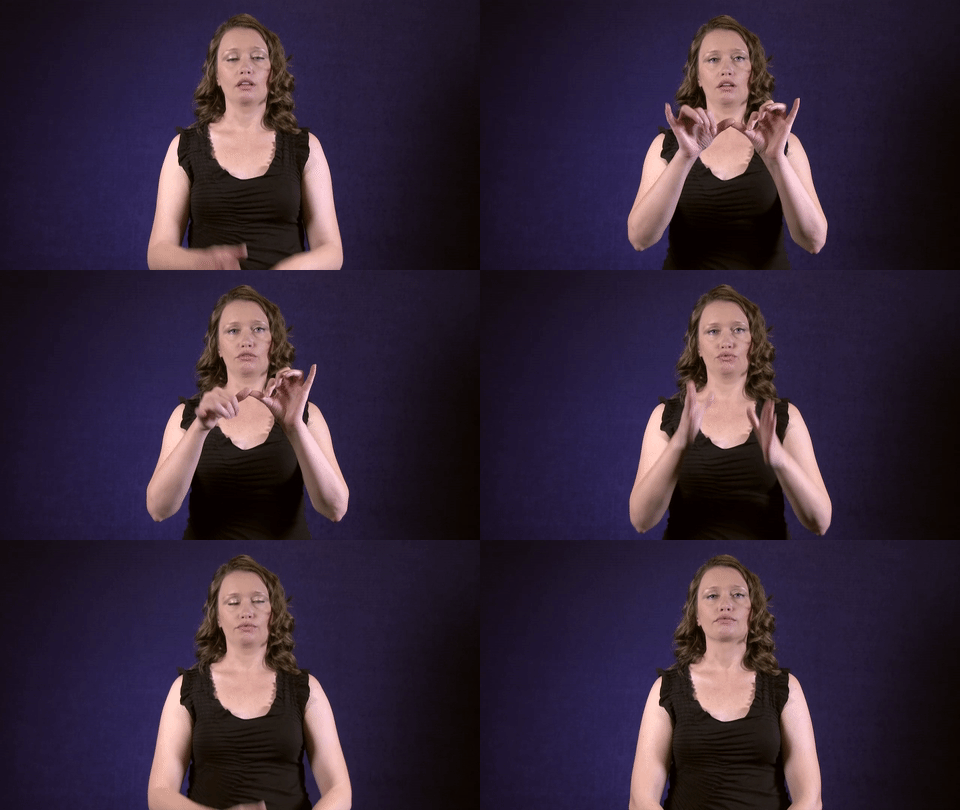
To produce the sign for engineer in ASL, both hands take the “E” handshape. The palms face downward, and the fingertips of both hands tap together twice at the thumbs. This movement refers to the idea of connection and design, emphasizing the creative and technical skills of an engineer.

This sign is closely related to the sign for mechanic, but the difference lies in the handshape at the beginning of the sign. While the sign for mechanic uses a different starting shape, the sign for engineer in ASL uses the letter “E” to emphasize the profession’s specific title and technical nature. It is important to use the correct sign in context to avoid confusion between different but similar career signs.

The sign for engineer in ASL can be used when discussing various specializations such as civil engineer, electrical engineer, mechanical engineer, and software engineer. To specify which type, you would sign engineer followed by the appropriate modifier or fingerspell the particular field. For example, after signing engineer, you might fingerspell “C-I-V-I-L” to indicate a civil engineer.

In educational settings, knowing the sign for engineer in ASL allows students and interpreters to participate in STEM-related content more fluently. Using this sign can help deaf and hard-of-hearing students engage in discussions about design projects, inventions, or team roles in technical fields. It also assists in career counseling sessions and classroom presentations about future goals.

When using the sign for engineer in ASL, facial expressions and context also help clarify meaning. If you are describing someone’s profession, talking about studies in engineering, or involved in a discussion about job industries, this sign will be appropriate and clear. Like many occupational signs in ASL, this sign is grounded in both handshape and context.

It’s useful to practice the sign for engineer in ASL along with other STEM-related job signs. The more frequently you use it in real situations, the more natural your signing will become. Watching fluent signers in videos or live conversations can also build confidence and improve your understanding of how the sign fits into larger sentences.

In online conversation or digital content such as YouTube or TikTok, the sign for engineer in ASL is often featured in career series and educational v

Synonyms: developer, designer, architect, inventor, creator

Educational resources: Find related learning materials in our course bank!

Want more? Check out some of our popular learning activities on the homepage!

Need to look up a sign? Use our highly rated dictionary: https://aslinteractive.com/best-asl-dictionary/

Follow us on tiktok: https://www.tiktok.com/@aslinteractive. More social media links at the bottom of this page!

Long-tail Keywords: what is the sign for engineer in ASL, how do you sign engineer in American Sign Language, ASL sign for engineer

Categories:

tags: Engineer in ASL, ASL sign for engineer, how to sign engineer in ASL, engineer meaning in American Sign Language, learn engineer in ASL

Parameters

*Handshape*:

The handshape used in the sign for ENGINEER in ASL involves both hands forming the letter “G” handshape. This means the thumb and index fingers are extended parallel to each other, while the remaining fingers are curled into the palm.

In the sign for ENGINEER in ASL, the G-handshapes touch at the thumbs and gently tap together a couple of times. This motion resembles other professional-themed signs but is specific due to the use of the “G” handshape and subtle movement.

*Palm Orientation*:

In the sign for ENGINEER in ASL, both hands use the “G” handshape. The dominant hand contacts the base of the non-dominant hand at the thumb tips. The palms are oriented downward, with the inner sides of the hands facing each other horizontally.

This consistent palm orientation is important for clarity in the sign for ENGINEER in ASL, as it distinguishes the sign from other similar ones like “mechanic.” Proper palm placement enhances the accuracy and fluidity of the sign.

*Location*:

The sign for engineer in ASL is located at the dominant side of the body, typically near the wrist area of the non-dominant hand. The non-dominant hand is held horizontally in a flat “5” handshape, palm facing down, while the dominant hand forms an “E” handshape and taps the wrist of the non-dominant hand twice.

This specific wrist-level contact helps to differentiate the sign for engineer in ASL from other profession-related signs. The gesture stays close to the body’s midsection and does not move into a larger signing space.

*Movement*:

In the sign for engineer in ASL, both hands use the letter “G” handshape. The dominant “G” hand taps the thumb side against the thumb of the non-dominant “G” hand twice. The hands stay in a horizontal orientation, mimicking gears connecting—an iconic representation of engineering work.

This repeated tapping motion helps distinguish the sign for engineer in ASL from similar signs like “mechanic.” Make sure the movement is firm but not exaggerated, indicating precision and technical knowledge. ‍♂️

*Non-Manual Signals*:

The sign for ENGINEER in ASL typically uses the same motion as the sign for “mechanic,” but with an “E” handshape instead of an “M.” While producing the sign, the facial expression should remain neutral and attentive, reflecting a technical or professional context.

Maintaining a focused, matter-of-fact expression conveys the seriousness and specialty of the field when using the sign for ENGINEER in ASL ️. Avoid overly animated or emotional NMS, as the sign refers to a profession rather than an action or emotion.

*Prosody, Dominant/Non-Dominant Hand*:

The sign for ENGINEER in ASL uses both hands in the “G” handshape. The dominant hand taps or brushes its thumb against the thumb of the non-dominant hand, which remains stationary. Repeat the motion a couple of times in a steady rhythm.

In the sign for ENGINEER in ASL, the dominant hand performs the movement while the non-dominant hand provides the stable base. Both hands should stay at chest level. Hand orientation and short, clear taps are essential in conveying the correct meaning.

Tips for Beginners:

When learning the sign for ENGINEER in ASL, begin by practicing the base sign for TECHNICIAN or MECHANIC, as the sign is similar. The dominant hand forms the “E” handshape and taps twice against the thumb side of the non-dominant hand, which is held out in a horizontal flat position. Make sure your handshapes are clear and your movement is distinct—unclear hand positioning can make the sign confusing or incorrect.

One of the most common mistakes when doing the sign for ENGINEER in ASL is failing to form a clean, well-articulated “E” handshape. Beginners often let the fingers spread wider than they should or the thumb tuck too far. Take the time to master how an “E” hand should look and feel, then build muscle memory through repetition so you can form it naturally in flowing conversation.

It’s also easy to rush through the tapping motion or miss the rhythm altogether. The two taps should be deliberate and evenly spaced—rushing them might make the sign resemble others, which reduces clarity. A mirror can be a helpful tool to check if you’re placing the dominant hand in the right position and moving with accuracy.

Remember that facial expressions play a vital role in ASL. Even though the sign for ENGINEER in ASL is manually coded, pairing it with appropriate facial cues improves overall communication. For instance, when discussing different kinds of engineers, such as software or civil, fingerspelling may follow the base sign.

Keep in mind regional variations—some ASL users may use a slightly different method, especially in academic or professional settings. Always be open to observing and practicing with native or fluent signers. Daily short practice sessions will significantly improve your muscle memory and confidence when using the sign for ENGINEER in ASL.

Connections to Other topics:

The sign for ENGINEER in ASL connects closely with occupational signs like SCIENTIST, DOCTOR, and TEACHER, which use a common structure of integrating a role-specific sign with the “person” classifier (a downward movement of flat hands at the sides to represent a person). This shared pattern helps learners categorize career-related vocabulary and fosters better recall through sign structure recognition. Understanding this can also help in creating compound signs for specific fields, such as MECHANICAL ENGINEER or ELECTRICAL ENGINEER.

The sign for ENGINEER in ASL starts similarly to the sign for MACHINE or ENGINE, involving the interlocking or tapping of fingers, which represents mechanisms or gears. This mechanical concept links ENGINEER to the broader category of technical or mechanical concepts in ASL. When referring to different types of engineers, the general sign is often preceded by a category-specific sign, such as CIVIL, SOFTWARE (which may be fingerspelled), or AUDIO, forming detailed compound signs like SOFTWARE ENGINEER.

Because the sign shares features with other signs involving tools or machinery, it can be useful to explore related vocabulary such as WORK, BUILD, INVENT, and DESIGN. These signs often accompany ENGINEER in ASL narratives or discussions to provide context or describe job functions. For instance, in casual or professional dialogues within the Deaf community, one might combine DEPLOY, CODE, and ENGINEER to detail tasks of a software engineer.

Fingerspelling is also critical for nuanced terms. For instance, scenarios where specificity is crucial—such as military or aerospace contexts—may rely on fingerspelling the exact field before signing ENGINEER. The flexibility to compound or clarify through established signs and fingerspelling makes the sign for ENGINEER in ASL a powerful anchor in technical and professional vocabulary .

Summary:

The sign for ENGINEER in ASL uses two modified letter hands. The dominant hand forms the modified “E” handshape, tapping lightly against the non-dominant “E” handshape at the wrist. This action mimics connection or linkage, evoking imagery of mechanical design or technical structure. The sign is often executed with a deliberate motion, reflecting the precision and methodical nature associated with engineering professions.

In some regional variations, the sign for ENGINEER in ASL may incorporate slight movement changes or facial expressions. These subtle adjustments can signal different contexts, such as electrical or software engineering. In certain Deaf communities, fingerspelling “ENGINEER” is still preferred, especially in situations that call for emphasis or specificity. This fingerspelled approach maintains exact terminology, especially when technical subjects are involved.

The sign shares similar features with the sign for “MACHINE” or “MECHANIC,” particularly because of the overlapping technique in hand orientation. These signs reflect the conceptual link between mechanics, systems, and engineering as disciplines. The rolling or clasped fingers between the hands suggest a sense of interlocking gears or technical components, making the sign visually descriptive.

Many professionals in STEM fields are increasingly represented in the Deaf community, making the sign for ENGINEER in ASL an important part of academic and career-related vocabulary. Learning this sign is essential for interpreting career fairs, science discussions, or workplace conversations that involve engineering topics. Within educational settings, the sign serves as part of a growing lexicon used in STEM-related ASL curricula.

Linguistically, the sign falls into the category of compound construction. It combines visual metaphor and iconicity with a set classifier-like precision. The use of modified handshapes highlights how ASL applies form and function from real-world tools or concepts to create meaning. This abstraction sets ASL apart in its visual-spatial strategy to convey abstract roles or professions.

The term “engineer” originates from Latin and relates to ingenuity or design. In ASL, its visual structure is adapted to embody mechanical connectivity, not just academic intelligence. This distinction is a prime example of how ASL uses conceptual imagery as a building block of meaning. Engineering, therefore, is not just a title—it is linked to the visual metaphor of construction and problem-solving.

Facial expressions in the sign for ENGINEER in ASL are typically neutral but poised. When used in a specific reference, such as “software engineer” or “civil engineer,” users may combine it with compound signs or brief fingerspelling. In many Deaf communities, it’s not uncommon to see this title supplemented with classifiers that suggest scale, structure, and type of engineering being referenced.

Grammatically, the sign functions as a noun and applies easily to complex constructions within a sentence. It follows standard noun-verb syntactic rules in ASL, whereby professions often anchor a phrase or clause. The ease with which the sign integrates into topical structures showcases ASL’s rhythmic economy and flexibility. Users can sign “HE SHE ENGINEER” or “MY DAUGHTER ENGINEER” with clear comprehension.

The sign for ENGINEER in ASL expands metaphorically to other expressions of design and planning. For example, it’s sometimes used metaphorically in poetry or storytelling in Deaf culture to indicate complexity, human ingenuity, or transformation. These artistic uses remind us of the layered meanings a given sign may have beyond its surface interpretation.

From a cultural lens, Deaf professionals identifying as engineers often embrace this sign as a badge of success. It is a visual symbol of a career path that reflects accomplishment, leadership, and technical mastery. Communities celebrate such titles during graduation ceremonies or professional conferences, reinforcing the sign’s positive cultural resonance.

Children growing up learning the sign for ENGINEER in ASL see more than just a job title. They witness a pathway to careers in design, problem-solving, and system thinking. Early exposure to such signs can inspire Deaf youth to pursue STEM education and leadership. Language access thus becomes a vital bridge to opportunity.

In cinematic and educational ASL interpretations, the sign is used during televised science programming, documentaries, and academic lectures. Accurate portrayal of professional signs like ENGINEER ensures authenticity and inclusion. Sign language interpreters continuously adapt this sign contextually, maintaining linguistic fluency and technical fidelity.

When teaching the sign for ENGINEER in ASL, educators may reference diagrams or engineering tools to reinforce concept linkage. This multisensory methodology strengthens memory retention and helps learners associate motion with meaning. Signing in conjunction with tactile or visual aids aligns with many best teaching practices in bilingual Deaf education.

In Deaf history, representation in engineering fields was historically minimal but is now growing. Organizations like DeafTEC and NTID support training and opportunities for Deaf individuals entering engineering disciplines. These institutions help normalize the sign for ENGINEER in ASL in professional and academic milestones. The sign, in turn, evolves with its community, becoming both common and celebrated.

Common errors in producing the sign often involve incorrect handshapes or palm orientations. New learners

Want more? Check out some of our popular learning activities!

ASL Interactive Resources

ASLInteractive YouTube Channel

Follow us on tiktok: @aslinteractive.com

Follow us on Instagram: aslinteractive

Facebook page: aslinteractive

Facebook group: aslinteractive

LInkedIn: ASL Interactive LLC

Twitter: @ASL_interactive

*Some information on this page is AI-generated. AI can make mistakes. Please check the information.


Responses