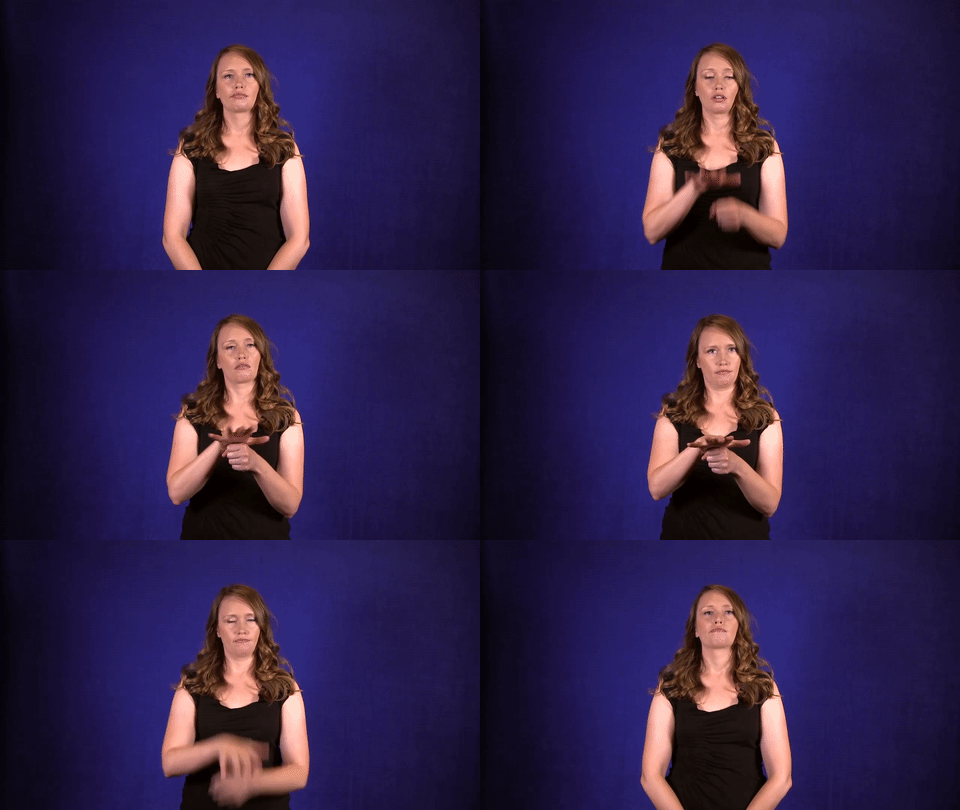
Definition: Sufficient or adequate.
Sign for ENOUGH in ASL
Practice Activities:
A good way to start practicing the sign for ENOUGH in ASL is by repeating it in front of a mirror. Focus on your handshape and movement to make sure you’re executing the motion smoothly. Practice saying it slowly at first, then increase your speed as you become more confident.
Next, try using the sign in short phrases. Examples include “That’s enough,” “I’ve had enough,” or “Enough food.” Say these phrases aloud while signing them to link the ASL movement with the English meaning. Practice these phrases multiple times until the sign feels natural within a sentence structure.
Storytelling is another helpful activity. Create a short narrative about a time you had enough of something—a noisy environment, too much work, or an excessive amount of sugar. As you tell your story in ASL, focus on pausing and emphasizing the sign for ENOUGH in ASL where appropriate. This exercise will help reinforce meaning and expression.
Partner up with a classmate or language buddy and role-play different everyday scenarios. One person can act frustrated or tired, signing “It’s enough!” while the other person responds. This will help you understand the emotional tone and body language that can add depth to the sign for ENOUGH in ASL.
You can use flashcards with images or phrases to prompt the sign. For instance, show a photo of a large plate of food and sign “enough” to describe it. Use pictures from magazines or online to add variety to your practice and build stronger associations.
Finally, record yourself using the sign in different settings and review your video for accuracy. Look for signs of clarity, fluidity, and expression. Practicing the sign for ENOUGH in ASL through repetition, context, and interaction will make it more natural and expressive in real-life conversations.
Cultural Context:
In American Sign Language, the sign for ENOUGH in ASL carries more than just the literal meaning. It reflects cultural values of assertiveness, boundaries, and self-awareness deeply embedded in the Deaf community. Understanding how and when to use the sign for ENOUGH in ASL is essential for clear and respectful communication.
The sign for ENOUGH in ASL is often used to express limits—whether emotional, physical, or social. Whether you’re setting boundaries in a conversation or signaling that assistance or a situation has met its limit, this sign plays a powerful role. It’s more than just vocabulary; it represents an empowered way of expressing needs.
Within Deaf culture, directness is highly valued. The sign for ENOUGH in ASL fits naturally into this cultural norm. When someone uses this sign, it communicates clear intent without the need for extensive explanation. This aligns with ASL’s visual and efficient nature.
Deaf individuals may use the sign for ENOUGH in ASL to gracefully exit conversations, settle arguments, or indicate that they’ve had sufficient food or rest. Context varies, but it always conveys a strong but polite message. It’s an effective sign in both personal and public situations.
Using the sign for ENOUGH in ASL is also a way to teach young children about self-regulation. Deaf parents and educators often incorporate it into lessons on emotional intelligence. Teaching this sign early helps children understand how to communicate limits in a healthy way.
In group discussions or classroom settings, the sign for ENOUGH in ASL can be a visual cue to slow down or stop talking. It helps manage turn-taking without interrupting the flow of communication. It’s a discrete yet powerful element of group dynamics.
The sign for ENOUGH in ASL also plays a role in advocacy and protest settings. Activists may use it to express that a situation or behavior is no longer acceptable. It visually reinforces messages of justice, fairness, and social change within the community.
In everyday conversations, people often overextend or go too far emotionally. Using the sign for ENOUGH in ASL brings conversations back to center. It’s a reminder to communicate clearly what is or isn’t acceptable in the moment.
Learning to use the sign for ENOUGH in ASL respectfully requires awareness of tone, body language, and intention. Just like in spoken languages, context shapes meaning. ASL users pay close attention to facial expressions and movement to add nuance.
The sign for ENOUGH in ASL mirrors cultural values of balance and clarity. Whether used
Extended Definition:
The sign for ENOUGH in ASL (American Sign Language) is a useful sign that helps convey when something is sufficient, adequate, or needs to stop. This sign plays an important role in everyday conversations where setting boundaries or expressing limits is necessary.
To make the sign for ENOUGH in ASL, place your non-dominant hand in a flat, horizontal position as if it’s a surface. Then use your dominant hand, shaped like the letter A, to gently glide over the top of the non-dominant hand from fingertips to palm. The motion stops once the thumb of the dominant hand reaches the end of the non-dominant hand, symbolizing that nothing more is needed.
This sign can be used in a variety of contexts. For example, you might use it during mealtime to let someone know you have had enough food. It’s also used when you want someone to stop talking or when you’ve had enough of a situation.
In conversations about rules or restrictions, the sign for ENOUGH in ASL helps express limits or constraints. It’s not just about physical quantities—it can also describe emotional or mental boundaries. Using this sign communicates that you’ve reached a point of sufficiency or saturation.
You may see variations in how this sign is performed, especially across different regions or age groups. However, the foundation of the movement remains consistent, ensuring that the meaning is clear. Being familiar with these variations can help improve your overall ASL comprehension.
Learning the sign for ENOUGH in ASL enhances your ability to communicate clearly and respectfully in many kinds of interaction. It gives you a direct way to express preferences, feelings, or needs without requiring lengthy explanations. The efficiency and clarity of the sign make it extremely practical in both casual and formal situations.
This sign is also a great example of how ASL uses visual and kinetic elements to express abstract ideas. By learning signs like ENOUGH, users gain insight into how meaning is shaped in this rich and expressive language. Whether you are a beginner or an experienced signer, understanding the sign for ENOUGH in ASL builds your vocabulary and deepens your communication skills.
Young children learning ASL often benefit from mastering clear signs like this. It aids in communicating emotions and limits, which is especially valuable during developmental stages. Parents, teachers, and caregivers frequently incorporate the sign for ENOUGH in ASL into routines involving food, behavior, and emotional regulation.
In social interactions, using signs correctly promotes understanding and reduces misunderstandings. If you’re asking someone if they’ve
Synonyms: sufficient, plenty, adequate, ample, satisfactory
Educational resources: Find related learning materials in our course bank!
Want more? Check out some of our popular learning activities on the homepage!
Need to look up a sign? Use our highly rated dictionary: https://aslinteractive.com/best-asl-dictionary/
Follow us on tiktok: https://www.tiktok.com/@aslinteractive. More social media links at the bottom of this page!
Long-tail Keywords: What is the ASL sign for enough, How do you say enough in American Sign Language, How can I learn to sign enough in ASL
Categories:
tags: enough in american sign language, how to say enough in ASL, ASL sign for enough, learn enough in ASL, enough sign language meaning
Parameters
*Handshape*:
The sign for ENOUGH in ASL uses a flat B-handshape formed with the dominant hand. The non-dominant hand is held in a closed fist, palm facing up. The dominant B-handshape sweeps across the top of the non-dominant fist, as if smoothing it over. This movement shows that something meets or exceeds a needed level, reinforcing the concept of the sign for ENOUGH in ASL . The handshape remains firm and clear throughout the sign.
*Palm Orientation*:
For the sign for ENOUGH in ASL, the palm of the dominant hand is oriented downward, with the fingertips brushing across the top of the non-dominant hand. The non-dominant hand is held flat, palm facing up, as if offering a surface.
This palm orientation reinforces the idea of covering or fulfilling a need, which aligns with the meaning of the sign for ENOUGH in ASL. The downward motion and palm positioning visually convey sufficiency or completion.
*Location*:
The sign for ENOUGH in ASL takes place in the neutral space in front of the signer, at about chest height. One hand is typically held flat and horizontal, palm up, while the dominant hand moves over it in a concise forward motion.
This location allows for clear visibility and smooth execution of the sign for ENOUGH in ASL. Since it stays within the signer’s personal space, it ensures focus on the hand shapes and movement without needing large gestures.
*Movement*:
The dominant hand, shaped in a flat “B” handshape, moves horizontally across the top of the non-dominant hand, which is held in a loose fist with the palm facing up. The dominant hand glides smoothly over the knuckles of the stationary hand from back to front, implying a covering or sufficient motion.
This movement in the sign for enough in ASL suggests that there is an adequate amount of something. The speed and firmness of the movement can emphasize just how sufficient it is.
*Non-Manual Signals*:
When using the sign for ENOUGH in ASL, the non-manual signals often include a firm or slightly annoyed facial expression, showing clear intent or emphasis. Eyebrows may be neutral or slightly lowered depending on how serious or assertive the message is.
Mouth movements can include a tight-lipped motion or the mouthing of “enough,” which helps reinforce the sign for ENOUGH in ASL. The head may nod firmly forward once to add emphasis, especially in more directive or emotional contexts. ♀️
*Prosody, Dominant/Non-Dominant Hand*:
The sign for ENOUGH in ASL uses both hands. The non-dominant hand is held flat and horizontal, palm up, representing a base or amount. The dominant hand is in a flat “B” shape and moves forward across the top of the non-dominant hand, brushing just above it to indicate sufficiency.
This movement shows that the level of something is sufficient or adequate. The sign for ENOUGH in ASL is commonly used in conversations about limits, satisfaction, or when something meets expectations.
Tips for Beginners:
When learning the sign for ENOUGH in ASL, make sure your hand shape and placement are precise. The dominant hand in a flat “B” shape moves across the top of the non-dominant fist in a smooth, forward motion. It represents the idea of covering or surpassing, which visually reflects the concept of “enough.” Consistency in hand position is key—keep your movements fluid and don’t rush the motion.
One common beginner mistake is over-exaggerating the motion or not aligning the hands properly. If the dominant hand doesn’t adequately cover the non-dominant fist or moves off-center, the meaning might not come through clearly. Practice the motion slowly at first while watching yourself in a mirror to build muscle memory and ensure accurate placement.
Facial expressions are another crucial part of conveying the sign for ENOUGH in ASL clearly. Your face should match the context—show firmness when insisting something is sufficient or neutrality when simply stating a fact. Many beginners focus only on the hands, so remind yourself to practice with your face, especially when signing sentences.
Another tip for mastering the sign for ENOUGH in ASL is to use real-life context to practice. Try applying the sign in simple phrases like “That’s enough” or “Is this enough?” This helps train your muscle memory and supports fluency. Repetition using natural language will develop your comfort with the sign faster than isolated drills.
Recording yourself during practice can help you catch small accuracy issues and work on becoming smoother. Watching native signers in videos or ASL classes will reinforce correct form and speed. Keep your fingers relaxed and your movements deliberate so your signing communicates effectively.
Lastly, when signing with native users, frame your whole body posture to reflect communication intent. Respect the space between your hands and body, and don’t hold back from asking others for feedback. With focus and repetition, the sign for ENOUGH in ASL will quickly become part of your fluent vocabulary.
Connections to Other topics:
The sign for ENOUGH in ASL shares related mechanics with signs like FINISH, FULL, and SATURATED, which all convey aspects of completion, sufficiency, or reaching a limit. These connections allow learners to understand the concept of thresholds or satisfaction within ASL vocabulary. The broad palm movement of the sign also ties closely to spatial referencing in signs related to measurement or quantity, which deepens conceptual understanding.
The sign for ENOUGH in ASL can be incorporated into compound phrases like ENOUGH-MONEY or ENOUGH-TIME. In these combinations, ENOUGH precedes the subject, forming a grammatical pattern that reinforces ASL syntax. It often combines with temporal or resource-based signs to express sufficiency in contexts like budgeting, scheduling, or personal limits.
Conceptually, ENOUGH can align with emotional expressions like DONE, TIRED, or FED-UP. These signs may carry more intensity or context-dependence, but their use overlaps when discussing emotional boundaries. The sign for ENOUGH in ASL is also useful in expressing boundaries or limitations, which is helpful in educational or behavioral contexts, such as with children or in therapeutic settings.
The directional nature of many ASL signs adds flexibility to ENOUGH when constructed in compound signs. For example, a signer might use directional verbs before or after ENOUGH to indicate who has had enough—such as in “I give you ENOUGH” to suggest offering a sufficient amount. This adaptability broadens its practical use beyond standalone meaning.
The sign for ENOUGH in ASL relates to quantity signs like A-LOT, LITTLE, and NONE, all of which help form comparative or contrasting statements. Pairing ENOUGH with facial expressions and head movements can shift the tone from neutral to emphatic, allowing for nuanced communication. Understanding this range encourages learners to use the sign accurately and expressively ✋.
Summary:
The sign for ENOUGH in ASL is a dynamic and expressive gesture with strong connotations of completion, sufficiency, and emotional closure. It carries practical meaning, but also reveals cultural and situational depth within conversations across the Deaf community.
To produce the sign, one typically uses the dominant hand in a flat B-handshape. This hand is brought downward and across the top of the non-dominant hand, which is held in an S-handshape, palm facing sideways.
The movement is deliberate and somewhat firm, suggesting a barrier being placed or a decision being finalized. The facial expression that accompanies the sign for ENOUGH in ASL often plays a significant role in conveying urgency or relief.
This sign might surface in conversations when discussing how much food is sufficient, how much effort has been enough, or even when someone emotionally signals that they have reached their limit. Its versatility makes it a core vocabulary item for daily and emotional interactions.
The concept of ENOUGH ties deeply to ideas of boundaries, satisfaction, and adequacy. In ASL, it doesn’t merely refer to quantity but can also carry emotional or psychological subtext.
The sign exists within a broader category of quantifier-related terms. Signs like MORE, LESS, and PLENTY complement the sign for ENOUGH in ASL and form a useful semantic field for learners.
Grammatically, ENOUGH can function effectively within various sentence positions depending on its syntactic role. ASL’s visual grammar allows it to modify nouns or to act emphatically at the end of a sentence.
In cultural conversations, the sign for ENOUGH in ASL can empower personal expression. In contexts of protest or resistance within the Deaf community, it can be used dramatically to signal oppressed feelings or collective exhaustion.
Similar to how spoken English uses intonation to express frustration or calm, ASL users enrich the sign for ENOUGH through facial grammar. A stern look may accompany the sign in heated conversations, while a soft smile might show peaceful resolution.
This sign also reveals an underlying cultural value within the community—communication boundaries. Being able to respectfully and clearly indicate the sufficiency of a topic, volume, or behavior is deeply connected to accessible and direct discourse.
The development of this sign has roots in classifier usage, although its present form has become codified as a lexical item. The intersection of movement, palm orientation, and handshape demonstrate how visual-linguistic elements solidify meaning in ASL.
In learning environments, the sign for ENOUGH in ASL becomes significant in emotional intelligence and language pragmatics. Educators often connect this sign to discussions about consent, personal limits, and empowerment.
Linguistically, the sign offers an excellent example of spatial reasoning and how it reflects abstract states. When signing ENOUGH, the spatial relationship between the hands metaphorically reinforces the idea of a threshold being reached.
The sign supports a range of modifications. When repeated or emphasized with larger movement, it can suggest finality or exasperation. When signed once with calm rhythm, it conveys peaceful acceptance.
Learners often pair the sign with others, such as TIRED, BUSY, or STRESS to elaborate personal states. Saying “I’ve had enough” in ASL becomes deeply embodied and visceral with corresponding facial affect and intensity.
Communicators also use the sign in rhetorical statements or emotionally driven narratives. This versatility is part of why the sign for ENOUGH in ASL is essential not just for vocabulary building, but for self-expression.
Discourse-wise, ENOUGH may surface in agreement or refusal behaviors. For example, in pauses or transitions within conversations, one might sign ENOUGH to close a topic or end a conversation respectfully.
There are interesting cross-linguistic comparisons with other signed languages. In some signed languages, the gesture for ENOUGH might differ slightly in hand movement, but the spatial metaphor of completion remains intact.
In terms of signed pragmatics, this sign belongs to a thematic set of expressions that manage social interactions. Like STOP, WAIT, or THAT’S-IT, the sign for ENOUGH in ASL helps manage turn-taking and emotional pacing in group settings.
It often overlaps semantically with signs denoting finality or limits. But it stands out due to its gentle neutrality or firm reinforcement, depending on how the signer executes it.
Facial grammar plays a massive role in shaping the meaning of the sign. Raised eyebrows might express inquiry about whether something is ENOUGH, while furrowed brows could show overwhelming feelings.
Children learning ASL as a first language often grasp the tactile and symbolic nature of the sign quickly. Caregivers use it frequently in daily routines, reinforcing boundaries and choices, such as limiting screen time or snacks.
In storytelling exchanges, ENOUGH can punctuate a narrative. Gaining a dramatic or comedic tone, it offers rhythm and structure in storytelling, becoming part of the performative style of native signers.
Emotionally, the sign connects to themes of self-care and autonomy. In affirmations or mental health dialogues
Want more? Check out some of our popular learning activities!
ASL Interactive Resources
ASLInteractive YouTube Channel
Follow us on tiktok: @aslinteractive.com
Follow us on Instagram: aslinteractive
Facebook page: aslinteractive
Facebook group: aslinteractive
LInkedIn: ASL Interactive LLC
Twitter: @ASL_interactive
*Some information on this page is AI-generated. AI can make mistakes. Please check the information.


Responses